
1411: Reflections on War
Season 14 Episode 11 | 26m 18sVideo has Closed Captions
Nebraska veterans share stories of combat and remembrance.
Nebraska veterans share stories of combat and remembrance. The segments include: Boys from the Bario, Gentle Valor, The Liberators, and Tuskegee Heroes.
Problems playing video? | Closed Captioning Feedback
Problems playing video? | Closed Captioning Feedback
Nebraska Stories is a local public television program presented by Nebraska Public Media
1411: Reflections on War
Season 14 Episode 11 | 26m 18sVideo has Closed Captions
Nebraska veterans share stories of combat and remembrance. The segments include: Boys from the Bario, Gentle Valor, The Liberators, and Tuskegee Heroes.
Problems playing video? | Closed Captioning Feedback
How to Watch Nebraska Stories
Nebraska Stories is available to stream on pbs.org and the free PBS App, available on iPhone, Apple TV, Android TV, Android smartphones, Amazon Fire TV, Amazon Fire Tablet, Roku, Samsung Smart TV, and Vizio.
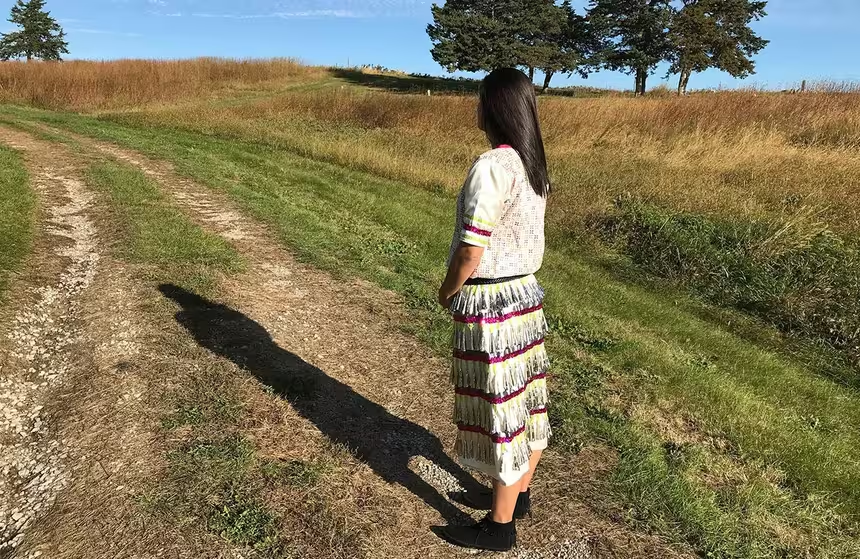
Do you have a Nebraska Story?
Do you have a story that you think should be told on Nebraska Stories? Send an email with your story idea, your name, your city and an email address and/or phone number to nebraskastories@nebraskapublicmedia.org. Or, click the link below and submit your information on nebraskastories.org.Providing Support for PBS.org
Learn Moreabout PBS online sponsorship(gentle music) [Narrator] Coming up on "Nebraska Stories".
Honoring the Latino Veterans of Scottsbluff, (upbeat music) a combat nurse recounts her memories of war, (upbeat music) a surprise reunion at a gathering of Veterans, (upbeat music) and two Tuskegee airmen who helped win World War II reflect on the battles they faced when they returned home.
(upbeat music) (upbeat music) (upbeat music) (upbeat music) (upbeat music) (upbeat music) (upbeat music) (nostalgic music) NARRATOR: They were young men from The Scottsbluff High School, Class of '63.
(truck driving on snow) Kids from the barrio, the Mexican side of town.
JOE: Growing up in the barrio, for me, was a lot of fun.
BEN: We'd ride our bikes up and down the barrio and just play baseball, go to Overland Park.
MARTY: It was a carnival atmosphere.
On a summer night after working in the beets, and the packing plant, you would have 200 kids every night.
GREGORY: We played baseball, basketball, football, everything.
We were all alter boys over at the church here.
GAVINO: My classmates, we all grew up in this neighborhood so we, it was, brings back a lot of memories.
NARRATOR: Memories of a different kind lie ahead.
(military music) By one count, 60% of the Mexican American men in the Scottsbluff Class of '63 were drafted into the military during Vietnam.
JOE PEREZ: My name is Joe Perez.
I'm a Vietnam veteran.
BEN TREVINO: My name is Ben Trevino.
I served in the US Army from 1965 til 1968.
GAVINO SALDIVAR: My name is Gavino Saldivar and I was a navy person, Navy Seaman.
MAURICIO RAMIREZ: Mauricio "Marty" Ramirez.
I was drafted in September of 1967.
GREGORY RODRIGUEZ: My name is Gregory Rodriguez.
I was in the Army.
NARRATOR: Some enlisted, some drafted.
Some saw combat, some didn't.
All served.
So did a lot of other soldiers from places like Scottsbluff's barrio.
The Pentagon officially counted Latino's as white during Vietnam, but various estimates show the number of Latino's in the Military as double their share of the American population at the time.
Veterans who say they were forgotten because of the unpopularity of the war and their heritage.
BEN: For the longest time, it seemed to me like we weren't recognized for our service.
I feel like we were second-class veterans.
(snare drum and marching) MARTY: Veterans Day, historically has been celebrated all over the country.
But in the unconscious celebrations like this, specifically to minority groups and Mexicans, has been forgotten.
NARRATOR: In Scottsbluff, change started with a special float in the 2019 Veteran's Day Parade.
(cheers) VETERAN: Thanks for coming out, guys.
MARTY: We're gonna march with pride displaying our Mexican-ness.
(horns honking) VETERAN: Hey, thanks for coming out.
Thanks.
Thank you, sir.
MARTY: Through this float, and our military service.
And we do this with confidence and that's the change.
VETERAN: Actually, it makes you feel proud.
VET: Yeah.
Yeah, really good.
VETERAN: Proud to be, that I came from here and proud that all these people took the time and put the effort in to make this happen.
NARRATOR: A parade down a street that, 50 years earlier, represented something else.
MARTY: We were segregated, seriously.
Mexicans didn't cross over the street where the parade was.
It was understood you did not go over there.
We didn't have jobs, we didn't have homes.
I mean, there was an invisible line.
VETERAN: Thank you.
(laughing) MARTY: A sincere welcome to what I believe is going to be very historic.
NARRATOR: Something else, the barrio boys-- MARTY: We have this proud historage.
NARRATOR: --started working on after talking at a class reunion.
MARTY: All of us went to Vietnam.
And we need to do something about this.
(somber music) NARRATOR: Outside a community center that sits on what used to be their ball field, (somber music) a permanent reminder that Mexican-Americans from the Scottsbluff area went to war, and some didn't come back.
GAVINO: And I think that there are times that, specially right now, where there is this focus on, my grandson, yeah, you got to go back and do all this kind of stuff.
And we want to focus on we did our duty, we did our job.
GREGORY: So this monument is sort of a way of telling them these are the people who did leave this valley, that did do other things, that did go out to see the world, that made an impact on this world, that made this a better life.
And for those of you that wanna grumble and complain of how horrible things are, they're the ones who put their life on the line to give you the freedom to be able to do that.
MARTY: We are Americans.
We're proud of America.
We served America.
We are Americans.
And we want to pass that pride on to our future generation.
(light music) NARRATOR: Stop by Cheryl Feala's home in rural North Bend during harvest and you'll likely see her busily preparing a hearty lunch for her family and their hired hands.
CHERYL FEALA: This is when he came and worked on combine and this that's how he charged it out.
NARRATOR: Or working with her daughter-in-law on the books for their farm.
CHERYL: Push down.
There you go.
NARRATOR: You may even catch her with some of her most favorite little people, her grandchildren.
These are just some of the many things Cheryl now enjoys after retiring from a successful nursing career that began a long time ago in a place very far away from home.
CHERYL: It was getting towards my senior year.
I was running out of money.
You know you went to school year around so you really didn't have the opportunity to get a job and get some money to continue your schooling.
Well at that time things were pretty heavy in Vietnam.
A lot of fighting, a lot of need for nurses.
NARRATOR: In 1966, Cheryl was entering her final year at St. Elizabeth School of Nursing in Lincoln when she and four other young women went to a recruiters office to enlist.
In return for paying for her senior year, Cheryl committed to two years of nursing duty in the United States Army.
After graduation, Cheryl went to basic training in Texas.
Upon completion she was assigned to an Army hospital in Alabama.
Six months later, 21 year old Second Lieutenant Cheryl Thurber would be in Vietnam, 55 miles from the demilitarized zone.
The year was 1968.
CHERYL: I was actually assigned to the emergency room and so with that came four to six corpsmen and two interpreters and we relied heavily on them.
NARRATOR: Chu Lai Air Base was located on the coast of the South China Sea.
Cheryl was assigned to the 27th Surgical Hospital where she assisted with triage and minor surgery.
CHERYL: Our day usually went with either the ambulatory would come in or the people from the village.
No matter where you were, if you heard helicopters coming in everyone went to their stations.
Because you knew things were going to happen.
On a heavy day, they would land, you would go out to get the patient, bring them in, he took off another one would come in.
And they would maybe be as full as they could possibly be and still take off.
If you were wounded and you made it to the ER, your chances of survival were pretty good.
So the helicopters were a big part of getting these fellows back to us.
NARRATOR: When the wounded poured in, identifying them was often a complicated process.
CHERYL: Somebody would come from medical records to take names and they would have dog tags, the guys, but we didn't always rely on those because the VC, the Viet Cong liked to switch those around.
So those who could answer, we would get their names and stuff.
If they couldn't answer, if we couldn't get anything, then they were marked with a number.
Either on the face or the shoulder, somewhere where they would be identified.
And the paperwork would go with them.
The thing that I remember about these guys the most is that most of them just wanted to be patched up so they could go back out.
They had their comrades back there that they all had each other's back.
They relied on each other and their big thing was, I got to get back.
Sometimes they could, sometimes they couldn't.
NARRATOR: Cheryl found that providing immediate medical care sometimes included small comforts.
CHERYL: So many of the guys would come in and the first thing they would want was a cigarette.
So I kept cigarettes and a lighter with me.
And one of the gentlemen that came in, a young man, he had lost his lighter, and so I said, "Well here, you take mine, "and I'll just go to the PX and get another one."
So he did, he took it, and it was a couple of months later this young man showed up in the ER and it was this kid and he came to return my lighter.
NARRATOR: But not all servicemen survived.
The morgue sat near the hospital and when the ER was empty Cheryl helped identify the dead.
CHERYL: The hard part was when the helicopters would come in later with the body bags.
There was just one time I remember I was with the doctor and we opened up a body bag and this soldier looked intact.
He looked fine until you went to lift his head.
You did your best.
You did what you could.
You can't do more than that.
You can't do more than what you're actually able to do.
And you have to come to grips with that.
I think once you come to grips with that it's not that you like it, but you have to accept it.
NARRATOR: Cheryl herself was in harms way.
Chu Lai was a major military air base and was regularly targeted by the Viet Cong.
CHERYL: There was always a threat that something would happen.
And in fact there was a nurse in Chu Lai that died.
She died after I was there from shelling that came into her ward.
But for the most part, I didn't really feel unsafe because the soldiers all kept their weapons.
We had barrels outside of the wards filled with sand, but we had all kinds of guys around us with weapons.
We would end up in the bunker, so I never really felt like I personally had to defend myself.
I felt taken care of.
NARRATOR: Working a 12 hour shift nearly every day of her year long tour, there wasn't much down time.
But when she could Cheryl would spend time on the beach.
CHERYL: It was very serene there.
You could lay on the beach, soak up a little sun, get in the water.
When you got there you basically were in another world.
Every once in a while you'd hear the helicopters come in, and the helicopters that came in towards evening, you appreciated because they came in and they fired into the water to keep the sharks sand stuff back.
This is what they told me.
I took their word for it, I don't know.
I didn't see any sharks.
NARRATOR: Cheryl's tour came to an end in 1969, when she returned to Nebraska to continue her nursing career she found herself on a steep learning curve.
CHERYL: My biggest adjustment I think was the medications were all different.
Everything had changed.
I mean they weren't all different but they had had such advancements in pharmacy, such advancements in technical use of equipment.
NARRATOR: As her life moved forward Cheryl's memories of Vietnam faded to the background.
She married, had children, and helped her husband grow their farm.
All while working as a nurse.
Her quiet and gentle manner makes it seem impossible that this nurse, mother, and farmer's wife, experienced the darker side of human nature.
CHERYL: I didn't talk about it at all for probably 20 years.
Even my folks didn't ask.
Well my dad had been a World War II veteran, so I think he knew enough not to ask.
When my oldest daughter was a junior or senior in high school and they found out locally I'd been in the service, so they had asked me to speak to her class, in history class.
And I said that I would.
So I went and I told them a little bit about it, it was a short synopsis.
And she came home and she says, "How come you never told me?"
And I said, "Well, it just was never brought up."
NARRATOR: Among the statues at the Veteran's Memorial Park located in North Bend, Nebraska, stands a bronze sculpture of a young woman in uniform.
Resolute in posture, she stand with her brothers in the arms ready to answer the call to duty.
CHERYL: Well it needed to be done.
Who was going to do it?
If you didn't volunteer to go over and take care of these people who was going to do it?
Fighting for the right thing.
(calm music) That's all simply.
(slow music and flag flapping in wind) (jazz music) [Narrator] A sea of red isn't a rare site in Nebraska, but this isn't Husker Red.
These red shirts are worn by veterans who flew on one of seven Heartland Honor flights transporting Nebraska's World War II vets to the World War II Monument in Washington DC.
(clapping) Organizer Bill Williams has spent the last year and a half gathering donations to ensure that Nebraska's World War II veterans see the monument built in their honor.
[Bill] We were able to take 1500 veterans on seven flights and the age range is 80 to 98, is the oldest veteran we've taken.
The World War II Memorial wasn't completed till 2004.
And therein lies the problem because they're all at an age where they can't do it, most of them on their own.
(horn music) [Narrator] A team of volunteers, guardians, and medical staff accompanied these veterans on the Honor Flights.
(horn music) [Bill Bush] It's beautiful.
Every fella should see it.
They really treat us royally, couldn't been any better.
(horn music) [Narrator] The Memorial honors the 16 million Americans who served in the war, and some 400,000 who lost their lives in the effort.
[Camera Man] 1, 2, 3.
[Narrator] Many veterans never dreamed they get the opportunity to see the Memorial.
Alfredo Abalos spent three years in the service and says the trip was an inspiration.
[Alfredo] The admiration we had received from all the people, you know, concerning our service, you know, and, and the fact that we were World War II veterans, and I think the fact that we're dying down, you know there's very few of us now.
(horn music) Just like World War I, you know, we, we, we fade away.
(horn music) (audience applause) I believe that, that all us, you know remember this as one of the outstanding events of our life.
(horn music) [Narrator] Elmer Chap, a small town Nebraska farm boy, volunteered for the Army and was only 19 when he fought in the Battle of the Bulge.
Though he didn't know the other veterans on his trip, he felt a camaraderie with them.
[Elmer] Just brothers, yeah, we were, yeah.
We were all, there for the same reason.
It was a emotional experience.
And the strangers would come up to you and say how appreciative, you know, I mean, they were.
[Narrator] The reunion of these Honor Flight veterans was a celebration of shared experiences, both from the recent, and distant past.
As a number of dignitaries paid tribute to Nebraska's greatest generation, there was another small group in attendance that wanted to say a more personal heartfelt thank you to those soldiers directly involved in liberating Nazi concentration camps.
How do you do?
Another liberator.
Well, yes, yes, yes I was.
[Narrator] Survivor Kitty Williams was not quite 19 when the Germans invaded Hungary in March of '44.
She and her father were sent to Auschwitz and then separated from each other before her father was killed at the camp.
(classic music) [Kitty] You know, they rounded up all the Jews in every country that they occupied.
(classic music) First they took all our possessions and then they took our lives.
How, how did, how can you?
(classic music) You know, how can you say that and make any sense of it, in a way?
(classic music) [Narrator] Kitty Williams narrowly escaped death herself.
She was scheduled to be sent to a Nazi extermination camp.
When Allied forces arrived, her brother-in-law was freed from Dachau.
The camp that Elmer Chap helped to liberate.
They were like skeletons, that a few more days and they would not have made it.
So, thanks to this gentleman.
You're very, very welcome.
And his, and his buddies.
(classic music) [Narrator] After helping to defeat the SS soldiers guarding the Dachau Camp, Elmer Chap used his newly purchased Agfa camera to document horrors, he feared the world might never believe.
(classic music) [Elmer] The gates were opened and, all the faces of the refugees, when they found out there was Americans, you know, I mean they all tried to get out the gate at the same time, you might say.
(classic music) You could see the freedom in their eyes and their faces, you know, you know I mean that's, that was, it was worth the effort, I mean.
[Narrator] Both Elmer Chap and Kitty Williams feel lucky to have survived the harrowing experiences they both had as young adults.
And 60 years later, neither expected to have a reunion of sorts with strangers that could evoke such shared understanding.
(classic music) [Kitty] We owe our lives to them.
And that's why I'm so emotional because, because without these soldiers that we saw today, (classic music) you know, we wouldn't have lasted very long.
(classic music) And we owe everything that, to these soldiers, now old men (classic music) but they were young and dashing and I married one of them.
(classic music) (classic music) (classic music) (classic music) ♪ MUSIC ♪ LT.
COLONEL CHARLES LANE: Prior to President Roosevelt setting up the program in 1941, Blacks were not allowed in the Air Corp and in the service, they would be limited primarily to service units.
Meaning the cooks, the bakers, the clean-up, the gardeners.
And in fact, the attitude was that in the general population of the United States felt that Blacks did not have the capability to manage technical situations.
You know, I was 18 when I went through the program.
I thought I was bullet-proof so what the hell.
I was following Paul and he was an upper classman.
And we bowed to the upper classman, you know.
By the time I was 16, having built model airplanes and knowing and understanding that Blacks were not allowed to fly, when I turned 16, I knew-I knew-I knew all the regimens dealing with aerodynamics.
When the Tuskegee Airman Program became available, I jumped at the chance.
And I just wanted to learn how to fly.
And once I did, it was just-I just enjoyed it.
I loved it.
LT.
COLONEL PAUL ADAMS: No more praises.
Nobody to tell me what to do and what not to do.
When flying, I felt free.
(Aircraft engine) LT.
COLONEL PAUL ADAMS: I felt free for a change.
(Aircraft engine) LT.
COLONEL PAUL ADAMS: Until you come on the ground and land an airplane, come up to the operations and sign the papers, you was-you-Did you pilot that airplane?
No way.
No way, no way no Black man could pilot no airplane.
Not in South Carolina.
LT.
COLONEL CHARLES LANE: I did things that I normally wouldn't do.
You were actually within yourself.
You know, you were there by yourself.
As a fighter jockey, you didn't have a navigator, bombardier or anything.
You did everything.
In other words, you were king unto yourself.
And I loved it.
And I was king of my own regiment at the time.
I loved it.
And we knew what was happening.
We knew what we had to do.
We knew from time to time it'd still take a little effort to get first-class citizen down to the street.
(Aircraft engine) LT.
COLONEL CHARLES LANE: We had a saying.
First-class citizen in the air.
Second-class citizen on the base.
Third-class citizen once you left the gate.
♪ MUSIC ♪ (upbeat music) (upbeat music) Watch more "Nebraska Stories" on our website, Facebook and YouTube.
(upbeat music) "Nebraska Stories" is funded in part by the Margaret and Martha Thomas Foundation, and Humanities Nebraska, and the Nebraska Cultural Endowment.
(upbeat music) (upbeat music) (upbeat music) (upbeat music)


- News and Public Affairs

Top journalists deliver compelling original analysis of the hour's headlines.












Support for PBS provided by:
Nebraska Stories is a local public television program presented by Nebraska Public Media