
1412: Portraits of Humanity and More
Season 14 Episode 12 | 25m 49sVideo has Closed Captions
Capturing the essence of humanity, a coach who advocated for equity in sports and more.
Capturing the essence of humanity, a coach who's winning strategy included advocating for equity in sports, and a beautiful garden that sprouted from sorrow. Mark Gilbert uses art to show the complicated emotions of healthcare workers. Connie Miner was coming of age when Title IX became law; she coached collegiate softball and brought girls sports to the forefront.
Problems playing video? | Closed Captioning Feedback
Problems playing video? | Closed Captioning Feedback
Nebraska Stories is a local public television program presented by Nebraska Public Media
1412: Portraits of Humanity and More
Season 14 Episode 12 | 25m 49sVideo has Closed Captions
Capturing the essence of humanity, a coach who's winning strategy included advocating for equity in sports, and a beautiful garden that sprouted from sorrow. Mark Gilbert uses art to show the complicated emotions of healthcare workers. Connie Miner was coming of age when Title IX became law; she coached collegiate softball and brought girls sports to the forefront.
Problems playing video? | Closed Captioning Feedback
How to Watch Nebraska Stories
Nebraska Stories is available to stream on pbs.org and the free PBS App, available on iPhone, Apple TV, Android TV, Android smartphones, Amazon Fire TV, Amazon Fire Tablet, Roku, Samsung Smart TV, and Vizio.
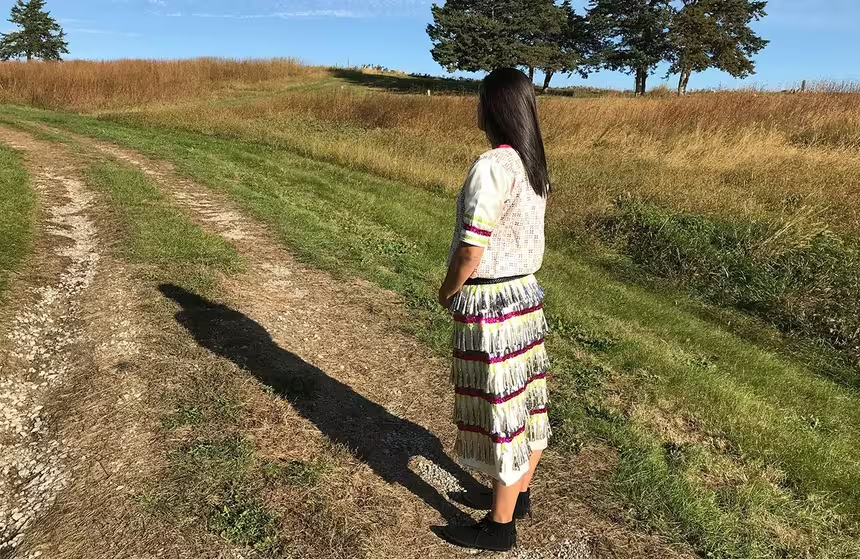
Do you have a Nebraska Story?
Do you have a story that you think should be told on Nebraska Stories? Send an email with your story idea, your name, your city and an email address and/or phone number to nebraskastories@nebraskapublicmedia.org. Or, click the link below and submit your information on nebraskastories.org.Providing Support for PBS.org
Learn Moreabout PBS online sponsorship(upbeat music) [Narrator] Coming up on Nebraska Stories, portraiture and the healing power of art, (upbeat music) lessons from a life on the diamond, and a garden where hope blooms every year.
(upbeat music) (upbeat music) (upbeat music) (upbeat music) (upbeat music) (upbeat music) (upbeat music) (charcoal rubbing) [Mark] I don't worry about things like precision.
(soft ominous music) What I'm trying to do is to make sure that every mark I make is a direct and honest response to who's in front of me.
(soft ominous music) Each mark is also, not just drawing what I see which is fundamental, (soft ominous music) but it's also to a certain extent drawing what I'm experiencing, what I'm feeling.
(soft ominous music) [Narrator] There's a symmetry in the journey of Scottish artist, Mark Gilbert.
(gentle music) Nearly 20 years ago, Mark passed through Omaha with an international tour of his landmark exhibition "Saving Faces".
(gentle music) Which featured arresting portraits of patients before, during, and after dramatic and sometimes disfiguring facial surgeries.
(gentle music) [Mark] To be showing in this space, (gentle music) especially in this space.
'Cause this is where it all started with me, in Omaha.
So I'd never been here before and so so it's lovely to be back here.
(gentle music) [Narrator] Now Mark is a professor of medical humanities at the University of Nebraska at Omaha where the first exhibit took place.
(gentle music) Still an artist.
He continues to do portraiture.
(gentle music) This work is part of a study exploring the experiences of frontline healthcare workers across the country.
(charcoal rubbing) [Mark] I often talk about the sort of vulnerability that it is in both sides of the easel.
When you're working on these portraits.
(gentle music) I've worked with people who know that they're in the last weeks of their life.
I've worked with people who are caring for people who they know are terminally ill and so on.
(gentle music) And I've never worked with people who are so, that their emotions were so on the surface and so raw (gentle music) that they broke down in a way that had never happened (gentle music) with anybody else I've ever worked with in the last 20 years.
(gentle music) You know, they were working crazy hours.
They were working with huge uncertainties about the care that they were able to deliver for the patients they were working with.
About their own wellbeing.
(gentle music) About when is this going to end?
About am I going to infect the people I care for, my family, my children?
(gentle music) [Narrator] Mark has probably had a dozen sessions with nurse practitioner, Sarah Lane during the past few years.
Even during the height of the Covid Pandemic.
[Sarah] And I remember after my first meeting with Mark we talked about a lot of things that I hadn't ever really maybe like tapped into.
And so I remember going home and just like being like exhausted.
(gentle music) It brought on so many emotions of just overall sadness for the patients and, you know, my coworkers and the struggle that, you know, we were all having.
(gentle music) That's what really prompted a lot of the, you know why I continued to come back because I just knew that this was important.
(gentle music) People will ask me about it and I can't really answer it.
Like in my head, I know, you know, what it was about and what it did for me but it's hard to share that with other people to put it to words.
(gentle music) [Mark] But I'm not an art therapist.
I don't do these pictures to make people feel better (gentle music) but often it does.
So, and when that happens, we recognize that and record it.
And I'm pleased.
[Narrator] Even in silence, there can be a therapeutic dialogue.
(gentle music) As Gilbert's most recent exhibit involving dementia patients in Halifax, Nova Scotia, reveals.
(gentle music) It took me years to properly recognize this that that silence isn't an empty void.
There's a huge amount of communication that happens in that silence.
There's a huge amount of expression.
(gentle music) Either, you know, with us both looking at each other (gentle music) and the drawing facilitates that facilitates the relationship building.
(gentle music) When we think about people with dementia, sometimes we end up thinking that they've, kind of lost so much that they have nothing left to give.
(gentle music) That they've lost the capacity to be productive or to be purposeful.
But hopefully the exhibition is able to allow people to really engage and be maybe even reengage with that notion that people who are living with dementia still have an amazing sense of personhood.
There are still are things that nourish them.
There are still things that bring joy.
(gentle music) [Narrator] Every frame is a window into a deeply private world.
(gentle music) [Dr Kelly] We don't often see this depicted in art.
(gentle music) You know, that there's a veil across that chapter of life that I think that your work helps to lift.
(gentle music) [Narrator] Gerontology professor Dr. Chris Kelly says, "The lives of older adults are often overlooked."
(gentle music) [Dr Kelly] Our last days were spent among family and friends.
Those who are closest to us.
(gentle music) The rest of the world is kind of outside of that veil.
What Mark has done with this exhibit has pulled back that veil and to show us the beauty of life in that penultimate chapter.
And to have a better understanding of just what individuals are going through.
(gentle music) The feelings, the fears, (gentle music) the many emotions that they are experiencing.
(gentle music) Art and literature and music and everything that the creative world is about is a part of our lives from our earliest memory to our last moments on Earth.
(gentle music) That lifelong education doesn't stop.
And, I think that for the subjects of Mark's paintings, I think that they were aware that they are, they were participating in something incredible, that they're participating in the education and the understanding of people of all ages, about what it means to be human.
(gentle music) (gentle music) [Mark] So this was a piece, yeah, so it was done in 1992.
And so it's just kind of typical of the kind of drawings that my dad would do.
You know, prior to every single painting that he did, he always did a series and we all had to sit for him.
You know, I had to pose from him.
[Narrator] Mark's own mom, had Alzheimer's and died of a stroke before this project began.
(gentle music) [Mark] It's called "The Chair" but I think, I always call it "The Empty Chair".
So it is the empty chair, it's the chair my mum sat in.
So again, it's that testament to bereavement and to loss.
(gentle music) [Narrator] This is the first time Mark's work has hung side by side with his dads.
Both of his parents were artists.
They met at the Glasgow School of Art in the 1950s.
It wasn't unusual for him to be sitting for me in the morning, and I'd be sitting for him in the afternoon, this is when I was, we were in Glasgow.
So these pictures are kind of unique in as much the picture my mum on her own.
(gentle music) [Narrator] When Mark's mom, Pat, was in her final days, his father Norman made these drawings of her.
(gentle music) [Mark] I was staggered that he was doing them.
Frightened to look at them, you know, I didn't wanna look at them.
(gentle music) And I remember he asked me about two or three times, "Do you wanna see them?"
And I said, "No, not yet."
And then when I saw them, I loved them.
You know, I, and again, it kind of forced me to come from behind the easel, you know?
So I kinda was almost like I became like one of my participants.
Those pictures sort of present some of the most traumatic times of my life and I love them.
(gentle music) [Narrator] Norman passed a few years after his wife Pat, and never had the chance to see these works displayed together.
(gentle music) But the drawings serve another purpose to soften the medical gaze and invite new understandings of the deeply isolated worlds of dementia, death, and dying.
(gentle music) The meaning of the pictures doesn't reside with my dad or with my mum.
Or with the, you know, with the people in these pictures.
You know, the meaning's constantly in flux.
And so that you know the audience, you know bring their own meanings bring their own experience to the pictures.
(gentle music) For me as a son, (gentle music) they've taught me more about the healing power of art than anything else I've ever experienced.
(gentle music) (gentle music) (upbeat music) (upbeat music) (upbeat music) (upbeat music) (crack of hitting ball) Better.
When you're here your elbow went this way right away, remember it's this way, so you stay in path, remember?
Okay [Narrator] Young, strong, disciplined, and female.
It's commonplace to see women out in the field or on the court today, (crowd cheering) but 50 years ago it was a different story for women like Connie Miner.
(bat cracking) There you go.
(metal clink) [Connie] I was pretty good at sports and I loved it, and so I knew I wanted us to have a girls' basketball team and at the time we didn't.
My mom went into the school board and and said, you know, if the boys have it, the girls should have it.
And so I had basketball one year in high school and I think track two years.
(inspirational music) [Narrator] In 1972, Connie Miner was coming of age when Title IX became law.
The federal civil rights legislation prohibited sexual discrimination and educational programs, it opened the doors to sanctioned athletic activities for girls and women.
(inspirational music) Connie was a gifted athlete, but organized sports were limited during her high school years in Red Cloud.
She spent her summers playing in a fast-pitch softball league.
[Connie] When we were at practice, we learned, you know, we didn't mess around, I mean we learned different skills and things like that.
[Barb] When she first was starting to play softball and wanting to pitch, if all of us were kind of burnt out with catching, she would just go to the north side of the house and just hit against the house.
I mean just pitch and bang against the house and bang against the house.
She went out north the house and pitched against my house and then I gotta pitch back, so I pitched the ball back to her instead of hitting the house all the time, I didn't like the sound of it.
(Connie and dad laughing) [Narrator] The league's head coach was a local woman named Kay Cover, she too was a gifted athlete in her youth, became of age long before Title IX.
And she was, you know, for me, encouraging, supportive, "It's okay keep, you know, going after it," so it was never, I never heard anything from her that was negative in any way, you know, she just, you know, pushed me.
[Barb] We went to a tournament and when we got there, I needed to go to the restroom, so I went to the restroom and the stall and another group of girls coming in there going, "Connie Miner is here and she's gonna be pitching over on field, you know, A you know, we'll have time to go and watch her."
And I'm kind of going, "Is there another Connie Miner?
And I mean, that's just my sister."
(inspirational music) [Narrator] Connie enrolled at the University of Nebraska at Kearney where she played on the the women's softball team.
She was a four-time all conference player and was twice named Conference Pitcher Of The Year.
(inspirational music) On her graduation, the head coach offered her a job.
[Connie] He asked me to stay on and coach with him.
I didn't get paid to coach, but I was, you know I was there for practices and travel and games.
[Narrator] From player to unpaid part-time assistant coach.
To support herself, Connie worked nights at a local manufacturing plant.
She coached at UNK for two years before leaving to play for Nebraska's Summer League team.
When I went to Lincoln, you know, I played for the Nebraska team in the summer and I worked for Lincoln Office Supply Company.
[Narrator] She sold office supplies by day and played ball in the evenings and on weekends.
When head coach Nancy Plantz left Nebraska for Eastern Michigan in 1983, Plants asked Miner to come along.
I was disappointed she was leaving Nebraska, but at the same time, you know, she wanted me to go with her and I did talk to the new people that came in to Nebraska but he just, he wanted me to be a grad assistant and I was like, "Nah, I'm gonna go be an assistant at a Division One program."
[Narrator] The job was, again, part-time, but it came with pay, $10,000.
When Plantz left Eastern Michigan in 1987, Miner applied for the top job.
(piano music) [Connie] And I got paid 18 to be the head coach, which was not as much as the both of the assistant coaches for baseball and part of it was because I was, I was just turned 30, I was young and I had no head coaching experience, is what they said.
The AD said he would move me up as fast as he could and he did, you know, cause we did pretty well, but I wasn't gonna walk away from it.
[Narrator] As head coach, Miner not only advocated for herself but also for her softball program.
[Connie] I remember at meetings where they'd say, "Well we don't have this because of women."
Some of the coaches had been there for a while, they didn't like it, I mean I didn't hold back, I was like, "Well, if you have a daughter, do you want this to happen to her?"
You know, it should be fair, I said, "It's not even close to equal, we're just trying to ask it to be fair."
[Narrator] Even with the support gap, Miner developed EMU softball into one of the most competitive in the Mid-American conference while also earning Mid East Regional Coach Of The Year in 1988.
But after 13 years with the Eagles, the Division I coach left for San Jose.
[Connie] We had an AD change and I didn't like some of the direction and so I kind of started looking, I thought, well maybe I'm ready for, you know, a change.
[Narrator] As she did for Eastern Michigan, Coach Miner began rebuilding San Jose's program.
[Barb] She likes that challenge of, you know, building the team up, improving the facilities, building a name for it, versus like somebody else has created a program and now I'm just taking it over.
[Connie] They were struggling and I scheduled tough because if you schedule preseason tough I think you're just better prepared for conference.
I was kind of fiery, I mean I'm pretty intense as a coach, Division One coach and I think I got some of that from Kay and she didn't care either, you know what I mean?
I just say, they put their uniform on the same way we do, let's go play, you know, don't get into, you know, intimidated by that.
So I think I have a little bit of that, you know, that fieriness about the competition part, probably I got from her.
[Narrator] She spent three years at San Jose State, then two years as assistant coach at University of California, Riverside.
Then in 2003, UNC Chapel Hill called.
Donna Papa's the head coach, still is and been there forever.
I got to know her when I was at Eastern Michigan and I was excited about the opportunity, I found out how the other world lives, it was crazy.
We were Nike sponsored, right?
And I would, I'd go in with the equipment, I'd go, "Donna, I got 'em all this."
I said, "I still have this much money, what do you want me to get?"
I mean it was crazy, I, for the first time I saw how the other side of the world lived, it was crazy.
And, but you know, that opportunity came back to be the head coach at Riverside and I liked it there and Donna agreed that if the Riverside job opened up she'd let me outta the contract, 'cause I would obligate a contract, I wouldn't try to get out of it.
[Narrator] She was head coach of the Highlanders for nine years before being released in 2012.
With an offer from the University of Oakland, Miner headed back to Michigan but not without a stipulation.
But I didn't accept it for two weeks, because I had met with him when I said, "Until you put money into the, you know, the program and the field and things like that, why would I come there?"
I said, "But I know I can build a program."
[Narrator] They found the money and as she had done at other schools, Miner began rebuilding Oakland Softball Program.
[Connie] I was there at, again, seven in the morning, I didn't leave till nine or 10 at night.
I had the AD come in three months after and so he goes, "We're all, Connie, we get here, you're already here and you're still here when we leave."
And they go, "You're not gonna leave are you?"
And I said, "Oh no, I'm committed to the I said, "I would never do that."
[Narrator] Oakland picked up steam, by the second year they were competitive.
[Connie] Some of my kids came in the office and I'll never forget it, they were hot, they came in, they go, "Coach Miner, have you seen the rankings?"
And I said, "Yeah, I have, (inspirational music) they send it to me right away."
And they go, and they looked at me 'cause I was just calm as could be and they're like, "Aren't you mad?"
I said, "No, I'm not mad," they go, "You're not mad, they ranked us seventh?"
Then I said, "Ask me the right question," so they're going back and forth and then they go, "We think we got it, (inspirational music) what do you think about the rankings?"
And I said, "That's the question," and I said, "They're so wrong, (inspirational music) they're so wrong."
I said, we're, I said, "I feel like we'll be in the running for the championship."
(inspirational music) [Narrator] The next year, The Golden Grizzlies won the 2015 Horizon League Softball Championship [Connie] Going from not making the tournament last year, fighting game and then, you know, getting picked seventh this year and then standing here as champions, regular season, and now the tournament, going post season is a storybook, these girls wrote every chapter of it.
(inspirational music) [Narrator] By the season's end, Miner decided to write a new chapter in her life.
You know, I felt like I did, you know, I did everything I was supposed to do at Oakland, I was brought in to rebuild the program, we won it and I had the next coach set up to win so then I was like, "You know, I did everything I was supposed to do and you know, it's time."
[Narrator] After 40 years as a Division One coach, Miner eyed retirement but softball wasn't done with her just yet.
In 2016, coach Miner was inducted into Eastern Michigan's Hall of Fame.
[Connie] I've had time to reflect about it and you just think about, you know, all the amazing student athletes and families and staff and you know, that you had around you that put you in that position.
And you know, I believe that the people you surround yourself are the ones that get these awards for the head coaches.
(inspirational music) That was a little bit shorter, the last one, there you go.
-So separate right?
-[Lexi] Yeah.
(inspirational music) When you get done, try to hold center to me on that, okay?
[Narrator] Now living in Colorado, Miner spends her retirement coaching girls.
[Connie] Well, when I started with Lexi, she was eight, so eight through high school and I have a couple kids that in the summers that I coached since I've been here that are in college and the summer, sometimes they'll, "Hey coach can you get me in for a lesson?"
So even sometimes when they're back in the summer from college, and say "can you fit me in?"
and say sure, I just love it.
So, if I can help them get to where they wanna be in softball, that's, you know, that's a fun, yeah.
(inspirational music) [Narrator] Free from the pressure of collegiate sports, it's a much more relaxed coach Miner who's working with these young athletes, helping improve their skills in a sport she not only loves, but spent her lifetime breaking a path for others she hopes will follow.
(inspirational music) (inspirational music) ♪ (soft music) JAN WILHELM: My name's Jan Wilhelm and the reason this garden was started because of my husband.
He went through a lot with his son, his family but many years ago, he told me to change my stones into diamonds and so I decided I was gonna do something.
I watched him hurt badly from losing his son and so I decided it's time because I know how it leaves a big hole in everybody's heart.
And it did with mine watching him hurt so bad, so in January, a Saturday morning, I woke up, I had a person tell me and I know it was God, he says, get up, get started with the garden today or it's never gonna happen.
Spring will be here in three months and to get started.
So I called a friend of mine.
We started the Humboldt Garden Club.
I put a plan together and designed it.
I took it to the city council, they approved it.
And our garden club got together and we just started working, working, moving rocks, bringing in rocks, cleaning down trees and brush, and we created this garden in tribute to all cancer survivors, the ones that are fighting for their lives, and to all the loved ones that we've lost from cancer.
We also have a greenhouse that we stored a lot of our plants this winter.
The lavender ribbon has the hope.
We've made the hope in bricks and it's for all cancers.
We're hoping for a cure on the lavenders for all cancers.
Even though we have single beds here, each bed is for a certain cancer color.
That's our ribbon of hope.
So hopefully someday we'll have a cure.
(upbeat music) TERESA MATRISCIANO: Well my mom actually found the garden.
She and a friend went down and visited and instantly just fell in love.
She really wanted to do something for Danielle, something to honor her.
And so she talked about having a fairy made.
So she had a fairy statue made in honor of Danielle.
(upbeat music) DANIELLE MATRISCIANO: I didn't know about it.
I knew that we were gonna have the ceremony and everything for me, but I didn't know about the statue or the plaque or anything that was gonna be dedicated to me, so it was really cool.
We walked around before we actually had the ceremony and I saw it but I didn't think anything of it.
I just thought it was one of the other bronze statues that was out there.
My grandma said she found it and she said it was a perfect representation of me, of always being positive and the fairy is super, I don't know, she looks happy.
The statue does and she looks like she's having a great time and my grandma just said it reminded her of me.
(upbeat music) (crowd cheering) TIM MATRISCIANO: We had a great time and it's beautiful and Jan and her husband just make you feel comfortable and they've done such a wonderful job.
And I was looking around trying to figure each flower.
I consider myself an amateur gardener, but I was picking out things and I said, look at that hen and chicks, what's that doing and they were different.
So you get to see and those were all volunteer gardeners down there that help with all that.
It's just neat.
So I will be back.
JAN WILHELM: I want them to feel the peace and the love that God's given us and remember the good times they had with their families and just heal from that broken heart.
Like we had today, I think they felt a lot from this garden.
People come in here, get a sense of peace, like God's right here with us and they could feel like their family member's with them.
It's just very peaceful and serene.
(bells chime) (upbeat music) (upbeat music) Watch more "Nebraska Stories" on our website, Facebook and YouTube.
(upbeat music) "Nebraska Stories" is funded in part by the Margaret and Martha Thomas Foundation, and Humanities Nebraska, and the Nebraska Cultural Endowment.
(upbeat music) (upbeat music) (upbeat music) (upbeat music)
Video has Closed Captions
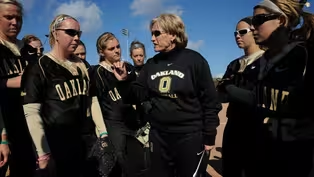
Clip: S14 Ep12 | 11m 28s | Her coaching strategy included advancing equity for her players. (11m 28s)
Video has Closed Captions
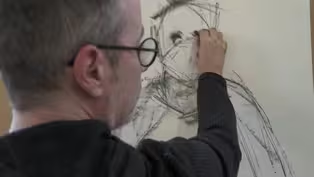
Clip: S14 Ep12 | 8m 56s | Capturing the essence of humanity (8m 56s)
Providing Support for PBS.org
Learn Moreabout PBS online sponsorship















Support for PBS provided by:
Nebraska Stories is a local public television program presented by Nebraska Public Media