
1413: 7 Years a Correspondent and More
Season 14 Episode 13 | 28m 23sVideo has Closed Captions
Nebraskan reflects on years as a war correspondent, humble tumbleweed elevated with art.
Nebraskan reflects on her years as a war correspondent, the humble tumbleweed elevated through art, & the Pawnee's efforts to preserve their sacred, ancestral seeds. This episode features Beverly Deepe Keever, the longest serving war correspondent; Les Bruning's journey to create the Tumbleweed Symphony mobile for a Kearney Art Center; and the Pawnee tribe working to save the sacred corn.
Problems playing video? | Closed Captioning Feedback
Problems playing video? | Closed Captioning Feedback
Nebraska Stories is a local public television program presented by Nebraska Public Media
1413: 7 Years a Correspondent and More
Season 14 Episode 13 | 28m 23sVideo has Closed Captions
Nebraskan reflects on her years as a war correspondent, the humble tumbleweed elevated through art, & the Pawnee's efforts to preserve their sacred, ancestral seeds. This episode features Beverly Deepe Keever, the longest serving war correspondent; Les Bruning's journey to create the Tumbleweed Symphony mobile for a Kearney Art Center; and the Pawnee tribe working to save the sacred corn.
Problems playing video? | Closed Captioning Feedback
How to Watch Nebraska Stories
Nebraska Stories is available to stream on pbs.org and the free PBS App, available on iPhone, Apple TV, Android TV, Android smartphones, Amazon Fire TV, Amazon Fire Tablet, Roku, Samsung Smart TV, and Vizio.
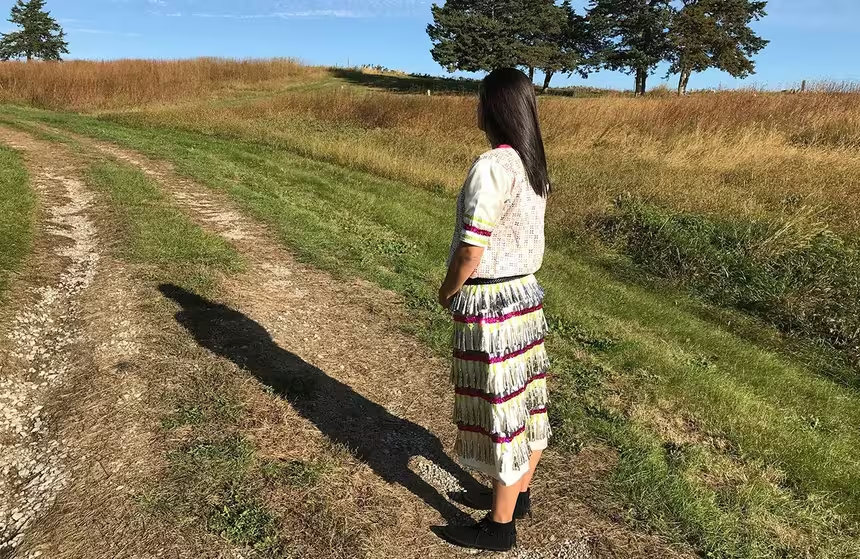
Do you have a Nebraska Story?
Do you have a story that you think should be told on Nebraska Stories? Send an email with your story idea, your name, your city and an email address and/or phone number to nebraskastories@nebraskapublicmedia.org. Or, click the link below and submit your information on nebraskastories.org.Providing Support for PBS.org
Learn Moreabout PBS online sponsorship(upbeat music) [Narrator] Coming up on "Nebraska Stories", the longest serving American correspondent of the Vietnam War, (upbeat music) the humble tumbleweed, elevated through art, (upbeat music) and the ancestral corn of the Pawnee takes root again in Nebraska.
(upbeat music) (upbeat music) (upbeat music) (upbeat music) (helicopter whirring) (equipment rattling) [Narrator] On April 29th, 1975, South Vietnam's government and military collapsed as North Vietnamese troops attacked Saigon.
(helicopter whirring) US forces rescued 7,000 Americans and South Vietnamese allies in our country's sobering end to the Vietnam War that left more than one and a half million people dead.
(helicopter whirring) 88-year-old Nebraskan Beverly Deepe Keever reported on that war and the risks that came with it.
[Keever] This American advisor said very casually, "Don't worry, you never get the first bullet that gets you."
[Narrator] Back then her newspaper byline was Beverly Deepe.
She was America's longest serving Vietnam war correspondent.
(gentle music) Born in 1935 in Hebron, Nebraska.
Beverly Deepe's parents' tireless work kept the family farm afloat in the Great Depression.
(gentle music) It also inspired in Beverly a curiosity to explore faraway places.
I went into journalism because I wanted to understand people and culture in other countries.
(gentle music) [Narrator] With journalism degrees from the University of Nebraska and New York's Columbia Journalism School, Keever worked as a public opinion pollster and a freelance reporter after college.
(gentle music) She bought a ticket to East Asia and paid for her travels teaching English and selling freelance newspaper stories.
[Brooke] So this is someone who's got a halo, you know, she's anointed.
There's something really marvelous about her in her sense of herself.
Even coming from a small Nebraska town.
(gentle music) [Narrator] In 1962, Keever arrived in Saigon, drawn by the news of South Vietnamese troops fighting Viet Cong guerrillas backed by Communist North Vietnam.
(gentle music) [Mitch] It's a tinderbox.
Hasn't quite exploded when she's there in the early 1960s and there's still a lot of questions about where America's gonna go, where America's role is.
[Narrator] US military advisors were involved too.
Sent by President John F. Kennedy to stop the spread of communism.
[Larry] The words were repeated again about how in in Vietnam, literally, the free world stood in the balance.
[Narrator] As more US troops poured in, Keever wrote to a friend in Nebraska.
[Wartime Keever] I am undergoing a shock treatment here.
All those professional and personal ideals which had never been shattered until I reached here seemed to be under constant bombardment.
(gentle music) [Narrator] Keever was the only woman among a handful of male correspondents covering South Vietnam at the time.
The men earned full-time pay with health benefits.
Keever did not.
Because she didn't have healthcare, Keever almost died from an infection on one war reporting trip.
[Keever] An American secretary with the construction company found me and got me to the hospital.
That took me a long time and it still has left my liver damaged from infectious food and water and so on.
[Narrator] Keever persevered and kept reporting.
[Brooke] For a woman to make a career, if you're willing to be a stringer, you can find a war and it's easy to get hired because everyone is happy to hire you for cheap.
[Keever] When I was finally hired for "Newsweek" they said, "Well, I don't know what New York will say about hiring a woman."
They were stuck though.
They had to find somebody.
[Narrator] She wrote about US military and South Vietnamese pacification programs, which provided rural villagers with medical care and new schools.
She covered America's steady military buildup in South Vietnam too.
[Keever] It turned out to be more than I bargained for.
I got a war with it.
(weapon booms) (explosion booms) [Narrator] In 1964, as American involvement in Vietnam escalated, Keever became a full-time special correspondent with the "New York Herald Tribune."
A tip from a South Vietnamese general helped Keever break one of her biggest stories.
[Keever] Interviewed the first North Vietnamese prisoner who said he came in from North Vietnam in units.
[Narrator] President Johnson though, was up for election at the time.
[Keever] Johnson did not want to be, you know, doing anything to retaliate against the North, and so they denied it.
[Narrator] Keever says it was a tip off that partisan politics was leading US decision making on the Vietnam War.
One month later, the US Congress approved the Tonkin Gulf Resolution.
Vietnam now became America's war, with General William Westmoreland in command.
(upbeat 1960s music) (upbeat 1960s music) Westmoreland preached search and destroy military tactics and he requested more US troops to find and kill the enemy.
Keever believes that was a misguided philosophy.
[Keever] That's all they knew.
They had to fight with what they had, but they didn't have the right machinery.
[Narrator] The Viet Cong were no match for America's fire power.
But Keever reported they were winning support and recruiting new fighters from South Vietnam's poor villages.
[Keever] I wanted to get the Vietnamese viewpoint, and I did write it, and they were very, very blunt.
(gun shots) [Narrator] By 1967, more than a half million US soldiers were fighting in Southeast Asia and 200 of them were dying in combat each week.
The war was not getting better for America.
(explosions booming) 4,000 US Marines in South Vietnam's remote Khe Sanh Combat Base were attacked by 30,000 North Vietnamese soldiers.
The unprecedented barrage didn't stop for 77 days.
American supply planes had minutes to land and take off before North Vietnamese mortars found their targets.
Keever risked flying in to report the story.
[Keever] We knew it was dangerous, but The president, Westmoreland, the general, everybody they were focusing on that.
That's what the story was, so you just did it.
(gentle music) [Narrator] Keever wrote this description of Khe Sanh's grueling conditions.
(gentle music) [Wartime Keever] Khe Sanh is six dirty hands grabbing into a C-ration box.
A Communist mortar round thumps into the center of the box between the outstretched fingers.
Six Marines lay dead, like tattered rag dolls.
(gentle music) [Narrator] Keever's Khe Sanh reporting was nominated for a Pulitzer Prize.
(gunfire popping) Almost simultaneously, 80,000 Viet Cong and North Vietnamese troops launched the largest attack of the war.
The Tet Offensive, spraying surprise assaults on military and civilian targets in hundreds of South Vietnamese towns and cities.
[Keever] Cause an uproar in the east, attack from the west, and that's all they did.
[Narrator] US and South Vietnamese troops counterattacked, inflicting heavy casualties on the Communists.
North Vietnam's Tet Offensive was a military failure, but a propaganda success for the enemy.
[Keever] It raised the possibility of an American defeat in Vietnam, which the American officials had said never could have happened.
[Narrator] The fighting convinced a growing number of Americans that the Vietnam War could not be won.
More than 58,000 American military service members made the ultimate sacrifice, fighting and dying for our nation.
(gentle music) 395 of them were Nebraskans.
(gentle music) Almost 50 years later, Keever says the real battle in Vietnam wasn't about stopping Communist insurgents.
It was a power struggle for economic and social justice between South Vietnam's wealthy minority and its poor majority.
(gentle music) [Keever] The military thinking has to realize that the American approach to power is different than what you're going to need probably in the future.
(helicopter whirring) [Narrator] In 1969, America took a new path and began withdrawing troops from Vietnam.
After seven years covering the war, Beverly Deepe Keever took a new path too.
Well, did you want me to mention about Chuck?
(upbeat music) [Narrator] Beverly fell in love with Chuck Keever, the Marine Corps officer who escorted Beverly to interview medical teams who were treating rural Vietnamese villagers.
[Keever] He was really an incredible guy.
I'm so fortunate that I met him.
[Narrator] The two left Vietnam in 1969 and married a year later.
It was eight years to the day after Beverly Keever first arrived in Vietnam.
Chuck Keever died in 2021.
(gentle music) Through it all, Keever says she's been lucky.
[Keever] I was lucky I got to Vietnam as early as I did, when it was a Vietnamese show.
How I met Chuck and how I got out of there when I did.
I was stunned the way it ended.
(gentle music) (gentle music) (gentle music) [Les] A sculptor is anyone who makes things.
You gotta use your hands and talk with your hands.
It's really what it is but something three dimensional comes out of that.
(gentle music) Shapes are just like words.
(gentle music) Yeah.
Shapes are my words.
(gentle music) I'm Leslie Bruning.
I'm a sculptor living and working in Omaha, Nebraska.
[Narrator] In Downtown Omaha the Hot Shops Art Center is part of the city's thriving art scene.
Inside is a collective of studios where artists of all types work and collaborate.
Les Bruning, one of its founders, is a sculptor known worldwide for his bold designs and vibrant colors.
(gentle music) [Les] Both my mom and dad grew up on farms in Missouri and from that generation they made things.
And so growing up I made things.
(gentle music) [Narrator] Today he's speaking to a group of students who traveled from Kearney to get a peek inside the world of a professional artist.
I went to Nebraska Wesleyan and I had kind of a boring freshman year, you know, because I was taking biology and things that I wasn't sure why I was in class.
My sophomore year I signed up for a ceramics class and the rest is history.
[Narrator] The students are here as part of a grant from the MidAmerica Arts Alliance for which Bruning has been commissioned to create a mobile.
[Les] Baked on.
Metal is heavy and so most people don't ever think of metal as being light, but if you're making mobiles and using metal, you can make 'em seem very light and fluid and a lot of that happens with how things balance.
(guitar music) [Narrator] When finished, the mobile will hang in the Merryman Performing Arts Center in Kearney which was originally built in 1926 and is listed on the National Register of Historic Places.
[Les] I went out to see the space and took pictures of it and looked at it from different angles and thought about, you know, how it's gonna fit in that space.
(guitar music) [Narrator] His goal is to capture the spirit of Nebraska, and he was inspired by an unlikely source.
(guitar music) Well, the central part of it is a tumbleweed.
(guitar music) If you look at pictures of tumbleweeds or look at the real tumbleweed, you'll see they're translucent, they're dry, they're airier, they're sort of hostile looking.
(guitar music) One of the themes that I've always used when I talk about art is a theme of chaos and then what do you do with chaos?
Well, that's what creation is.
It's creating something out of chaos.
(guitar music) I think tumbleweeds are chaos because they're untamed.
I mean, they've been trying to kill those things for hundreds of years (laughing) and they can't do it.
(guitar music) They just randomly go wherever they want, you know, so that's really chaos.
(guitar music) [Narrator] The piece called Nebraska Symphony manages the chaos through a delicate balancing act creating a kinetic sculpture in constant motion.
Yeah.
One of the ideas is that wind affects everything in Nebraska and so- [Narrator] The main structure of the piece is a spiral invoking the tornado-like dust devils Bruning remembers chasing as a kid while growing up in the panhandle of Nebraska.
(guitar music) [Les] The thing about a mobile is you want it to be able to move, but you don't need fast movement.
Each one of these has a loose connection so that it self-balances.
(guitar music) Now, just the movement of the air in the building opening the door will create a light movement in it at all times and then it'll gently go up and down this way.
(guitar music) That's the Nebraska wind.
(guitar music) All right, we got all these on.
Yeah.
Always have to twist them to get them on.
[Student] Yeah, I'm saying- [Les] Look at that one.
Isn't that nice?
[Student] Cool.
[Les] Today was installation day, which is always sort of the climax of many months of work.
Mainly it turned out how I envisioned it, but I didn't know how I was going to get there when I started.
(guitar music) Probably, I want it like this.
(gentle music) [Sophia] It was super exciting because just seeing the idea first and then finally getting to see it was a huge thing, I think it's really cool that we gotta see how it was broken down into pieces and how we could assemble it all together rather than just like a drawing on a piece of paper.
(gentle music) [Student] I think the concept of like doing like wind in like Nebraska, I guess like kind of like exploring that as a concept is really cool.
(guitar music) (guitar music) [Anais] It's really iconic to like Nebraska and I guess just the Midwest in general, like wind, and it's like the tumbleweed and the empty landscape.
(gentle music) One thing I find interesting is like the use of glass, though, because you don't really like associate that with the tumbleweed, I guess.
It's very like delicate, but I think it worked out well.
(gentle music) What surprised me most about the finished piece was how big it was because I thought it was gonna be like a medium size like chandelier kind of thing, and it's pretty big.
[Denise] We knew we had this soaring two-story lobby that deserved really a wonderful piece of art and the fact that it's kinetic and it catches the light, it's just wonderful.
(guitar music) Like I tell my wife, the easiest thing I do is go to work (guitar music) because I'm completely free at work, (guitar music) but it's always take it to the end and do it right.
(guitar music) (guitar music) (birds chirping) (birds chirping) (upbeat music) (upbeat music) [Deb] My mom said there wasn't a straight spoon in the house when I was a little girl that I'd be outside digging all the time.
I've been growing plants, it seems like all my life.
The flowers that I use they're still the same flowers that I I was growing when I was a teenager.
Everywhere I moved, I kept the seeds and kept growing 'em and kept collecting them.
(upbeat music) My people, the Akiikatu the Pawnee, didn't always live in Oklahoma.
Our homeland was in the land that later became Nebraska.
(upbeat music) (upbeat music) My great-great grandparents couldn't take much but they took their sacred corn.
(upbeat music) [Electa] We held onto that corn from that walk all the way from Nebraska down to Oklahoma.
A really difficult challenging time where many of our people were lost but some of us still held those seeds.
Then it's just a really beautiful thing to me that decades later we found a way for those seeds to still germinate, even if they were down to like a handful of seeds.
(upbeat music) (upbeat music) (upbeat music) (upbeat music) (birds chirping) (door creaks open and close) [Deb] I like this one.
We called it the knife chief corn because we thought Dennis knife chief had cross pollinated corn or something.
But he came up with this striped corn this red white striped, and about six feet down they they found the buffalo skull.
Well, a buffalo hadn't been there since 1863 and inside the buffalo skull was that seed.
(gentle music) (gentle music) [Deb] The corn didn't reach its full potential in Oklahoma.
The Oklahoma soil weakened the seed (gentle music) so our Pawnee put the seeds away.
(gentle music) [Deb] One of the first questions I asked is, "Hey, where's our corn?"
I mean, that's what we're known for.
It took a long while to answer that question.
Our culture committee, our chiefs asked families and they would produce what they had and some of it we couldn't get to grow 'cause it was stored so poorly, but some were kept in bundles and there'd only be 20 seeds in there.
(gentle music) (birds chirping) (birds chirping) One day I got an unexpected call from Nebraska that gave me hope that we could grow our corn again in our homeland.
[Ronnie] I worked at the Archway in Kearney over I80 that teaches a lot of the history about the trails and transportation, and I had natives telling me "You really need to teach more about the thousand years before that."
So that's how I met Deb Echo-Hawk, was I wanted to start a program about the Pawnee because we're in the homeland here in central Nebraska, so wanted to have gardening as part of that because I've always...
I grew up on a corn farm and I've always gardened.
(gentle music) She sent me just 25 seeds in 2004 the first year, and I planted them like we do.
We plant corn in late April here in Nebraska.
So I went out and did that and I was all excited and it all rotted in the ground.
It was too early and too cold.
So the next year she sent 25 kernels.
She said, I have 25 left.
This is it.
I can't part with the last 25.
We have to be able to show our children what it looked like once.
[Deb] Ronnie O'Brien, she's my little corn sister.
In fact, we gave her name in Pawnee.
Yeah, I think she cried for days when that happened.
(gentle music) We talk almost daily and sometimes several times a day.
(gentle music) Other Nebraska farmers wanted to plant Pawnee corn too.
One was Del Ficke, a man that I would later call friend.
(gentle music) [Del] We wouldn't be here if it wouldn't have been for the Pawnee helping my family.
When they homesteaded just a mile south of here in 1869 there was a Pawnee encampment, another mile south of them.
It was the Pawnee and they ended up, trading food and things with them and it's evolved into a love affair and, like I say, in a very spiritual way.
It's become the connection with the Pawnee people.
They are truly family.
This is a manicuring of a precious resource from a historical and spiritual base that is teaching us how we need to be in the future.
It is teaching the next generations.
(Native American Music) (Native American Music) [Pat] To see and to hear Del, when his great grandparent homesteaded this place and how the Pawnees helped them through that winter.
They felt they owed something to them Pawnees.
It's pretty awesome that he still feels that way.
(gentle music) I mean that was a long, long time ago, and things die off but that's still in his heart in his family's heart to recognize that.
That really tells me a lot about about him and his family, that they're really good people.
(gentle music) [Deb] Yeah, so it really makes a nice drink and you know you don't have to heat it, just infuse it.
Each fall we travel to Nebraska to pick and prepare corn for our ceremonies and to restore our traditional diet.
(gentle music) [Anna] There's always a feeling for me when I am here with this land of being home.
Which in a sense, maybe I feel a little bit silly to say because I've never lived here, but it's true.
(gentle music) [Deb] I love to remind Nebraskans that we were the first corn huskers.
(gentle music) [Electa] We're smiling more than we have in a long time.
There's a little bit of teaching that goes into almost everything that we're doing.
Yeah, it's been beautiful to see it all play out into a camp setting.
So this year we're processing eagle corn.
We've been working towards this moment for a long time to be able to serve eagle corn to the people at our dances at our spring ceremonies where everybody could try it.
Everybody could know what it tastes like.
[Deb] I like the eagle corn to taste 'cause when we shell it, we get the whole thing.
We're careful about how we take the kernels off the cup but when you cook it, you know we'll blanche roast it and then take it off the cob.
But then when you cook it, it turns like super round and it just kind of pops in your mouth.
And to me it's got this really incredible nut like taste.
That's definitely my favorite.
And we like it when it looks like a eagle with this wings spread out.
It's fun to find that design in there.
And a lot of other designs it's just like a art show every day.
You know, looking at all the different varieties.
(birds chirping) Lots of prayers have gone into this corn in all faces of production.
And anytime you pray to brings out the healing properties of plants, we've been putting wrong foods in our bodies.
So if we get back to a food that our DNA, our bodies recognized, then hey, we're going to have healthier people.
(gentle music) We use corn as most tribes do in every celebration there is.
Pow wows, ceremonies, and there's just so much reverence to it.
When we were on the verge of extinction it was just a miracle that we found some of our corn.
I mean, what an adventure it has been.
[Pat] Mother corn is very, very, very sacred.
To have something that was passed down generation to generation, to generation, and we're still able to to consume it, (gentle music) to taste it, it touches the soul (gentle music) to realize our grandma's, (gentle music) great grandma's took care of this enough to supply us.
(gentle music) (gentle music) (birds chirping) (Native American music) (Native American music) (Native American music) (Native American music) (Native American music) (Native American music) (Native American music) (Native American Music) (upbeat music) (upbeat music) Watch more "Nebraska Stories" on our website, Facebook and YouTube.
(upbeat music) "Nebraska Stories" is funded in part by the Margaret and Martha Thomas Foundation, and Humanities Nebraska, and the Nebraska Cultural Endowment.
(upbeat music) (upbeat music) (upbeat music) (upbeat music)
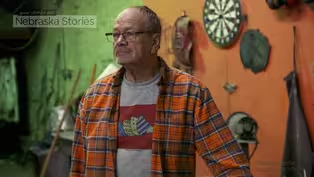
Les Bruning's Tumbleweed Symphony
Video has Closed Captions
Clip: S14 Ep13 | 6m 33s | The humble tumbleweed elevated through art. (6m 33s)
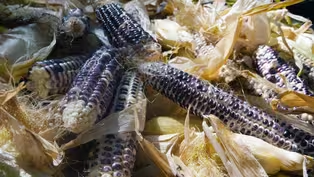
Video has Closed Captions
Clip: S14 Ep13 | 10m 41s | The Pawnee's efforts to preserve their sacred, ancestral corn. (10m 41s)
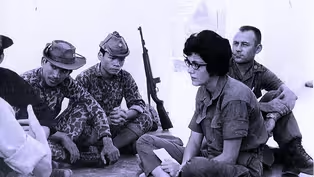
Video has Closed Captions
Clip: S14 Ep13 | 9m 55s | She was the longest serving American correspondent of the Vietnam War. (9m 55s)
Providing Support for PBS.org
Learn Moreabout PBS online sponsorship















Support for PBS provided by:
Nebraska Stories is a local public television program presented by Nebraska Public Media