
Black Church in Detroit: Gospel Music in the Black Church
Season 50 Episode 26 | 26m 46sVideo has Closed Captions
Black Church in Detroit: Gospel Music in the Black Church | Episode 5026
A look at the history of Negro spiritual folksongs and gospel music in the Black Church. Producer AJ Walker learns more about how gospel music grew out of Negro spirituals created by enslaved Africans. Then, hear about the connection between gospel and blues music. Plus, a look at some of the past gospel performances featured on the show. Episode 5026
Problems playing video? | Closed Captioning Feedback
Problems playing video? | Closed Captioning Feedback
American Black Journal is a local public television program presented by Detroit PBS
Black Church in Detroit: Gospel Music in the Black Church
Season 50 Episode 26 | 26m 46sVideo has Closed Captions
A look at the history of Negro spiritual folksongs and gospel music in the Black Church. Producer AJ Walker learns more about how gospel music grew out of Negro spirituals created by enslaved Africans. Then, hear about the connection between gospel and blues music. Plus, a look at some of the past gospel performances featured on the show. Episode 5026
Problems playing video? | Closed Captioning Feedback
How to Watch American Black Journal
American Black Journal is available to stream on pbs.org and the free PBS App, available on iPhone, Apple TV, Android TV, Android smartphones, Amazon Fire TV, Amazon Fire Tablet, Roku, Samsung Smart TV, and Vizio.
Providing Support for PBS.org
Learn Moreabout PBS online sponsorship- We've got a really wonderful show coming up for you on American Black Journal.
It is Black Music Month, and we're dedicating our entire show to music in the black church.
We'll talk about the roots of gospel, and its evolution into the contemporary sounds of today.
Plus we'll examine the connection between the blues and gospel, and we'll look back at some gospel performances on this show over the year.
Stay right there.
American Black Journal starts right now.
- From Delta faucets, to Behr paint, Masco Corporation is proud to deliver products that enhance the way consumers all over the world experience and enjoy their living spaces.
Masco serving Michigan communities since 1929.
Support also provided by the Cynthia & Edsel Ford Fund for Journalism at Detroit Public TV.
- [Woman] The DTE Foundation proudly supports 50 years of American Black Journal in covering African American history, culture and politics.
The DTE Foundation and American Black Journal, partners in presenting African American perspectives about our communities and in our world.
- Also brought to you by Nissan foundation, and viewers like you.
Thank you.
(upbeat music) - Welcome to American Black Journal, I'm Stephen Henderson.
Today, we're continuing our series on the black church in Detroit, which is produced in partnership with the Ecumenical Theological Seminary, and the Charles H. Wright Museum of African American History.
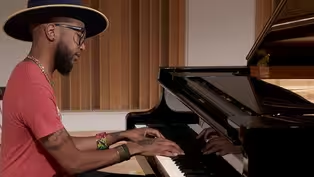
In honor of black music month, we're examining the roots of gospel in the black church, and how it has uplifted African Americans for centuries, American Black Journalist, AJ Walker sat down with Dr. Brandon Waddles to talk about the history and evolution of gospel music.
(relaxing piano music) ♪I will open up my heart ♪ ♪ (gentle piano music) ♪ ♪To everyone I see ♪ - Can you talk to me about the connection between gospel and the Negro spiritual?
- Yes, absolutely.
Gospel music, black gospel music is an offset of the Negro spiritual.
One of the main differences between the two, is that we are not exactly aware of the composers of Wade in the Water, or Joshua Fought the Battle of Jericho, or Didn't my Lord Deliver Daniel.
However, there are known composers of famous gospel songs, like, Oh Happy Day, Edwin Hawkins, or Total Praise, Richard Smallwood.
And so while there are certainly similarities between the two, there are certainly differences between, but both are certainly influential to the culture and the fabric of American music, and America in general.
- I feel like another connection between gospel and the Negro spiritual is the way it uplifted people, and kind of gave them hope.
Because I feel like a lot of people you know you feel hopeful when you hear gospel music, and Negro spirituals.
- Absolutely.
The Negro spiritual was so important to these enslaved Africans, who as scripture would foretell, were brought into the strange land, having been asked to sing a new song.
We understand that many of these enslaved Africans, came to the Americas with different dialects, different languages that they spoke.
Music has always been a universal language, and coded therein within these songs were messages, not only messages of hope, but messages that would lead these enslaved Africans to freedom.
Follow the Drinking Gourd, they were following the constellation.
Deep River My Home is Over Jordan, Jordan River scripturally is of course referring to in their context, the Mississippi.
It was their way to freedom.
If you think about jazz and blues, and certainly black gospel music, songs like Precious Lord, written by the father of gospel music Thomas Dorsey, were written to express the despair and the tragedy of having lost not only his wife and his child in a car accident, but it certainly expressed the hope of a savior, that would lead him through those troubling times.
(relaxing piano music) ♪ Precious lord ♪ ♪ Take my hand ♪ ♪ Lead me on, let me stand ♪ ♪ I am tired ♪ And so both of those genres, these truly black American genres, speak to both the reality of the situation, but also the hope of a present future.
- I know I've heard people say in the past that the music today is not the same, and it just is not as emotional as it has been in times past.
And when I think about a lot of the R and B artists today, not all of them come from a gospel background.
So when you compare to rhythm and blue singers of the past, most of them had their roots in the church, Aretha Franklin, Sam Cook, Otis Redding, those people, and then today, they just say it doesn't feel the same.
- So many of the legendary R and B and soul singers that you named, like Aretha Franklin, James Brown, Ray Charles, Anita Baker, and all of those, not only were they influenced by the sounds of gospel, but they were influenced by the preaching of the gospel too.
Aretha Franklin talks about how her father, the very legendary Reverend CEO Franklin, influenced the way that she's sang, by virtue of the way that he preached.
- [Rev.
Franklin] I believe that they have taken away my lord.
I believe the world is concerned about that.
- And so the cadence in his hoop.
You know influenced her soul efforts and her vocalism.
James Brown talks about the way that he moved across the stage.
And we talked about James Brown as the godfather of soul and certainly influencing the dancing of Michael Jackson and Chris Brown.
He learned those by just sitting around in church and watching the pastor move across the pool pit as they were getting to the height of their sermon.
And so if there's anything missing, it's not even so much then missing the sounds of the gospel singing.
They're just missing the entire lived experience of the communion, the theatricality sometimes, the performative aspects of black church.
There's nothing like black church folk getting together on a Sunday.
All of these genres from the blues to gospel to jazz are still heavily heavily utilizing elements of the Negro spiritual, which of course are connected to African culture and tradition.
The idea of the storyteller, the Griot in African American culture, this idea of community engagement within music.
The idea that music is going to be part of almost every great life event.
And that happens with gospel.
It happens with jazz.
It happens with rhythm and blues.
It happens later with rock and roll.
It happens of course, with hip hop and rap.
And I know that we try and steer clear of trying to make connections between the two, but there is no hip hop and rap without the Negro spiritual, without the storyteller, without the call and response.
There are certainly elements of hip hop and R and B that have, hip hop and rap and R and B that have found their way into gospel.
- The blues are about pain and sadness and gospel is about healing and hope.
Now, despite these differences the two genres share some of the same roots, some of the same influences and musical traits.
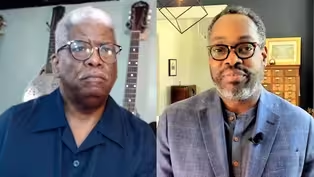
I spoke with Reverend Robert Jones Sr. who is also a blues musician about the connection between the blues and gospel.
I'm one of the people who listens to popular music all the time and delights in the idea that in so many songs written by so many artists I can hear the church, right.
I can hear gospel music in prince.
I could hear it, of course, in Aretha.
I can hear it in Demi Lovato or Chance the Rapper.
- Right.
- It really is part of American music, this history of gospel, but nowhere do you hear it more of course than in the blues - Right.
- And the connect between those two is really something special.
- Right?
Well, absolutely Steven.
I mean, when you think about American music if you were to come up with a metaphor of a tree that all of these different styles that you just mentioned are the branches and the trunk is the blues, but even deeper in the ground would be the roots.
- Yeah.
- And the roots, that's the spiritual.
- Yeah.
- So not only do you, because you can hear, you know you can hear it in Demi Lovato, or you can hear it in, you know, just name whoever because it's all sort of rooted in the black spiritual and then comes up through the blues and branches out through everything else.
- Yeah.
Yeah.
So as a Reverend and a musician, talk about how you how you navigate those connections and how they kind of spill over, I guess from one line of work into the other.
- Well, I was really blessed.
I'm a native Detroiter, but I was blessed to have this grandmother from Southern Alabama, from Conecuh county Alabama who loved many, many kinds of music.
So aside from going to and growing up in the black church she had no problem with putting some Muddy Waters or Lightnin' Hopkins or BB King on the Magnavox and you know, and entertaining the entire block.
So I grew up with like both of those influences and I really feel fortunate that if I had just been a church kid, I may not have been able to make the connection with the blues.
And if I just been sort of a kid who listened to nothing but blues, I probably wouldn't hear that.
But being this hybrid kid allows me to view both of those kind of musics in a sense without prejudice, if that makes sense.
- Mhm.
- So I can see the connections.
And I've really been blessed by the connections between both the sacred and the secular.
- Yeah.
So, you know the blues is about people expressing pain and sadness through music and gospel is usually about healing and hope.
Those two things would seem to be at odds in some ways I've always felt like though there is a connection between the messages as well as the music itself.
- Definitely something happens with the spiritual which is the music that came outta slavery, which was heavy which was about, you know, getting heaven when you die or suffering or being resilient and enduring.
And then the blues was kind of like about the idea of not suffering on the plantation, but hopping a train and getting away from, from all of that stuff.
And then in like around 1930 they melded into this music called gospel.
You had these sort of blues musicians who were looking at how the vitality was slipping out of sacred music and they combined the blues with the sacred and that produced gospel, which you rightly identified as being joyous music, right?
It's the good news, but there is no joy without some pain, right?
- Yeah.
- Weeping endures for night, but joy comes in the morning.
- Yeah.
- So you have both of those elements mixed in.
And I think the sacred and the secular really grew up right next to each other.
And if your socialization was to steady you know, be steady, to raise a family to endure the hardships that you were given, you know folks push you toward the sacred.
But if your inclination was I'm going to, you know escape from this situation I'm in and I'm enjoy some life while I'm here, your inclination was toward the blues, but strangely enough they always have this symbiotic relationship.
The greatest gospel singers tend to come out or the blues and the greatest instrumentalists come out.
Or is that the other way around.
The greatest instrumentalists come out of the blues, the greatest singers come out of the church.
- Yeah.
Yeah.
So, if you think about both gospel and blues, you know they've had time periods where they were more popular than they are right now.
And I guess some people might say that they are becoming more and more lost art forms especially as, you know, people leave the church or don't don't react or interact with the church the same way they used to.
And blues is not as prevalent on the airwaves or anywhere as it used to be.
- Right.
- But how do you feel about that?
- I think these are foundational forms and they keep reinventing themselves.
They find a way to push through 'cause they don't go away.
I mean, chances are, if you're a young singer, the first place that somebody told you that you could sing was in church.
- Was church, yeah.
- Right.
Right.
So, I was having a conversation with a young lady the other day at the Henry Ford museum, and she was amazed that the new Elvis movie, which of course has to feature a lot of blues, has a cover of a tune done by Big Mama Thornton, called "Ain't nothing but a Hound Dog," but it is redefined by Doja Cat.
(men laughing) - So it just, it doesn't go away.
- Right.
- It just sort of morphs into something else.
And the difficulty is sometimes finding the strand you know, finding why Ludacris has Lead Belly's "Pick a Bale of Cotton" in a song called Rosa parks.
- Right.
- You know, how does that work?
- That's right.
I also wanna talk about the fact that these are uniquely African American art forms, and they remind us, I think, just when you were talking about the modern influences that we see for them.
They're a reminder of how much if not all of American music really owes its existence and finds its roots in the African American experience and therefore in the African American music.
- Definitely.
You know, one of the things that I think we don't necessarily appreciate at first listening is that this music went far beyond entertainment.
It was music that allowed you to work in rhythm.
It was music that conveyed life messages of just, you know, wisdom, of how men and women interact with one another.
It was poetry.
And you know it carried a technology of work.
I think one of the reasons that African Americans were as resilient as they were in a system like slavery was they learned how to make the music keep their bodies moving, how to put their mind somewhere else.
In spite of of the backbreaking labor that they were dealing with, right?
Those are functions that come from African music translated through American experience, and we don't really think about it very much until we find ourselves using it.
- Yeah.
- So that when you have a time of crisis.
I remember during 9/11, folks were singing spirituals, they were singing, you know, they were singing "We shall overcome.
We are not afraid."
All those kind of things because it's useful.
And when the use, you know, when you find that not only is it beautiful and it's resilient but it's useful.
- Mhm.
- And it comes back when you need it.
And then there is the idea too, I think of no matter what the era, when you hear that voice that carries the African American singing aesthetic, when you hear Fantasia Barrino you instantly know that's a church girl.
- Yeah.
- I don't care what she's singing, right?
She's got the sanctified church right there with her.
She kicks off her shoes.
She lets, you know she lets the spirit have its way.
And there is an, an experience in the black church calls, singing yourself happy.
- Mhm.
- Right?
So at a certain point not only does the music serve as entertainment but it also can serve to sing yourself happy.
- Yeah.
- When you, when you need that technology.
- We have had several gospel performances on this show since it began airing on Detroit public television in 1968.
So we thought it would be a good time to reach back into the archives and take a look at a few of those special appearances.
Here they are.
(gentle piano music) ♪ God never fails ♪ ♪ God never fails ♪ ♪ He abides in me ♪ ♪ He gives me victory ♪ ♪ For God never fails ♪ ♪ You just keep the faith ♪ ♪ And never cease to pray ♪ ♪ Just walk upright ♪ ♪ Call Him noon, day and night ♪ ♪ He'll be there ♪ ♪ He'll be there ♪ ♪ There's no need to worry ♪ ♪ For God never fails ♪ ♪ I never worry ♪ ♪ I never fret ♪ ♪ The Lord Gold almighty has never failed me yet ♪ ♪ Rebuke and scorn, I know that I've been reborn ♪ ♪ For God never fails ♪ ♪ God never fails ♪ ♪ God never fails ♪ ♪ He abides in me ♪ ♪ He gives me victory ♪ ♪ For God never fails ♪ ♪ Just keep the faith and never cease to pray ♪ ♪ Just walk upright, call Him noon, day and night ♪ ♪ He'll be there ♪ ♪ He'll be there ♪ ♪ There's no need to worry ♪ ♪ For God never fails ♪ ♪ You can say what ♪ ♪ Do what you will ♪ ♪ But I ain't gonna let it get me down, no ♪ (gentle piano music) ♪ The road in the rough, the mountains get hard ♪ ♪ To climb sometimes, but I ain't ♪ ♪ No, no, ain't gonna let it get me down, no ♪ (gentle piano music) ♪ Can't you see that I'm, I'm a little too strong ♪ ♪ This is why I can't go wrong if I hold on ♪ ♪ Hold on ♪ ♪ Hallelujah ♪ ♪ I don't know ♪ ♪ What tomorrow's gonna bring ♪ ♪ Hey ya it may be sunshine ♪ ♪ Hey it may be rain ♪ ♪ Yeah yeah yeah I know one thing children ♪ ♪ I'm gonna make it after all ♪ ♪ O Pharaoh what's so evil ♪ ♪ Enslave God's most precious creation ♪ ♪ Wicked and hard chest master ♪ ♪ applied suffering ever day ♪ ♪ Think right how long can this go on ♪ ♪ (indistinct) ♪ ♪ Are about to break ♪ ♪ Father reply ♪ ♪ I've heard your cry ♪ ♪ And I make away your escape ♪ ♪ Now if I have to prophecy to set my children free ♪ ♪ These are my people ♪ ♪ Oh turn the river into blood, send the locust ♪ ♪ To Nevar ♪ ♪ These are my people ♪ ♪ Don't you know he said it ♪ ♪ Said it back then ♪ ♪ Now he said it again that my people ♪ ♪ These are my people ♪ ♪ That Jesus Christ is born ♪ (upbeat drum music) ♪ Go and tell ♪ ♪ Go and tell ♪ ♪ On the mountain ♪ ♪ On the mountain ♪ ♪ Oh and over and over ♪ ♪ Over hills and everywhere ♪ ♪ And every every where ♪ ♪ You ought to go and tell him ♪ ♪ Go and tell him ♪ ♪ Go and tell him on the mountain ♪ ♪ On the mountain ♪ ♪ Go telling everyone ♪ ♪ That Jesus Christ is born ♪ ♪ He made me a wise man ♪ ♪ Upon, upon the city ♪ ♪ (indistinct) ♪ ♪ And if I am to be of wisdom ♪ ♪ Then I am the least of them all ♪ ♪ Go and tell him ♪ ♪ Go and tell him ♪ ♪ On the mountain ♪ ♪ On the mountain ♪ ♪ Oh and over ♪ ♪ Over the hills ♪ ♪ And everywhere ♪ ♪ And everywhere ♪ ♪ You oughta go and tell him ♪ ♪ Go and tell him ♪ ♪ Go and tell him ♪ ♪ On the mountain ♪ ♪ Go and tell everybody ♪ ♪ That Jesus Christ was born ♪ - That's gonna do it for us.
Thanks for watching.
You can see all of the black church in Detroit episodes and learn more about our guests at americanblackjournal.org.
And you can always connect with us on Facebook and on Twitter.
Take care and we'll see you next time.
(gentle music) - From Delta faucets to Behr paint, Masco corporation is proud to deliver products that enhance the way consumers all over the world experience and enjoy their living spaces.
Masco serving Michigan communities since 1929.
Support also provided by the Cynthia Etzel Ford fund for journalism at Detroit public TV.
- [Woman] The DTE foundation proudly supports 50 years of American Black Journal in covering African American history, culture and politics.
The DTE foundation and American Black Journal partners in presenting African American perspectives about our communities and in our world.
- [Man] Also brought to you by Nissan foundation and viewers like you.
Thank you.
(bright piano music)
Negro Spirituals: The Music That Helped Free Enslaved Africa
Video has Closed Captions
Clip: S50 Ep26 | 6m 27s | Negro Spirituals: The Music That Helped Free Enslaved Africa | Episode 5026/Segment 1 (6m 27s)
Video has Closed Captions
Clip: S50 Ep26 | 10m 11s | The Sacred and the Secular: How Gospel Music Grew from the Blues | Episode 5026/Segment 2 (10m 11s)
Providing Support for PBS.org
Learn Moreabout PBS online sponsorship
- News and Public Affairs

Top journalists deliver compelling original analysis of the hour's headlines.

- News and Public Affairs

FRONTLINE is investigative journalism that questions, explains and changes our world.












Support for PBS provided by:
American Black Journal is a local public television program presented by Detroit PBS