
Amy Baur and Brian Boldon
Clip: Season 4 Episode 24 | 10m 21sVideo has Closed Captions
Public artists Amy Baur and Brian Boldon work with digital images, glass and tile.
In the Union Depot in Saint Paul, an installation by public artists Amy Baur and Brian Boldon incorporates digital images, glass and tile.
Problems playing video? | Closed Captioning Feedback
Problems playing video? | Closed Captioning Feedback
Minnesota Original is a local public television program presented by Twin Cities PBS
Amy Baur and Brian Boldon
Clip: Season 4 Episode 24 | 10m 21sVideo has Closed Captions
In the Union Depot in Saint Paul, an installation by public artists Amy Baur and Brian Boldon incorporates digital images, glass and tile.
Problems playing video? | Closed Captioning Feedback
How to Watch Minnesota Original
Minnesota Original is available to stream on pbs.org and the free PBS App, available on iPhone, Apple TV, Android TV, Android smartphones, Amazon Fire TV, Amazon Fire Tablet, Roku, Samsung Smart TV, LG TV, and Vizio.
Providing Support for PBS.org
Learn Moreabout PBS online sponsorship(Amy Bauer) Brian Boldon is a visual artist, a sculptor, my collaborator, and my husband.
(Brian Bolden) Amy Baur is a visual artist, photographer, and digital artist, my business partner, my artistic collaborator, and my spouse.
(Amy) When we collaborate, we have different processes, I think, but in the end, we have sort of the same vision, and so we're a really great team.
The process that Brian and I do to make artwork is kind of unusual.
Essentially we take any digital image, mainly photographic, and I manipulate that in Photoshop.
Then it's sent to a printer that's been refurbished with glaze inside, so there's no longer any toner.
(Brian) Instead of having ink in it, it has ground-up glass and pigments in it.
(Brian) Can I take a look?
(Amy) Yeah.
(Brian) That's printed onto a piece of water slide transfer paper.
Then that is able to come out of the machine and be soaked in water and slid onto the surface of ceramics and glass, and then permanently fused in the kiln.
(Amy) And that's why it is so permanent, because it's not ink, it's glaze, so it can't be scratched, or UV light doesn't hurt it.
So this process is not only really useful for a large-scale public work that we do, but we also use it in our own private studio work.
[bass, percussion, & vibraphone play in bright rhythm] (Brian) My work is really installation-based work.
It's about creating environments in spaces that one can move through and move around.
It sort of has evolved into trying to create spaces that challenge the idea of linear perspective.
It's sort of influenced by virtual reality environments and digital space, where there's no up and down.
There's really no beginning and no end.
It's not only about just creating a pure fiction and it's not about fantasy, and it's not about creating some sort of set design.
It's much more about creating a sensibility that maybe the references that you're using to describe what you're seeing are not the thing to be focused on, but you tap into some sensibility that goes beyond just what it looks like.
I really like creating a situation that's not easily decipherable, and finding something in the work that just kind of insists a different take, a different perspective.
There's a piece I have; it's called "3-D Chair," and it's a glass construction, and I took a chair and I hung it from a cable, and I spun it, and I photographed it while it was spinning.
I took six stills out of the rotation and put it at right angles to one another.
And it became completely believable that there was an object inside of this glass construction.
It was a very transformational piece for me because it played off that exact sensation that we have about our relationship with physical space and our environment.
Once you understand what a chair is, do you really every think about the chair?
You infer that you know what chairs are, and you no longer look at them.
I just insisted upon making it prismatic.
We are biologically virtual beings.
We spend most of our time not in the present.
I'm just an artist, but I've done enough research to know that neuroscience is proving a lot of this now.
And unless you hit your thumb with a hammer, and you go that really hurts, it's really hard to be in the moment.
Well, I think that's a huge opportunity there as a maker, as an artist, because you're the person that's intervening, you're the person saying, I care enough about this idea, that I'm going to act on this; I'm going to build this, I want to share this idea.
(Amy) I think I've showed some straight ones in the very beginning, but honestly, I never really have been interested in just a photograph.
I love when other people do it, but I want to create not a factual world.
I want to create images that are to the right and left maybe of fact.
[acoustic guitar plays softly] I've always been really fascinated with the idea of having a physicality in the imagery, so I will spend a long time going through my collections or looking at junk shots for just the right bent nail [laughs] or rusted lid of something.
And I like that it has a history; I like to find something that maybe somebody used, so utilitarian, and something found.
This recent work, "Open Spaces," it's kind of a contradiction in terms, and I like that because what I think I'm doing is, I'm containing, in a sense, a landscape, and so I think these are super pined down, open, sparse, distilled landscapes.
I am using photographs that I've taken, and then, using the decal process, fused that to glass.
Some of the glass I've curved in the kiln, slumped, so it actually creates a curve.
[soft scraping] The exterior of the work is laminated birch, and it's curved as well, and then I very carefully glue this transparent, almost vellum-like paper onto it.
And as I work, that's become a big part of it, where I like the sort of overlapping of that paper, creating maybe another very liminal suggested hill or horizon line.
And then I really like this idea of combining found objects.
They actually physically raise the work, and I like that idea that air can move between the open spaces and the ground, but also, I think that they are a marker of our external world.
So here I am creating these imagined spaces, you know, I'll use a hinge to connect two pieces of glass together, or I'll raise them with these things.
I think it's the one place where somebody looking at the work could say oh, I recognize that.
I'm really asking for just a moment where the viewer would look at this work and really look.
So I'm hoping that there's a sense of recognition and maybe pause, reflection.
(Brian) When we started working across mediums, and exploring 2-dimensional imagery that's captured by cameras and physical materials like ceramics and glass, we thought it would be a really interesting thing to try out some experimental ideas, and so we began working together 8 years ago, and it's been really interesting where we have gone with these kind of collaborations.
♪ ♪ This is a project that's going to the Ralph Carr Justice Center, Denver, Colorado.
It's a piece that fits in between the appellate court and the supreme court in the Grand Corridor, and it's about 120 feet long.
We bring all of our cameras, and we try to get a sense of the location and try to make something that's really, you know, really local, really about that particular site.
Instead of shooting the building, we'll go and we'll shoot the reflections of all of the buildings.
We'll shoot like, the details of the buildings, We'll try to create a sense of place and aspects of what it feels like to be in that city.
So we're generating a kind of a visual archive of imagery that we bring back.
(Amy) Then I work very long hours in front of the computer, pushing, melding, and working these together in Photoshop.
Then I print them out and you know, then it's Brian's job to decal every one of 'em and then fire 'em.
(Brian) Each tile is a 10 by 16; it's about 1250 square feet, it's about 680 tiles and I'm doing about 16 to 32 square feet a day, [laughs] so this has been, oh, 4 months with the work, not full time.
Conceptually, it's kind of pure and simple.
I mean, we use architecture materials and we encode it with electronic imagery.
We work really hard to integrate and make it kind of feel like the architecture and the artwork are really just reacting to one another.
You really don't get that opportunity as a fine artist to impact 130 feet of space to this level.
In the public art realm, you really have that opportunity, and over time now, we've done, I think, 17 projects together.
The experience level has gotten up to the point now where we can really understand space and understand the sort of dynamics of how to impact a space, and it's really exciting to actually realize that.
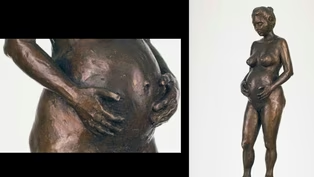
Video has Closed Captions
Clip: S4 Ep24 | 5m | Fawzia Khan's past as an OBGYN & immigrant inspires thoughtful sculptural installations. (5m)
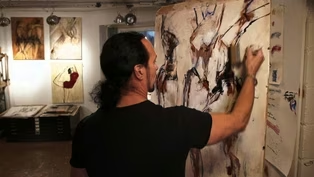
Video has Closed Captions
Clip: S4 Ep24 | 6m 3s | Painter Gary Welton's study of movement is inspired by early stop motion photography. (6m 3s)
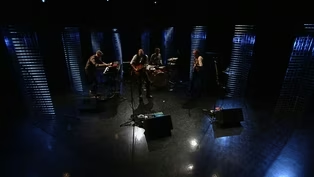
Greycoats: The Lions and The Swans
Video has Closed Captions
Clip: S4 Ep24 | 5m 31s | Literature and mythology influences the atmospheric music by Anglo-rock quartet Greycoats. (5m 31s)
Providing Support for PBS.org
Learn Moreabout PBS online sponsorship











Support for PBS provided by:
Minnesota Original is a local public television program presented by Twin Cities PBS