
Gary Welton
Clip: Season 4 Episode 24 | 6m 3sVideo has Closed Captions
Painter Gary Welton's study of movement is inspired by early stop motion photography.
Painter Gary Welton's study of movement is inspired by early stop motion photography.
Problems playing video? | Closed Captioning Feedback
Problems playing video? | Closed Captioning Feedback
Minnesota Original is a local public television program presented by Twin Cities PBS
Gary Welton
Clip: Season 4 Episode 24 | 6m 3sVideo has Closed Captions
Painter Gary Welton's study of movement is inspired by early stop motion photography.
Problems playing video? | Closed Captioning Feedback
How to Watch Minnesota Original
Minnesota Original is available to stream on pbs.org and the free PBS App, available on iPhone, Apple TV, Android TV, Android smartphones, Amazon Fire TV, Amazon Fire Tablet, Roku, Samsung Smart TV, LG TV, and Vizio.
Providing Support for PBS.org
Learn Moreabout PBS online sponsorship[strings and guitar play] (Gary Welton) I think that the dance is a universal language.
It might have even come about before speaking, so to me it's a very primitive way to express an emotion or tell a story.
When I go to the theater and see a ballet, for example, to me it's like watching a painting come to life.
It's a melody; it's melody of the music and the melody of the rhythms of the dance.
That's what I want to get on canvas.
♪ ♪ Capturing movement in a static medium has always been a challenge for all artists, I think, and we're lucky today to have had people like Eadweard Muybridge who was a photographer that studied motion.
He captured movement of animals and people in sequential photographs that showed movement, and that was really the advent of motion pictures.
For a painter painting in two dimensions, pretty much a static form, the way I do it is to show kind of the way Muybridge did, and it's a series of sequential movements that illustrate the motion forward.
My paintings come from one dancer model.
Sometimes people look at it and think well, he had 3 dancer models, but rarely is that the case.
I mean, one is complicated enough, particularly when he or she is moving around.
So it's usually the succession of movement by the one dancer model.
There's another nice one.
I call my work abstract figurative.
I do like the abstract, and I do like the more figurative, more realistic work.
Somehow I want it to be in between, a little bit of each.
To me that's where the life is.
It looks good, a good start.
[piano, strings, drums, & bass play in bright rhythm] The speed of the dance, the speed of the movement, is the direct connection between the abstract quality or the realistic quality of the work.
The faster the model moves, the more abstract the work is, and the slower she moves, the more realistic it is.
If the dancer is moving quickly, I have to work very quickly, and I have to find my way through the maze, basically as a series of marks that get made on the canvas.
It has very little thought at that point; the thought comes later in the resolution of the work.
I like to define that kind of balance between the abstraction and the realistic representation in the work.
Today I have a piece that I started some time ago and it's ready to be worked on again.
It needs a little resolution.
I think there's always a fear, when an artist is making a mark.
I mean, you can ask anybody to make a mark on a piece of paper or a blank canvas.
It's kind of a hard thing for a lot of people to do.
And there's a resolution that needs to come eventually to all the little problems that come up in any kind of artwork.
Once you make a mark, there's something else needs to be done, you know, it's a nice dialogue.
That's what I enjoy about it.
I love coming to the studio and having that dialogue.
And because I work on many pieces at one time, maybe 6 to 10 pieces, I can walk in the studio and have my coffee, and I can look around and see which piece is talking to me today, and that's the one I'm going to work on.
This painting is an example of the way I work because it shows some of the shapes that I saw in the movement.
I put a skirt on because it really shows motion, and I believe that it's closer now to the way I want it to be to explain what I saw that day in my studio.
I like to work with a lot of mediums; ink and watercolor are fantastic, I love that, it's so free, and I love the fluidity of it and the transparency, the fact that you can't erase it, you have to kinda go with the flow on it.
What I can do with the fluidity of the ink or the watercolor or the paint on that paper, to me it's also reminiscent of the dance as well; it's very fluid.
I think that a good painting is more understood later than earlier.
There's an impact up front, but I'm asking the viewer to really give it some time and look at it, so that they can kind of unravel the mystery.
Paintings live and die a thousand lives.
They die, and they're resurrected and they die and they're resurrected.
It's kind of a painful process, and I think I have to be fearless in the way I approach it, because if I'm not willing to kill it it won't be resurrected to a better piece.

Video has Closed Captions
Clip: S4 Ep24 | 10m 21s | Public artists Amy Baur and Brian Boldon work with digital images, glass and tile. (10m 21s)
Video has Closed Captions
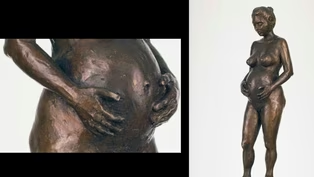
Clip: S4 Ep24 | 5m | Fawzia Khan's past as an OBGYN & immigrant inspires thoughtful sculptural installations. (5m)
Greycoats: The Lions and The Swans
Video has Closed Captions
Clip: S4 Ep24 | 5m 31s | Literature and mythology influences the atmospheric music by Anglo-rock quartet Greycoats. (5m 31s)
Providing Support for PBS.org
Learn Moreabout PBS online sponsorship

- Arts and Music
The Best of the Joy of Painting with Bob Ross
A pop icon, Bob Ross offers soothing words of wisdom as he paints captivating landscapes.





 New Episode
 New Episode



Support for PBS provided by:
Minnesota Original is a local public television program presented by Twin Cities PBS