
A Better Future
Season 3 Episode 6 | 26m 46sVideo has Closed Captions
A Better Future
A Chicago community surrounded by industry fights for a cleanup, a creative approach to keeping food waste out of landfills in Cleveland and The Catch.
Problems playing video? | Closed Captioning Feedback
Problems playing video? | Closed Captioning Feedback
Great Lakes Now is a local public television program presented by Detroit PBS
A Better Future
Season 3 Episode 6 | 26m 46sVideo has Closed Captions
A Chicago community surrounded by industry fights for a cleanup, a creative approach to keeping food waste out of landfills in Cleveland and The Catch.
Problems playing video? | Closed Captioning Feedback
How to Watch Great Lakes Now
Great Lakes Now is available to stream on pbs.org and the free PBS App, available on iPhone, Apple TV, Android TV, Android smartphones, Amazon Fire TV, Amazon Fire Tablet, Roku, Samsung Smart TV, and Vizio.
Providing Support for PBS.org
Learn Moreabout PBS online sponsorship(gentle upbeat music) - [Narrator] Coming up on "Great Lakes Now" A community surrounded by industrial sites fights for a cleaner future.
- Enough is enough, no more.
We're tired of being the toxic dumping ground for the city - [Narrator] Keeping food waste out of landfills to protect the climate and feed people.
- We saw just how much food was being thrown away and so to us it was just this unconscionable thing.
And so if we thought, "How could we like close that loop" - [Narrator] And news from around the Great Lakes.
(gentle upbeat music) (air whooshing) - [Voice Over] This program is brought to you by the Fred A. and Barbara M. Erb Family Foundation.
the Charles Stewart Mott Foundation.
- [Voice Over] The Consumers Energy Foundation is committed to serving Michigan from preserving our state's natural resources and sustaining our future to continuing business growth, academic achievement, and community involvement.
Learn more at ConsumersEnergy.com/foundation.
- The Richard C. Devereaux Foundation for Energy and Environmental Programs at DPTV, the Polk Family Fund, and Viewers Like You, thank you.
(gentle music) - Hi, I'm Ward Detwiler.
Welcome to "Great Lakes Now."
Some residents living in one of the most polluted places in the Great Lakes region are fed up for the toxic sites next to their homes and neighborhood parks.
And they're fighting for a cleaner, healthier future for their neighborhood.
- [Narrator] In its heyday, the Southeast Side of Chicago and the adjacent northwest Indiana was an industrial powerhouse and as long as jobs were plentiful residents put up with the smoky air and polluted waters of the Calumet River.
Longtime Southeast Side resident, Linda Gonzalez says all that pollution was just part of life in that area of Chicago.
- Yeah, I mean it was great.
I mean, we really weren't aware of a lot of the environmental pollutions.
You know, the steel mills were in business and there was a lot of people that were really active in the community.
- [Narrator] Decades ago it was standard practice for factories, mills and refineries to dump liquid and solid waste into nearby waterways and marshes.
But as manufacturing jobs started disappearing people were left with the ruins of industry and a polluted environment.
- [Mark] You know, this place has been a dumping ground for more than a hundred years.
- Artist Mark Banks grew up on the Southeast Side.
He works out of his garage studio - And since then we've kind of just struggled with not only the pollution itself but also the lack of any economic infrastructure.
- [Narrator] His art directly ties into his surrounding neighborhood.
- I call my art artwork, "Trespassive Art."
I go on a lot of these derelict sites to get my reference material.
For example, this painting that I'm doing right now I had to sneak onto private property on a Sunday when nobody was around to take pictures.
These are things that nobody was ever supposed to see - Living among what he describes as fields of rotting giants where steel mills once stood, Banks says he strives to transmit the violence of what he calls in industrial ecocide onto the canvas.
- And so I very much hope that my art in that spirit has some kind of ability to change people's minds and more importantly, to change policies and to change ways of being, ways of living for us (gentle upbeat music) - [Narrator] After years of putting up with industrial pollution on a grand scale Southeast Side residents are fighting back.
- I'm about a block from the Calumet River and there they used to store open piles of pet coke.
And so that stuff used to just blanket our neighborhood.
And it wasn't until some activist pushed back and really got those piles moved and covered.
- And in 2022, community activists won a victory against a scrap metal company.
In a deal worked out with City Hall years before, the company agreed to move from the north side of the city to the Southeast Side.
But residents waged a vigorous campaign against the company.
Siding with residents, City Hall eventually denied the necessary permits.
However, a judge recently ruled that the company should be allowed to operate on the Southeast Side.
Community activists say they are deeply disappointed by the ruling and will be appealing.
(electronics buzzing) - Enough is enough, no more.
We're tired of being the toxic dumping ground for the city.
- Amalia NietoGomez is Executive Director of the Alliance of the Southeast.
She says the area has more than two dozen toxic sites many of them located near schools and parks and higher rates of asthma, cancer and other chronic diseases.
- We are already environmental justice community and so we don't want any more toxic dredging here.
- [Narrator] The latest battle on the Southeast Side is over a toxic waste dump created by years of dredging the shallow Calumet River, to make it deep enough for huge freighters - This site is connected to the Illinois International Port District and its operations to allow shipping to happen.
- Juanita Irizarry is Executive Director of Friends of the Parks in Chicago.
The nonprofit group has concerns about all the muck being dredged up by the Army Corps of Engineers.
- The Calumet River is not particularly deep, and so the Army Corps needs to dredge, which ends up bringing up toxic materials that are at the bottom of the river bed.
- [Narrator] That toxic material contains lead, mercury, arsenic, barium and PCBs, just to name a few.
And it has to go somewhere.
Since the mid 1980s, it's all been dumped in what is called a Confined Disposal Facility or CDF on a little piece of land on the Southeast Side where the Calumet River meets Lake Michigan.
It is situated right next to a park called Calumet Park.
And now after decades of dredging and dumping the Army Corps of Engineers has run out of room, so it wants to expand the site, not outward but up.
- They wanna build a 25 foot higher berm and then be able to add more space behind that to keep dumping there.
We think it's ridiculous to do that in any case but most certainly right on the Lake Shore.
- [Narrator] In an effort to keep the dump from growing any larger the Environmental Law and Policy Center has filed a lawsuit on behalf of the Alliance of the Southeast and Friends of the Parks.
They are suing the US Army Corps of Engineers to force them back to the drawing board.
- They knew that this site was supposed to be closed and capped by 2022 because it would be full and they did not look at real options outside the 10th ward or outside an environmental justice community.
- The biggest worry is that the toxic materials already in the CDF could leach into Lake Michigan jeopardizing the drinking water source for millions of area residents.
- We do know that there are interactions between the lake and the retention ponds just because fish were found in the retention ponds.
So we do know there's already interaction we just don't know the extent of it, and so we would like water quality data to see what that is.
(somber music) (sea gulls calling) - The Southeast Side community activists recently scored another small victory.
The Army Corps of Engineers is delaying expansion of the CDF, after receiving a notice from the Illinois EPA.
The environmental agency said the work will now require a different type of permit than the one granted before.
The US Army Corps of Engineers declined our request for an interview.
But in a statement, a spokesperson said "Due to the new permit requirement, completion of the vertical expansion will be delayed one to two years."
A spokesperson for the Illinois EPA said various permits related to expansion of the CDF are currently under review.
The delay is good news for those fighting to stop the dump from expanding.
This gives them time to shore up support from Illinois to US Senators and newly elected Chicago Mayor Brandon Johnson.
During his recent campaign, the Mayor said he would reestablish a Department of the Environment and said he is committed to environmental justice.
- Think communities are starting to fight back and say, "Hey look, you know no more."
We've done our fair share and we need healthy alternatives now.
- For more on toxic sites around the Great Lakes and efforts to clean them up, visit GreatLakesNow.org.
In both the US and Canada, food waste is a huge problem squandering resources and producing greenhouse gases.
But one group in Cleveland is aiming to divert food for the landfills feed hungry people and inspire Clevelanders and the rest of us to reconsider what we put in the trash.
(air whooshing) - [Narrator] When you drive around Cleveland, Ohio, you see remnants of the city's gritty industrial past as well as vibrant art, bustling restaurants and lush urban gardens.
And if you know where to look you'll also spy Rust Belt Riders' trucks and food waste drop-off bins.
The Rust Belt Riders provide composting services to residents, businesses and organizations.
Co-founder Daniel Brown and his team divert an impressive amount of food waste from landfills.
- Since 2014, we have diverted 13 million pounds of food waste from going to landfills.
And just last year we picked up 5.5 million pounds of food scraps.
- [Narrator] While that's an impressive stat Brown says it's just the tip of the iceberg.
- A sobering but also alarming statistic is that we're estimating that 5.5 million pounds of food waste that we're collecting is about 1% of all of the food waste in our region.
And so there's a lot more food that needs to be diverted a lot more infrastructure that needs to be created.
- [Narrator] Food waste isn't just a Great Lakes problem.
According to Brown food waste is one of the most overlooked problems in the US.
- Roughly 40% of all the contents in landfills could otherwise be composted and much of that is food.
This is at the exact same time, one in northeast Ohio, one in five children are food insecure.
And so the amount of food that we send to landfills from a from a capital standpoint comes out to around $218 billion dollars annually on the growing, processing, transportation and disposal of food that never gets eaten, that's like 1.4% of our GDP nationally.
And all that material, when it goes to landfill, it emits methane gas which is a very potent greenhouse gas that accelerates the climate crisis.
And so one of the biggest things that we can do, to create a more equitable, healthy community that is climate resilient is to ensure that food not ever go to landfills.
- [Narrator] Rust belt Riders began humbly in 2011, while Brown and his co-founder, worked at a local farm to table restaurant.
- We saw just how much food was being thrown away in an environment that was arguably the most thoughtful procurer of local foods and a supporter of our local food system.
And so to us it was just this unconscionable thing.
And so if we thought, "How could we like close that loop?"
- [Narrator] Their initial approach was relatively simple.
- If we could convince restaurants to provide us with their food waste, we could get that to community gardens and help them turn it into compost.
And so we cobbled together a couple thousand dollars.
We bought a mountain bike we welded a trailer to the back of said mountain bike, and sort of the rest is history.
We started riding around picking up food scraps like 300 pounds at a time and taking those to community gardens where we would turn it into compost.
- [Narrator] Fast forward to today, the once scrappy startup is now a full fledged worker-owned cooperative.
- Today we've got about 30 or so people on our staff.
We've got routes that we're running multiple times a day, six days a week.
We have a bevy of services that we offer.
So we offer commercial services to businesses, organizations, and institutions.
We work with around 300 different locations across Northeast Ohio to provide them with a clean, timely and community benefiting alternative to landfills.
- [Narrator] To close the sustainability loop, Brown and his team use the food scraps to create compost which is then used to create their line of Tilth Soil products.
- It isn't good enough to simply just divert food from going to landfills.
You need to actually create products from it that can be recirculated and reintroduced into our food system.
And so Tilth Soil's the manifestation of that idea.
And so we make potting mixes, we make raised bed fill mixes we make mixes for house plants and those are like bagged around me, as you can see.
- Here at the historic West side market.
Rust Belt Riders is working on a pilot program for the Mayor's Office of Sustainability.
That includes not only composting, but also food rescue.
Kathy Len from Circular Cleveland is the city's lead on the project.
- It's important to begin composting and food rescuing here at the West side market to begin our transition from a linear economy to a more circular economy where we want to increase the diversion of organic waste from the landfill and also provide more food to our residents, if they're in need.
- [Narrator] Chelsea Sherin, directs the food rescue component of the program on behalf of Hunger Network, an emergency food provider in Cleveland.
- Food rescue is really taking that surplus, usable and edible product.
It may not be perfect in every way, shape or form but taking that product, keeping it out of the landfill, and then donating it to people who need it.
- [Narrator] Vendors at the West side market use a food rescue dispatch line to coordinate their donations.
- So whenever a vendor has product, they're like, "Hey, I got two boxes."
They'll shoot a text or their call and say, "This is so and so, from the West side market at this booth I have three boxes of produce to donate," and from there my team will coordinate a pickup.
Our program is direct transfer meaning we don't bank or warehouse or store any product.
We're trying to get it immediately from the donor to the recipient where it's often on the plates of those who need it within an hour.
- [Narrator] Robert Kurtz, Sales Coordinator for Rust Belt Riders works with vendors to compost any remaining food.
- If it can't be rescued and it can't go to somebody first then we try to make sure that it doesn't end up in the landfill by composting.
So we're asking them to take all of their food scraps that first, can't go to somebody in need and can't be eaten.
Things like the tops of pineapples, banana peels maybe berries that have gone bad, things like that.
We're asking them simply to just put them in a composting bin, which we come around and pick up and divert from the landfills, and turn in the soil.
- [Narrator] The initial results of the program are promising.
- So since we started this pilot in January we've been able to divert 13,000 pounds of material.
We project that by the end of the pilot.
It's a six month pilot, we should have another 20,000 pounds captured.
- [Narrator] The City's collaboration with Rust Belt Riders doesn't stop there.
The team is helping the City outline a possible city-wide composting program.
- We're hoping that residents would be very excited about having access to composting provided by the City.
The biggest challenge that we face is we're asking people and businesses to change their behavior, and that's always very difficult.
We're all very set in our ways and our habits - [Narrator] But revamping Cleveland's approach to food waste has the potential to help the environment and also the local economy.
- A lot of what we're trying to do is demonstrate like there's a healthy economy to be had.
There are good paying jobs to be had.
This isn't just a cute thing that like is done in the Netherlands, right?
It can happen here and we cannot continue to be on this treadmill off a cliff, right?
And so we need to find a way to sort of reimagine our relationships with resources, with communities and reinvest and rethink how we design things, and so we're doing that humbly with food.
- For more about composting and agriculture in the Great Lakes region, visit Great Lakes now.org.
And now it's time for the catch where we take you around the Great Lakes to hear from reporters about the issues they're covering.
Bite-sized news briefs about the lakes you love.
Plus a look at an annual summer bike ride happening in Michigan's upper peninsula.
- [Narrator] If Michigan's upper peninsula makes you think of wilderness smoked fish and pasties, you are not alone.
But one thing you may not associate with the UP, is road cycling, and one man is on a mission to change that - We wanna show people all the safe roads available to ride their bike in the Upper Peninsula.
There are way too many vehicle to bike crashes around the entire country.
Bikers are looking for safe places, safe routes to ride their bike.
- [Narrator] According to the Centers for Disease Control and Prevention nearly 1000 bicyclists die and more than 130,000 are injured in crashes that occur on roads in the United States every year.
But in Michigan's Upper Peninsula there were only three fatalities and 15 serious injuries from accidents involving cyclists between the years of 2017 and 2021.
- And so the bike ride that we take people on showcases all of these quiet roads.
And it is a loudspeaker for the country to realize that the Upper Peninsula is full of quiet, paved, back country roads that not enough people know about.
- [Narrator] And that's precisely why in 2018 James created toward the Tour Da Yoop, Eh.
It's a 1,200 mile long loop divided into 10 sections that takes riders through the beautiful landscapes and towns of the UP, over the course of 10 days.
- Unique thing about the Upper Peninsula is it's a big landmass, but it's skinny.
And so it's an easy place to create this type of a loop logistically where you could do a section of it and then it's only 50 or 60 miles to ride your bike back to where you started.
- Since starting Tour Da Yoop, Eh, James has been pushing officials to adopt road safety and planning measures that take cyclists into account.
- And they see these safety measures are logical and rational and they take a little while to implement but the knowledge of them and the implementation of them is benefiting the entire State of Michigan.
And a lot of these practices can get applied throughout the rest of the country, as well.
More and more people are biking in the UP.
They're seeing it as a safe place.
We're having so much fun meeting people from around the country and inviting them to take on our plaid jersey challenge, and make it to the Hall of Plaid when they get all 1,200 miles done.
(air whooshing) - [Narrator] The US Army Corps of Engineers reports that the long-term average rise in Lake Superior's April water level is three inches.
Which means that at this rate, the lake could reach record levels this summer.
Mark Toregrossa, a meteorologist for MLive, has the story.
- The way Lake Superior and all the Great Lakes water levels are measured is a bunch of points are taken, measured with levels and then they're all averaged together over the course of several days.
That way it takes away the wind fluctuations the wave fluctuations and whatnot and gives us an average level or average height of the water level.
One inch of water on Lake Superior is equal to 500 billion with a B, gallons.
If it goes up another three inches it'll have another 1.5 trillion with a T, gallons of water in it.
That's a hard amount of water to imagine - [Narrator] But the water levels of all the Great Lakes do not necessarily rise and fall together.
- If you remember two years ago or so Lake Michigan and Lake Huron, Lake Erie, Lake Ontario were all at record high water levels and have since dropped considerably.
The interesting thing about Lake Superior's water levels, right now, this year, is they are going the opposite direction of a lot of the other Great Lakes.
And now Lake Superior is only three inches below its record high water level for this time of the year.
The cause of this is precipitation.
The Lake Superior Drainage Basin which is the area surrounding Lake Superior, where where the rainfalls all drains in the Lakes Superior that has had very heavy above normal amounts of precipitation.
- [Narrator] Mark believes that global warming is an underlying cause and that lake levels could be more variable in the future.
- It means the cycles that we've seen over hundreds of years could be more accentuated.
The heat brings energy, energy turns into storms.
So we're finding that we have wetter winters.
When the lakes normally fall, they're getting water in them and they rise.
But also with the heat, if we go into a dry pattern the evaporation can be stronger, higher and lake levels can go down.
So it's a very volatile up and down situation.
(air whooshing) - Nor Dan Wanschura is the Executive Producer and host of Interlock and Public Radio's Points North Podcast.
- Points North is a podcast about the land, water and inhabitants of the Great Lakes.
We wanna tell the stories of this region.
- [Narrator] One recent story highlighted in incident involving some anglers willing to do anything to win fishing competitions.
- Fish competitions are common throughout the Great Lakes region.
And what people might not know is there's oftentimes thousands of dollars at stake in these competitions.
Expensive boats, sponsorship deals.
And when you have a lot of money involved in a competition there's always the possibility that some people are gonna cheat.
So this particular episode, we hone in on two specific fishermen, Chase Cominsky and Jacob Runyan.
And they fish what's known as the Lake Erie Walleye Trail.
It's a series of competitions held on Lake Erie throughout the year.
And this particular event is held at Cleveland.
It's their championship event, and they are about to win the grand prize, the tournament prize, when the Tournament Director decides to double check their catch, and when he slices open the fish lead weights are discovered inside the fish.
There's a total of 10 lead weights adding seven pounds to their total catch.
All hell breaks loose from there and it's a scandal that really rocks the competitive fishing world - [Narrator] To combat the cheating, the tournaments have taken some extraordinary measures.
- I did talk to other anglers who suggested cheating has existed in these fishing tournaments ever since they've existed.
You're always gonna have guys trying to find ways around the rules.
And so one of the measures that's been put in place is to have the winners actually take polygraph tests lie detector tests to prove that they won the tournament, and they were following the rules.
- [Narrator] And let this be a lesson that it never pays to cheat.
The consequences for Kaminsky and Runyon were pretty severe.
- Chase Kaminsky and Jacob Runyon were charged with a handful of felonies.
They actually ended up taking a plea deal.
They were sentenced to 10 days in jail, $2,500 dollar fine, and they forfeited $130,000 dollar boat.
So that was the consequence.
It was no small potatoes sort of crime.
They paid for it in a big way.
- Thanks for watching.
For more on these stories and the Great Lakes in general, visit GreatLakesNow.org.
When you get there, you can follow us on social media or subscribe to our newsletter to get updates about our work.
See you out on the lakes.
(upbeat music) (air whooshing) - This program is brought to you by the Fred A. and Barbara M. Erb Family Foundation.
The Charles Stewart Mott Foundation.
The Consumers Energy Foundation is committed to serving Michigan from preserving our state's natural resources and sustaining our future to continuing business growth, academic achievement, and community involvement.
Learn more at consumers energy.com/foundation.
- The Richard C Devereux Foundation for Energy and Environmental Programs at DPTV, the Polk Family Fund and Viewers Like You, thank you.
(gentle music)
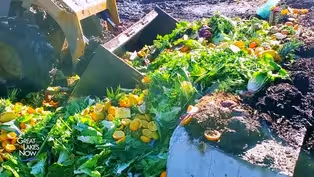
Battling Food Waste for People and the Planet
Video has Closed Captions
Clip: S3 Ep6 | 8m 6s | Learn how keeping food waste out of landfills can help to fight climate change. (8m 6s)
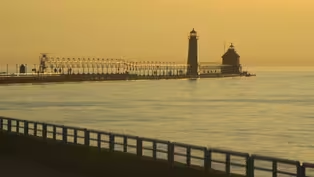
Video has Closed Captions
Clip: S3 Ep6 | 8m 13s | The Catch is Great Lakes Now’s one stop shop for bite-sized news about the lakes you love. (8m 13s)
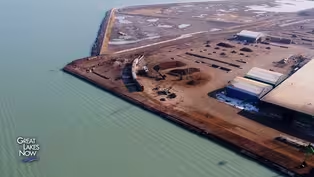
A Community Fights For A Cleaner Future
Video has Closed Captions
Clip: S3 Ep6 | 8m 23s | They live in one of the most polluted areas of the Great Lakes and they’re fighting back! (8m 23s)
Providing Support for PBS.org
Learn Moreabout PBS online sponsorship
- Science and Nature

Explore scientific discoveries on television's most acclaimed science documentary series.

- Science and Nature

Capturing the splendor of the natural world, from the African plains to the Antarctic ice.











Support for PBS provided by:
Great Lakes Now is a local public television program presented by Detroit PBS