
A Bowl, A Barn & A Tower: Birthplaces of the Entertainment Industry
Season 9 Episode 4 | 27m 42sVideo has Closed Captions
From a barn to a bowl to a tower, the early history of Hollywood.
Nathan explores the early history of Hollywood, tracing the unexpected places where the entertainment industry began.
Problems playing video? | Closed Captioning Feedback
Problems playing video? | Closed Captioning Feedback
Lost LA is a local public television program presented by PBS SoCal
A Bowl, A Barn & A Tower: Birthplaces of the Entertainment Industry
Season 9 Episode 4 | 27m 42sVideo has Closed Captions
Nathan explores the early history of Hollywood, tracing the unexpected places where the entertainment industry began.
Problems playing video? | Closed Captioning Feedback
Where to Watch Lost LA
Lost LA is available to stream on pbs.org and the PBS app.
Providing Support for PBS.org
Learn Moreabout PBS online sponsorshipCecil B. DeMille moved the barn out of the Paramount lot, and it sat across the street from Capitol Records for several years.
Nathan Masters: [Laughs] Wow!
And people still today remember driving by and just seeing this barn that's just falling in disrepair, just sitting in the parking lot.
Nathan: The natural contours of the canyon were smoothed over with concrete, with benches, and now we have these boxes here.
Did I read that that, actually, had, unfortunately, the effect of ruining the natural acoustics?
Yeah, unfortunately.
Ringo Starr likes to come up here, from what I've heard.
And, look, you can almost touch these letters.
We're so close to "Capitol Records."
Nathan: It's really a treat to be up here.
Alison Martino: It is.
♪ Announcer: This program was made possible in part by: a grant from Anne Ray Foundation, a Margaret A. Cargill Philanthropy, the City of Los Angeles Department of Cultural Affairs, and the Roy + Patricia Disney Family Foundation.
Nathan: At the turn of the 20th century, Hollywood was about as far from Tinseltown as you could get.
Founded in 1887 by an ardent prohibitionist and a devout Episcopalian, it began as a country hamlet of lemon groves and horse barns in what was then known as the Cahuenga Valley, a community that abhorred gambling, liquor, and popular entertainment.
Wealthy migrants planted orchards and sumptuous gardens around baronial mansions, drawn by the prospect of a refined ranching life in an idyllic California retreat.
The most celebrated of these estates belonged to painter Paul de Longpré, whose rose gardens drew sightseers to Hollywood long before movie stars ever did.
And among those early tourists was filmmaker D.W.
Griffith, who, in 1910, quietly shot the first motion picture ever made in Hollywood, right there in de Longpré's garden.
The community that looked down on popular entertainment was already losing the argument.
Three years later, another filmmaker would arrive, and Hollywood would never be quite the same ever again.
Angie, hi!
So excited to be here at the barn.
Welcome to the barn.
Nathan: This barn is about as close as you can get to the birth of Hollywood as we know it.
Angie: Right?
I mean, the barn is our main artifact.
You know, even though we're up here in our archives right now, I always tell everybody, this barn tells us several different stories, and it now, sadly, is the oldest structure still standing in Hollywood.
You have some amazing photographs here.
This is not what people picture as Hollywood today.
Angie: It wasn't part of Los Angeles City yet.
We were kind of part of what was called the Cahuenga Valley.
We had the Cahuenga Lemon Exchange... In fact, that's what this barn was really kind of utilized for, was part of the groves.
And that's around, what, 1910?
Mm-hmm.
And now, let's fast forward three years-- Yeah.
Three and a half years or something like that, and this barn comes into the picture-- Angie: Yes.
Nathan: ...and also a man named Cecil B. DeMille.
♪ "The Squaw Man" really kind of took interest to Cecil B. DeMille and Jesse L. Lasky and Samuel Goldfish, because it was the top play at the time.
Yeah, the play was actually adapted into a novel.
Angie: So why not make it a successful movie?
Again, it's what you'd call, like, hot-- like, if there's a best-selling book... Angie: They wanted it to be a full-length feature, meaning it was gonna be at least 50 minutes.
It's not going to be these little shorts, which is, again, very experimental, because could you get people to sit in a theater?
♪ Here's a letter pertaining to an actress by the name of Red Wing.
"The Squaw Man" was a story of Native Americans, and Red Wing was one of our earliest of the Native American actresses.
This was them bringing Red Wing here and being part of that film as well.
So, this letter documents, basically, her hiring, then?
Yep.
This is written to "Sam Goldfish."
Yeah.
It says "Goldfish" on there.
Well, that was his name, right?
And then signed by DeMille here, in pencil.
Angie: Exactly.
Nathan: Wow.
Angie: They decided that the East Coast was just not gonna be a place to film this.
So, what they did is decide to move West.
Cecil B. DeMille got into a train, went to Flagstaff, Arizona, December 1913, and realized it wasn't the climate.
It was cold, it was damp, it was rainy, and got right back on the train and went as far west as he could, which was Los Angeles.
And then what he did was he stayed at the Alexandria Hotel.
Nathan: Oh, yeah.
So, what he ended up doing was sending a telegram back to Jesse L. Lasky and Goldfish out in New York, and said, "I'm going to rent this barn."
And we have what rarely ever comes out on display, is the original lease agreements.
Oh, wow, for this barn.
Wow.
Angie: At the time, the property was owned by a gentleman by the name of Jacob Stern.
Nathan: Okay.
Angie: And he was an up-and-coming real estate-- And he had a beautiful mansion that sat right across the street from the barn off of Selma and Vine.
Oh, I think I've seen a picture of that.
Yeah.
You have a picture of that over there, right there, a postcard.
I do.
Yep, gardens too.
Actually, not just a picture, a postcard.
So, Hollywood already had this tourism industry.
Angie: Oh, yeah, exactly.
Nathan: And then it was homes and gardens.
Angie: Yep.
Nathan: Yeah.
Angie: And then you have L.L.
Burns and Revier-- those were the two gentlemen that were also leasing the barn to be a developing lab-- would later on become-- start the Western Costume Company that we're familiar with.
So, DeMille was almost-- he was a subletter, in some ways.
Yeah.
Yeah.
So, this is interesting.
It's entered into the 24th day of December.
That's Christmas Eve, 1913.
And then on the back, yeah, we have here, signing for Jesse L. Lasky Feature Play Company is Cecil B. DeMille, general manager, lessee.
So, that's probably one of his earliest autographs.
This is pretty close to a document of the birth of Hollywood.
Yes.
Certainly the birth of what we know as Paramount today.
Yes.
And those copies are actually Jacob Stern's personal copies.
And then Cecil B. DeMille's collection is actually at BYU.
So, there's just the two sets of copies.
Nathan: Wow.
Angie: And we have different revisions, because, at first, it was just a couple-month lease.
It's all Jesse L. Lasky gave him approval for.
But then they were able to expand just on that Selma and Vine lot and make stages and eventually almost kind of add, like, glass house effects, where they can film finally inside and have the lights, because they just didn't have the lighting technology.
So, even an indoor scene was filmed outside.
Nathan: Now, of course, they didn't need sound stages.
No.
No.
Because there was no sound.
Exactly.
Enter 1916, where we partner with another gentleman by the name of Adolph Zukor, and they want to bring in more of these full-length featured films, which is hard to get distribution at the time, because people were used to the shorts.
Right.
And that's where Paramount comes in.
They needed to also have control and start having their own distribution.
So, they acquire Paramount Pictures.
Nathan: So, this is the original Paramount lot, then.
Angie: Yes, on Selma and Vine.
Nathan: Which actually grew out of the Stern Ranch.
Angie: Yep.
Yep.
Exactly.
Adolph Zukor had a lot of the big actresses.
He had somebody by the name of Mary Pickford.
Nathan: Oh, okay.
Angie: I love this photo.
This is actually her with the barn in the background.
[Nathan laughs] Oh, that's the barn.
Yeah.
So, when Paramount moved, the barn moved too.
Yes.
Now, that wasn't its final move, though, because the barn is not-- we're not on the Paramount lot right now.
No.
No.
We're across from the Hollywood Bowl.
No, there's another move in there.
A couple moves in there, actually.
Nathan: Wow.
Even moved a few times on the lot.
But when it was on the lot, you know, probably the longest of its life was as a Paramount gym.
It got moved, but that's because there was another preservation save in the meantime, which was, in 1956, Cecil B. DeMille had gotten word that he thought the barn might be demolished back then.
So, what they did is they worked with people like John Anson Ford, and they were able to make this a California landmark.
And it was the first entertainment-related anything to get landmark status.
Nathan: Wow.
Angie: So that was the big save.
And moved the barn out of the Paramount lot, and it sat across the street from Capitol Records for several years.
Nathan: [Laughs] Wow!
And people still today remember driving by and just seeing this barn that's just falling into disrepair, just sitting in the parking lot.
And then that's where Hollywood Heritage comes.
It was formed by five women who, in 1978-- where they're, like, you know, "There's no preservation in Hollywood."
And one of those ladies, Marian Gibbons, she got wind that Universal Studios might acquire the barn, and she's like, "You can't take a Paramount structure and give it to Universal."
So, that's when they're like, "This is gonna be one of our very first big saves."
So, John Anson Ford, the ladies went to him-- Nathan: He was a county supervisor?
Yeah, and they're like, "Help us."
And he knew about this property here across from the Hollywood Bowl, because there was actually supposed to be a museum here in the '60s.
And, by intimate domain, a lot of the homes were removed and demolished.
So, it was always earmarked to have a museum here.
So, we could tell early Hollywood agricultural story all the way to where Hollywood as entertainment started from this little barn.
Just from this one structure?
Yes.
Wow.
I'm so glad it's been saved-- multiple times now.
Angie: Yeah.
♪ Nathan: The arrival of the movie people unsettled many of Hollywood's old guard.
Film crews were noisy, actors were disreputable, and the whole enterprise seemed to threaten the quiet, respectable character of the community they'd built.
But the movies were here to stay.
And within a few years, a different kind of cultural project was taking shape, just up the hills, in the Cahuenga Pass.
If the Barn represented Hollywood's commercial dreams, the Bowl represented something else-- the belief that this improbable new city deserved a cultural life equal to its ambitions.
The idea was radical for its time-- an outdoor performing arts venue where symphonic music could be accessible not just to those who could afford it, but to everyone.
In 1920, two members of the Theatre Arts Alliance went searching the Hollywood Hills for a place to make it happen, and found it in a sagebrush canyon where their voices carried across the landscape-- a natural amphitheater then called the Daisy Dell.
♪ 1920s announcer: And now, pardon a little low-flying-- let's circle over the world-famous Hollywood Bowl, an outdoor theater embraced by hillsides that give it perfect acoustics.
Nathan: Next door to this now iconic venue, the Hollywood Bowl Museum holds documents that tell the story of how that idea became a reality.
Museum director Ljiljana Grubisic and archives manager Michele Beacham were kind enough to show me some of them.
One of my favorite documents is actually the Satisfaction of Mortgage.
And there's a story that they actually burned a copy of it on the stage.
Oh, like the original-- the original mortgage document.
"We don't need this anymore."
Yep.
Wow.
The alliance secured the land, and the Hollywood Bowl was born.
From the beginning, the audiences came.
Among their earliest events was an Easter sunrise service that drew thousands of Angelenos into the hills before dawn, streetcars running as early as 3:00 in the morning to carry them there.
Michele: The postcards are such an interesting part of the collection.
"We are going out to catch an Easter service daylight on Easter morning.
We leave here at 4 a.m.
and hear first trumpets up on mountain."
So, they actually had-- there were people playing trumpets up on the ridgeline.
Michele: Mm-hmm.
Ljiljana: Yes.
Yes.
Nathan: Of course, there's no better place to talk about the Hollywood Bowl's history than the Bowl itself.
I met up there with writer Derek Traub.
His book for the LA Philharmonic tells the Bowl's hundred-year history not as a straight chronology but as a set of ideas that have shaped the place from the start.
This is a an LA institution, the Hollywood Bowl.
It's one of the most magical places to spend a summer evening.
It's a marvel of engineering.
Derek: Yeah.
Nathan: There are some amazing pictures from the early days, with thousands of people.
Derek: Yeah, it was incredi-- It was literally just, like, a makeshift wooden stage with, you know, a hundred-piece orchestra on it.
So, there were about two dozen founders of this place, and probably as many ideas for what to do with it.
Christine Wetherill Stevenson, who was one of the first of them, she was a theosophist and believed in bringing together the world's seven great religions through seven different art forms, and she wanted to do these religious plays here.
The other founders had other ideas, so she packed up and went across the street and created the Pilgrimage playhouse, which is now the Ford Theatre.
The sort of prevailing idea here came from a woman named Artie Mason Carter, who was a piano teacher.
She had this idea for using this space, the Hollywood Bowl, for a summer of symphony concerts, four nights a week, ten weeks out of the year.
And this had never been done before anywhere.
William Andrews Clark Jr., who had just founded the orchestra, the Los Angeles Philharmonic, she sort of tried to talk him into lending his orchestra for this summer-long series, and he says, "No one is going to pay for these concerts.
No one's--" Like, "I'm just going to be out so much money for this."
In that first summer in 1922, it was just an overnight success, and it still is.
Not only did they not lose money, but they started to make money.
And in 1926, they finally had enough resources to put in the permanent benches.
This kind of shape of the amphitheater-- it's like a big balloon-- is designed by an architect named Myron Hunt.
Yes, and there's a connection there to the other Bowl, right?
Derek: Yes!
Nathan: The Rose Bowl!
Derek: Yes!
The shape of this place, it just-- it fits so naturally into the canyon.
♪ 1920s announcer: Mecca for lovers of music and spectacles is Hollywood Bowl, tremendous outdoor amphitheater, where the outstanding orchestras and soloists of the world perform.
With a capacity for some 12,000, this great Bowl presents programs of every type for every taste.
Nathan: So, the natural contours of the canyon were smoothed over with concrete, benches, and now we have these boxes here.
Did I read that that actually had, unfortunately, the effect of ruining the natural acoustics?
Yeah.
Unfortunately, there was this sort of, like, belief in the time that sort of man can conquer nature and improve upon it.
Like, we have our LA River and this sort of a similar idea happened here, where it's like, "We can make this dusty canyon into this perfect canyon by pouring concrete and putting these permanent benches in," which is nice we have this permanent seating area, but it did start to mess with that natural resonance.
So, the sound is better now than it ever has been, but it's been kind of a journey over the last hundred years to sort of recreate what was originally here.
This amazing shell we see here is-- is not the first.
It's-- Yeah.
A lot of people think when we say "Bowl" that the bowl indicates the shell.
No, the bowl is the canyon.
Nathan: Yeah.
Derek: The name "Bowl" predates the shell.
The LA Phil started doing concerts here in 1921, 1922.
The first shell doesn't go in until 1926 for a few reasons-- one, that was when they laid all the concrete and the sound started to get wonky.
So, they're like, "Okay, let's put up something to hopefully reflect the sound out a little bit better."
And the second reason was we had an orchestra rehearsing here during the day in the summer, and they were tired of sitting under the hot sun.
Nathan: I can imagine.
Derek: We cycled through four shells in the 1920s while they were playing around with the aesthetics and the acoustics and could never quite settle on one, and then, in 1929, they put in a shell, and we have the stock market crash and other kind of priorities change, so they're like-- though they didn't think it was gonna be a permanent shell, they left it, and it survived until 2003.
It's a pretty good run.
So, after the war, the Bowl fell on really hard times, and it was in danger of closing for a while.
Derek: Yeah.
In 1951, the Bowl went bankrupt.
They started with this big opera production that no one showed up for.
There was some bad weather.
There was some, like, misgauging of the interest in it.
And so, they were out of money to pay the musicians.
And we had survived a Great Depression and World War II, and all these ups and downs, and, all of a sudden, in 1951, we weren't gonna have a Hollywood Bowl season for the first time in almost 30 years.
A philanthropist [Laughs] and a business leader and a brilliant woman named Dorothy Chandler was roped in.
[Laughs] She was the wife of Norman Chandler, who was the publisher of the "LA Times."
The ruling family of Los Angeles, essentially.
Yeah, you could take, like, the Vanderbilts and the Astors and the Rockefellers and put them into one, and that's the Chandlers.
Right.
That's how influential and important they were.
And Dorothy Chandler was sort of this society wife, and so, she went to work as a volunteer.
And so, they bring her in, in 1951.
The place is in, like, $100,000 worth of debt.
And in 12 days, she turns it around.
She moves into our then music director's house, Alfred Wallenstein, gets out his Rolodex, calls every great musician across the country who's been playing here for decades.
She had that sort of Artie Carter vibe of, like, the community needs to be bought in and invested.
So, she started a fundraising campaign, used her husband's newspaper, the "LA Times," to advertise it.
And, yeah, they raised the $100,000, got the place back open in 12 days.
Nathan: So, Artie Carter championed classical music.
Derek: Yes.
Nathan: You know, the Hollywood Bowl stages a lot of popular music shows too.
What would she think about that?
How would she feel about, you know, Jimi Hendrix or the Beatles up here?
Derek: Artie Carter would probably be a little skeptical of all of the music that we present at the Hollywood Bowl.
She was a bit of a purist.
But we have-- For all of our classical and all of our jazz shows Tuesdays, Wednesdays, and Thursdays, we offer thousands of $1 tickets.
Correcting for inflation, a $1 ticket in 2026 is a lot cheaper than a 25-cent ticket in 1926.
So, I think the fact that the egalitarian impulse of the Hollywood Bowl is still alive and well, I think, would make her very happy.
Nathan: It's easy to say that Carter was ahead of her time, but Carter and Dudamel, this democratizing impulse, isn't universally shared in the classical music community, even-- even today.
Yeah, no, it was very controversial at the time to do just symphony concerts for everyone, and it is-- like, still today, we have the largest audience for orchestral music in the country gathered here each summer, and other orchestras other places ask us, "How do you do that?"
And it's like, "We can't tell you, you just need to go back in time a hundred years and create a Hollywood Bowl."
Amazing!
Cheers to another hundred years.
Nathan: There you go.
♪ By the mid-20th century, Hollywood had become something no lemon rancher could have imagined-- a cultural capital whose influences stretched across the globe.
In 1956, that transformation assumed physical form just off the corner of Hollywood and Vine, with the construction of the Capitol Records Tower, the world's first circular office building, and one of the most recognizable silhouettes on the LA skyline.
I met up there with Vintage Los Angeles' Alison Martino, whose father, Al Martino, is among the music legends to record inside.
So, Alison, I can't believe there's a controversy about this, but, apparently, some people don't believe that this is a stack of records.
Some people don't believe it.
Some people do believe it.
It is kind of an urban myth.
But look at it.
I always wanted to believe it was a stack of records.
I was told it was a stack of records when I was a kid.
But I think that it's never been confirmed.
Although, Louis Naidorf, who was the architect of the building, they say did not know what the project was when he was building it.
It was a top-secret Project X. Alison: It was called Project X. He had done a thesis when he was studying architecture at Berkeley about the future of office buildings and computers and how computers would be taking over, and maybe you didn't need as much space as time went on, and he wanted to make, like, a futuristic, round building.
This is for his thesis.
This is, like, 1951, and he's, like, 19 or 20.
Then when he got this project, he was working for Welton Becket and Associates.
Yeah, famous architectural firm in LA, done so many amazing structures here.
Alison: Greatest buildings from LAX to the Pan Pacific to the Beverly Hilton-- We can go on and on.
I think Louis may have pulled a little inspiration from that thesis.
So, Alison, we're in for a real treat today-- or at least I am.
I know you've been in there many times, but we're about to go inside the building today.
Now, they're doing some preservation work, so, a lot of places we can't see, but we're gonna go to the lobby and take a look.
I'm so excited to go back inside.
Nathan: All right, let's go.
♪ So, Alison, you stopped by your car and grabbed some treasures from the Vintage Los Angeles archive.
I could have brought, like, oh, like, suitcases full of stuff.
But I do have some interesting Capitol Records memorabilia from back in the day.
One of my favorites is this tray.
Nathan: Oh!
You know, like, you know, TV dinners were kind of popular in the '50s.
And it showed who the artists were at the time.
As you know, and I'm sure you've heard, Nat King Cole was the hottest seller of Capitol Records at the time, and they would call this actual building "the house that Nat built."
Sort of a play on Yankee Stadium, the house that Ruth built.
Right, right, right.
And then some of the other-- their catalog at the time.
It's interesting, Capitol Records in the '50s was a little reluctant to sign rock acts.
Nathan: Really?
And RCA and Decca and Columbia had that.
I think they were a little Elvis scared.
[Laughs] This was when rock and roll was a little new.
Yeah, it was new.
And Elvis was on the Ed Sullivan show and all that.
Nathan: Shaking his hips.
And I think they were like, "Well, because it's a fad--" Nathan: Yeah.
[Laughs] "...let's stick with Dean Martin right now," you know?
And so, little did they know that, seven years later, the Beatles were around the corner, so-- Nathan: Sure.
I think they made the right move by waiting for the Beatles to come on and change the world.
Nathan: A Capitol act.
Alison: A Capitol act.
Probably the most important thing I brought was my dad's gold record.
And here it is.
This is what they would present an artist when they hit a certain amount of sales.
Nathan: I don't think I've ever seen one of these up close.
This is what they look like, and they were done, like, linen and wood... Nathan: Yeah.
Yeah.
...with the plaque.
Because this was a big deal, right?
This was-- this was-- when you-- you-- you made it.
This entire lobby was filled with these.
You couldn't even see the marble.
So, you and your dad would walk in here through the lobby?
He would point it out.
Yeah.
Yeah, I mean, why not?
Right?
You have to.
Alison: Yeah, it was very fun.
Years ago, they took them all down, and, luckily, we were able to receive this.
Wow, which is in many ways probably more important, right?
Yeah, I think this one has been-- because, I mean, Paul McCartney walked by this, you know?
So, by the way, here's my dad.
Nathan: There he is.
No, I'm not bringing this because-- you know what?
I'll tell you why I'm bringing this.
Because I'm on the back.
Oh, this-- Wow!
[Laughs] We had no idea that this was what they would choose.
Nathan: They snuck you in.
They did.
Nathan: Whoa!
But we didn't know it was going to be on the back.
This is a beautiful photo and really a beautiful backside of a record cover.
Alison: It's very sweet.
Nathan: Wow.
Yeah.
Bugs Bunny: Hey, look, there's my record store.
♪ Now, right next door, we have Capitol Records recording studio.
Alison: Glenn Wallichs, who had the first record store before Tower Records-- it was Wallichs Music City.
He created shrink-wrap for records, so if you'd gone around the country going to record stores, they were usually behind the counter.
Nathan: So you'd just go to the clerk and say, "I'm looking for this record."
Right.
Right.
And he had an idea of flipping through records.
Maybe you'd buy more.
Maybe you'd learn more.
So, he thought this would be a great idea.
So, this was-- He essentially invented the modern record store.
Alison: Right.
When Glenn Wallichs opened Wallichs Music City, it was called Television Corner, because you had NBC, you had Wallichs, and Dot Records.
Nathan: This is down-- is it Selma?
Alison: Sunset and Vine.
Nathan: Sunset and Vine, right.
Kind of close to where the Cinerama Dome is.
Alison: Right there.
In many ways, Capitol Records is a child of this record store.
Alison: It is.
Nathan: So, your dad recorded here-- Alison: Yes.
In the studios right back here.
And so, you must have been in and out all the time.
Alison: I came here quite a bit, but what I really enjoyed seeing was the musicians.
Because back in Studio A is a very, very large studio where you could fit 40 people, 50 people, full orchestra.
And it was just fascinating to me.
Now, speaking of the studios, I mean, that is one of the things that made this place so revolutionary, aside from the architecture.
Yes.
These are some special studios with some special things underneath, right?
The echo chambers downstairs... Yes, the famous echo chambers.
...that are very, very, very famous and that were created by Les Paul.
Nathan: Right, the guitar genius, right?
He wanted some reverb, you know.
We didn't have the technology then, so we decided, "Why don't we come up with, like, a chamber?"
We go underground, and we build, like, a safe room kind of a thing, and we connect a wire up to the recording, to the soundboard, and it would go down, and a big speaker would play the music down there, and they'd sing over it, and it would have this echo, and this, like, sort of reverb, and it would signal back up to the studio, and they'd mix it in.
And sometimes they'd layer it on top of each other, so that-- you can really hear it on "Good Vibrations" by the Beach Boys.
That's where you can really hear the echo chamber effect.
And so, do these echo chambers create a signature Capitol sound?
Yes, yes.
And there's-- once you kind of catch on to those-- to that sound, and you're listening to music, you might say, "Ah, is that a Capitol alb--?
That must be a Capitol artist."
Nathan: That's the kind of thing that you can do when you're building a building from scratch explicitly for a record company.
Alison: Right.
That's why I think this does stand the test of time as the greatest record company on the West Coast, because it was built for that.
So, the Echo Chambers, unfortunately, we can't go see that-- but another place that is usually off limits that we are able to go see is the rooftop.
And I understand you've been up there before.
[Alison laughs] But we're going to go up there now.
You want to go take a look?
I'm so excited.
Nathan: Okay.
♪ This tower rose at the very moment that Hollywood began to fall.
The Golden Age had dawned just two blocks away, in a barn on a lemon ranch.
But by 1956, radio and TV production were deserting the neighborhood, the movies had long since decamped for Burbank and Culver City, and the old glamour was fading fast.
Yet the Capitol Records Tower kept the faith, its rooftop beacon blinking out "Hollywood" in Morse code.
And from that vantage point, 13 floors above the Walk of Fame, you can still read the whole story.
So, this might be not just the best view in Hollywood, but in all of the city.
Alison: I absolutely agree with you.
There's nothing like it, and it feels like we're much higher than 13 stories, because we're up on a hill.
Nathan: Yeah, there's a little bit of an illusion to it.
Right.
I mean, look behind us at the Hollywood Hills and the Hollywood sign, I mean-- Nathan: And the 101 Freeway.
Alison: And as you're going around the circle, you're now seeing-- Nathan: All these beautiful old neon signs, yeah.
Alison: And the Pantages is right over there.
The Knickerbocker was over here.
And we can even see a little sliver of the Pacific Ocean over there.
Alison: I know!
That's crazy.
The Santa Monica Bay, down beyond Century City, and-- yeah.
Alison: I can see why Ringo Starr likes to come up here, from what I've heard.
And, look, you can almost touch these letters.
We're so close to "Capitol Records."
Nathan: So, 1956, it's sort of this transitionary time for Hollywood, right, a lot of TV and radio production, which used to be centered around this very famous intersection, Hollywood Vine, in some ways one of the most famous intersections in the world, right?
This was sort of LA's Times Square.
Alison: The stretch of what Johnny Mercer's wife called the capital of the industry.
In many ways, this announced Hollywood's arrival as the entertainment capital of the world.
I know that some other cities claim that.
I know, I know.
I mean, Las Vegas, really?
I know, I know.
That's a different show, different thing.
Well, thank you so much for having me.
I'm so happy to be out here again.
Nathan: Yes, this is amazing.
You can really see that there are all these layers of Hollywood history here.
Alison: Yeah, this is layers of time right here.
♪ Nathan: In little more than a century, the quiet country hamlet of Hollywood became one of the most mythologized places on Earth.
Three landmarks tell that story-- a barn, a bowl, a tower.
Each one a monument to a different kind of dream, layered one on top of another, in a neighborhood that Hollywood forgot it used to be.
♪ Announcer: This program was made possible in part by: a grant from Anne Ray Foundation, a Margaret A. Cargill Philanthropy, the City of Los Angeles Department of Cultural Affairs, and the Roy + Patricia Disney Family Foundation.
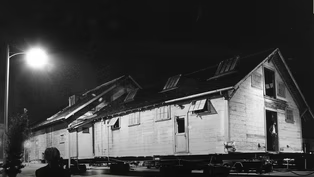
Before Soundstages: Hollywood’s First Feature Film Was Made Here
Video has Closed Captions
Clip: S9 Ep4 | 8m 36s | The barn where Hollywood’s first feature film was made. (8m 36s)
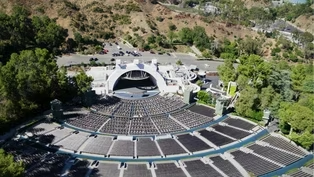
A Bowl, A Barn & A Tower: Birthplaces of the Entertainment Industry (Preview)
Preview: S9 Ep4 | 30s | From a barn to a bowl to a tower, the early history of Hollywood. (30s)
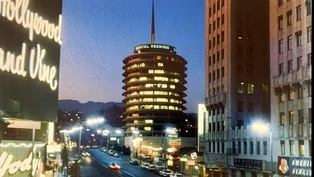
The Hollywood Landmark Where Music Legends Made History
Video has Closed Captions
Clip: S9 Ep4 | 9m 20s | Inside Capitol Records Tower, where music legends shaped Hollywood history. (9m 20s)
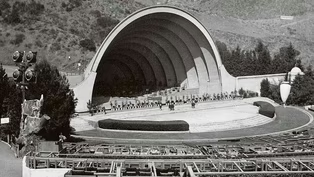
How a Canyon in the Hills Became the Hollywood Bowl
Video has Closed Captions
Clip: S9 Ep4 | 8m 36s | How a natural amphitheater in a Hollywood canyon became an iconic music venue. (8m 36s)
Providing Support for PBS.org
Learn Moreabout PBS online sponsorship












Support for PBS provided by:
Lost LA is a local public television program presented by PBS SoCal