
A Century of Gridiron Glory and More
Season 15 Episode 3 | 26m 7sVideo has Closed Captions
This episode explores the origins of Nebraska's college football cathedral and more.
This episode explores the origins of Nebraska's college football cathedral, the Nebraska Hand Cornhusking Contest, a Yazidi refugee finds hope in the Nebraska soil, the sweet origin story of Nebraska's official soft drink, Kool-Aid. Lincoln is home to a college football cathedral. For one hundred years, Memorial Stadium has been the heart of Husker football.
Problems playing video? | Closed Captioning Feedback
Problems playing video? | Closed Captioning Feedback
Nebraska Stories is a local public television program presented by Nebraska Public Media
A Century of Gridiron Glory and More
Season 15 Episode 3 | 26m 7sVideo has Closed Captions
This episode explores the origins of Nebraska's college football cathedral, the Nebraska Hand Cornhusking Contest, a Yazidi refugee finds hope in the Nebraska soil, the sweet origin story of Nebraska's official soft drink, Kool-Aid. Lincoln is home to a college football cathedral. For one hundred years, Memorial Stadium has been the heart of Husker football.
Problems playing video? | Closed Captioning Feedback
How to Watch Nebraska Stories
Nebraska Stories is available to stream on pbs.org and the free PBS App, available on iPhone, Apple TV, Android TV, Android smartphones, Amazon Fire TV, Amazon Fire Tablet, Roku, Samsung Smart TV, and Vizio.
Do you have a Nebraska Story?
Do you have a story that you think should be told on Nebraska Stories? Send an email with your story idea, your name, your city and an email address and/or phone number to nebraskastories@nebraskapublicmedia.org. Or, click the link below and submit your information on nebraskastories.org.Providing Support for PBS.org
Learn Moreabout PBS online sponsorship(light music) (upbeat music) -[Narrator] Coming up on Nebraska Stories.
Building UNL's football cathedral.
(upbeat music) The sport of old school cornhusking.
(upbeat music) A Yazidi refugee finds food for his soul in the Nebraska dirt.
And a toast to Kool-Aid, oh yeah.
(rock music) (rock music) (rock music) (rock music) (rock music) (light music) - [Narrator] In Lincoln, Nebraska, the skyline is home to a college football cathedral.
(light music) For 100 years, Memorial Stadium has become a place that has bound the state together.
(light music) The origins of this Nebraska landmark can be traced to a post World War I America (light music) eager to honor those who gave the ultimate sacrifice.
(light music) - [Kay] There was a national movement after World War I to build memorial structures.
There were, you know, 20 or 30 schools in the process of building a memorial building.
(light music) It was a movement that kind of swept through academia from coast to coast.
(soft upbeat music) - [Mary] They had really big plans for this building, right?
And it was gonna have the memorial, and that would be a rotunda area, colonnades, (light music) there would be a museum that you could put artifacts from the different war periods.
'cause they'd started to think beyond just World War I.
They were gonna have the, of course, the football field, indoor track.
(light music) So it really became this giant thing.
(light music) - [Narrator] Despite the initial designs and plans, in 1923, work began on just an east and west grandstand that would make up Memorial Stadium.
- It's very labor intensive to build a poured in place concrete building, which is exactly what the original memorial Stadium is.
(soft upbeat music) It's the core of the stadium on the east and the west side.
(soft upbeat music) - [Mike] The construction company had 89 days to complete the project.
They lost 31 days to weather, it was an issue.
So it went up pretty fast.
(soft upbeat music) - [Bob] The design of the building is interesting in that it's very typical of its era.
The late 19th and early 20th century saw architects and architecture in this country, not exclusively but heavily based in what is known today as a neoclassical architecture.
(birds chirping) And here's where the capital and the stadium share some talent.
And the Capitol was started under construction a good year before Memorial Stadium was begun.
And that was enough time to bring in a man from the university, a PhD philosopher, and head of that department at the university in the 1920s by the name of Dr. Hartley Bur Alexander.
(soft upbeat music) He was brought into the team and provided all the inscription, some in painted murals, some carved in stone.
He provided images of what the subject matter was to be in carvings on the outside of the building.
He organized the entire thematic scheme, both on the exterior and the interior of the capitol.
He was asked by the university, "You know, you're doing this for the capitol, how about providing some work for us at the stadium?"
Which he was glad to do.
(soft upbeat music) There are four corner pavilions and the two inscriptions on the east side of the building, that face campus were dedicated as memorial statements to those who'd given their lives in service to the state and nation.
(soft upbeat music) "In commemoration of the men of Nebraska who served and fell in the nation's wars, (soft upbeat music) their lives, they held their country's trust.
(soft upbeat music) They kept its faith, they died it's heroes."
(soft upbeat music) Since this facility was to be about sports as well, there were two inscriptions installed on the corner pavilions on the West stadium.
(soft upbeat music) "Not the victory, but the action, not the goal, but the game, in the deed the glory."
(soft upbeat music) "Courage, generosity, fairness, and honor, and these are the true awards of manly sport."
(soft upbeat music) Anyone can build a stadium.
What you put into it, what you say you stand for, (soft upbeat music) is more a statement of who you are as a people.
I mean, he darn well knew that.
(soft upbeat music) And so, he chose statements on the face of the stadium.
If you take time to read them, (soft upbeat music) talk about the merit of the activities to go on inside the stadium.
Not the win loss record, but how you conduct yourself competing in those sports, representing our state.
(soft upbeat music) The stadium was essentially an east and a west stadium.
The east stadium that which faced campus was to be the main entrance.
(soft music) The real visual appearance of the stadium was oriented to the east as it should be, the campus where the students would enter.
And that's still to this day, the predominant student and faculty side of the stadium, the West stadium, more the general public.
(soft music) And so, the East Stadium and West were both clad with a facade.
(soft music) It had a whole series of arches along the exterior face of the building.
And at the very center of the east side was this semi dome, which was a semi-circular recess into the face of the stadium, with a half dome at the top of it.
(soft music) It had kind of coffers in it and bosses or flowers in the center of that dome.
So it had some real antecedents in Roman architecture.
(soft music) It was meant to be a very impressive, make no mistake about it, where the front entrance is kind of expression on that side of the building.
(soft music) - It was a really quick build, really.
'cause you're talking that, you know, they're groundbreaking in April of 1923, but they're playing games in October of 23.
But again, that's where you had, the field could be made available.
Certain sections of the stand could be available, but the entire stadium was not complete at that time.
(soft music) - [Kay] It still had wood frame holding the concrete.
It looked a little too fresh to be safe.
But I do think they tested it before they let people sit up there in the stands.
- And in fact, I think there's a note where Parsons Construction Company that was responsible for actually building the stadium, they just said, "If you're gonna be having fans in the stands in October or on these games, we're not gonna be responsible for any injuries."
(soft music) - [Kay] The first game happened in October 13th in 1923, and that was against Oklahoma.
(soft music) - Nebraska won that game fairly handily, I think 24 to nothing or something like that.
And the interesting thing about that was, that Nebraska wore blue jerseys that day because Oklahoma had only brought its red ones.
And rather than having both teams looking the same, Nebraska agreed to, "Oh, we'll do the blue jersey thing."
So that's the only time that Nebraska ever didn't wear red in a game.
- And then the next game on October 20th against Kansas and Jayhawks is when it was actually dedicated.
And at that time they said it was 30,000 fans could come into the stadium.
Now sometimes, depending on the archival record that you're looking at, you might see that read as 31,000.
And in fact, at one point I found a citation where there was actually 47,000 possible seats in the stands because the intention was that you could bring in bleachers in an emergency situation.
(soft music) - [Narrator] Nebraska had begun a new chapter on campus, and within the football program, (soft music) even though the stadium wasn't quite finished, the first games played inside, ushered in an era of winning football that only grew from there.
(soft music) (upbeat music) (upbeat music) -(cornstalks rustling) -(bangboard thumps) - [Narrator] It's a beautiful September Saturday in Nebraska, and these huskers are preparing to take to the field, but they won't be slinging pig skin at Memorial Stadium.
These fierce competitors are going old school in a battle of the bangboards at the annual Nebraska State Hand Cornhusking Contest.
- [Duane] Well, somebody said there's gonna be a corn pickin' contest today, and I thought I'd join the crowd.
- [Narrator] Today's crowd is a bit smaller than during the heyday of corn picking contests.
The 1936 National Championship in Ohio drew about 160,000 people.
At the time, it was considered the fastest-growing sport in the US.
Sherman Henriksen of rural Lincoln took home Nebraska's first national title, husking 38 bushels of corn in 1933.
(corn stalks rustling) -[Harrison] I'm a fairly competitive person, and something like this, it's not super difficult, but it's pretty fun.
Like, once you really get into it, it's a pretty fun sport, I guess.
(guitar music) (wagon clatters) - [Narrator] Before farming became mechanized, shucking corn by hand and pitching ears into horse-drawn wagons was how harvesting was done.
(guitar music) (bangboard thumps) - Whoa, whoa.
- [Duane] I grew up pickin' a load of corn with my dad every morning before school.
Oh, yes, I know what corn pickin' is.
(guitar music) (corn stalks rustling) You wanna keep your eyes on the ears of corn ahead of ya.
You never look at the wagon because your ears will tell you if the ear hits the bangboard.
(bangboard thumps) And the way you do it, you pick it.
You get it like this, (guitar music) and you don't throw it like this.
You flip it.
-(corn rustling) -(bangboard thumping) - [Paul] The big thing was 100 bushel a day.
"Boy, I'd like to get 100 bushel a day."
And I did it once, only once.
(guitar music) I was young.
But I think it might've been a little bit dark almost when I went out there and it was probably dark when I quit.
(guitar music) - [Narrator] Nebraska is one of nine states still holding cornhusking contests.
And it is a timed event.
Depending on the class a picker is in, they can husk anywhere from 10 to 30 minutes.
-- [Judge] Cut.
-Three, two, one, go!
-[Narrator] The person who picks the most weight of husk-free corn wins.
And there's quite a process involved in deciding the winner.
-(leaves rustling) -Nice.
-(bangboard thumps) -Whoo!
(corn rumbling) - [Patti] They empty the wagons into the big metal tubs.
They weigh the metal tubs.
(machinery running) And any gleanings that are in the bags they forgot to pick or they miss the wagon, those count against them also.
And so you take the gross weight and you minus the ounces of the husk and the minus the pounds of the ears, and that's what they have for the day.
(fiddles play "Star Spangled Banner") (violins play "Star Spangled Banner") - [Narrator] Gothenburg and Holdredge have hosted the contest in the past, but it's found a permanent home at the Stuhr Museum in Grand Island.
-[Announcer] The event is important, certainly for the competitors, and we are very grateful for the competitors that are here.
All of you should be very proud because right here where you stand in this state is how we taught the world how to feed itself.
(upbeat country music) - [Narrator] Taking on the State Hand Cornhusking Contest presented some unexpected challenges to the Stuhr Museum.
-[Chris] This event was in jeopardy of just falling off the face of the state, so to speak, and not being held.
We didn't have some of the resources that we needed.
So we partnered with several folks and they came in strong and we were able to do it.
-[Bryan] Some of our growers helped us with the ground prep to get it ready for planting.
The horse teams came in and broke all the sod and the prairie grass.
(chains jingling) I'd always loved farming and being around agriculture.
It's just a passion that I've always had.
And I felt like with the last name of Corn, I kind of had to do something in ag, so it was just a perfect fit.
(country music) -[Chris] We do living history at Stuhr Museum.
That's what we're known for.
And if this isn't living history, I don't know what is.
I mean, it's modern-day interpretation of something that's happened a hundred years ago.
(corn stalks rustling) From a historical perspective, I desperately wanted this to happen here.
(corn stalk rustling) - [Narrator] And happen, it did.
(upbeat country music) -[Brynn] I got first.
(clicking sounds) I think I got 18 ears, I think.
I think so.
(distant chatter) (corn rustling) -[Harrison] I picked 260 pounds of corn in 30 minutes.
And then I placed third out of three, but I was pretty close for second, so.
And they're both previous national champions.
So I felt like I did okay.
- [Duane] I was tardy once in 13 years and never absent, so.
(guitar music) I made sure I went to school so I didn't have to pick corn all day.
(companion laughs) -[Patti] Dwayne Frazier, he had a gross weight of 39 pounds.
He had 0.5 ounces of husks against him, and he had 3.2 pounds of ears against him.
- [Harrison] I think history is kind of a big part of our world.
(guitar music) Our generation is really straying away from the old techniques and manual labor.
And I think it's fun to look back and see how the older generations used to farm this land and make their money.
(guitar music) (guitar music) (soft music) [Narrator] At a weekly produce stand at a Lincoln Farmer's Market.
Shahab Bashar helps his customers find just the right fresh ingredients, green peppers and tomatoes or more specialized items like pickling peppers and shishitos.
[Narrator] Shahab helped grow this produce as part of a nonprofit called Community Crops designed to help people grow their own food.
[Narrator] Shahab also works part-time at Community Crops as the Yazidi cultural liaison.
-Yeah.
[Narrator] Providing interpreting and translation assistance including advice on how to get the most out of Nebraska soil, which differs from the sandier soil of his homeland in Northern Iraq.
[Narrator] Shahab is part of Lincoln's Yazidi refugee community.
A non-Muslim ethno-religious minority, many of whom like Shahab and his family, were forced to flee from Iraq after multiple genocides.
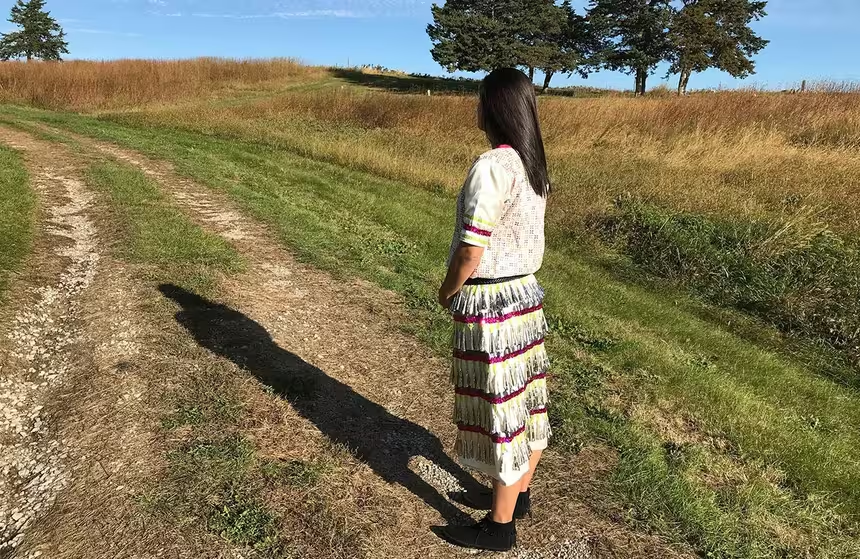
(soft music) Lincoln is home to some 3,000 Yazidis, the largest such community in the US.
[Narrator] Shahab's family served as translators with the US Army in Sinjar, Iraq before receiving visas to come to the US, joining Lincoln's growing Yazidi community in 2017.
(soft music) With the trauma of the genocide back home and the culture shock of their new home.
The family struggled to adjust.
(soft music) [Narrator] Part of the culture shock had to do with food.
[Shahab] [Narrator] That's when Shahab and Community Crops launched the effort to find the seeds to grow food that is culturally important to the Yazidi community.
[Shahab] [Narrator] When Shahab is attending rows, he's helping other immigrants and refugees navigate some of the same struggles he and his family faced.
[Shahab] At the Yazidi Cultural center, (soft music) (soft music) [Narrator] Friend and fellow Yazidi refugee.
Nawaf Haskan was also an interpreter for the US military.
(soft music) [Narrator] 6,000 miles from Sinjar.
Food is key to preserving cultural traditions in his own family.
(soft music) Both Nawaf and his wife Layla are skilled chefs cooking elaborate feasts from unwritten recipes passed out from one generation to the next.
(soft music) At their home in Lincoln, the camera eats first, so Nawaf can post images to his Instagram site, Yazidi Kitchen in America.
[Nawaf] [Narrator] Over aromatic plates of Dolma, lamb stuffed Kutelk dumplings, and pickled shishito peppers.
Nawaf and Shahab are not just planting seeds, they're planting a future in the US with their growing families.
[Nawaf] [Narrator] Shahab has his farm and the culinary traditions, it inspires, only strengthens the connection of his soul to the Nebraska soil.
[Shahab] [Narrator] Shahab likens his existence to that of a tree or plant part of the land here, ready to grow roots in his new home.
(soft music) (soft music) (guitar music) (guitar music) [Justin] In 1900, David Perkins opened a general store in the village of Henley.
It became a central hub in the community.
And helping David run the store was his 11-year-old son, Edwin.
Edwin was a curious kid who spent his spare time doing science experiments.
Eventually, Edwin began creating products to sell in the family store.
In 1918, he invented Nix-O-Tine, a remedy he declared cured tobacco habits.
Edwin targeted advertising for Nix-O-Tine toward veterans, and it turned into a great success.
The profit from sales allowed Edwin to move to Hastings, where he spent more time developing new products.
One was a fruit-flavored concentrated drink Edwin called 'Fruit Smack.'
It was an instant hit, not only in Nebraska but in neighboring states too.
But as the popularity of his new drink grew, Edwin was confronted with a big problem.
Fruit Smack was packaged in glass bottles that often broke during shipping.
He struggled to find a solution.
And then in 1926, Edwin attended a food manufacturing convention.
There he learned about a new food preservation method.
Inspired by jello, he invented a powdered formula for Fruit Smack and gave it a new name, Kool-Aid.
(cheerful guitar music) Within three years, Kool-Aid was distributed across the United States.
Edwin was also innovative when it came to advertising.
He packaged Kool-Aid in vibrant colors with images of children on the envelopes which appealed to young consumers.
He also displayed Kool-Aid in colorful, eye-catching boxes and called this method of selling "The silent salesman," although not everything was smooth sailing.
In the middle of Kool-Aid success, Perkins did have to change the spelling of his famous product in order to meet new regulations.
But that didn't stop the momentum that was built.
By 1939, Kool-Aid was rated as the seventh most popular soft drink in the country.
This allowed for the General Food Corporation to buy Perkins Product Company.
And that's when Kool-Aid popped.
Oh, yeah.
(funky music) (funky music) Kool-Aid became the center of pop culture.
(vintage Kool-Aid ad song playing) (vintage Kool-Aid ad song playing) (vintage Kool-Aid ad song playing) -From the 60s, -(upbeat music) the 70s, the 80s, the 90s, and the 2000s, (funky music) the Kool-Aid brand was on everything and anything you could could think of.
From hats and children's toys to shirts and even action figures.
Kool-Aid even branches out to different food products such as ice cream and even cakes.
(funky music) Everyone across the country knew what Kool-Aid was and couldn't get enough of it.
(funky music) Nearly 100 years later, Kool-Aid remains a well-known brand available worldwide.
(upbeat music) (upbeat music) (upbeat music) - [Narrator] Watch more Nebraska stories on our website, Facebook and YouTube.
(upbeat music) Nebraska Stories is funded in part by the Margaret and Martha Thomas Foundation.
(upbeat music) (upbeat music) (upbeat music) (upbeat music) (upbeat music)
Video has Closed Captions
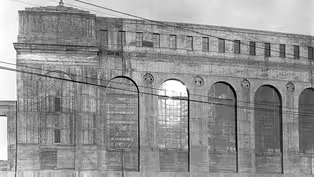
Clip: S15 Ep3 | 8m 36s | The creation of a Nebraska icon, Nebraska's Memorial Stadium. (8m 36s)
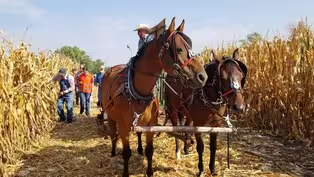
Cornhusking, Harvesting Heritage
Video has Closed Captions
Clip: S15 Ep3 | 6m 35s | Watch cornhusking the old-school way. (6m 35s)
Providing Support for PBS.org
Learn Moreabout PBS online sponsorship















Support for PBS provided by:
Nebraska Stories is a local public television program presented by Nebraska Public Media