A Clearer Future | Carolina Impact
Clip: Season 14 Episode 1405 | 6m 4sVideo has Closed Captions
Central Piedmont students learn to capture medical images and care for the people in them.
The new radiography program at Central Piedmont Community College is bringing healthcare careers into focus. Inside the classroom and a lab equipped with a $200,000 machine, students learn to capture medical images and care for patients who may be scared or hurting. As the college responds to workforce needs, a professor and two students show why the human touch still matters in a high tech field.
Problems playing video? | Closed Captioning Feedback
Problems playing video? | Closed Captioning Feedback
Carolina Impact is a local public television program presented by PBS Charlotte
A Clearer Future | Carolina Impact
Clip: Season 14 Episode 1405 | 6m 4sVideo has Closed Captions
The new radiography program at Central Piedmont Community College is bringing healthcare careers into focus. Inside the classroom and a lab equipped with a $200,000 machine, students learn to capture medical images and care for patients who may be scared or hurting. As the college responds to workforce needs, a professor and two students show why the human touch still matters in a high tech field.
Problems playing video? | Closed Captioning Feedback
Where to Watch Carolina Impact
Carolina Impact is available to stream on pbs.org and the PBS app.
Introducing PBS Charlotte Passport
Now you can stream more of your favorite PBS shows including Masterpiece, NOVA, Nature, Great British Baking Show and many more — online and in the PBS Video app.Providing Support for PBS.org
Learn Moreabout PBS online sponsorshipA century of service leaves quite a legacy, next, a new in-demand program trains the next generation of healthcare professionals.
When you need an X-ray, you'll probably think about what that image might reveal, not everything required to capture it.
Central Piedmont Community College recently launched a radiography program that trains students while local healthcare employers seek more skilled professionals in that area.
"Carolina Impact's" Chris Clark shows us how students master the equipment while developing skills that extend beyond the classroom.
- Everybody was super hesitant, especially me, I was like, "I do not wanna touch this at the moment."
- [Chris] David had worked construction, then spent a year and a half studying architecture.
His mother, who worked in a hospital, suggested he consider something else.
- I was thinking about how could I interact with people more, be in the daily lives of people?
- [Chris] That brought him to Central Piedmont's new radiography program.
Here, the person on the table is a classmate, and he's preparing for the day that it's a patient.
- That's right about there.
- [Chris] For the college, it all started with a request.
- Our industry partners reached out to us because there's a severe shortage in healthcare.
- [Chris] Radiologic technologists produce the images doctors use to diagnose injuries and illness.
- So Central Piedmont just stepped forward and said, "Okay, what do you need?"
- [Chris] The result is a two-year associate degree built around classroom instruction, lab practice and supervised clinical training.
- So she's almost kind of, like, putting this pressure on her ribs because she's like, "No, no, no, my..." 'Cause now she knows what we're doing.
- [Chris] Starting the program and outfitting a lab with new equipment, David still remembers being told what one of these machines costs.
- This is a $200,000 machine, and I was just like, "Whoa, this is a house right here."
Like, "We gotta be careful around this thing."
But I was really impressed with the kind of equipment that they had there, knowing that it was all brand new because they just installed it all.
14 by 17.
- [Chris] But it's here for him to use.
(tray clattering) - It makes me feel like I actually have something to work with here, you know?
- [Chris] Learning to operate, it starts with anatomy, radiation protection and patient care, then students put those lessons to work.
- So now what do we have her do?
What is...?
What are my...?
What's my technique?
- The lab is supervised by our faculty that are experts from the field, and a lot of them are still practicing in the hospitals.
- [Chris] For Virginia Phannareth, even the smallest adjustment has a purpose.
- We don't have X-ray vision, we can't, you know, see inside of people, but it's almost like we have to pretend we do to make sure that we're not obscuring any sort of anatomy, because in real life, someone is looking at these images and making a real life diagnosis.
- [Chris] She checks the patient's position, making sure the anatomy will be clearly shown.
- I look at it from standing it up upright, now, I'm gonna be able to see how much water's in, right?
- [Chris] The college's simulation center adds another layer of practice using life-like mannequins.
- Our simulation center uses multiple scenarios to be able to walk the students through that experience, so it gives them an opportunity to fail and fail safely.
- [Chris] The instructors help students think through what they could do differently next time.
- The shadow that's being projected is projecting the anatomy.
- [Chris] Students must demonstrate their skills in the lab, clinical rotations then take their training beyond campus.
- But once they get out there and start dealing with real patients, that's different.
- [Chris] Experienced professionals supervise them, and for David, it's also a chance to start building relationships.
- You get to deal with a lot of hospitals in your clinical times, and that kind of lets you build the connections that you have.
- [Chris] Completing the degree prepares students to take their national certification exam.
- In this case, we have given the patient contrast, and that's why it's so white.
- [Chris] Virginia first explored healthcare careers at Butler High School.
She didn't see medical school as her route into the field though.
- But I did want something that would be financially stable as well as something that I would really be interested in.
- [Chris] Central Piedmont estimates starting salaries in the Charlotte region at roughly $53,000 to $71,000 a year, and its continuing education courses give working technologists a way to train in CT, MRI, and mammography.
Dr.
Moran says the college is also preparing students to work alongside artificial intelligence.
- They're great out right now, but if we were to take an exposure, what are all of these called?
- The AI is just simply a tool that we're going to work alongside with to help with the diagnosis for the patients.
People ask a lot, "Is that going to be one of those jobs that disappears with AI?"
Absolutely not, there's no way.
- [Chris] She points to what these students are practicing, positioning patients, protecting their safety and thinking through what each person needs.
- The human-centered patient care is always gonna be there.
- [Chris] In a hospital, even asking someone to move can be complicated.
- You're gonna have patients that are gonna come in with all types of conditions, whether it be something that's a physical condition, it could be a fear, any type of thing, so motion is very important.
- [Chris] They may be hurting, unable to move comfortably or difficult to work with.
- Radiography is actually a unique blend of science, technology and patient-centered care, so that individual has to be not only technically good, but they also have to be able to be a compassionate person.
- [Chris] Virginia's worked in restaurants and she's learning how to bring that experience into healthcare.
- Some people, they can be a little frustrating, so when it comes to dealing with people's bedside manner or things like that, really it's just, like, don't take it personally, like, they're not mad at you, they're either in pain or they have something going on, it's really easy to make it personal, I feel like my big thing is just don't make it personal.
- [Chris] David is finding his footing too.
- Nowadays, I just go confidently straight into it, move the equipment around, I know exactly where it needs to go.
I deal with a lot of tools, this is just another tool that I can use.
- [Chris] Central Piedmont is preparing this class for people they haven't met yet, and Virginia already knows how she hopes those patients will remember her.
- I hope they would remember that I was nice to them, that I made them laugh, that I made their experience comfortable.
- [Chris] For "Carolina Impact," I'm Chris Clark.
 New
NewA Century of Service: The Story of Lake Norman Regional | Carolina Impact
Video has Closed Captions
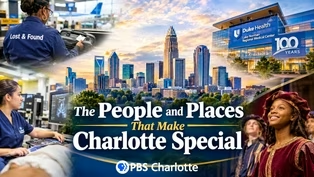
Clip: S14 Ep1405 | 7m 6s | Duke Health / Lake Norman regional medical center celebrates it's 100th Anniversary. (7m 6s)
 New
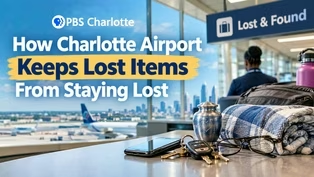
NewHow Charlotte Airport Keeps Lost Items From Staying Lost | Carolina Impact
Video has Closed Captions
Clip: S14 Ep1405 | 6m 7s | Meet Charlotte Airport's Lost & Found, ranked #3 among the nation’s 20 busiest airports. (6m 7s)
 New
NewMore Than Shakespeare | Carolina Impact
Video has Closed Captions
Clip: S14 Ep1405 | 6m | Shakespeare helps young actors find confidence, community and a place to belong. (6m)
 New
NewOctober 6th, 2026 Preview | Carolina Impact
Video has Closed Captions
Preview: S14 Ep1405 | 30s | CLT Airport Lost & Found; Duke LKN: A Century of Healing; A Clearer Future; & More Than Shakespeare (30s)
Providing Support for PBS.org
Learn Moreabout PBS online sponsorship New Episode
- News and Public Affairs

Top journalists deliver compelling original analysis of the hour's headlines.
 New Episode
- News and Public Affairs

Today's top journalists discuss Washington's current political events and public affairs.
 New Season
 New Episode
 New Episode
 New Episode
 New Episode



 New Episode
 New Episode
Support for PBS provided by:
Carolina Impact is a local public television program presented by PBS Charlotte