
A conversation with Bruce Campbell and a look at independent movie theaters
Season 10 Episode 52 | 26m 46sVideo has Closed Captions
Bruce Campbell’s new film and how movie theaters have found new ways to stay open.
We’ll talk to actor and filmmaker Bruce Campbell about his new film “Ernie & Emma.” The Michigan native screened it at the Redford Theatre in Detroit earlier this month.
Problems playing video? | Closed Captioning Feedback
Problems playing video? | Closed Captioning Feedback
One Detroit is a local public television program presented by Detroit PBS
A conversation with Bruce Campbell and a look at independent movie theaters
Season 10 Episode 52 | 26m 46sVideo has Closed Captions
We’ll talk to actor and filmmaker Bruce Campbell about his new film “Ernie & Emma.” The Michigan native screened it at the Redford Theatre in Detroit earlier this month.
Problems playing video? | Closed Captioning Feedback
Where to Watch One Detroit
One Detroit is available to stream on pbs.org and the PBS app.
Providing Support for PBS.org
Learn Moreabout PBS online sponsorship- Coming up on "One Detroit", we'll talk with Michigan born actor and filmmaker Bruce Campbell about his new independent film, "Ernie and Emma."
Plus, we'll examine how some local independent movie theaters are managing to survive while many others have closed.
It's all coming up next on "One Detroit".
- [Voiceover] Across our MASCO family of companies, our goal is to deliver better living possibilities and make positive changes in the neighborhoods where we live, work, and do business.
MASCO.
A Michigan company since 1929.
Support also provided by the Cynthia & Edsel Ford Fund for journalism at Detroit PBS.
- [Narrator] The DTE Foundation is a proud sponsor of Detroit PBS.
Through our giving, we are committed to meeting the needs of the communities we serve statewide to help ensure a bright and thriving future for all.
Learn more at dtefoundation.com.
- [Voiceover] Nissan Foundation.
And viewers like you.
(soft music) - Hello, I'm Zosette Guir and this is "One Detroit".
Actor and filmmaker.
Bruce Campbell is a metro Detroit native, who's well known for his independent horror film, "The Evil Dead."
He and director Sam Raimi made the cult classic with a group of Michigan friends in 1981.
Campbell returned to Michigan recently for a screening of his newest indie film, "Ernie and Emma" at the Redford Theater, where the Evil Dead premiered one.
"One Detroit's" Chris Jordan caught up with Campbell to talk about the new movie.
(soft music) - [Chris] So just tell me a bit about the film and about this homecoming for it.
- Well, the Redford, of course, is the mother theater for us.
It is still one of the great remaining monoliths of motion picture history.
Almost a hundred years old now.
We must support these places because they will tear them down.
You know, it was old when we premiered "The Evil Dead" in '81.
You know what I mean?
So that's how old this place is.
Nothing has changed.
Volunteers have done an amazing job.
That was the key importance to go back to the Redford with a movie that frankly is off the grid.
No studios we're allowed to interfere or intervene.
And I'll tell you, it's really fun to do a movie with no notes.
And I say that flippantly, but it's everything to me because as an artistic person, the only reason you have to listen to Paramount's notes is because they put up the money, even if it's kind of a lousy note.
But that's the weird relationship the arts and commerce have.
You know, it was a good chance now finally, my wife and I, we put up the money.
We're like, let's do an age appropriate movie that it's sort of like it's hallmark with drugs, alcohol, swearing, and infidelity.
- [Emma] My final wish is for you to spread my ashes.
The letters will guide you to each place.
Basically, I want one last hurrah with you.
- You went too soon.
- [Emma] This might be a good way to finally spend some quality time together and maybe even resolve a few issues along the way.
- You know, it's funny, Emma made me promise her that I wouldn't punch you in the face.
- Now what's funny about that?
- She's dead.
She'll never know.
It's the story of Ernie Tyler.
He is the Rogue Valley's number one pear salesman three years in a row.
He's the pear guy.
It's on his license.
And you know, he is a rear view mirror guy.
He drives a 20-year-old car.
'cause that's kind of when things were hopping in his little valley.
And his wife dies and he is one of these guys who is probably one of the least prepared humans to have a spouse leave.
So drop a bomb on a guy who doesn't like bombs dropped on him, and just see what happens.
See if he makes it through.
See if he crawls from the wreckage.
- The people who've been following your career know you for horror and slapstick comedy.
There's a bit of a physical comedy in there too, but it's a very different sorta film for you or really see a different side of you as an actor.
And I'm curious how you came to this project and this story?
- It's a pivot.
I'll admit that.
You know, a lot of it was just yearning for a good part.
It's all an actor ever wants.
I tell writers, man, you wanna get an actor, write a big fat juicy part.
The monologues, the speeches, the single tear, you know, the highs, the lows.
I would've jumped all over the script like a cheap suit because, you know, a lot of what I'll get these days, and any actor gets, you get a script where the lines could be interchangeable.
And they're hospital procedures, police procedurals.
That doesn't get me excited.
You know what I mean?
And shotguns and boomsticks and quippy one-liners and fake blood doesn't get me excited anymore either.
You know, I've sort of hung it up 'cause I'm just, I'm too old for that.
It really is that simple.
And now where's my brain?
I want to do stuff that tells a story of loss and heartache and renewal.
Because when I was 21 doing Evil Dead, I hadn't experienced that much of life now.
Now that I'm 68, yeah, now some has happen.
I've been married for 35 years.
So if you're married that long, not every one of those years is gonna be, you know, of one for the ages.
You might have some real stinkers in there.
And I have.
And so why not write about it?
Because everybody, you know, I was almost gonna start my Q&A this way saying, raise your hand in the audience if you've lost a loved one.
You know, everybody has.
So it's a story hopefully people can relate to.
You know, and you wanna take a character on the journey.
Ernie, hopefully is a better man by the end of the movie.
So I like journeys.
Look, I like redemption because I do want the audience to root for Ernie, you know, he can be an idiot, but he's the idiot you got.
- You and your wife made this one completely outside Hollywood, outside studios.
Probably the most independent thing you've done since the original "Evil Dead."
What inspired you to like totally break off from the system like that and how was that experience?
- It's the only way to be a free little bird that flies around, you know?
It was a glorious experience that I will never go back.
And I'll be honest with you, because I'm an adult, I'm a professional.
I've done my 10,000 hours, I've laid a lot of bricks.
I know how to do this.
Most people in the film business now are 25 years old, and God bless every single one of them.
But I don't wanna be in the learning world of a director or a writer.
Part of the beauty is, over the years, you know when to tap out.
You know when to go, that's not gonna work.
So what we tried to do is the movie takes place in Oregon.
It did not originally, it was Detroit.
My dad was a Detroit madman, '50s, '60s, '70s for you know, MacManus, John and Adams.
Campbell Ewald, my dad would introduce himself, "Hi, Chuck Campbell," Campbell Ewald, even though he had no relation to the guy who ran the company, but he had fun with that.
But my wife said, Hey buddy boy, we're putting up the money for this.
Wouldn't you like to sleep in your own bed?
And it really hit me.
I was like, I've never slept in my own bed in the last 25 years.
So I went, you know, you could, you could.
So he's just a sales guy and our area is the home of Harry and David, and it's on the arches.
You see a lot of these fellow pear orchards everywhere.
But I've been watching the pear industry die like I watched the auto industry die in Detroit.
I find it very poignant and very just, I mean, they used to do pears in our valley for decades and decades.
And now it's a lot of wine.
They just put wine in.
I think they can make more money.
So those things really resonated with me.
The other thing that we did was, let's shoot when you should really shoot this movie.
Not in January and not in Bulgaria.
I've done a lot of things in places that just should have never been in that place at that time, because it's for the convenience of the people, again, who are putting up the money.
You want to air it on TV at this time, you gotta make it at this time.
You don't care if it's good for the movie or not.
So we shot in June.
I mean we caught the Applegate Reservoir, one of these beautiful reservoirs near us.
I mean, 95% full.
You look at the thing, you go, wow, what is that?
And the air is clear.
There's no wildfire smoke.
The grass is green, the valley's, everything is just lovely.
So, you know, that's the stuff you can do when you're running the show.
And as a result, the movie looks exactly how it should look.
- While you wound up changing the setting from Detroit to Oregon, there's obviously still some little Detroit references peppered in there.
And of course, a lot of your, you know, collaborators on it are longtime collaborators going back to "Evil Dead."
I saw on the credits that Joe LoDuca score was recorded in Ferndale here.
- You know, when I knew this was happening, I blew the "Evil Dead" dog whistle.
I really did.
I mean, Kurt Roff who shot the movie, was a crew member on "Evil Dead."
You know, Mike Ditz, who photographed the poster for the movie was our set photographer.
You know, I mean, and what that does, that gives you familiarity.
When I worked with Joe LoDuca we watched the movie together, we don't have to beat it to death.
Joe goes, yeah, I get it.
I know what you need.
It was a great chance to surround myself.
Kaye Davis, she edited the movie.
She cut "Evil Dead" too.
But so they have the same skills, you're just telling 'em to light a human, not a monster.
You can, I want filmmakers to know it's easier now than it was.
The equipment's smaller, it's cheaper.
The lights are about this big now.
A little little microphone you can clip on your shirt, editing software, music software.
I wanna encourage filmmakers from Michigan, Detroit, Indiana, all the parts where they think they don't make movies here.
I can't do it here.
Yeah, you can.
Yeah, you can.
Get a couple of buddies together, pool your resources, make a movie.
Doesn't have to be a horror movie.
Whatever you want.
I want filmmakers to feel empowered.
People go, well, you're Bruce Campbell, you could just make a phone call.
Well, took a while to get to the point where I could do that, but I'm doing the same thing that I'm asking you to do.
Just get a bunch of friends together and make a movie.
- Southeast Michigan has been home to several independent movie theaters over the years.
Although some of these movie houses have closed their doors, others have managed to remain open by finding new ways to bring in revenue and attract audiences.
"One Detroit's" Bill Kubota and Chris Jordan visited some of these historic theaters to find out what it takes for them to survive.
- [Chris] On Detroit's east side, the nonprofit Friends of the Alger Theater has worked to save their idle movie house for decades, which serves as a community billboard.
- We put on our marquee messages weekly.
And we make enough money from that to pay our water bill and our electric bill.
- [Chris] Alger friend Jackie Grant says this movie house formally showed its last feature film nearly 40 years ago.
She found proof up in the projection booth.
- "Friday the 13th part 5" in 1985.
It's right there.
- [Chris] They didn't come back to get the real, huh?
- Apparently not.
- [Chris] The Alger opened in 1935.
In more recent years, the plan, create a community center and maybe show some movies again, but not likely with these projectors.
- We are in my favorite place.
This is the lobby of the Alger Theater.
I know you're thinking it's just a mess, but that's changing as we speak - [Chris] Overhead, the lobby's getting a new roof, but there's so much more work to do.
Meanwhile, on Detroit's northwest side, the Redford, one of the few independent movie theaters in southeast Michigan is also owned by a nonprofit and has been since the late 1970s.
Here I'm meeting film writer and theater volunteer John Monaghan.
- The fight always seems to be like, how do you get people to come to a theater instead of staying at home and watching Netflix?
- That's been a challenge, you know, about what to show.
And certainly our content has changed quite a bit in the last 20 years as our audiences kind of aged out.
- Thank you.
- [John] Nobody is paid at the Redford Theater.
We're all volunteers.
It is a good business model.
The nonprofit business model is very good for a theater like ours 'cause it's hard to make money in the theater business.
So it takes a lot of pressure off certainly when you don't have a big payroll.
We really do try to create an experience here as much as we can going to the movies like you would've in the 1940s or '50s.
And part of that for a lot of us is the ability to show actual film on film, which we do quite regularly on our old late 1950s Norelco projectors that project both 70 millimeter and 35 millimeter with carbon rods that make a spark between them like they would've used back in the day.
- Is finding the carbon rods and sourcing those like a problem itself.
- That's a whole other element.
Yeah.
Yeah.
There's only a finite amount of those around and we're always trying to find somebody who's got a stash of them.
And sometimes when we do find the carbon rods, they're not exactly the right size.
So I've been stockpiling some of those for trades.
You know, maybe we'll find somebody who needs those and has the ones we need.
And of course, the film prints too are not being newly struck the way they were.
So we're working with antique film prints too, many of which are found through local collectors who have been very generous in letting us use their prints.
- [Announcer] This is Radio KSIK.
You've been listening to Music for Old Invalids.
- [John] But there's nothing like seeing, like recently "American Graffiti" for instance, we had a technicolor print of that, which looked just stunning.
Upcoming we're showing "Clockwork Orange" on film.
Heck, we even have a print of "Home Alone" that we're showing a 35 print of.
And we of course, we don't just show 35 millimeter.
We have state of the art a digital projection, which looks quite good.
As much of a purist as I am on film, we have really, really nice digital projection here too.
- [Chris] When you enter the Redford, you'll encounter some ways it raises money to keep running.
- Often people will come over here to the counter where Larry, the T-shirt guy design shirts for the different programs.
We have a 50/50 raffle counter over here where folks walk away with maybe a hundred dollars in cash prizes.
Over here is the wall where kind of paying tribute to the famous folks that have been through the theater.
Probably most famously, you know, Bruce Campbell from "The Evil Dead."
He was here.
- And one of the reasons why this theater is iconic to a lot of horror fans is of course where "The Evil Dead" premiered.
- [John] Yeah, we're really proud of that.
The fact that both the first two "Evil Dead's" and the short film that you know, was that they got seed money to make the feature with also premiered here.
- Right there.
- [John] And we're also really proud that the more recent horror classic it follows, you know, has its opening sequence that was filmed right here in the theater too.
And we're showing that this year for its 10th anniversary.
- [Chris] At the Redford, more sites to behold, not just on the screen.
The decor considered exotic back in the day, adorns many walls throughout.
- [John] That Asian motif that it was designed with originally in the '20s became out of fashion during World War II.
And the entire theater was painted a battleship gray.
And it really wasn't until the Motor City Theater Oregon Society purchased the theater in 1977 that that restoration began.
And it's ongoing.
- [Chris] The Bartola Instrument Company built the organ that has been here since the theater opened.
It remains virtually unchanged today.
- [John] But as you can see, it's back, it's back to its original grandeur.
There's not a bad seat in this house and it's pretty large screen.
Some people like to sit right here at the edge.
It's a nice vantage point.
- What do you hear from other people who run independent theaters in the state?
Do you talk much with other theater owners?
- That's a good question.
I have great interest in the other theaters that are doing similar to what we're doing.
Certainly the Detroit Film Theater, which is still just so wonderful.
And the Michigan Theater in Ann Arbor and the Penn Theater and what they're doing, which is also, you know, on that volunteer model.
That's a huge success story, the way they were able to save that neighborhood theater and keep that going.
- [Chris] Then there's the Senate Theater in southwest Detroit, also built in the 1920s and still operating.
- That's another organ society that actually runs the Senate.
Believe it or not, there's two organ societies in our city.
- When you're hearing those stories of other theaters and what they're doing, how many are continuing to make a go of it as a for-profit and how many are kind of embracing the nonprofit model?
- Yeah, the nonprofit model seems to be pretty predominant.
I mean, look at the profit model certainly didn't work for the Main Art theater or the Maple Theater, which, you know, both of those are gone which is really sad.
Something's gotta take the place of those venues because we don't in Detroit right now, have a proper art house that's showing the modern stuff, and that's gotta happen too.
- [Chris] The Howell Theater in Livingston County, another old movie house.
A couple of decades ago it was split into two screens.
The lobby was a diner for a while.
It became the Historic Howell Theater when Toledo native Tyler DePerro bought it 10 years ago.
Tell me a bit about the history of the theater.
You said it's 96 years old?
- Yeah, it'll be turning 96 December 11th of this year.
So it was built in 1827.
It opened December 11th, 1828.
It was the first talkie theater of Livingston County.
The first movie that played to was called "Show People" directed by King Vidor.
- [Chris] It wasn't silent, but no audible dialogue.
This one featured technology called synchronized sound.
So there was music that came in on queue.
- Back then.
It was just one screen and they had actually like vaudeville acts that would play, that would like go on before the movie started.
- Were you scared or apprehensive buying like a small town independent movie theater in 2014?
- Yeah, I mean, totally a big risk.
I moved to Howell, moved to Michigan for the theater.
I mean, I had done this research like making a list of like what makes a good downtown.
If that's local shops, walkable downtown, different activities throughout the year.
Having people in the community wanting this movie theater space to reopen.
There isn't like a how to operate a movie theater guidebook and like there isn't a website where you can go and find that out.
And like hiring employees and running the Kickstarter campaign to raise money for the projectors.
There are people that certainly come into the theater that are like, man, like I wish I had your job.
Like it's the dream job of like operating a theater and you have to love it.
Like it's all the time, it's all day, it's all night.
You take it home with you.
People come in, like they went on their first date here, they met their wife here.
Talk about the nostalgic memories of it, that kind of appreciation and like connection with like a downtown movie theater.
It's like over like a chain where like there's not really that nostalgia for like a big theater chain.
This is theater two.
- [Chris] DePerro is finding ways to better engage the community, find revenue streams by hosting weddings and other things.
- We've had concerts, improv comedy, we have church here every Sunday.
The stage I'd put in in 2014, but the original stage that was here like in 1928, that's actually behind the screen here.
Those vaudeville acts had performed on when the theater first opened.
You can tap dance a little bit or do a little dance or something.
- I don't think I'll do either of those things.
DePerro has made other smaller additions to the historic Howell.
Some it seems just for people like him.
- This red light's kind of like the movie magic, like we're going up to where the projectors are at.
Like all the magic happens.
This is kind of, yeah, this is kind like the Willy Wonka terror tariff tunnel of it all.
- [Chris] Upstairs, more remnants of the past.
Some original art deco seats, an idle 35 millimeter projector along with more modern technology to take its place.
- The movies come on a hard drive like this.
The DCP, Digital Cinema Package.
This is for "Lost Boy."
It's not like film where it's on a film reel, but it's on a drive like that.
- Wow, that's 173 gigabytes for "The Lost Boys."
- Here's our vintage marquee letters.
They actually stopped making these letters, so they're very vintage.
- [Chris] Oh wow.
- [Tyler] Put those up by hand on a rod outside, the pincher claw.
You could see like the sides, there's little hooks on there.
So when they hook onto the slotted slots on side of the marquee.
- [Chris] How old are these?
Did these come with the theater?
- [Tyler] Yeah, some of these came with the theater and then some I did buy additional letters, but over the last couple years they actually stopped making, producing these letters altogether.
So we have to like tape the backs or glue them when they break.
- DePerro is getting by in this for-profit enterprise by building a following.
Howell has become a destination for independent moviegoers from places like Lansing, Ann Arbor and Detroit.
- On social media they'll put out like a list of all the cities that's opening and it's like, you know, like New York, LA, Powell, Michigan, why is it playing there?
Like why are they the only theater that's showing this movie?
And then they come out and they discover us and they love the space and who else would be showing this movie other than us?
- Yeah, well I mean that's definitely how I discovered you guys is when you were the only theater in Michigan showing "The Babadook" at first.
- Ba ba-ba dook, dook, dook.
- [Tyler] Yeah, yeah, like The Babadook like after the movie was done, like when audiences kind of come out and they just talk to like other people in the theater about the movie.
Like that's kind of the other rewarding thing about it, it's like when I see a movie at like a chain theater, it's like, go in, see the movie and you leave.
And there's not really any connection or appreciation or discussion after.
- [Chris] While the Historic Howell Theater has its community of film enthusiasts, Detroit's historic Alger Theater engages its community, but that has little to do with the movies.
- [Jackie] Right now we are doing HOPE applications with the city for property tax exemption.
We are the leaders in HOPE applications for all the community partners around the city.
So we're doing that good work and we've been doing it for a number of years here.
- [Chris] Here, the coming attraction, an overlook along East Warren Avenue.
- We are on the upper deck of Alger Theater, a great outdoor space that we'll be using for events very shortly.
We haven't used it much because we haven't had a bathroom for about 30 years, but that's changing as we speak.
We've probably put right now into this building, which the public doesn't really know close to half a million dollars.
It doesn't show because you don't see plumbing outside, you don't see electrical, you don't see taking asbestos out.
Those are not the sexy items in any of this.
- [Chris] More money needed.
A few million dollars, Grant said to keep restoring a place to serve the morning side, East English Village and Cornerstone Village Neighborhoods.
Volunteers here, like the Redford on the other side of town, just trying to hold onto their historic structures by bringing people together.
- Film especially is a real like a social art.
I think it's sad that people are watching "Casablanca" on their phones.
I think to see it in an auditorium, there's nothing like it.
- Oh, you must be kidding.
- So the event kind of is its own reward.
(suspenseful music) - And since producing this report, the Alger Theater in Detroit has undergone several improvements.
That'll do it for this week's show.
Thank you for watching.
Head to the "One Detroit" website for all the stories we're working on.
Follow us on social media and sign up for our newsletter.
(upbeat music) - [Voiceover] Across our MASCO family of companies, our goal is to deliver better living possibilities and make positive changes in the neighborhoods where we live, work, and do business.
MASCO.
A Michigan company since 1929.
Support also provided by the Cynthia & Edsel Ford Fund for Journalism at Detroit PBS.
- [Narrator] The DTE Foundation is a proud sponsor of Detroit PBS.
Through our giving, we are committed to meeting the needs of the communities we serve statewide to help ensure a bright and thriving future for all.
Learn more at dtefoundation.com.
- [Voiceover] Nissan Foundation.
And viewers like you.
(upbeat music)
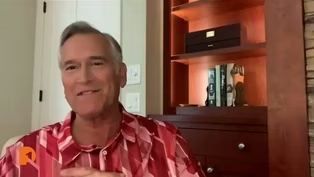
Actor and filmmaker Bruce Campbell returns to Michigan with new film “Ernie & Emma”
Video has Closed Captions
Clip: S10 Ep52 | 9m 49s | He showed his new film at the Redford Theater in Detroit where “The Evil Dead” premiered in 1981. (9m 49s)
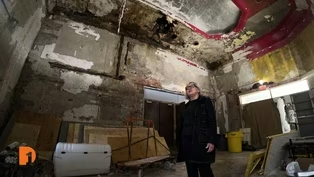
Local independent movie theaters finding new ways to stay open
Video has Closed Captions
Clip: S10 Ep52 | 13m 34s | One Detroit’s Chris Jordan and Bill Kubota visit some of metro Detroit’s remaining movie theaters. (13m 34s)
Providing Support for PBS.org
Learn Moreabout PBS online sponsorship New Episode
- News and Public Affairs

Top journalists deliver compelling original analysis of the hour's headlines.
 New Episode
- News and Public Affairs

Today's top journalists discuss Washington's current political events and public affairs.


 New Episode
 New Episode
 New Episode
 New Episode
 New Episode
 New Episode

 New Episode
Support for PBS provided by:
One Detroit is a local public television program presented by Detroit PBS