
A conversation with the author of “Aging While Black”
Clip: Season 54 Episode 35 | 8m 58sVideo has Closed Captions
Last year, American Black Journal spoke with Raymond Jetson at a virtual town hall on caregiving.
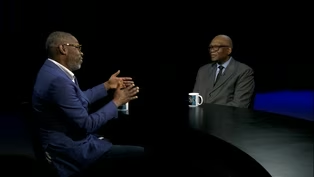
We’re featuring an excerpt from a conversation host Stephen Henderson had last year with Raymond Jetson, author of the book, "Aging While Black." The two spoke during a Detroit PBS virtual town hall on caregiving. Jetson explains how aging and caregiving experiences affect African Americans differently than others.
Problems playing video? | Closed Captioning Feedback
Problems playing video? | Closed Captioning Feedback
American Black Journal is a local public television program presented by Detroit PBS
A conversation with the author of “Aging While Black”
Clip: Season 54 Episode 35 | 8m 58sVideo has Closed Captions
We’re featuring an excerpt from a conversation host Stephen Henderson had last year with Raymond Jetson, author of the book, "Aging While Black." The two spoke during a Detroit PBS virtual town hall on caregiving. Jetson explains how aging and caregiving experiences affect African Americans differently than others.
Problems playing video? | Closed Captioning Feedback
Where to Watch American Black Journal
American Black Journal is available to stream on pbs.org and the PBS app.
Providing Support for PBS.org
Learn Moreabout PBS online sponsorship"Aging While Black," the title itself intimates the unique circumstances that African Americans face in this space, caregiving.
Of course, I always say that if you take any situation and add race or a racial dimension to it, race is often an aggravator in that situation.
It makes things more difficult, more challenging or worse.
Talk about the unique circumstances here that affect aging for our community.
- So thank you again.
I would say in the book that I just wrote, the top line statement is that aging in America is not a race-neutral experience.
And so, very often, we talk about aging and the critical components of aging as if it is a universally-shared experience.
And the reality is that for African Americans, the American experience has been different in every way.
So why wouldn't it be when it comes to aging?
And in particular, as it relates to caregiving, we first of all find the tension between the systemic inequities that exist and the cultural expectations that are attached to caregiving.
And so, the economic strain that caregiving places, especially on Black women who reduce their work hours or exit the workforce early to provide caregiving services to family members and loved ones, which leads to lower retirement savings and financial insecurity later in life.
We have health disparities, which are well-documented, that Black elders are more likely to experience chronic conditions that require caregiving.
And you couple that with the complex needs in a healthcare system that lacks cultural competency as a general statement, you will see how these things are aggravated.
And then in terms of our community, there is this strong cultural value placed on taking care of our own, which causes people to oftentimes bear circumstances in ways that are not healthy for them or the people in which they seek to provide care.
And then lastly, I would suggest that Black elders and caregivers are often overlooked or underrepresented in mainstream aging services.
And this cacophony of circumstances creates a situation where aging while Black and caregiving while Black is aggravated greatly.
- Yeah, so what's your hope for this book in terms of how it might change the conversation about how we care for the aging population among African Americans, and how we care for those of us who care for the aging in our population?
- So the hope, first of all, for the book is to spark important conversations about what is happening with aging in America and Black aging in particular.
The book is connected to the Aging While Black movement, which rests upon three pillars that we think are appropriate to every aspect of the aging experience.
The first is recalibrate the village.
The village has deep and important roots in the African American tradition.
We must intentionally rebuild and strengthen the community networks so that caregiving is shared and not this noble weight that we carry individually in our communities.
We need to develop cooperative caregiving models and community leadership groups so that we are thinking collectively about how we address this very serious and only exacerbating need.
There are 11,000 people in America who reach the age of 65 every day.
This started a few years ago and will continue until the year 2040.
In the next 20 years, a trend will continue where the number of Black people over the age of 65 will triple from four million to 12 million.
The infrastructure in our community is ill-equipped to deal with this.
And so, we need to be intentionally thoughtful in our families, in our communities, in our anchor institutions, in the organizations that serve Black people.
The second pillar of "Aging While Black" is embracing innovation.
And so, how do we use technology to bridge this gap?
There's a brilliant brother in Aurora, California, I'm sorry, Aurora, Colorado, Brannon Peterkin, who's created an app called finish'd that allows for caregiving services to be secured by aging people and their families to be involved.
And that's just an example of how we need to maximize the use of technology.
And the last pillar of "Aging While Black" is leaning into Sankofa.
How do we view aging Black people as valuable resources rather than someone in need of care?
We are having an increasing number of accomplished, experienced, determined people who are going to be showing up in our communities.
In just nine years, in 2034, there will be more people over the age of 65 than under the age of 18.
How do we turn that into a resource?
How do we create spaces for younger generations to connect with older generations to address the issue impacting them both at the same time?
- Talk about how we find joy and inspiration in this space.
I mean, we have been talking about it as a challenge, which it is, but one of the things that I've experienced over the last three years where I've had to give more care and support to my mom is these little moments where I'm experiencing things that I never experienced with her in my entire life and where our relationship changes, changes for the better in some cases because we're spending more time.
I feel like that's an important dimension of this as well, and it's important for us to take note of those things and to look for them when we're in this situation.
- Yeah.
Stephen, you just mentioned a critical ingredient, which is being intentional about creating these moments of joy.
And I emphasize the word create intentionally.
I was listening to a radio program earlier today and the speaker said something that just really resonated with me.
He said, "Our joy is created, it's not discovered."
And so, we have to be intentional about creating it and recognizing that the relationship is different.
I am seeing a side of my mom now.
I am hearing stories about her childhood and I'm able to ask questions about elders in our family and other things.
And it's a joy to create space for her to share.
And my mom gave me a Father's Day card where she wrote in there how proud she was of me on being a successful author.
And I mean, I have it in the room now.
It's still just something that brings a smile to my spirit.
And so, I think we have to be intentional about creating those moments of joy, leaning into that inner strength and creativity.
September is Healthy Aging Month
Video has Closed Captions
Clip: S54 Ep35 | 11m 30s | This month is a time to promote physical, mental, social, and financial well-being among older adult (11m 30s)
Providing Support for PBS.org
Learn Moreabout PBS online sponsorship New Episode
- News and Public Affairs

Top journalists deliver compelling original analysis of the hour's headlines.
 New Episode
- News and Public Affairs

Today's top journalists discuss Washington's current political events and public affairs.

 New Episode
 New Episode
 New Episode
 New Episode


 New Episode
 New Episode

Support for PBS provided by:
American Black Journal is a local public television program presented by Detroit PBS