
September is Healthy Aging Month
Clip: Season 54 Episode 35 | 11m 30sVideo has Closed Captions
This month is a time to promote physical, mental, social, and financial well-being among older adult
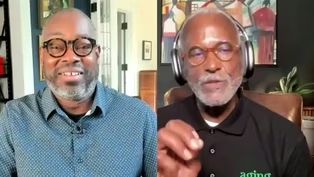
Host Stephen Henderson sits down with Detroit Area Agency on Aging President & CEO Ronald Taylor for a conversation about physical, mental, social, and financial well-being among older adults. Taylor talks about the unique challenges faced by aging African Americans, which are compounded by systemic inequities and racial disparities.
Problems playing video? | Closed Captioning Feedback
Problems playing video? | Closed Captioning Feedback
American Black Journal is a local public television program presented by Detroit PBS
September is Healthy Aging Month
Clip: Season 54 Episode 35 | 11m 30sVideo has Closed Captions
Host Stephen Henderson sits down with Detroit Area Agency on Aging President & CEO Ronald Taylor for a conversation about physical, mental, social, and financial well-being among older adults. Taylor talks about the unique challenges faced by aging African Americans, which are compounded by systemic inequities and racial disparities.
Problems playing video? | Closed Captioning Feedback
Where to Watch American Black Journal
American Black Journal is available to stream on pbs.org and the PBS app.
Providing Support for PBS.org
Learn Moreabout PBS online sponsorshipSeptember is Healthy Aging Month, a time to promote physical, mental, social, and financial wellbeing among older adults.
This year's theme is curiosity has no age limit.
I love that phrase.
And that simply means you should stay engaged, learn, and embrace new experiences at any age.
Here to talk about healthy aging in the African American community is the President and CEO of the Detroit Area Agency on Aging, Ronald Taylor.
Welcome back to "American Black Journal."
- Thank you so much for having me, Stephen.
- So I do love that phrase about curiosity.
I think that is a key to staying healthy mentally and maybe even physically- - I would agree.
I would agree.
And I would say that, you know, the curiosity has no age is very important.
And when you take a look as far as healthy aging and one of the real key components is regards to like staying mentally-active, mentally-engaged, but also socially-connected.
And so, mentation is one of those areas in which we really focus upon in regards to one of the elements when we take a look as far as the five M's of healthy aging.
- [Stephen] Talk about the five M's.
- So we talk about mobility, we talk about mentation, we talk about meditation and... - Two more.
- Yeah, two more.
So we talk about, we talk about what matters to individuals also.
- Yeah, yeah.
So mobility, that's one that I think is particularly difficult to maintain as you get older.
And I think for a lot of seniors, that's where we see challenges start to crop up.
- Yeah, mobility is a huge issue as far as the just the act, the ability to get around and just to be mobile and to be able to run the errands.
And when we take a look as far as some of the activities of daily living, mobility is one of the key indicators as related to if someone could age successfully within the community.
But then I would also say as far as mobility, it also goes into the ability to have transportation.
And that transportation allows you to have access, whether it's access to healthcare, access to food, or access to be able to attend church or to participate in other social activities.
- Yeah, talk about the challenges that African American seniors face in our community that might look different from what other people are dealing with.
- Yeah, I would say that the challenges in African American community is compounded because of some of the systemic issues in which our community, as far as the disparities that we've had to address and that we've had to deal with.
So when you take a look as far as the systemic issues, whether it's been education, whether it's been healthcare, whether it's been insurance, or just the disparities around income and the like, we have been starting from what I'll say a deficit for a longer period of time in which we've been trying to overcome.
But what I would like to say is that while the disparities are very real, they should not be our destiny and they should not dictate as far as what the real outcome is going to be.
And the reason I really lean into that is because when we take a look as far as within the world, there's what, five or six areas that are considered blue zones.
And those blue zones are, you know, communities in which individuals have a longevity of life and have a propensity to age beyond 100 years of age.
And I think the city of Detroit should have that as an aspiration.
- We should be trying to get there.
- That's correct.
- Yeah.
- That is correct.
- Yeah.
And we're not, I mean, we should make it clear, we're not really there.
- No, we have a long ways to go.
But I think the issue is in regards to, there has to be some individual and also some collective community efforts to really improve lifestyles to address some of the social barriers to care.
Again, whether it's access to healthcare services, whether it's food deserts, whether it's transportation services, whether it's the cadre of medical professionals that can provide services, whether it's solid housing.
So it really crosses the full continuum in the community.
- Yeah.
One of the things I think gets overlooked in the discussion about aging sometimes is the preparation for that stage of life that's necessary, right?
That if you're trying to get to a place where your later years are comfortable and that you can do all of these things, you got to start thinking about it much earlier.
- Yes, you do.
And what I will say is that aging is a journey and that we are aging each and every day in which we're alive.
So as part of that journey, we should think about the, is we take a plan about, you know, what college we want to go to, as we plan about other significant mile markers in our lives.
We also have to plan about a what about when I reach a particular chronological age and what do I want that to look like?
So our lifestyle needs to mirror to some regards as far as what we want.
When I say that a lot of chronic illnesses could be addressed if there were lifestyle changes earlier in life.
Also when we take a look at it from a financial perspective or even from a housing perspective, or even what our social network looks like, there's some real consideration that has to be taken in regards to if we want to age in place with a dignity and a quality of life.
- Yeah.
I think when you say those things, for some people they're thinking about financial planning and that's important.
But it's also some other kind of planning that people need to do.
It's not just money.
- That's correct.
- It's also your physical health.
It's, you know, place, thinking about place, and what matters about place, all kinds of things.
- It really is.
And I would say that in order to age in place, and I think at the end of the day, we all would like to be able to age in the community and age in with our family and our friends.
- A community that's familiar, right?
- That's familiar and also that's our home.
And so, I would, you know, I would offer that you have to take a look, what I offer and what I share with individuals, excuse me, is that you have to take a look as far as what is your family history as related to from a medical perspective.
- Yeah, yeah.
- And also, what does your financial resources look like and what are you able to do?
Can you afford the house in which you're currently in?
What is the housing stock?
And what are the repairs?
And is the house adaptable and can you actually be mobile in it?
What is your social network?
Do you have a resource or do you have a bank of individuals that you can lean into to stay connected, that can check in on you, they can help prepare a meal, or that you can go out to dinner with?
And so, it is really a big continuum that has to be taken into consideration as related to planning to what I would say age in place and also just to grow older.
- Yeah, when you think about Detroit and Metro Detroit, what would you say are the kind of top three burdens or challenges that folks here face when they get to that point where they're aging and need to make a change?
- Yeah.
Some of the biggest issues in which we hear is in regards to health.
You know, what's the health status of that individual?
And then also from a financial perspective, what are their financial limitations or abilities?
And I would also say is in regards to the housing and the housing stock.
And many individuals would prefer to stay at home and there's a lot of activities and efforts to help individuals remain at home.
But, you know, sometimes if we all need, and I would say this for myself, I currently stay in a two-story home where the bedroom is on the second floor.
And I'm really starting to evaluate whether I need to- - Does that work?
- Will this work for me in the next few years?
So those are some of the considerations.
- Yeah.
The idea of that, the thinking about housing, it gets into other challenges we have with housing, with affordable housing, especially in Southeast Michigan and in Detroit, but also adaptable housing.
- Correct.
- And as you point out, it's great if you go out and buy a house, that's part of a financial portfolio that will help you in your older age.
But then you also have to think, can I stay in this place?
Most of us have, if we own a house, we own a two-story house.
- Yep.
Yep.
You know, it's a consideration that I think sneaks up on us.
And it's not something that you really think about as far as what may happen 30, 20 years down the road.
But when that time elapses and you are at that point where you say, "Oh, these steps are getting a little bit more difficult."
- [Stephen] I can't do this every day, right?
- I can't do this all the time, yeah.
Then I think it really comes into consideration.
But I think there is such a large swath or a large continuum of housing options.
But again, the financial resources have to be available for you.
- Yeah.
Yeah.
And then I think, we've only got about a minute and a half left, but I want to talk about the importance of that community.
- Okay.
- When you get older, being able to stay connected to communities that matter to you, and that's your family, but it's also your neighbors or just your friends, or the people who make your life what it is.
So many people, I feel like when they age, they lose a lot of that.
- You know, that is probably one of the biggest issues that I would say individuals face is that social connectedness.
- Yeah.
- And Stephen, what I'll tell you is that in the Metro Detroit area, we anticipate that probably 1/3 of older adults live alone and that those individuals that are living alone, that of the time in which they're awoke, they're probably spending at least 10 hours or more by themselves.
- By themselves.
- And so, that lack of, that loneliness really leads to what we consider to be depression and that depression leads to mental health.
So the issue of social connectivity, it is huge.
And it is one in which we're trying to address and one in which we're trying to really promote for our community and for older adults.
- Yeah.
And it's hard because these other issues, physical mobility, finance, they all affect that too.
- That's correct.
That's correct.
- It's all in one ecosystem.
- That's correct.
- Yeah.
- That's correct.
- Okay.
Ronald, it's always great to talk with you.
Thanks so much for being here.
- And thanks for having me.
Thanks for having me.
A conversation with the author of “Aging While Black”
Video has Closed Captions
Clip: S54 Ep35 | 8m 58s | Last year, American Black Journal spoke with Raymond Jetson at a virtual town hall on caregiving. (8m 58s)
Providing Support for PBS.org
Learn Moreabout PBS online sponsorship New Episode
- News and Public Affairs

Top journalists deliver compelling original analysis of the hour's headlines.
 New Episode
- News and Public Affairs

Today's top journalists discuss Washington's current political events and public affairs.

 New Episode
 New Episode
 New Episode
 New Episode


 New Episode
 New Episode

Support for PBS provided by:
American Black Journal is a local public television program presented by Detroit PBS