Prairie Sportsman
A Decade of Minnesota and Pristine Green
Season 17 Episode 13 | 27m 46sVideo has Closed Captions
Host Bret Amundson reflects on 10 years of hosting and researchers investigate cyanobacteria blooms.
Host Bret Amundson reflects on 10 years of hosting Prairie Sportsman and recalls some of his favorite moments in front of the show’s camera, and researchers are investigating cyanobacteria blooms where they least expect them, Minnesota’s pristine northern lakes.
Problems playing video? | Closed Captioning Feedback
Problems playing video? | Closed Captioning Feedback
Prairie Sportsman is a local public television program presented by Pioneer PBS
Production sponsorship is provided by funding from the Environment and Natural Resources Trust Fund and Shalom Hill Farm. Additional funding provided by Big Stone County, Yellow Medicine County, Lac qui...
Support provided by:


Prairie Sportsman
A Decade of Minnesota and Pristine Green
Season 17 Episode 13 | 27m 46sVideo has Closed Captions
Host Bret Amundson reflects on 10 years of hosting Prairie Sportsman and recalls some of his favorite moments in front of the show’s camera, and researchers are investigating cyanobacteria blooms where they least expect them, Minnesota’s pristine northern lakes.
Problems playing video? | Closed Captioning Feedback
Where to Watch Prairie Sportsman
Prairie Sportsman is available to stream on pbs.org and the PBS app.
Providing Support for PBS.org
Learn Moreabout PBS online sponsorshipMore from This Collection
The Environment and Natural Resources Trust Fund has awarded a billion dollars to more than 2,500 projects that protect, conserve, preserve and enhance Minnesota’s natural resources. This playlist includes many of these projects featured on Prairie Sportsman, an outdoor show produced by Pioneer PBS for all Minnesota PBS stations.
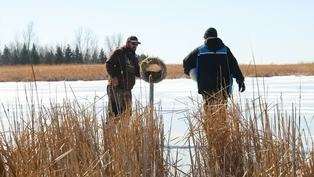
Video has Closed Captions
The value of hen houses to duck populations and the University of Minnesota tracks entomology. (27m 46s)
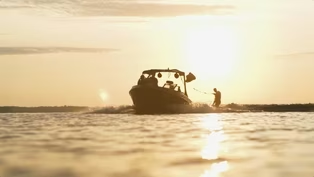
Memorial Park and Powerboat Impacts
Video has Closed Captions
Shakopee’s Memorial Park Mill Pond's waterfowl viewing, and the impacts of powerboats on lakes. (27m 46s)
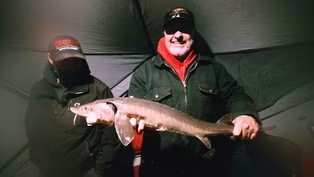
St. Croix Sturgeon and Aquatic Plant Restoration
Video has Closed Captions
Joins anglers on the St. Croix River to fish for sturgeon and Minnesota aquatic invasive species. (27m 46s)
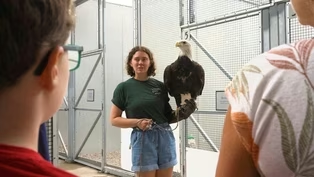
Rabbit Hunting and Raptor Rehab
Video has Closed Captions
Join a group of long-time friends on their annual rabbit hunt and the Raptor Center cares for birds. (27m 46s)

Alclair Outdoors and Robotic Weed Control
Video has Closed Captions
The story behind Alclair Outdoors and researchers test a weed terminator in a cornfield. (27m 46s)
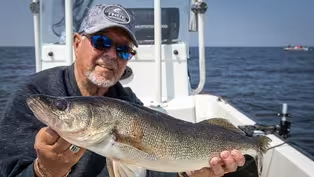
Tradition on the Water and Spiny Waterfleas
Video has Closed Captions
An annual friend's trip to Lake of the Woods and tracking spiny waterfleas. (27m 46s)
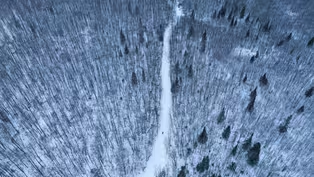
Arrowhead 135 and Bringing Youth Outdoors
Video has Closed Captions
The Arrowhead Ultra 135 winter race and Project Get Outdoors. (27m 46s)
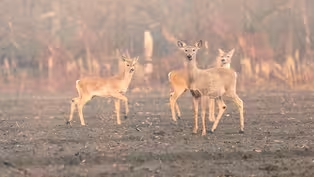
Danny's Deer and Offal Wildlife Viewing
Video has Closed Captions
Danny Thompson manages land for deer while trail cams monitor deer offal scavengers. (27m 46s)
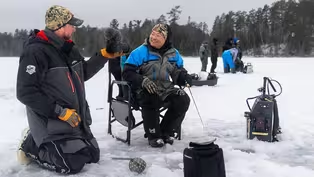
Video has Closed Captions
A Minnesota DNR crappie barotrauma study and problems with dumping baitfish. (27m 46s)
Precision Shots and Green Ammonia
Video has Closed Captions
A precision rifle competition and converting wind energy into green ammonia. (27m 46s)
Bass Classic and Aquatic Research
Video has Closed Captions
The Dick Hiley St. Jude Bass Classic and advances in controlling AIS in Minnesota. (27m 46s)
Video has Closed Captions
A retired conservation officer on a pheasant hunt and conservation can start at home. (27m 46s)
Providing Support for PBS.org
Learn Moreabout PBS online sponsorship(bright music) - On today's "Prairie Sportsman," I look back at a decade of sharing Minnesota's outdoor opportunities as the host of "Prairie Sportsman."
I'm Bret Amundson, and today on "Prairie Sportsman," we got another cold weather Minnesota adventure for you.
Then we join researchers working to uncover the cause of mysterious cyanobacteria blooms in Minnesota's pristine Northern Lakes.
- A lot of the nutrients that might be stimulating blooms were coming from the lakes themselves.
♪ Dah-Dah - Welcome to another episode of "Prairie Sportsman," where we celebrate Minnesota's great outdoors.
(bright music continues) (gentle music) - Funding for "Prairie Sportsman" is provided by: the Minnesota Environment and Natural Resources Trust Fund, as recommended by the Legislative Citizen Commission on Minnesota Resources, by Mark & Margaret Yackel-Juleen on behalf of Shalom Hill Farm, a retreat and conference center in a prairie setting near Windom, Minnesota, on the web at shalomhillfarm.org, and by the Friends of Prairie Sportsman.
To become a friend of "Prairie Sportsman," visit pioneer.org/prairiesportsman.
(audience applauding) - Hi, good evening everybody.
I'm Bret Amundson, and we are live tonight.
Welcome to "Prairie Sportsman."
I'm Bret Amundson.
I've been saying that for 10 years now, and it never gets old.
For this final episode of the season, we're gonna take a look back at some of my favorite memories over the years from that first live episode to this season, Prairie Sportsman's 17th overall.
I'm proud to continue what Rich Massey and Tim Bakken created at Pioneer PBS many years ago.
(upbeat music) This show has always been about Minnesota's outdoor opportunities and the science, research, and management behind those opportunities.
While I love to hunt and fish, we also have to acknowledge the boots-on-the-ground biologists who get into the weeds around the state.
Without the conservation efforts of so many, we wouldn't be able to do what we love.
While there are many to thank in this effort to preserve and sustain the prairie chicken, one name that comes to mind is field biologist, Dr.
John Toepfer, who sadly passed away in the fall of 2018.
- [Narrator] He was a real strong field biologist.
He spent his career studying these birds.
- We also enjoy our time visiting with conservationists, artists, and other notable residents who spend time outdoors.
One of my favorite moments was meeting photographer Jim Brandenburg, and then pheasant hunting Touch the Sky Prairie near Luverne, Minnesota.
- Part of our culture where it's important experience of hunting, which I grew up with, and it's crucial to our American experience.
and we can share that too.
- [Bret] We were in Luverne for the Governor's Pheasant Hunting Opener and had an invite the next morning to hunt some prime private land owned by Nobles County Pheasants Forever president, Scott Rall.
(dog splashing) (Bret chuckling) Are you gonna try to cross?
- I think I'll just, yeah, try to.
- [Bret] Now as our cameraman, Dylan, gets ready to cross, I reach out to grab the camera and he loses his footing.
It was deep, cold, and hard to see.
From Minnesota's Southwest to the Arrowhead of the Northeast, we traveled to Ely to jump on a dog sled and go lake trout fishing in season 11.
Doesn't get any better.
(laughing) (upbeat rock music) And I've been marking fish this whole time.
Hen, hen, hen.
Oh my gosh, there's a rooster.
A few years back, Dan Amundson joined the crew and was able to capture this amazing elk footage during a hunt near Lancaster, Minnesota, in the Northwest.
(elk bugling) (upbeat music) I missed a nice deer in the Southeast and learned how to fly fish at Whitewater State Park.
Now we don't just hunt and fish, but find other ways to enjoy the outdoors, tell stories, and learn about the history of our state.
- 1732 is when the fort got its beginning.
21 people stayed in the fort for the first three years.
Pretty cool spot.
And you kind of ask yourself, "Why did they pick this spot?"
- Why did they pick it?
- Well, it's kind of unique, in a way, where it was kind of isolated, you know, like Lake of the Woods in this area, just, you know, having a good harbor is important.
- We always find ways to enjoy winter in Minnesota, probably because it can last for a long time.
One unique way that I found that out was by hanging onto a frozen wall of ice near Sandstone.
(playful music) Oops.
Yep, that's me.
You're probably wondering how I got myself into this.
Well, last year while rafting the whitewater of the Kettle River near Sandstone, Tony Vavricka from Hard Water Sports told us about the winter activities in the area.
Just over the banks of the river across from Banning State Park sits in idle sandstone quarry.
That quarry naturally made ice walls where water would run off and freeze on its steep cliffs.
That caught the attention of thrill seekers from the region who would sneak into the area to climb the ice.
(gentle stringed-instrument music) I am Bret Amundson, and today on "Prairie Sportsman," we got another cold weather Minnesota adventure for you.
I've eaten crickets, netted tullibees, dodged flying rough grouse, and learned how to forge a knife.
- In 2011, I had necrotizing pancreatitis, ended up in the hospital for almost 10 months, and I lost more than half my body weight.
And I got down to 140 pounds.
- Hmm.
- They wanted me to go to the gym and work out.
And I had this external drain bag, and I wasn't gonna do that.
And my son sent me a video, and he said, "Hey dad, I think you'd like to do this."
This guy built a forge out of a brake drum, still have the brake drum coal forge, and he uses that.
He said, "I think you might like doing that.
You know, you can just gets some frustration out by beating steel."
And so I did.
And when I first started- - Did the work?
- It worked.
- We highlighted (elegant music) a once in a lifetime event on Lake of the Woods, braved cold temps in a layout boat, hunted doves in an interesting surrounding.
- Get us away from all the nonsense and introduce us to the outdoors and hunting and introduce you to a different kind of lifestyle, a healthy lifestyle versus the city lifestyle, which can be very dangerous.
And as a young guy, as a young man, you can get into a lot of trouble.
But I was able to avoid all that, because my dad took us out of that and introduced us to hunting.
So that was very, very special.
(upbeat music) - [Bret] I've helped search for fawns using a thermal drone.
Oh, there's one walking next to it too.
It looks like something.
- Well, this could be a bird, like a pheasant.
- [Bret] Pretty small.
- Kinda tell in the strut.
- Sure.
Love it.
- Looks pretty small.
We'll have to turn on the camera.
- A skunk.
- A skunk.
- That's perfect.
(Bret laughing) - [Drone Operator] That's the first skunk we've had.
- It wasn't a fawn.
It wasn't a pheasant.
It was the first skunk that they've gotten on camera this morning.
We're still looking.
I was gonna make a joke like, "That stinks," but dad jokes.
- That stinks.
Well, I was just asking Rod.
- Thank you very much.
I'll be here all week.
- Have you guys ever been skunked?
(Bret laughing) - And I was meaning, you know, like not finding fawn in the field.
He's like, "Oh yeah, many times."
And then we run across one that's an actual skunk.
- That would've been a way better joke than the one I came up with.
We've given back to veterans.
- A lot of our younger vets especially are coming back from deployments, really struggling with PTSD.
One of the other gentlemen there stated last night, you know, a lot of people aren't aware, but 22 vets a day commit suicide.
It's just an issue I think that hits home with a lot of us veterans.
And if something like this can prevent just, you know, one of those deaths from happening, I think, to me it means everything.
It's so important.
- I've never, never shared my story about my battle with, my family's battle with childhood cancer.
So I was nine years old, I was diagnosed with leukemia.
We didn't have St.
Jude.
It tore us up, man, like me getting cancer.
It devastated, like the family dynamic was stressful.
Like, "How you gonna pay for this?
How you gonna?"
You're trained to do everything right.
You're conditioned.
Pay your taxes, wash your face, brush your teeth.
You're conditioned, you're brought up to do all these different things.
Drive on the right side of the road.
But one thing you're not taught is how to handle your kid getting diagnosed with cancer.
So, so I saw what it can do to a family without the help of St.
Jude.
And so like that's why St.
Jude is so special to me, 'cause I see them alleviate that pressure.
(gentle guitar music) - And there are a few segments that I'm really proud of, including our upper Midwest Emmy-winning segment on barotrauma.
Today we're in northern Minnesota on a small but deep lake, crappie fishing.
Most of the fish are 30 to 50 feet deep.
If you're gonna target crappie that deep, there's some important things you need to know.
And in this episode, we're gonna tell you what those are.
So what is barotrauma?
Barotrauma in fish is similar to the bends in humans.
When a fish comes up from deep water, it goes through a change in pressure.
This change can cause internal damage to the fish.
Sometimes it's visible, sometimes it's not.
We always try to bring the best cinematography when we can.
(gentle music) While I'm proud of all the shows we've done, my favorite is a little personal.
It featured some buddies with their old hunting partners.
And it was the last hunt, my old lab Mika was ever on, simply called "Old Dogs."
- A dog might be a small part of your world, right?
To them, we are everything, right?
Yeah, for opportunities like that to be able to get out and find birds and do what they love, yeah, like that is what they live for.
Now Corey put a nice shot on that bird.
Annie pointed it.
Corey shot it.
Mika retrieved it.
On behalf of our crew and Pioneer PBS, I want to thank you for watching, thank our supporters, and anyone who's welcomed us into their lives.
The last 10 years have been a blast, and we look forward to the next 10 showcasing Minnesota's great outdoors.
(mysterious music) Something strange is happening in Minnesota's remote Northern Lakes, and we don't know why.
Scientists from the St.
Croix Watershed Research Station are on the case.
- Lakes in northern Minnesota are valued across the state for their high water quality and for the incredible recreational opportunities they afford Minnesotans.
But recently, reports of cyanobacterial blooms have been rising in these lakes, and we are investigating why that might be happening in places where we least expect them.
Cyanobacterial blooms tend to look like thick green paint has been smeared across the surface.
They tend to be shiny.
They are blue green, hence their name cyanobacteria.
- [Scientist] That might be the most blue green.
- And the toxins that are produced pose a significant public health risk to people who might be recreating in the Boundary Waters or the Superior National Forest - [Bret] With potential public health risks looming on the horizon, can researchers discover why these Northern Lakes are going from pristine to green?
(dramatic music) - So here at the St.
Croix Watershed Research Station, we specialize in the study of lake water quality and the history of lake ecosystems.
So this project is focused on how and why we might be seeing a change in some of our most pristine lakes.
(slide projector whirring) (slide changer clicking) So there have been anecdotes of lakes in the Boundary Waters and within the Superior National Forest that are more naturally productive.
So people have been observing greenness in these lakes for many decades.
I think the concern now is that the algal community may have shifted from algae that are green and are blooming, but now they're becoming the type of algae that can produce toxins and have more negative ecosystem implications.
And cyanobacteria are the group of algae that we're most concerned about.
And they've been around for millions of years.
They are responsible for the changes in the Earth's atmosphere that resulted in life as we know it.
And so they are a important part of any aquatic ecosystem.
The issue with cyanobacterial blooms is when they bloom in excess of all these other algae.
And so the balance is thrown off in the ecosystem.
And so our work is hoping to identify whether these shifts truly have occurred and if there is more of a threat for toxins being produced in these lakes into the future.
- [Bret] While toxins from cyanobacteria are a concern, these troublesome organisms have found an admirer in the research team's microbiologist, Hailey Sauer.
- Yeah, turning around.
I'm such a fan of cyanobacteria, because they are the ultimate competitor.
They are the New York Yankees (baseball organ music) of the water column.
So cyanobacteria can store phosphorus in their cells.
They don't need it right now, but they might need it later.
And so it makes them competitive.
They've evolved to become buoyant so they can go up into the sunlight, do their photosynthesis.
Night comes around, they'll sink down in the water column where all those nutrients are, grab them and then float back up.
And then they can just kill their competitors through the use of these toxins.
They're not doing it because they wanna hurt the water.
They just wanna do it so that they can live there and no one else can.
(gentle music) - [Bret] A large part of the success of this bacterial dynasty is the organism's ability to compete for phosphorus, a critical nutrient for life.
- Phosphorus is part of our biological structures, so it's part of our cell walls and it's part of our DNA.
It's also a really important part of the machinery that produces energy for all of us to live our lives.
So it's true for people and it's true for the organisms that we're concerned about in this project.
We think of phosphorus as what's called a limiting nutrient.
So it is in the least supply relative to demand.
And what that means is that it controls how much growth can happen or how much productivity can happen in a lake.
By adding phosphorus, you're relieving that limiting nutrient and you're allowing much more growth and productivity to happen.
For a long time, people have changed the way that phosphorus moves through environments.
And specifically, we've added a lot of phosphorus.
So runoff from agricultural, industrial, and urban landscapes can be really rich in phosphorus.
And that gets into our waterways and it gets into our lakes, and it can fuel algal growth.
What's curious about these pristine lakes is that their watersheds haven't been developed.
And so it's this puzzle as to, like, why are we seeing the kinds of increases in potential productivity, more algal growth, more blooms that we see typically in other parts of the state that are more developed.
- [Bret] Researchers begin to tackle this puzzle during an initial phase in 2022, and they had a suspect in mind.
- Our initial hypothesis was that dust coming from far away was depositing in these lakes, bringing in nutrients.
and stimulating algal blooms.
But ultimately what we found was that the amount of dust that was coming in was not a significant contributor to the amount of nutrients that were present in the water column.
And so this indicated that a lot of the nutrients that might be stimulating blooms were coming from the lakes themselves.
♪ Dah-dah.
- [Bret] With distant dust eliminated as a prime suspect, the team began looking for a new culprit.
- So when we're thinking about where phosphorus could be coming from in the lake, we're looking at the sediments or the mud at the bottom of the lake.
And it exists in sediments in a number of different forms.
But the form that lake scientists and managers think a lot about is phosphorus bound to iron.
So iron is able to bind with phosphorus in the water column, and it sinks to the bottom into the mud.
And it can hold it there, which means that that phosphorus is no longer available to be taken up by algae and cyanobacteria.
But that iron can only hold phosphorus in the presence of oxygen.
And without oxygen, the iron will be reduced and solubilize, and it releases that phosphorus back into the environment.
So oxygen is a critical piece of whether or not sediments can hold on to their phosphorus.
- [Bret] And the amount of oxygen in a lake can be impacted by water temperature, specifically by a phenomenon known as lake stratification.
- As someone who recreates on a lake, you might be familiar with the fact that the top layer of a lake tends to be much warmer than the bottom.
So if you're swimming or paddling on a lake, you're on the the warm layer.
But if you swim down into to a deeper layer, you can feel around you that the water is getting colder.
And this difference in temperature is actually also reflective of difference in water density, so how thick the water might be.
So colder water is denser, and that's why it's on the bottom.
And this difference in density also creates this physical barrier between the colder bottom layers of a lake and the warmer upper layers of a lake.
So now that it's disconnected from the atmosphere, there are other biological processes in the sediments that consume oxygen.
And so the bottom waters experience anoxia, a loss of oxygen.
- And when that happens, you get these pulses of phosphorus out of the sediment.
- [Bret] For a while, the phosphorus emitted from the lake bed will be trapped in the colder bottom layer of the lake.
But as the lake temperature equalizes, the lake will mix, and nutrients from the bottom will be freed to the surface waters where they'll be used by algae and cyanobacteria.
While this mixing is common in many lakes, it was not expected in the lakes the research team was studying, - We've presumed that many of these lakes wouldn't mix at all, that they would be the same temperature throughout, that their bottoms would never be different from their tops, because the lake isn't thought to be deep enough to be forming these layers.
But what we were finding is that they actually were stratifying and mixing intermittently and somewhat unpredictably throughout the summer period.
And so in these conditions, we're actually finding that that sediments and nutrients are being stirred up into the water column multiple times throughout the summer and essentially pulsing nutrients pretty frequently for algal growth and productivity.
- [Bret] With this updated evidence, researchers now had a new suspect for the increase in toxic blooms in Minnesota's pristine waters.
- Our hypothesis is that climate change is a major culprit for warming lakes and stimulating the stratification anoxia process.
We're seeing a difference in the way lakes respond.
So their tops are actually warming faster than their bottoms.
And so this is increasing the strength of the stratification that we're seeing in lakes.
And so in lakes that used to be well mixed throughout their entire water column are now starting to experience periods of stratification and anoxia - [Bret] To help test their theory, the investigative team is gathering more data to improve their understanding of these Northern Lakes.
- So what we've done is we've taken sediment from the bottom of each of our study lakes, and we've exposed them to two experimental treatments: one in which the sediment is exposed to oxygen and one where they have no oxygen availability.
And so we're testing how much nutrients are coming out under each of these two conditions.
And so if we know that a lake has experienced so many days of anoxic conditions, we can then calculate how much nutrients we would expect to be coming out of those sediments and understand whether the nutrients that we're seeing in the water column that are simulating these blooms can be directly attributed to the nutrients or if there's another culprit involved.
- [Bret] As part of their investigation, the team utilizes the research station's lab, which can essentially look back in time, an important capability when researching something as fleeting as cyanobacteria blooms.
(upbeat music) - It's easy to see cyanobacteria when they're in the bloom, but then it's a windy day and the lake water moves around, and all of a sudden they're gone.
So what's left to know that they were there?
Well, they died, potentially.
They don't have a really long life cycle.
So they die and then they sink to the bottom.
Just like everything sort of is slowly sinking to the bottom of a lake, so are these cyanobacteria that were once on the surface.
- So basically what happens is, over time, material from both within a lake and from the surrounding environment accumulate on the lake bottom, and they form layers of sediment.
And so what you can do is if you collect a sediment core, you can basically use those layers of mud or sediment to be able to reconstruct what was happening in the lake and the surrounding environment.
- And when we those sediment cores, we can take bits of them, extract DNA, and get a sense for what organisms were maybe around during a time when this mud settled to the sediment.
- [Bret] Not only can researchers see what was there, but also what they were doing.
- We can go in very targetedly, and we can say, "I wanna know which ones of these organisms are producing the liver toxin."
And so I can just say, "I wanna look at all of the DNA I have, tell me how many copies of that gene that I have."
And that gives me a sense for how much of the population might be producing that toxin.
- [Bret] Although the team is still in the early stages of their research, a picture of these Northern Lakes is beginning to emerge.
- They're trending in this direction that would suggest that they're going to become better hosts for toxic cyanobacteria.
But it's not like these lakes have have swung and become entirely new ecosystems.
I think there's a lot of hope for maintaining the pristine quality of our most prized lakes in Northern Minnesota.
- [Bret] And the work of maintaining the quality of these lakes has benefited from collaboration.
- So when we started this project just this last year through the help of the Environment and Natural Resources Trust Fund, we partnered with 1854 Treaty Authority and the Red Lake DNR, which are two tribally-led resource management entities in Northern Minnesota.
And so we're expanding the number of lakes that we're monitoring over the next three years.
And we're also trying to address questions that are related specifically to tribal concerns.
For example, how do cyanotoxins affect wild rice growth?
How might it affect different kinds of recreation or ceremonial uses that communities have around different lakes that are experiencing blooms?
And so I think that our partnerships with these organizations are not only advancing our scientific goals, but they're advancing our desire to address the more socially impactful questions.
- [Bret] While these lakes are experiencing uncertain times, their place in the hearts of Minnesotans remains a constant.
- The Boundary Waters and the Superior National Forest are a state treasure.
There are so many Minnesotans that have really amazing memories of recreating in the boundary waters.
And so preserving that water quality and those experiences for future generations is really important to our identity as Minnesotans.
(gentle music) (gentle music continues) - [Announcer] Funding for "Prairie Sportsman" is provided by: the Minnesota Environment and Natural Resources Trust Fund, as recommended by the Legislative Citizen Commission on Minnesota Resources, by Mark & Margaret Yackel-Juleen on behalf of Shalom Hill Farm, a retreat and conference center in a prairie setting near Windom, Minnesota, on the web shalomhillfarm.org, and by the Friends of Prairie Sportsman.
To become a friend of "Prairie Sportsman," visit pioneer.org/prairiesportsman.
(bright music)
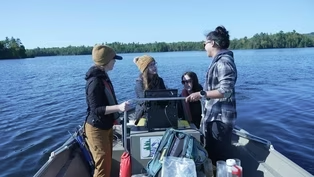
A Decade of Minnesota and Pristine Green
Video has Closed Captions
Preview: S17 Ep13 | 30s | Host Bret Amundson reflects on 10 years of hosting and researchers investigate cyanobacteria blooms. (30s)
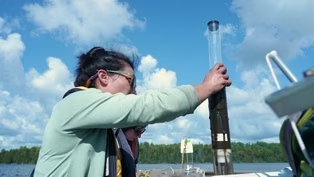
Video has Closed Captions
Clip: S17 Ep13 | 15m 34s | Bret Amundson looks back at a decade of sharing the best of Minnesota’s outdoors. (15m 34s)
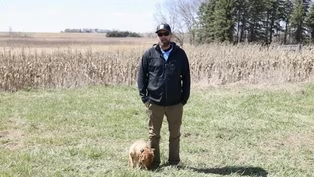
Video has Closed Captions
Clip: S17 Ep13 | 9m 54s | Bret Amundson looks back at a decade of sharing the best of Minnesota’s outdoors as the host. (9m 54s)
Providing Support for PBS.org
Learn Moreabout PBS online sponsorship New Episode
- Science and Nature

Explore scientific discoveries on television's most acclaimed science documentary series.
 New Episode
- Science and Nature

Capturing the splendor of the natural world, from the African plains to the Antarctic ice.


 New Episode







Support for PBS provided by:
Prairie Sportsman is a local public television program presented by Pioneer PBS
Production sponsorship is provided by funding from the Environment and Natural Resources Trust Fund and Shalom Hill Farm. Additional funding provided by Big Stone County, Yellow Medicine County, Lac qui...