
A look at our new “Destination Detroit” documentary
Clip: Season 54 Episode 29 | 10m 25sVideo has Closed Captions
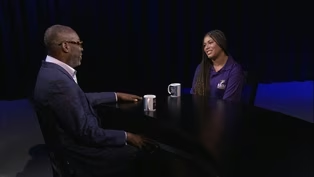
The film features interviews with more than 60 people, including genealogist Karen Batchelor.
Detroit PBS is shining a light on our region’s history with its “Destination Detroit” documentary. It explores the histories of people who helped shape Southeast Michigan, including Karen Batchelor. She talks about her family's 1917 arrival inDetroit, and she explains how researching her family tree led her to become the first African American member of the Daughters of the American Revolution.
Problems playing video? | Closed Captioning Feedback
Problems playing video? | Closed Captioning Feedback
American Black Journal is a local public television program presented by Detroit PBS
A look at our new “Destination Detroit” documentary
Clip: Season 54 Episode 29 | 10m 25sVideo has Closed Captions
Detroit PBS is shining a light on our region’s history with its “Destination Detroit” documentary. It explores the histories of people who helped shape Southeast Michigan, including Karen Batchelor. She talks about her family's 1917 arrival inDetroit, and she explains how researching her family tree led her to become the first African American member of the Daughters of the American Revolution.
Problems playing video? | Closed Captioning Feedback
Where to Watch American Black Journal
American Black Journal is available to stream on pbs.org and the PBS app.
Providing Support for PBS.org
Learn Moreabout PBS online sponsorship(upbeat music) - [Narrator] Detroit's iconic train station at Michigan Central, full of history, American history.
It's been called the Ellis Island of the Midwest.
- My family came to Detroit via my grandmother.
- [Narrator] Everybody comes from somewhere.
- And she came from Natchez, Mississippi.
She came on train.
- [Narrator] People gathered at the train station to share their migration stories.
- My grandparents were born in Pforzheim in Germany, and my dad was actually born there as well.
And they immigrated to Detroit in 1954.
So I'm first-generation American on my dad's side.
- I came as a refugee from Burundi.
I've been here since November, 2015.
- [Narrator] Detroit PBS presents "Destination Detroit," stories from people who came here and built the Motor City.
- Detroit, we always think about its population loss and its loss more population than any other city.
It grew faster than any other city in the country.
- It becomes this major city that's growing so fast because of the automotive industry and the African-American population in Detroit skyrockets.
- [Announcer] New travel luxury in every Ford car.
- Detroit was vast and wide.
Both of my grandfathers felt that it was imperative to get somewhere that was hustle and bustle.
- [Narrator] The legacy of the American autoworker carries on to this day.
- I come from labor.
Labor is in my blood.
It comes from the history of my family.
- My grandfather and my mom's family, they come over here in 1974, at the time when the Lebanese Civil War was about to start, but also for the opportunity at pursuing the American dream.
- [Narrator] America at 250, our country's anniversary, a time to look to the future and reflect on our past.
- My mother's family is from Zacatecas, Mexico.
- You know, this neighborhood has been revitalized many times over by new families coming in.
They don't know any of this.
- We have to tell our own story.
- After the war, about 100,000 Holocaust survivors come to the United States, and about 4,000 of them settle here in Michigan.
- We boarded a ship, Queen Elizabeth, and it took us about five days to get to New York.
Finally, I got to Detroit.
I felt better, much better there.
- So my father, he was a South Vietnamese military personnel.
He came to Michigan in 1975.
- We are nomadic beings.
We've always been moving.
And so we're moving in search of opportunity.
We're moving in search of liberation and freedom.
We're moving in search of a pursuit of excellence.
- The "Destination Detroit" documentary features interviews with more than 60 people, including genealogist Karen Batchelor.
While exploring her ancestors' history, she learned one of them fought in the American Revolutionary War.
She became the first African-American member of the Daughters of the American Revolution nearly half a century ago.
Here's her story.
(upbeat music) - My grandparents came here in 1917, and they settled in Hamtramck.
I have a picture of them that shows them at the Detroit train station on the day that they got there from Georgia.
And I guess there must've been photographers around, and they, "Oh, we'll take your picture "and commemorate this."
So they, for whatever reason, and they weren't wealthy or anything, they had this picture taken, and my Aunt Mary standing on a stool, looking like shocked at it all.
But that's how my dad's side of the family got here.
- [Narrator] Karen Batchelor's dad would become a prominent doctor in Detroit.
He trained at Wayne University's medical school during World War II.
- I became a mom in August of 1975.
And it was around that time after my son was born that I realized, "Wow, I don't know a lot "about our family history."
And within 10 months, going to the Burton Historical Collection at Detroit's main library and writing off to a historical society in Erie, Pennsylvania, where my maternal great-grandmother had come from, I was able to put together enough facts and found a Revolutionary War patriot.
It was William Hood.
He fought in the Battle of Fort Freeland where they came to the rescue of a fort that had been taken over by the British.
And that kind of got me started.
This is my great-great-grandmother.
And her family line takes me back to 1630 in this country.
My genealogy mentor took me aside and said, "I really think you ought to apply to DAR, "Daughters of the American Revolution."
Mom talked about how she had been to a concert in D.C.
when she was a student at Howard.
It was 1939, and it was when Marian Anderson had to sing on the steps of the Lincoln Memorial because she had been denied access to use DAR's Constitution Hall, which was a concert venue and still is.
- [Reporter] 75,000 mass before Lincoln Memorial to hear Marian Anderson, colored contralto, make her Capitol debut at the Great Emancipator's Shrine.
Refusal of the DAR to let her use their hall fanned a countrywide controversy.
- [Interviewer] What was the image for a lot of people with the DAR?
- Well, certainly in the black community, people were, you know, people did ask me, "Why would you wanna join a group like that "who had discriminated against us?"
And here's what I would say was the reason.
When I was 14, ninth grade, I integrated a school in Detroit.
And it was on the east side.
I had to take a bus an hour and a half each way.
And my parents wanted me to do this.
And this was part of their way.
This was the year after the Civil Rights Act and I was to integrate this school.
There were four of us kids at the school.
And we weren't in class with one another.
None of the black kids were together.
There were no black teachers.
It was probably one of the loneliest years of my life.
It was the first time I ever got called the N-word.
And I remember after a couple weeks, getting home from one of those days that I was sobbing.
And I asked my parents, "Why are you making me do this?"
And dad said, and I will never forget this, it has been maybe my mantra through all the years since.
But he said, "Because somebody has to."
- [Announcer] Tonight, we present a landmark in television entertainment, "Roots."
- [Narrator] 1977, the year the miniseries "Roots" premiered on network television.
Suddenly, Americans started doing their own genealogy research.
- In July of 1977, two women at the Ezra Parker chapter of DAR in Royal Oak, Michigan.
They were inviting me to apply to them and become a member.
They were going to sponsor me.
- [Narrator] Applications to other chapters ignored, but Karen was in.
It made local headlines and the "New York Times" front page.
- So join us for "Good Morning America."
- Then, national television.
- On ABC.
- There were a lot of news stories.
I did a lot of interviews.
This was the beginning of a lifetime journey for me doing family history.
And then these two pictures are Aunt Clara.
So the first person I started talking to about the family history.
And she was the self-appointed family historian, whether you wanted to listen to her or not.
And I wish I had listened more intently.
I get a lot of satisfaction from going through historic records and finding a clue and seeing what more I can find about a family history.
Remember, I started off not knowing much other than what we talked about at the dinner table.
And now I've been able to go back to 1630 in this country.
I have eight Revolutionary War patriots.
It's beyond my wildest dreams.
- [Narrator] A half century later, Batchelor's still digging into her family's past.
- Grandma kept me going on the research and she lived to be 97.
And every time we talked, she would end the conversation with, "And I saw people hanging from a tree."
And in fact, I was able to document later that there was a lynching in her area in Georgia when she was a young teenager that no black people would have been at the lynching unless they were the target, but she would have seen the aftermath of this.
And she always talked about it, but I was able to document later what she probably had seen.
Family history is no longer something that you could call a hobby, as it was when I first started.
It is a cultural imperative.
The more that we know about ourselves, the more we understand how we are an integral part of the fabric of this country.
I mean, I'm more American than apple pie.
And I think it's important for our children to understand this because they may not be learning it in school and it may not be available as readily available today as it was last week.
But the fact is we know more about who we come from now than we knew in my grandmother's generation and certainly in my parents' generation.
So this is a journey.
Annual ARISE Detroit! Neighborhoods Day celebrates 20 years
Video has Closed Captions
Clip: S54 Ep29 | 13m 4s | On August 1, community groups, block clubs, churches, schools and more will host a day of community (13m 4s)
Providing Support for PBS.org
Learn Moreabout PBS online sponsorship New Episode
- News and Public Affairs

Top journalists deliver compelling original analysis of the hour's headlines.
 New Episode
- News and Public Affairs

Today's top journalists discuss Washington's current political events and public affairs.
 New Season
 New Episode
 New Episode
 New Episode
 New Episode
 New Episode
 New Episode

 New Episode
 New Episode
Support for PBS provided by:
American Black Journal is a local public television program presented by Detroit PBS