
Annual ARISE Detroit! Neighborhoods Day celebrates 20 years
Clip: Season 54 Episode 29 | 13m 4sVideo has Closed Captions
On August 1, community groups, block clubs, churches, schools and more will host a day of community
The annual ARISE Detroit! Neighborhoods Day marks its 20th anniversary on Saturday, August 1. The event was founded by the late Luther Keith, a former newspaper journalist and executive director of ARISE Detroit! Host Stephen Henderson sits down with Luther's daughter and ARISE Detroit! Board Member, Erin Keith, to talk about this milestone anniversary for both the event and the organization.
Problems playing video? | Closed Captioning Feedback
Problems playing video? | Closed Captioning Feedback
American Black Journal is a local public television program presented by Detroit PBS
Annual ARISE Detroit! Neighborhoods Day celebrates 20 years
Clip: Season 54 Episode 29 | 13m 4sVideo has Closed Captions
The annual ARISE Detroit! Neighborhoods Day marks its 20th anniversary on Saturday, August 1. The event was founded by the late Luther Keith, a former newspaper journalist and executive director of ARISE Detroit! Host Stephen Henderson sits down with Luther's daughter and ARISE Detroit! Board Member, Erin Keith, to talk about this milestone anniversary for both the event and the organization.
Problems playing video? | Closed Captioning Feedback
Where to Watch American Black Journal
American Black Journal is available to stream on pbs.org and the PBS app.
Providing Support for PBS.org
Learn Moreabout PBS online sponsorshipThe annual Arise Detroit Neighborhoods Day is marking a major milestone this year.
The citywide event and the nonprofit organization behind it are both celebrating 20 years of existence.
Neighborhoods Day takes place on Saturday, August 1st from sunup to sundown all over Detroit.
Community groups, block clubs, churches, schools, and others will host beautification projects, school supply giveaways, art and music festivals, resource fairs, and much, much more.
This massive day of community pride was the brainchild of Arise Detroit's late founder, executive director, Luther Keith, who was also a great friend of the city.
- I believe in the vision that Luther Keith had regarding the city of Detroit and the opportunity to showcase good things happening in Detroit.
And so that's what brought me in, having followed him from being an editor for the local newspaper.
And when he retired, his desire was to showcase in a more positive light Detroit.
And so he came up with Arise Detroit.
- Luther was a true Detroiter.
All about us, all for us.
We will remember him and we will continue his legacy and making sure that we celebrate our wonderful city of Detroit.
- Joining me now is Luther's daughter, Erin Keith, who is a member of Arise Detroit's board of directors.
Welcome to American Black Journal.
- Thank you, Stephen.
So great to be here.
- 20 years.
- 20 years.
- We were talking before we started rolling the cameras.
Somehow it doesn't seem like it's been 20 years since your dad came up with this idea, but it has.
- It has been, and it's been a great 20 years of empowering neighborhoods and we're super excited about this anniversary.
- Yeah, so for people who may not be familiar, I can't imagine that anybody doesn't know what Neighborhoods Day is, but talk about sort of how this works and talk about how much it means to the people who participate.
That's always so impressive to me.
If you go out and attend one of these events, how excited and passionate everybody is about this work.
- Absolutely, so I'll start by saying ARISE stands for Activating Resources, Inspiring Service, and Empowerment.
And it was literally sketched out by my father on a napkin.
I can remember we were riding in the car, leaving church, and he was just retiring from a very long career at the Detroit News where he had seen countless individuals in the city doing the work, seeing a problem, and fixing a problem who weren't being profiled in sometimes negative headlines about the city.
And he was like, "What would it mean "to really connect volunteers who are doing the work, "who are passionate about being part of a change "in the city of Detroit "to all of these mom-and-pop organizations, "the block captains, "all of the people who are holding down the fort?"
And that is how ARISE was born.
And the signature event that's been happening for 20 years, as you mentioned, is Neighborhoods Day.
It features all types of different service projects throughout the city happening on the first Saturday in August every year.
And so this year we're hoping to have at least 100 participants, everything from health screenings to opportunities for young people to engage and meet their community members, blow bubbles, sidewalk chalk, art festivals, anything you can think of to be of service, free health clinics, free haircuts, anything you can think of.
So we're excited to see what this 20th anniversary holds.
- Yeah.
Each year when I would talk to your dad ahead of this event, he would talk about, "Well, this year we got something new, something different."
And I was always kind of excited to hear what that was.
What's gonna be different about this Neighborhoods Day?
- I think one thing we're really excited about is some of the partnerships with newer organizations in the city.
Bass Blue will be hosting a cleanup at the Detroit Institute for Girls.
There's also a new bookstore called the Howard Family Bookstore that just opened and they'll be collecting books by black authors for children to distribute them for free to empower young people in the community.
So I love seeing some of the up-and-coming businesses and up-and-coming organizations get an opportunity to participate so that more of their neighbors even know the great things that they're up to.
- Yeah, yeah.
And as you point out, it's 20 years.
So you essentially grew up with this event.
You saw it from its birth to now.
Talk about what it means to you as Luther's daughter.
- Yeah, well, this very much feels like a way to honor the legacy of my father who I miss dearly.
I would even come home when I was away for college and for law school in Washington, D.C., I would come home for every Neighborhoods Day and participate.
So it very much feels like not only a citywide tradition, but a family tradition and it feels quite nostalgic.
He would drive us around to all the different service events and I'd plug in here and plug in there.
So to be on this side of things as a board member is quite surreal, but it really feels like something that he was most passionate about, which was telling Detroit's positive story.
So yes, it's a day of service.
Yes, it's about volunteerism, but it's also about shining a positive light on the people who are doing amazing things every single day who don't always get that spotlight.
And so ensuring the media has something positive to say about Detroit feels very much aligned with the person my father was.
And yeah, it's been an amazing legacy to grow up in and grow into.
- Yeah, yeah.
Talk about how the organization is doing.
I mean, it is a fairly significant organization now, not just an idea that your dad had.
- Right.
- How is it all going?
- It's going pretty well.
I mean, we've grown to a coalition of over 400 connected organizations, community leaders, churches, block clubs.
We're excited for what the next decade will hold in terms of our programming.
We're excited about bringing more storytelling components into Arise, especially intergenerational storytelling.
So beginning to capture more information about who are the people who have lived on these blocks for 20 or 30 years?
Who are the people who integrated these neighborhoods who are now in their 80s, who have a real story to tell about the perspective?
Who are the young families moving to different communities and choosing Detroit as their home?
What's their experience?
And so yes, the service and the volunteerism is a key component, but wanting to make sure we captured that as well.
This is about the stories of all the people who make Detroit a wonderful place to live.
- Yeah.
You know, I also always wonder when this takes place, how it reflects the way the city is changing.
And the city is changing in so many different ways.
A lot of the focus is often on the way the city is changing because of new people who are coming.
But it's also changing in terms of the people who have been here and have been doing this work for so long.
Things are moving in really fast ways, I think, in all these communities.
And this is a great way to kind of check in in different places and see that.
- Yeah, absolutely.
And I think not only checking in, but saying, what is the challenge that you feel like your community is facing as either a resident who's been there for years and years or a person who's just new to the community?
And how can you use your talents and your skillsets to fill that gap?
Without belaboring the point, my dad would always tell this, who's gonna help me bake the bread story, which I think is one of my favorites.
And I love it.
It's a metaphor really, but it's about this farm where a chicken is trying to bake some bread and she goes to the cow and is like, do you have any flour?
Would you wanna help me bake the bread?
The cow doesn't have time.
Goes to the rooster, would you wanna help me bake the bread?
The rooster doesn't have time.
And so she says, you know what?
I'll just do it myself.
I've asked my community members.
They don't wanna help me bake any bread.
My community needs bread.
I would like some bread.
I'm gonna bake it myself.
And so she finds it, figures it out, scraps together the ingredients and starts baking the bread.
And here come all the other animals smelling the bread, being prepared and cooking out the window.
Like, hmm, I really would like some bread.
So then they all come to the window and ask her for some.
And the metaphor that my dad would always try to accomplish with that story is be the person who helps bake the bread.
Don't just come when it's baked.
You know your community needs the bread.
Be the person that breaks the bread.
Be the person that asks other people and invites them in to bake the bread.
And I think that's what Arise is all about is making sure that individuals can plug into being a part of that change.
- Yeah, yeah.
So you grew up here as well, of course.
Talk about how you see Detroit and how you see Detroit changing and growing, not just as someone who has been involved with Neighborhoods Day and ARISE, but just as someone who's been here.
- Yeah, I mean, I will say this.
You know, it's been really heartening to see some of the development that's happened.
It is also distressing sometimes.
It's a both and for me.
I remember when I went away to college and I graduated from college in 2013 and that was the time Detroit was going through a bankruptcy.
And so I wanted to come home and work in Detroit, but I was looking at the economy and saying, how would I possibly do this right now?
- How can I manage that?
- And then I matriculated through law school and at the time I graduated then, it was still a realization that as a person who wanted to be a public service lawyer, at that time, there was no public defender office to even plug into to be able to represent the types of clients that I really hope to serve.
And so even looking at it from a professional standpoint, the options have certainly increased.
I have so many friends who are returning to the city to contribute their talents, who are moving back home, not by force, but because they wanna come home, they wanna contribute.
And so I'm really interested in seeing how more people who have grown up here, who are interested in giving back, ways that we can concretely plug in, that we can bring our talents, that we can have a space to share our ideas of what the city is missing, but also all these areas of opportunity that we see.
And it's been really wonderful, but also I wanna make sure that our community stays engaged, that it stays feeling like the aspects of Detroit that we loved when we grew up here, knowing your neighbor, going to the grocery store and bumping into your fifth grade teacher, right?
Those are the things that make Detroit a big city, but a small city.
And I wanna see as it continues to develop, those pieces not be lost in the process.
- Yeah, your work as a lawyer, talk about how that kind of furthers all of those thoughts.
- Yeah, well, certainly I think there are lots of areas where we can continue to fight and champion justice in our community.
There are lots of things happening from our jail system to our prison system, to our incident defense system that still have a lot of need, a lot of need for progress, a lot of need for advocacy and not taking our foot off the gas.
And so I'll say that really the neighborhoods are where that power can be built and really corralled to do something positive.
Neighborhood members are who vote in these elections.
Neighborhood members are who pick our judges and prosecutor and all these other important things.
And so obviously we're a nonpartisan organization, but I'll just say that's what it means to build community power in an engaged neighborhood is people who actually care who's on the ballot, people who care what issues are coming up and understand how civic engagement ties into all of this.
And so I think that captures it.
- Yeah, yeah.
So you've been, of course, part of Neighborhoods Day since it started.
Do you have favorites that you go see every year?
- I love going to the Belle Isle Art Fair.
I love the Little Detroit Community Garden.
I love going to the Sidewalk Festival.
I would say there's so many wonderful events from the East side to the West side that we stopped at every year.
A lot of the churches where they're literally just grilling hot dogs and passing out flyers.
Like those are my favorite events where people are just getting it done.
Seeing the young people in the bounce houses having the time of their life and being like, "Hey, Neighborhoods Day."
That's the spirit of what it's all about.
And I love seeing the free haircuts, the free hairstyles, face painting, all the things that really feel like it's about neighbors meeting neighbors for the first time who have maybe been neighbors for a while and never met each other.
And their kids being able to play together.
That, to me, is what Neighborhoods Day is all about.
- Yeah, no, that's really great.
Well, I'm glad that it's all still happening and going forward.
And I'm really glad that you're such a big part of it.
I know that would mean a lot to your dad, who, of course, I miss as well as you do.
But thank you so much for coming here.
- Thank you for having us.
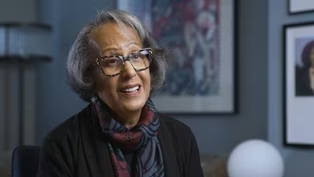
A look at our new “Destination Detroit” documentary
Video has Closed Captions
Clip: S54 Ep29 | 10m 25s | The film features interviews with more than 60 people, including genealogist Karen Batchelor. (10m 25s)
Providing Support for PBS.org
Learn Moreabout PBS online sponsorship New Episode
- News and Public Affairs

Top journalists deliver compelling original analysis of the hour's headlines.
 New Episode
- News and Public Affairs

Today's top journalists discuss Washington's current political events and public affairs.
 New Season
 New Episode
 New Episode
 New Episode
 New Episode
 New Episode
 New Episode

 New Episode
 New Episode
Support for PBS provided by:
American Black Journal is a local public television program presented by Detroit PBS