Articulate
A Place of Their Own
Season 8 Episode 6 | 26m 46sVideo has Closed Captions
Playwright Sarah Gancher and musicians Jay Ungar & Molly Mason travelled far to find home.
Playwright Sarah Gancher and folk musicians Jay Ungar and Molly Mason travelled far to find home.
Problems playing video? | Closed Captioning Feedback
Problems playing video? | Closed Captioning Feedback
Articulate is a local public television program presented by PBS39
Articulate
A Place of Their Own
Season 8 Episode 6 | 26m 46sVideo has Closed Captions
Playwright Sarah Gancher and folk musicians Jay Ungar and Molly Mason travelled far to find home.
Problems playing video? | Closed Captioning Feedback
How to Watch Articulate
Articulate is available to stream on pbs.org and the free PBS App, available on iPhone, Apple TV, Android TV, Android smartphones, Amazon Fire TV, Amazon Fire Tablet, Roku, Samsung Smart TV, and Vizio.
Providing Support for PBS.org
Learn Moreabout PBS online sponsorship- Articulate with Jim Cotter is made possible with generous funding from the Neubauer Family Foundation.
- Welcome to Articulate, the show that explores the useful truths that art explains so well.
And on this episode, A Place of Their Own, playwright, Sarah Gancher believes it is a spiritual act to make someone laugh, but this idea was born out of grief.
- [Sarah Gancher] I want to be able to move people to this point where that happens with humor and with comedy where it's like, I have this idea about the world, and then I have another one.
They directly conflict; they are both true.
And that clash releases laughter, it releases joy.
- [Jim Cotter] And for folk musicians, Jay Ungar and Molly Mason, who've been partners in life and in music for more than four decades, playing together privately, has fixed many a tiff.
- [Molly Mason] Sitting down to go through something, play a tune, or just have a little jam with a couple of country dance tunes or whatever, and immediately all that's gone.
And it's all about the music and it's wonderful.
- [Jim Cotter] That's all ahead on Articulate.
(exhilarating classical music) (exhilarating classical music) - [Jim Cotter] Sarah Gancher is something of an enigma.
She gets people to laugh and to grieve and often in the same breath.
- [Gancher] When I was very, very, very, very little and people would ask me what I wanted to be when I grew up, I had two answers.
One was a squirrel and the other one was a writer (laughs) Writer turned out to be slightly more achievable.
- [Cotter] And as a writer she's contributed to the comedy series, the Colbert Report, created study guides for the Metropolitan Opera, composed two musicals with the rock band, The Banks's, and written several highly acclaimed plays.
Along the way, she has also worked with circuses.
One in Norway would become pivotal in her journey.
Gancher's life has never felt linear and she's been fearless with each change in direction.
This stems, at least in part from her early home life in Oakland, California.
Mom and dad, she says, were unadulterated hippies.
- [Gancher] Parents literally met at a commune on the Haight-Ashbury during the summer of love at a Buddhist, like, meditation.
And my dad's friends told him, you've got to go see this cute little red head that is translating for this monk.
I think you'll really like her.
- [Cotter] The two fell in love and eventually had a daughter Sarah who became enchanted by her father's gift for spinning a yarn.
- [Gancher] He would tell me these bedtime stories that like lasted for like years, you know, that that would sort of change and grow and evolve and you know, bring on new characters and go to different planets and all this kind of stuff.
He was also a musician.
So I grew up playing with his band.
They practiced every Wednesday night in our garage and I would usually go to bed - when I was little - I would go to bed, listening to them.
And then when I was older, I would play with them.
And I learned to improvise that way.
- [Cotter] Fiddle.
- [Gancher] Fiddle.
Yeah.
- [Cotter] Sarah Gancher's father was also an environmentalist and a writer.
He was a senior editor at the Sierra Club magazine.
And later the editor of a technology magazine and a much loved local character.
- [Gancher] He was really at the center of this big, amazing group of friends that had all become friends during the sixties.
They all sort of loved music.
They all loved laughing.
He was very, very funny.
- [Cotter] Gancher adored him.
People often told her you're so much like your dad, but when she was in high school, her father became ill and it was colon cancer.
He was given just months to live.
He would survive for two years.
Then when she was 17, Sarah Gancher's beloved father, the most important man in her life, died.
Her world was riven apart.
Her heart broken.
Sarah knew that he had been writing an unfinished novel.
This would become for her a living embodiment of her dad.
- [Gancher] When I first read it, it was something very private that I was scared to even read, you know, I just sort of thought it would be too painful.
And then I read it and got obsessed with the ideas in it.
And it was his voice.
You know, that this voice I had been so starved for.
And then also that reflected so much of him, so much of what I knew of him and missed of him.
- [Cotter] The book was a comedy about the Three Stooges.
It imagined they were members of a cult in Azerbaijan, a Jewish Tallestan Buddhist cult that sought enlightenment through laughter.
The fourth Stooge lived in New York where he did vaudeville.
They would proselytize through comedy, and eventually they headed for Hollywood.
- [Gancher] I just thought to myself, I would like to try to finish this someday and to try to, you know, complete it and complete kind of in a way his life's work.
And I thought to myself to do that, I'm going to need to know a lot more about comedy.
- [Cotter] So in college she threw herself into the study of humor.
She wrote shows for stand-up comedians, directed acts for avant-garde circuses and managing her own grief, she became addicted to making others laugh.
- [Gancher] Like overnight, I was like, this is it.
I am devoting my life to comedy, that's what I'm doing now.
You know, I'm going to study Commedia dell'arte, and I'm gonna study clowning and I'm gonna study like the great silent comedians.
I got a job as the props master for Big Apple Circus so that I could watch the clowns every day.
You know?
And I think that I was really was like, I believe it is a spiritual act to make somebody laugh.
And, you know, I want to be able to move people to this point where that happens with humor and with comedy where it's like, I have this idea about the world, and then I have another one, they directly conflict, but they are both true.
And that clash releases laughter, it releases joy.
It changes your body.
- [Cotter] Around that time, Gancher began studying jazz, the music her father had played and loved.
It was different from watching new as a classically trained violinist.
It freed her and taught her to improvise and it helped her to grieve her father's death.
- [Gancher] I had a great deal of emotion.
I had a huge ocean of grief inside of me that I was not ready to put into words in any way, shape or form.
And it had to get out somehow.
And the classical pieces that I knew how to play were just not cutting it.
But you know, when I started to improvise in jazz, it was a huge relief that I felt like I could finally say what it was that I actually wanted to say without having to like filter it through somebody else's words.
- [Cotter] Later in her twenties, Gancher moved to Budapest, Hungary, where several of her well-known plays are set Many who know her work assume it was some kind of pilgrimage, but Gancher has no family or roots there.
- [Gancher] It was, it was slightly random.
- [Cotter] When she traveled with the Norwegian Circus troops, Tele Pelarez, she fell in love with the Balkan brass music that played on the bus.
And when she and her then boyfriend Rick Stinson took a trip to check out a brass band festival in Serbia, they stopped over in Budapest to visit friends.
They fell in love with the city.
Years later, the couple was married and living in New York and Gancher had moved on from comedy.
She was writing program notes for the Metropolitan Opera.
Stinson was in publishing.
They also had other side gigs as freelance writers.
But life in New York was intense and expensive.
They grew tired of trying to make ends meet.
- [Gancher] We were both, like working crazy hours and not making very much money.
And one day we were walking down the streets at our apartment after like a really long day, we were both exhausted and he turned to me and said, Do you want to just move to Budapest?
And I said, yeah, I do.
(laughs) - [Cotter] So they did.
There they soon became immersed in the local arts and music scene with Gancher playing the fiddle in the local bluegrass and American roots band.
- [Gancher] The band that I joined, which I love them so much, they could like sing with a perfect American accent, but then we would end the song and they'd be like, what does it mean 'big wheel, keep on rolling?'
(laughs) - [Cotter] Gancher made friends in the seventh district, a historically Jewish ghetto.
It was by then a gentrifying community of artists.
She and her friends would gather at a club and performance space.
- [Gancher] I would just sort of sit for hours and have long, intense, interesting conversations about every kind of thing.
And it became sort of like my home base while I was there.
It was sort of like my cheers.
And then slowly one by one, as I started talking to other Hungarian friends, I started finding out that like many of them actually were Jewish, but it was, it was not for public knowledge.
It was not something that people that they were going to advertise to people or even reveal unless they knew that it was safe.
- [Cotter] Many of them didn't even know they were Jewish until they were in their teens.
For some, it was even later.
Now as young adults, they wanted to understand this part of their identity, but they didn't yet know how.
- [Gancher] Sometimes it was a family secret.
Sometimes they had family members that were kind of like actively hostile to them, trying to find out about their identity.
And they really weren't necessarily raised with it.
- [Cotter] And Gancher could relate to them.
She had Jewish roots too, and was looking for ways to express them.
It's the theme she'd come to explore in her play The Place We Built, which is about a group of young Bohemians who build a bar in Budapest, as they tried to connect with the Jewishness they used to hide.
- [Gancher] They were sort of in this really interesting, like a really fascinating space where they're like, this is a part of me, it's like, maybe I feel drawn to this culturally, but not, not religiously.
Or maybe I want to pray, but I don't know how I feel about Israel.
And they were sort of creating this really, in Hungary, very unique community of young Jews that were sort of creating a-la-cart, Jewish identity, sort of like each one deciding for themselves what that meant for them.
- [Cotter] Her neighborhood in Budapest reminded her of the lower east side in New York.
It made her feel like she belonged and had roots, even though it wasn't home.
- [Gancher] I would sort of walk around this neighborhood and sort of feel like there, there is some relationship here between me and this place, but I don't know what it is, I don't understand it.
I don't understand who I am as an American, as a Jew in Hungary.
- [Cotter] What were the things about that Hungarian culture that you think you adapted and what made them attractive and what were the things you almost subliminally took on board?
- [Gancher] I, I feel like just, I think that when I had been in New York before that there had been sort of an experience of like being a little bit like on a hamster wheel.
Meeting and talking with people in Hungary that I sort of came to have this value of like slowing down and, you know, taking time to like, to go out, to be in conversation with a big group of friends to sort of spend all night talking and debating and wondering, and dreaming.
- [Cotter] Being in Budapest also helped Gancher to see how much of an American she was.
And she soon began to realize that the American lens, wasn't the only way to see things.
- [Gancher] Of course, as happens for so many Americans, right?
That you go to another place, you start to learn more about the specifics of that place and then you understand how much you were shaped by the specifics of the world that you come from.
Right?
- [Cotter] That's the big lesson, right?
- [Gancher] Yeah, right.
That's the big lesson, is that we're all just like that there is no default, there's no given.
- [Cotter] This would become an important part of Gancher's plays.
She sees theater as a means of bringing people together and transporting them to places where you linger and experience the world from a new perspective, with the characters on stage.
For those few hours, you see things from their point of view.
- [Gancher] But of course, there's just, I mean, it's such a reminder this year of how, how special and unique it is to go and sit in the dark with other bodies and have your heartbeats synchronized with them and to get still at the same time and to sniffle at the same time and to laugh at the same time and the way in which a play's ideas change you physically along with a community.
- [Cotter] The community part's the most, I mean, maybe the most important.
- [Gancher] I think so too.
- [Cotter] Experiencing something with other people, absolute strangers, and having similar emotional responses that brings us closer, that helps us understand each other.
- [Cotter] Eventually Gancher and her husband returned to New York.
Their son, Isaac was born and she began to come into her own as a playwright.
Over time, she thought less about finishing the book her father had started.
Amongst other works, she produced Seder, an intimate, epic about a Hungarian woman who survived Stalinism of the fall of the Soviet Union.
Mission Drift, the musical, which travels west through space and time and pursuit of the soul of American capitalism.
And a folk rock semi-autobiographical musical called The Lucky Ones.
Her 2020 play Russian Troll Farm, a Workplace Comedy made the New York Times Best Theater of 2020 list.
It tells the story of Russian writers who create fake news for social media.
- [Woman] There have been 200 kids abducted by strangers in LA province in the first month of 2016.
- [Woman's Voiceover] Actually it's 1,265 hashtag inmemorium, hashtag livesattheborder (click) hashtag (inaudible).
- [Cotter] And while writing, Gancher found some peace with the grief that had been with her for so long.
- [Gancher] There were a lot of feelings that did not go away, but calmed down when, when they were, when they were spoken out loud, you know?
So that grief is still with me.
It will always be with me, but it's not quite as loud anymore.
And to be honest, I actually don't want it to go away.
I mean, it's like really become one of my engines.
If you have a really big feeling, and if you work really hard on making a worthy vessel for it you know, part of the hugeness of that can live inside that vessel and still be there for you, but you don't have to carry it as much.
- [Cotter] Sarah Gancher has not finished her father's book, but she doesn't feel the need to anymore.
Her son, it turns out, is quite the comedian himself.
And she feels that she has found her father's spirit alive in him.
- [Gancher] He's like, from the time that my son started to walk, he's been trying to make people laugh, you know?
And his name is Isaac, which means laughter.
And like that's very important to him somehow.
He loves nothing more.
He's seven now.
He loves nothing more than to just fall down and do a pratfall to make somebody laugh.
- [Cotter] Sarah Gancher is obsessed with questions of how history shapes us and how where we live is critical of making us who we are.
She's constantly weaving laughter with music, with grief, and in doing so transporting herself and us back to places we've been physically and emotionally in search of something elusive.
(Inspiring music) (folk music) - [Cotter] After his wife, Molly Mason, came out of surgery to remove a brain tumor, Jay Ungar didn't know how she would recover.
Doctors had warned him she might be a different person.
At one point during her convalescence when she still hadn't started speaking after waking up from a coma, Ungar and Mason's brother James decided to play the Blue River Waltz on two fiddles for her.
- [Mason] My brother didn't really know the tune.
He was harmonizing it and, harmonizing it as though it was a C chord and I called out A minor.
And of course that caused jubilation and the folks who were listening from what I hear, because I was able to speak and able to recognize chords.
So something was in there.
I think at that point, they didn't even know that was very much in there.
- [Cotter] It's hard to imagine a more fitting symbol to bring Mason back into her body.
She and Ungar have spent the past 40 years cultivating a shared life in folk music.
First as band mates and then as husband and wife.
They've played for presidents.
And since the 1980s have run camps in upstate New York that used music to unite.
- [Ungar] A lot of what we do here speaks to people with different backgrounds, different political beliefs, and it's a chance to be together and not necessarily know that about each other, but to know something human that connects.
- [Mason] You can almost see the beauty of where this tune came from, where this song came from in the past.
And that's a great thing.
And I think that makes us share our humanity.
- [Ungar] Part of what we're presenting is common heritage.
This is what we all have in common.
- [Cotter] For Ungar, the link between music and place came early in his life while growing up in New York City.
- [Ungar] Fortunately, my dad had built kind of a cabin or a bungalow, you call it.
It's 45 minutes north of the Bronx on a hillside community above on lake.
And I got to spend my summers there.
And that became my love.
I really connected with nature and felt more alive and human there.
Then when I began to hear fiddle music, which was something that my instrument could do, but I couldn't yet.
I connected that with the rural life, with a connection to nature, with a connection to farming.
And so maybe that's what I've been searching for, as a composer or writer of tunes, is music that helps heal me in some way.
- [Cotter] When they met both Mason and Ungar were in long-term relationships.
They were musical colleagues for years before they became a couple.
It was all a little awkward at first.
- [Mason] It was a very kind of wonderful and exciting, but clumsy time because we were still doing gigs with Fiddle Fever, where I was the bass player and a band member.
And he was the band leader.
And you know, our relationship was the same it had been for five years and then the gig would be over and we would be back into this burgeoning couple thing.
It was a funny time.
(folk music) - [Cotter] Working with a spouse can be complicated, but Molly and Jay have learned that music is often the perfect salve for any relationship tension.
- [Mason] I do remember times when we were arguing and not agreeing about something and then sitting down to go through something, play a tune, and immediately all that's gone.
And it's all about the music, and it's wonderful.
- [Ungar] It's not an act that we got along like this.
Something happens and there's complete love.
There it is.
- [Cotter] Much of their life together has not only been about sharing music, but also about creating spaces for others to share it.
In 1980, Ungar started the Ashokan Fiddle and Dance Camps at a state university of New York campus to bring American music and dance enthusiasts of all skill levels.
In 1982, Ungar wanted to compose a tune to capture the sadness that that year's camp would soon be over.
Within an hour fiddling around, he had, most of what would become Ashokan Farewell.
The tune would become iconic after it was used as the main theme for Ken Burns' 1990 documentary series, The Civil War.
It has since been covered by musicians far and wide, including bluegrass guitarist, Tony Rice, and the Royal Marine Band.
(Ashokan Farewell plays) - [Cotter] And a simple poignant waltz has, over the years, prove to have a particular universal emotional resonance.
- [Ungar] We were traveling in the Yucatan.
We rented a car and we were going to remote places and we decided to visit this cave, which had a deep Mayan history.
And we got there, there were two elderly Mayan people whose second language was Spanish.
First language Mayan, no English, and their grandchildren.
And they took a little money to let you visit the cave.
We had instruments with us.
So when we came out of the cave, Molly and I looked at each other and said, let's play a couple of tunes for these folks.
So then we played Ashokan Farewell and the woman just, tears started streaming down her face.
And that clearly she was not connected to Scottish, Irish, American culture.
There was a switch in that, that does that.
- [Cotter] As Molly Mason and Jay Ungar have built a life together over the decades.
They've come to learn that the switch that music can throw in people's brains is pretty universal.
A unifying force in their own relationship, it has also been a means to bring others closer together through shared heritage.
And in all they do, it's as much about the listener as the player, about giving as receiving.
(folk music) - For more Articulate, find us on social media or on our website, articulateshow.org On the next Articulate, poet Terrence Hayes has been hailed for his fearlessness and pushing the boundaries of convention, but in life he's learned to practice caution.
And it took Anthony Miguel multiple attempts to become principal clarinet of the New York Philharmonic.
Failure was never an option.
I'm Jim Cotter.
Join us for the next Articulate.
(stimulating classical music) - Articulate with Jim Cotter is made possible with generous funding from the Neubauer Family Foundation.
Video has Closed Captions
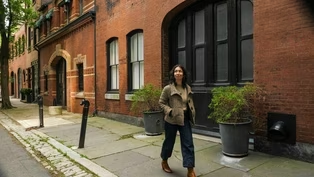
Clip: S8 Ep6 | 15m 27s | Sarah Gancher believes it is a spiritual act to make someone laugh. (15m 27s)
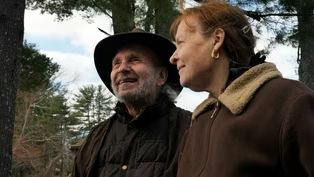
Jay Ungar & Molly Mason: A Sense of Place
Video has Closed Captions
Clip: S8 Ep6 | 10m 2s | Molly Mason and Jay Ungar have been music and life partners for decades. (10m 2s)
Providing Support for PBS.org
Learn Moreabout PBS online sponsorship

- News and Public Affairs

Top journalists deliver compelling original analysis of the hour's headlines.













Support for PBS provided by:
Articulate is a local public television program presented by PBS39