Totality: The Great Arkansas Eclipse
A Totality Story - ASMSA
Clip: Season 1 | 6m 12sVideo has Closed Captions
Eclipses and the Natural World at ASMSA
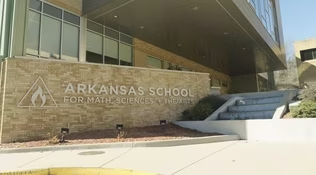
The Total Solar eclipse has everyone across Arkansas acting differently this weekend. However, the astronomy club at the Arkansas School of Math, Science and the Arts in Hot Springs have been busy preparing a series of experiments on just how this special event will affect animal life across The Natural State.
Problems playing video? | Closed Captioning Feedback
Problems playing video? | Closed Captioning Feedback
Totality: The Great Arkansas Eclipse is a local public television program presented by Arkansas PBS
Totality: The Great Arkansas Eclipse
A Totality Story - ASMSA
Clip: Season 1 | 6m 12sVideo has Closed Captions
The Total Solar eclipse has everyone across Arkansas acting differently this weekend. However, the astronomy club at the Arkansas School of Math, Science and the Arts in Hot Springs have been busy preparing a series of experiments on just how this special event will affect animal life across The Natural State.
Problems playing video? | Closed Captioning Feedback
How to Watch Totality: The Great Arkansas Eclipse
Totality: The Great Arkansas Eclipse is available to stream on pbs.org and the free PBS App, available on iPhone, Apple TV, Android TV, Android smartphones, Amazon Fire TV, Amazon Fire Tablet, Roku, Samsung Smart TV, and Vizio.
Providing Support for PBS.org
Learn Moreabout PBS online sponsorship(light music) - So the basic idea is we're going to use actual literal funnels.
I've got, I've got several different materials in here, including back projection cloth.
- I didn't really start falling in love with space until like my first semester here.
Before it was more passively.
I would, I have a shed at home and I would sit on top of it and stare at the stars at night because we live out in the middle of nowhere.
You can see the stars so wonderfully.
And I came here and I realized what kind of opportunity I would have.
- There is a pretty simple calculation we can do to figure out how long we need this to be.
It's mostly a special interest club.
Students join because they like stars.
They like looking at telescopes, constellations, they like learning about black holes.
And then multiply that by the diameter.
That gives you how long this part needs to be.
And the, the one last number you have to multiply by is the diameter you want for the image.
It's all student led.
I play a support role, but we have a great pair of co-presidents.
- What the lens does, - It's been a learning experience for both of us.
We have gone to like trying to figure out which ones, which way is the best way to communicate for both, with both of us.
So we usually have monthly meetings, one-on-one, trying to figure out what we're going to do for the next month or so.
- Being able to lead a club in the profession that I have spent my entire life loving.
I really hope that through the club I can inspire other people to, I guess, look at the stars.
- Almost.
- Almost.
- So we're all very excited about the eclipse.
They're expecting a bunch of people to come down to Hot Springs.
We'll be provided with the materials to professionally monitor the eclipse.
- We have a variety of experiments done that will are being planned by students all over campus.
For animal behavior, we have two major facets that we're exploring.
One is the students will identify some sort of organism, that could be an insect or a bird or, or whatever they choose.
They will use an app called iNaturalist to identify the animal and then keep track of it in the time before and during and after the eclipse to see, you know, what kind of behavioral changes they experience when it's dark in midday.
You know, do they engage in preparation for sleep or do they change their feeding habits or do they hide what, you know, what do they do when things act unnaturally in nature?
And then we are also preparing for an activity where we will put game cameras and microphones in areas where there are different animals, usually larger animals, than what we plan to, to watch on campus and track their behavior and how it changes.
We have students who are preparing to measure air temperature, ground temperature, and light level measurements again before, during, and after the eclipse.
The cloud survey is, is observational, so they'll be trained to recognize what kind of cloud types are in, you know, different regions of the spot sky.
See how that might change.
- That's looking a lot better.
Yeah.
There we go.
Excellent.
Okay.
Let's see how far we get if we go the opposite way.
Okay.
I think an event like this can really bring all of those interests together into one place.
I think it really ties us to, you know, the history of humanity, seeing these things in, in a rare occasion and being able to celebrate them.
- Whenever the moon like goes over the sun just a little bit.
It did the split like, like 30 seconds is like gone over, following through.
It's like a little ring, I think it's called a diamond ring effect, where it's like a little diamond ring.
I'm so excited to see that.
It looks, in my opinion, it's kind of cool.
- It's really exciting because it's just so rare.
- Point up that way and then we can see it that way too.
Yeah.
Let's try that one because that one ought to show the full disc of the sun.
- It's pretty tight.
- That's really good.
One of the challenges we face in a recurring way is how to capture a student's attention.
Because if you can't link to a student's, you know, internal fascinations, if you can't make them curious, big fantastic events in science really stimulate that interest, really captures a fascination that a student, you know, of almost any age group can really attach to.
And that can motivate them through a career of science education.
And so we're going to look at other designs.
Okay.
So the magnification's a little big for this particular surface.
- That's perfect.
We did it.
We did.
- So cool.
Wow.
 Now Playing
Video has Closed Captions
Clip: S1 | 6m 12s | Eclipses and the Natural World at ASMSA (6m 12s)
Video has Closed Captions
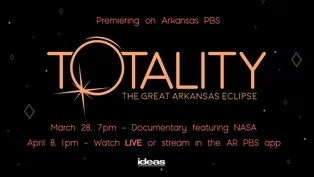
Clip: S1 | 1m 18s | Sneak peek at the Live event on April 8, 2024. (1m 18s)
Providing Support for PBS.org
Learn Moreabout PBS online sponsorship
- Science and Nature

Explore scientific discoveries on television's most acclaimed science documentary series.

- Science and Nature

Capturing the splendor of the natural world, from the African plains to the Antarctic ice.










Support for PBS provided by:
Totality: The Great Arkansas Eclipse is a local public television program presented by Arkansas PBS