Call The Doctor
Access to Mental Health Services
Season 34 Episode 10 | 24m 59sVideo has Closed Captions
Learn how to spot whether someone needs a little extra help.
Taking care of our physical health is important. But when was the last time you considered your mental health? Sometimes it's obvious that someone's mental state is deteriorating, but other times it's not. And having access to good mental health services can make a big difference.
Problems playing video? | Closed Captioning Feedback
Problems playing video? | Closed Captioning Feedback
Call The Doctor is a local public television program presented by WVIA
Call The Doctor
Access to Mental Health Services
Season 34 Episode 10 | 24m 59sVideo has Closed Captions
Taking care of our physical health is important. But when was the last time you considered your mental health? Sometimes it's obvious that someone's mental state is deteriorating, but other times it's not. And having access to good mental health services can make a big difference.
Problems playing video? | Closed Captioning Feedback
How to Watch Call The Doctor
Call The Doctor is available to stream on pbs.org and the free PBS App, available on iPhone, Apple TV, Android TV, Android smartphones, Amazon Fire TV, Amazon Fire Tablet, Roku, Samsung Smart TV, and Vizio.
Providing Support for PBS.org
Learn Moreabout PBS online sponsorship(upbeat music) - [Narrator] The region's premier medical information program "Call The Doctor."
- We hear all the time how important it is to take care of our physical health.
Perhaps now more than ever, medical professionals are reminding us how important it is to take care of our mental health as well.
The need for mental health services has grown significantly over the past few years.
But that need can look different from patient to patient.
And sometimes finding those who need the help most is the challenge.
We've brought together some of the area's best minds to discuss access to mental health services in this area.
Hear what they have to say now on "Call the Doctor."
Hello.
And thank you for joining us for this new episode of "Call the Doctor."
I'm Julie Sidoni.
I'm the news director here at WVIA.
And I'll be your moderator for this season.
This episode, as you just heard, is all about mental health, specifically access to mental health services.
Something that's growing both here in North Eastern and Central Pennsylvania and nationally as well.
Talking about mental health and the need for help used to be something the average person just didn't do.
We have asked some professionals to help us wade through what can be a confusing, and in some cases emotional topic.
We would love to help you find the help you or someone you know, might need.
So we're going to introduce now the panel that we've brought together.
I'm so happy that you're all here.
Thank you for joining us.
I'll give you a few minutes just to tell everybody who you are and where we can find you.
Dr. Tatu.
- Well, thank you so much for having me here.
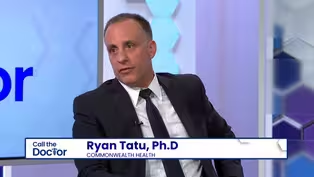
My name is Ryan Tatu.
I have a PhD in professional counseling.
I am the CEO at First Hospital.
We're one of the largest psychiatric hospitals in Northeast Pennsylvania.
And you will receive those services there.
- Welcome.
- Thank you.
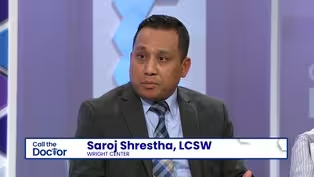
- I'm Saroj Shrestha.
I'm a licensed clinical social worker and the Behavioral Health Manager at the Wright Center.
And we do have like about nine clinics, and what's unique with Wright Center is that we have primary care and behavioral health integrated care in Wright Centers.
- We'll talk about that a little.
- Absolutely.
- I'm sure.
- I'm Dr. Tony Ragusea, I'm aboard certified clinical psychologist at Evangelical Community Hospital in Lewisburg, and about 15 years of experience doing psychotherapy, psychological testing, neuropsychological testing with a wide variety of patients.
- Right, glad you're all here.
I have to say, I'm not really quite sure where to start on this topic.
This is just such an enormous topic that could go in any number of directions, but I think it might be helpful first, to talk a little bit about the differences between mental health professionals with a counselor, and a psychiatrist, and a psychologist.
They're all different, of course, and how do you help people wade through that?
I'll give each of you a moment to tackle that if you'd like.
- Yeah.
So I think it's very difficult.
I think it's to understand that we do have medical professionals, doctors.
We have primary care that focuses on, you know, medical health, overall health, but we also have psychiatrists who are also medical doctors that prescribe and treat psychiatric symptoms.
We also have psychologists, psychologists, or doctoral level folks that provide assessments and also counseling treatment.
We also have professional counselors.
So professional counselors, break in different categories.
We actually have marriage family therapist who focus on marriage and family.
We actually have licensed professional counselors that focuses more on individuals counseling.
But while they can do other things they mostly focus on that.
So there's a whole spectrum of different levels of treatment.
And then we actually have social workers and licensed social workers.
We have LCSW, which is a licensed clinical social worker, that can also provide counseling.
So there's a different various services.
And so a lot of these disciplines can also be very focused on what they specialize.
- That's a lot of information already.
And something that people might have trouble wading through.
How do you figure out who needs which professional?
We'll give either one of you?
- Well, there's arguments to be made in different directions.
Sometimes it doesn't matter.
Sometimes it's about what is the professional you can get access to.
Because you may not have a lot of choices, depending on where you live, and what kind of insurance you have.
But the non medical, mental health professionals, so the psychologists, the clinical social workers, the licensed family counselors, those folks typically treat problems using behavioral interventions, whereas the medical folks, so your psychiatrists and your physicians, other physicians, psychiatrists or type of physician, they tend to treat mental health problems using medications primarily.
And there are just different reasons why you might choose one treatment over the other and it depends on nature of the problem that the person has.
And what the research says is about what the best way to approach that problem is.
- And also tagging along with the stigma in our society with the mental health, like access to the mental health, that's the biggest thing in our society is stigma, right?
And just to address that, like stigma in Wright Center, we have done the integration of the primary care and the behavioral together in our clinics so that anybody who walks in, in our clinic in Wright Centers, they have access to mental health services.
So that's really helping people in the area to have the access to mental health.
We have a team with the psychiatrists.
And we also have increased the psych residence program in the Wright Center, so that people who have access, we have access to the community for the mental health services.
- So I wanna kind of expand on what you said there.
For someone who has not gone through this process or hasn't had to seek help for themselves or a loved one.
Where does it start?
It can start with your family doctor, it doesn't have to start with your family doctor.
I understand at the Wright Center, you're trying to bring everyone to the table at the same time.
But currently, what do you see?
Where does that even start?
Where does it begin?
I'll ask you Dr. Tatu.
- So I think it's important that if we start identifying an issue or concern, what resource can you use?
One of the resources in Pennsylvania, they actually have a crisis number that you can call, 211.
- [Julie] 211.
That's a statewide.
- Statewide number.
And they offer a variety of different services such as, can you help pay utility, but part of the service they have is crisis services.
They have a trained and experienced professional at the other end to assess and determine what is it that's needed?
So I think we're concerned going on, anyone can reach out to that number and determine, okay, do I need help and get you connected to those resources?
I think that's key.
A lot of folks when you Google, it's very hard to determine what we just mentioned, what level of care do you go to.
So these professionals, they can hear out your story, and help to point you in the right direction.
So I think it's a good place to start.
- Where else might a patient start?
Or how might a story start here, if you're someone who needs help?
- I recommend getting in contact with a mental health professional.
And calling that person directly, you may wanna check with your insurance company first to see who in your area takes your insurance.
But then I'd call a mental health professional, that person is trained to provide an assessment to get a sense of what's going on with you and see what treatment might be best for you.
Now, that person may wind up referring you to a medical professional, for additional evaluation or screening, because sometimes there are medical conditions that can mimic psychological problems.
And there are psychological problems that can mimic medical problems.
And so sometimes there's back and forth between different professions to try to rule out or treat other explanations for the problem.
- Can you give me an example of that?
- Sure.
So, one of the most common examples that I can think of would be panic attacks, okay.
Any ER physician is gonna tell you that they see all the time, people coming into the ER, thinking that they're having a heart attack.
And when they do the assessment, they don't find any evidence of a heart attack.
And usually at that point, the explanation is that the person who was actually having a panic attack.
There are various markers you're looking for to distinguish between the two.
But oftentimes, people think they're having a heart attack, when actually they're having a panic attack.
And they're treated in totally different ways.
The best practice for treating a panic attack is using behavioral interventions, not medications, okay.
And so it's important to distinguish between the two if that person were to come to me first as instead of the ER, I might refer them to their primary care doc or a cardiologist just to rule out any possible heart issues that might be causing this symptom.
Okay.
But assuming that there aren't any identified, then we would treat it as a panic attack.
- We were talking earlier about, you know, so physical health can mean a lot of different things.
Mental health can mean a lot of different things.
Not everyone who has a problem with mental health will go down the road of drugs and alcohol, some will.
So I imagine that gets cloudy, so to speak, in that there are now a number of different issues to tackle all at once.
Can you speak to that a little bit?
So I think, again, mental health it can be very daunting, and very difficult how vast it can be.
I think the other challenge is I think mental health is difficult is because how what we perceive, I think when you look at things like Facebook, everything looks great.
So it's difficult how you feel feeling is, are other people feeling that same way.
So I think it's very important when when people are very, very difficult is that how are they reaching out for help, I think is gonna be key.
I think everyone's experience's a little different.
So I think that, when that happens, it's important to reach out to a mental health professional.
I think it has to be key.
I think, you know, talking to loved ones is key.
So I think when talking about mental health, I think it's again, very vast, but I think also, when you reach out, I think is gonna be key as well.
- Why is it such a big deal for people to reach out?
I'll put that one on you.
Why is it such a big deal?
- Stigma.
It's a stigma, right?
Definitely, like with the mental health people, you know, like, with the...
If you've broken your arm, people were snapping your, like, you know, cast and putting in Facebook, I got hurt.
But nobody says that I'm depressed, I have anxiety, I'm hearing voices.
Nobody can say that because of the stigma of the word suicide is gonna say, right.
So that's a bigger barrier.
And the people often because of stigma, and they're not reaching out.
But we really need to as a society, normalize this mental health, mental health is a very important topic.
All the physical health is related to mental health.
You know, so we've been hearing this for a long time, but we don't give really importance to the mental health, how important is to take care of your own well being first.
I'm a licensed clinical social worker.
I do practice self care, and I teach my staff like how to do self care, that's a very important thing.
And I'm also trained in trauma informed care sanctuary model, one of the mantra is like, your goal, what's your goal for today?
You know, how are we feeling and who are you gonna look for help?
I've been trying to teach staff the same way, like three goals, basically, what's the goal for today?
And who's gonna help you with that?
And how you're gonna accomplish this basically.
That's a very key important self care as well.
- But the idea of self care then gets into prevention, you know, is there a notion that you can prevent some mental health issues?
I imagine not all of them, but there have to be a number of different root causes of mental health issues?
- [Saroj] Absolutely.
- Sure, I mean, we can talk about this on so many levels.
There are individual causes of mental health problems.
There are family causes of mental health problems, and there are broader cultural causes of mental health problems, societal causes.
So examples might include, so on the individual level, for example.
What kind of lifestyle do I have?
Do I get enough sleep?
What's my level of stress?
Do I get exercise?
What's the quality of my diet?
Okay.
Problems in any of those areas could lead to greater mental health problems down the road.
But let's look at another example.
Let's look at a broader societal contributor.
Poverty, okay.
Discrimination, marginalization, inequity, income and equity.
These are known to be clear causes of mental health problems at the individual level.
They contribute.
And so to talk about prevention, you don't just talk about helping the individual to function better and take better care of themselves.
You also need to address the bigger sources, the families, the neighborhoods, the towns, the country.
- That's a big systemic issue more than it- - Yes.
- More than an individual.
- That's a big difference between the way mental health professionals look at problems versus medical professionals, traditionally, traditionally, medical professionals tend to look at problems as existing within the person, within the individual, whereas mental health professionals tend to see problems as belonging to many people and having many different causes.
And so we're often reluctant to diagnose the person because we feel like that kind of neglects the responsibility that other people are playing in this.
Their spouses, their kids, their partners, their parents, their neighborhood, their bosses, their colleagues.
Everyone's kind of playing a role in different ways.
And we're more about trying to tease apart who bears What responsibility here.
- And you're shaking your head over here.
- So I mean, you're talking about before the different factors, you know, that can contribute to mental health, such as you know, someone's economic status and certain challenges and stuff like that.
Absolutely.
And I think that to your point to prevention, I think there's a lot more we can do in the community.
I think that in terms of being preventative, you know, can we do better in terms of getting information, worth bringing to folks to the ER.
Do they have transportation to get to their appointment to see their mental health professional?
You know, are they able to, for example, where they're gonna get their next meal at?
When you have all these issues, and you put it on top of mental health just exacerbates it.
So I think there's a lot more work that can be done in terms of how we come together as a community to become aware of those factors.
Collect that information and decide how we're gonna handle these things.
If transportation is truly seeing a trend, how do we address transportation in our community, so these folks can get to their appointments is gonna be a key thing.
I think the other point is, is that the community pieces, mental health is something that we are meant to tackle together as a community.
It's not always it can be done in silos, I think a lot of work needs to be done.
Saroj has talked about it, integrated where we actually have a whole team approach, which is really good.
I think a lot more work needs to be done in terms of us being a community, raising awareness, getting education out there to our schools, to our police officers.
So a lot more work needs to be done there.
So when we come together, we can quickly identify someone and give them the help that they need.
- Where do we even start on this?
I mean it seems to me to grant better access to everyone, we need to fix problems that are way up here.
You know, which are very, very daunting, and I can imagine why this is such a conversation that never really has a solution.
- And again, like this is the thing with the school system, right?
We have to really have social worker access to social worker, not just the guidance counselor, one guidance counselor for 1500 students, that's impossible to do it, right.
We need to have more social workers in the school setting, so that we can really tackle this problem of the very early, early stages like, you know, anxiety, depression and at the school level, so that having the kids access to the social worker at the school level, I think that's a really key to go.
I think there has been nationwide train that advocacy, like more social workers is needed in the school system.
- Not just schools, but in hospitals, community health centers, right.
Other community organizations everywhere.
- [Saroj] Everywhere.
- Definitely.
- How young are you seeing mental health issues when you bring up schools?
Now I'm starting to- - Very young.
- Very young.
- I will say that the American Academy of Pediatricians, you have the, you know, American Academy of Child and Adolescent Psychiatrists, and you have children hospitals, all declare a national mental health emergency for kids.
The reason why is because the number of suicidal ideation is going up exponentially.
Suicides are going up.
So our kiddos are struggling.
So that's why it's so important to talk about, you know, getting to a specialist.
But also as a community, who are the gatekeepers?
Is it the schools?
Is it the police?
Who are the people who are involved around the kids?
And are they educated around mental health awareness and to recognize, because oftentimes, we don't wanna go, we don't always wanna take them to jail, we wanna divert.
If they need treatment, can we get to that treatment.
So I know that the county is doing a lot of work with our first responders.
They're doing a great job in Luzerne County, and getting the education out, we need more of that.
And as we move forward that needs to continue.
Because like I said, we want to try to divert them and get the treatment that they need.
- Is that what it takes for better access, better education?
I mean, it's not as simple tied up in a bow solution.
But that's kind of what I'm hearing is that if we can get the right people to the right... To those who need it most to be educated, or is that way over simplifying?
- No, that's certainly part of it.
It's also a problem with numbers.
There just aren't enough mental health professionals to meet demand.
And so we need to make progress there.
Providing ways to incentivize more people to go into these professions.
These are not generally the most financially lucrative jobs that are out there for health professionals.
So they're often disincentives to get into mental health as a profession.
But we have a real crisis of access to professionals.
There just aren't enough.
There are about 6000 psychologists in Pennsylvania and roughly maybe 3000, psychiatrists and Pennsylvania is a relatively well off state in that regard.
We're middle to above the pack, which really just goes to tell you how bad the problem is nationally, this is true everywhere.
And so we need to increase the numbers of professionals - 6000 and 3000 in the state of Pennsylvania.
- Yeah.
- That's very low.
That seems very low to me.
I mean, compared to- - I just wanna add for child and adolescents, there's only one child and adolescent psychiatrist for 8000 population.
- [Julie] Oh, my God.
- That's a very... Like it's unicorns to find.
- Do a lot of schools have therapists or counselors there?
Or is that something that you don't see very often around here?
- No, I think it's fairly common for schools to have some kind of counselor but, you know, the level of education, and training, experience that they have can can vary quite a lot.
- But I think the biggest issue to that point is let's say we have a counselor and they identify an issue.
And so let's say they tried to get into a psychiatrist and get an appointment.
Some have booked out four months.
And we know something is key to getting an appointment and how can you wait four months?
So there's an issue.
That's where we're saying that unfortunately, if some folks are so booked, and that's why we need more mental health specialists so we can get more access to the people the care they need.
- I hesitated to talk about signs that someone might need help.
But I do think it's kind of an important piece of this, whether it be you aren't feeling quite right yourself, or you're noticing a loved one isn't feeling or seemingly acting like they normally do.
I realized this is a big question.
But is there a moment where it becomes... You need to take care of this?
Is that moment, the very first sign?
What would you like to tell people to look out for in their own homes or in their own schools?
- So there's no easy answer to that question.
Oftentimes, what we're looking for when we're looking for evidence of a mental health problem is there for example, a significant change in their functioning from a previous level?
So are they struggling in some way that where they weren't struggling before?
Are they acting particularly odd or unusual for them?
That can alert us to a more acute kind of problem that may be emerging?
Is the person experiencing some level of stress that is causing them to have difficulties in just day to day functioning?
In getting up in the morning and sleeping at night, and getting to work in relating effectively with other people and meeting their responsibilities?
Taking care of themselves.
Eating well.
Exercising.
So are they experiencing difficulties in their ability to function?
That's one I think, rule of thumb, would you agree with that?
- I really agree with that.
One thing I will add to that, because I think to prove your point is when you see a change, let's say someone's doing well in school, they're no longer doing well, is when do we approach that child or that person?
And I think that's okay to reach out and saying, "You know, are you okay?"
You don't have to pretend to be a mental health professional to check on someone, see how they're doing.
And their concern is to reach out.
And that's why there are resources.
That's why I mentioned the 211.
If they're concerned, and you have a concern, reach out, get an appointment, and follow up on that appointment.
I think it'd be very important.
I think the other part is ask the person is, I mean, are they hurting other people?
Are they hurting themselves?
If you've seen a pattern that because, you know, coming from a hospital, I think is very important, you gotta seek out treatment for that person.
I think that is key.
If someone says, I feel like hurting myself, take that seriously.
I would not dismiss that, and seek help for that person.
And the way you can do that, you can do that too to 211.
If you feel like there's an emergency and serious in that moment, is take them to the hospital.
And get them assessed.
I think that is important.
I wouldn't dismiss those things.
- And what would you say to that Saroj?
- Is basically like...
It's very important like, you know, also the suicide rate, suicide is very, like people say that that's a choice.
That's not a choice.
That's mental health, or something is really going on inside, you know, we really need to look at it like Ryan and Andrew said.
Basically, you need to really look at the signs, what are the signs, also, in the pandemic, like after all this pandemic, teenagers were having extreme difficulties about school adjustment life and suicide.
There's studies out there, the suicides rate went up for the adolescents population.
- [Julie] During the- - This pandemic.
After the pandemic and this is going on.
And the good part is that there's a decrease in the white populations, but also there's increase with the black and brown population and the suicide rate went up in the adolescence populations.
That's a very significant, but again, look for the unusual signs, talk to them, you know, really, and seek for help.
- We have about, I'd say, 30 seconds, maybe 45 seconds here.
I told you, this would go fast.
And I know we haven't even even touched the tip of this iceberg.
But I'll say one more time, if there is something that you think would be particularly helpful to someone who might be watching this right now, what do you think that would be a Dr.Tatu?
- So one thing I will say is, I think we're talking about mental health being very large, but it starts with you.
I think that oftentimes we don't learn ourselves when we're not okay.
It's okay to teach people that are to reach out and to model student, things are not all right.
I think that's very important, I think most people will reach out to learn what do we do when we're in trouble?
I think that's very important to model.
- Alright, well, thank you to all of you.
And I'm sure if questions come in, I can push them your way.
I hope we've at least helped somebody out there but that's gonna do it for this episode of "Call the Doctor."
We thank you very sincerely for joining us.
And if you've missed even a portion of the show, you can head to our website wvai.org.
You can watch online or find a listing of where to catch that replay on TV.
I am Julie Sidoni.
And for all of us here at WVIA, we will see you next time.
(upbeat music)
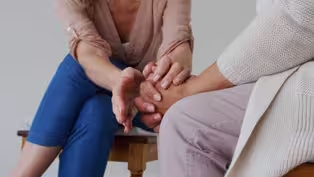
Access to Mental Health Services - Preview
Preview: S34 Ep10 | 30s | Airs Wednesday, May 4th at 7pm on WVIA TV. (30s)
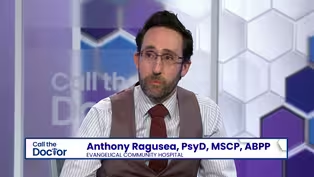
Anthony Ragusea, PsyD, MSCP, ABPP
Clip: S34 Ep10 | 58s | Anthony Ragusea, PsyD, MSCP, ABPP - Evangelical Community Hospital (58s)
Providing Support for PBS.org
Learn Moreabout PBS online sponsorship
- Science and Nature

Explore scientific discoveries on television's most acclaimed science documentary series.

- Science and Nature

Capturing the splendor of the natural world, from the African plains to the Antarctic ice.












Support for PBS provided by:
Call The Doctor is a local public television program presented by WVIA