
ACES Veterans Museum and the Ukrainian Cultural Center
Special | 25m 43sVideo has Closed Captions
Part one of this episode features ACES Veterans Museum in Germantown.
Part one of this episode features ACES Veterans Museum in Germantown, which works to preserve the history of Black and minority veterans in the Philadelphia area through events and exhibits. Part two highlights the Ukrainian Educational and Cultural Center in Jenkintown, an important community hub for preservation of Ukrainian culture and language.
Problems playing video? | Closed Captioning Feedback
Problems playing video? | Closed Captioning Feedback
WHYY Presents is a local public television program presented by WHYY
ACES Veterans Museum and the Ukrainian Cultural Center
Special | 25m 43sVideo has Closed Captions
Part one of this episode features ACES Veterans Museum in Germantown, which works to preserve the history of Black and minority veterans in the Philadelphia area through events and exhibits. Part two highlights the Ukrainian Educational and Cultural Center in Jenkintown, an important community hub for preservation of Ukrainian culture and language.
Problems playing video? | Closed Captioning Feedback
How to Watch WHYY Presents
WHYY Presents is available to stream on pbs.org and the free PBS App, available on iPhone, Apple TV, Android TV, Android smartphones, Amazon Fire TV, Amazon Fire Tablet, Roku, Samsung Smart TV, and Vizio.
More from This Collection
A community history project from Scribe Video Center taught video production to Philadelphians embedded in the local neighborhoods to show you what makes them so special.
Housing Issues in Philadelphia
Video has Closed Captions
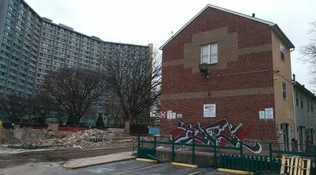
This episode features the UC Townhomes in West Philadelphia, and Elder Abuse in Housing (25m 39s)
Video has Closed Captions
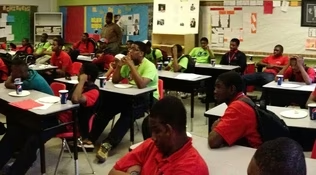
This episode features Simon Gratz High School and West Philadelphia High School. (28m 51s)
Providing Support for PBS.org
Learn Moreabout PBS online sponsorship(overlapping voices) - [Voice 1] Northwest community of West Philadelphia.
- [Voice 2] I'm here, I'm alive, I exist.
(bongos play in background) (indistinct chatter) - I live up there.
(indistinct chatter) - [Narrator] Once a bustling market place, the building on this very spot transformed during World War II.
Black soldiers ostracized by a segregated society, found solace within its walls.
Laughter and jazz replaced the clamor of commerce.
It became a haven for heroes far from home.
Now, the ACES Veterans Museum, whispers tales of forgotten lore, resurrecting the stories of those who fought for a nation not fully theirs.
Through faded photos and worn uniforms, the heroism echoes, reminding us that even brick and mortar can hold the weight of history.
The building in which we know as ACES Veterans Museum, has been known to many by other titles, yielding various purposes, ownership and value.
Its vast form of representation over the years holds so much history.
But because it was a place open to Black soldiers during World War II, for socializing and gathering, we honor it as a historical location and landmark.
- My name is AV Hankins, MD, FACP.
And I'm a director and innovator of a ACES Veterans Museum.
Upstairs, where Parker Hall was, was created because Blacks could not integrate.
And so even though they could fight and die, they weren't welcoming some USOs.
- Mm.
- But there were some courageous people that started the Hollywood canteen and they said, "No, if it's not integrated, it's not going to be."
And a lot of those people in the 1940s that stood up for human rights got Blacklisted in the 1950s.
My father who was in Special Forces was a Muslim, had a very difficult time of it.
(indistinct) Lorenzo, the first Hispanic commandant, had a very difficult time of it.
When my father came home, he had to sleep on the floor in the Y.
When Manuel Lorenzo came home, they got no benefits 'cause they weren't in Spanish.
But what these two men had in common was a concept that United States says, "All men are created equal, all women have value, all people should be loved."
That's as valuable as it was in 1940s as it is right now.
- As a veteran myself, I think it's a wonderful location to come and learn about the history.
I am a history buff myself, so I do history exhibits.
I actually also speak on history and have been doing one on Blacks in the military since the Revolutionary War.
So of course they have a physical location that highlights the importance really, of how we have served is just the honor to support.
- ACES is, as far as I'm concerned, it's a cultural heritage and it's something that has to be not only maintained but shared with the world.
- It means a whole lot to me 'cause it's the true history of Black soldiers and what we did and what we went through, the prejudice and stuff.
- It means a lot because I learned a lot and thinking that you know a lot, but you never know everything.
I did not realize that the history behind this building and I graduated from Germantown High School so I passed by this building many a days, many a years.
Plus I be on the avenue a lot.
And I just did not know that this was a USO for Black veterans.
- What ACES mean is a story that should be seen and told and anyone even not knowledge about the veterans and what they did, this is the place to come and see firsthand what ACES has to offer.
And I'm sure the public wants they get here and see what the displays are.
Some of the artifacts and some of the real items from World War I and II.
I'm sure they'll be so excited they'll want to spread the word that ACES is here.
- I've seen some pictures of some people that I know.
So the fact that it is such a rich history of military personnel, it is amazing that you don't see this anywhere else.
- Know ye that by virtue of exceptional service and the confirmed contributions to the traditions of the excellence and esprit corps of the Quartermaster Corps, corporal Benjamin Barry is inducted as a Hall of Fame member of the Quartermaster Corps.
In testimony thereof this day, 15 May, 2023.
Signed by Michael B Siegel, Brigadier General, US Army, the 57th Quartermaster General.
- Whoa!
(crowd cheers) - I was introduced to ACES I'd say back in 2008, 2009.
My father, Sam Hill, was a World War II veteran, for me it was important for him to get his recognition as being a veteran.
Those was his important years for him.
In fact, he never went anywhere without his World War II veteran hat.
So since the ACES Veterans Museum does honor days throughout the year, I would bring him regularly for those events.
And then of course since I was there as well as a veteran, then I would participate as well.
- After being a police officer for about 20 years, I found ACES 'cause I didn't live that far from it.
And I came, then I tried to help organize what she was doing because she was bring back what the guys in World War II went to.
- I believe, I wanna say 2014, I was walking in the area of Germantown, I live in Germantown, and Dr. Hankins was having, I saw veterans in the lot of a park.
And so I went over there being inquisitive to see what was going on.
And I was asked if I was I was a veteran.
I said yes.
And we sat down and I participated in the program by listening.
And I was very inquisitive 'cause I had never heard of the ACE Museum.
And I was impressed.
And especially when I went to the building where her office is at, I was even more impressed because of all the artifacts and the pictures of African American veterans from the Civil War all the way up to the present.
- When we discovered what upstairs turned out to be Parker Hall, a functioning USO for Black soldiers during World War II, we knew we were gonna do everything we could to preserve it, but we didn't know exactly what we were going to do.
And this was an opportunity to restore a place where Black veterans were and their families.
But it was also a chance to expand it.
And that's what we did.
We created ACES Museum honoring Black and minority World War II veterans and their families.
The decision was made that we were going to not only preserve Parker Hall, but in fact, make it showplace to show the role of Latinos, Puerto Ricans, Asians, women, just the diversity of people that fought for liberty then and now, because that is in fact the American concept that all men are created equal.
And even though sometimes you fall a little short, it's the idea that's wonderful.
This is not a place where you have a emperor, or you have a king, or you have a communist party where only certain people can advance.
And I've been blessed to go around the world and I will tell you that the American democracy, the great experiment is worth learning about and fighting for.
One of the reasons we have ACES Veterans Museum and our motto is respect the past, nurture the future because we have to nurture the future.
And it is so important that our children, particularly in this neighborhood, recognize the people who give their lives for us.
There's a sign in the museum, "Home of the free, because of the brave."
Thank you for coming out.
(audience applauds) - Thank you.
- So I created a nonprofit called Victoria Urban Outreach Tutoring Service.
I created it in 2016 and then I got it 501c3 in 2018.
So we've been on the ground providing educational resources and services to Philadelphia residents and its totality.
I came to be associated with ACES through my mentor and others that I met, like Dr. Hankins who runs the museum.
My mentor, Deborah Gary, she sat on the board of ACES Veterans Museum.
In addition, she created another organization called the Society to Preserve African American Assets.
And being on that board, I definitely identified ACES as one of the spaces that we wanted to preserve as an asset for our community.
My role in the ACES Veterans Museum short documentary was to be the director and visionary for that space and to really capture the life and the legacy that it has already left and the potential legacy that it can leave for Philadelphia residents.
Creating this film was amazing, time consuming, a lot of research, a lot of learning.
Due to this wonderful space at Scribe, I got opportunity to learn more about the technology and in depth about videography.
In addition to using some of the more modern technology like drones that they have to capture imagery, the interview process was amazing and a lot.
(chuckles) Identifying questions to ask, not wanting to overstep or under step and getting the trajectory of the vision outlined by the participants was really the whole focus that I hope to achieve.
I hope this film is used by ACES Veterans Museum, myself and others.
I hope it becomes a go-to film to uplift the work that's done in community through veterans and for veterans.
In addition, how everybody in every household and resident in Philadelphia County is connected to a veteran in some way.
And how can we push that?
So outside of sharing it at the wonderful premier, outside of sharing it at Temple, outside of sharing it on Veterans Day for 2024 with the veterans, we hope to take it to schools.
We hope to take it to universities to give them an identification of what they can really do if they set their mind to it in community.
(upbeat music) (birds chirping) (children singing in Ukrainian) (singing continues) (birds chirping) (upbeat instrumental music) - We have students here who are first generation, students who just arrived from Ukraine.
We have students who speak only English at home, students where one parent is a Ukrainian, the other parent is not.
In four hours, we're trying to teach them to speak, to read, to write the alphabet and also give them a chance to socialize and get to know each other.
And to create a bond that will last, you know, 10, 20, 30, 40 years.
- FOST is a scouting organization.
It is based off of the soldiers who formed together in order to preserve the Ukrainian culture.
Just something that we've all fought for.
But that doesn't mean that you can't be both.
I'm a second generation immigrant.
It was my grandparents who came here.
- You know, my father was never really able to go back to (indistinct) because of the war.
- [Observer] He traveled across the entire world.
But he never lost his sense of Ukrainian identity.
- His passion was to make sure that his children were able to understand the Ukrainian culture.
- And that was something he very much wished for me.
And I'm obliged to fulfill that wish.
Yeah.
(upbeat festive music) - There were a lot of (indistinct) that came through, right?
The waves of Ukrainians.
The people that are coming now, I think they are clinging to everything Ukrainian.
They wanna feel they're not far from home.
It's heartwarming, it's difficult 'cause, "Why they're here?"
You know why they're here.
It's sad.
(choir sings in foreign language) - You know, when I'm singing with the choir, like the songs, they're not just like, it's not just like, oh, like a fun little song.
You know, if we're singing about the Kosikev fighting against the Russians.
Russia's current war against Ukraine is also a war of cultural genocide and the actual war of extermination against the Ukrainian people.
We in the diaspora are not in Ukraine.
I think anything we can do to preserve Ukrainian culture is fighting against this Russian effort.
So in a small way, the Ukrainian Center is kind of helping Ukrainians in Philadelphia stay together and keep their identity and not lose it.
- Me personally, I lost part of my Ukrainian heritage when I tried to become American.
But few years ago, like two years ago when the war started, I kind of, something woke up inside of me.
- UNWLA started the biggest that I know of, campaign of collection.
And it happened in our facility from something that someone thought it was gonna be five or six bags of stuff they may collect, turned out to be millions of boxes.
It was overwhelming.
It was, it was emotional to see everyone that wanted to come to do something.
- I feel a bit guilty that I didn't send them to Saturday school.
I wanna tell other parents who are raising kids in situation like mine, like half American and half Ukrainian family.
Just get those kids out of the bed, take them to school, they will be really thankful to you.
- It's pretty cool to be able to say like, you know, it is like at home.
Growing up, so.
- Thanks, man.
- Just thankful.
- What am I trying to do here?
- I'm just trying to pass down that this is important 'cause this, the center is important.
If there were ever a time, now's the time to say yes, I'm Ukrainian.
Yes, I'm Ukrainian.
(sighs) (audience applauds) (upbeat festive music) (singing in foreign language) (audience applauds) (singing in foreign language) - I met Angelica Riley who's a co-director who was a journalist in Ukraine before coming to America 20 years ago actually at a Philly camp.
They had a mixer for young and upcoming filmmakers who were intro trying to work in the community.
When we both found out about our Ukrainian background, we decided that it'd be a natural fit with my technical experience and her journalist skills to try to make a story about our community.
And then we sort of searched for what opportunities were out there and that's how we came across Scribe and "Precious Places".
So she helped kind of discover our subjects and arranged the interviews.
We interviewed people together and I was running the camera, the sound, and the technical aspect of the editing.
When Ukraine was first invaded in 2014, one thing that was very difficult for the Ukrainian community is that most Americans didn't even know about our country.
When Russia then launched the full scale invasion in 2022, and I was older, I thought it was important to try to show the United States more about Ukraine community, what we stand for, where we hope for our country to go because the continued American support in the war is kind of a vital importance for the country.
That said, this is just kind of a small slice of life of how I was raised myself in this same community.
The challenge that we knew going into this Ukrainian Center shoot is that it is such a big community with so many different organizations under it, which if you watch the film, you'll see.
We didn't know who would be the main character if there would be a main character or if it's gonna be sort of an ensemble cast.
So we ended up shooting over 30 hours of footage throughout basically the spring and the summer.
And then the challenge after that was sorting through it and finding kind of thematic links.
We actually ended up falling upon mothers and sons, right?
There's three pairs of mothers when their children and the sort of multi-generational nature of the Ukrainian Center, right?
You sort of see that the love of one older generation has as they try to build something, pass it on to the next, and as the next generation grows up, they learn to sort of steward the place.
And then they're giving it onto the third generation and hopefully onto the fourth and the fifth.
And those are themes that came through.
But you know, we've never found that if we were just writing this as a script to start.
What I really enjoyed with this documentary is just how much music we were able to put in.
And none of it is a soundtrack that's added in.
All the music was captured.
From the dancing to the choir.
It made the documentary so much more rich.
And it's just what's there in the building if you walk in.
What I hope is that families coming over from Ukraine will watch the documentary and not only will they see the abundance of activity that you know, will be kind of fun to send their kids to, but the sort of deeper purpose to help keep them and their kids connected as they're here in a new land.
And the kids will become Americanized in some ways.
(upbeat percussive music) (indistinct chatter) (upbeat music)
















Support for PBS provided by:
WHYY Presents is a local public television program presented by WHYY