Buzz in Birmingham
Addiction Prevention Coalition
Season 5 Episode 3 | 26m 47sVideo has Closed Captions
Addiction Prevention Coalition (APC) aims to eliminate addiction in Central Alabama.
Through in-school prevention programs, community educational events, overdose prevention resrouces, and weekly support groups led by peer recovery specialists, Addiction Prevention Coalition (APC) aims to eliminate addiction in Central Alabama. APC’s biggest event of the year is its End Addiction Walk in downtown Birmingham.
Problems playing video? | Closed Captioning Feedback
Problems playing video? | Closed Captioning Feedback
Buzz in Birmingham is a local public television program presented by APT
Buzz in Birmingham
Addiction Prevention Coalition
Season 5 Episode 3 | 26m 47sVideo has Closed Captions
Through in-school prevention programs, community educational events, overdose prevention resrouces, and weekly support groups led by peer recovery specialists, Addiction Prevention Coalition (APC) aims to eliminate addiction in Central Alabama. APC’s biggest event of the year is its End Addiction Walk in downtown Birmingham.
Problems playing video? | Closed Captioning Feedback
Where to Watch Buzz in Birmingham
Buzz in Birmingham is available to stream on pbs.org and the PBS app.
Providing Support for PBS.org
Learn Moreabout PBS online sponsorshipDo we want people to use drugs?
No.
Do we know people use drugs?
Yes.
So we want them to stay alive until if and when they decide to get some help.
We like to create meetings that are more like little laboratories, trying to get local people to help local people in a way that serves local people.
We cultivate a culture of vulnerability.
We are meeting people where they're at to try to do things differently because everybody has pain.
Not everybody knows how to effectively manage it.
[Narrator] Funding for this program comes from the Mike & Gillian Goodrich Foundation, the Daniel Foundation of Alabama, and the Caring Foundation by Blue Cross/Blue Shield of Alabama.
They're not the rich and famous.
Their profit comes not from the thing they sell, but the good they do.
Our nation has more than 1.5 million nonprofit organizations that employ one out of 10 Americans, providing services that otherwise go unfulfilled and keeping our communities connected when all else fails.
But nonprofits often lack the tools to properly promote themselves, to inspire more donors and volunteers and clients to their cause.
That's where I come in.
I've been in the nonprofit world for 25 years.
I connect nonprofits with marketing professionals who donate their time and expertise so that at the end of the day, these life-giving organizations can do more, do better by creating more, that's right, buzz.
My name's Shane Herring.
I'm a personal long-term recovery.
I currently serve as a president for the board of directors for the Addiction Prevention Coalition.
(gentle music) My sister passed away in 2009 of a drug overdose.
She was five years younger than me and just the most amazing, kindhearted, beautiful, fun-loving person.
She was a fixer.
And a lot of the times she dated boys that didn't come from the same background that that we did.
My mom and my dad were together.
We had like safety, security, you know, all that.
And she felt like everybody deserved that.
One of the reasons we were founded was because there was a family who was well connected, had everything anyone could ask for.
They were perfect, right?
And yet they had a kiddo that was struggling with mental health and substance use issues, and they did not know where to go.
She and her boyfriend at the time did whatever they were doing and overdosed.
And he did not.
But, you know, a lot of times when you use opiates, you're falling asleep.
And before it was too late she, she was gone.
So I subsequently took a turn for that same drug to see.
My thinking was to make sure she'd not suffer towards when she passed away, you know?
And that was my thought, and I became addicted myself.
An old boss of mine used to say that we didn't have a painkiller problem; we had a pain problem in the United States.
The United States is such a small percentage of the world's population, like less than 5%, and we consume 99% of the world's hydrocodone, 80% of the world's opioid supply.
Why is that?
Because we don't know how to handle our stuff.
I was a volunteer.
I was PTO, teaching, taking care of my mom who lives in another state, kid with a disability.
I would take amphetamines throughout the day to sort of blast off and try to perform highly.
I was a very high achiever.
And then at night I would use huge amounts of alcohol and marijuana.
And of course, that was just a cycle of violence against myself.
We attack sort of this thing called addiction through prevention, harm reduction, and then recovery support.
But the thing that undergirds all of it is community.
And so we are doing our best work when we're in community where people are.
[Narrator] Over the years, Addiction Prevention Coalition has led the charge in organizing recovery groups, but their work first begins with prevention efforts in schools.
[Nichole] So we're going into schools, kindergarten through 12th grade, public/private schools, pushing in primarily through health classes, giving fact-based, science-based information about the impact of drugs on the body and brain.
[Narrator] Addiction Prevention Coalition also facilitates in-focus groups, which are peer-led prevention clubs in eight local high schools.
One of them is at the Alabama School of Fine Arts, led by senior Danielle George.
A few years ago during my middle school years, right around the COVID era, I actually had a close family member of mine die due to a fentanyl overdose.
Wow.
So I recognized a need really early on for people to know that there is support and there is recovery, especially for teenagers, that you don't have to do this just to seem cool or to fit in.
So in 2025, we served almost 9,000 students in our region.
And those are unique students that we're seeing up to four times.
Again, beginning in kindergarten, we're using puppets, literally puppets.
And we were talking about how turtles pull themselves inside when they're hurt, and we are encouraging them to stay outside and to talk to people and grownups that they trust.
So fast forward when you're stuck in the muck known as middle school, that's when a lot of people start coping in some unhealthy ways.
I had used drugs and alcohol since I was 15.
It didn't matter what drug or alcohol it was, it was an escape.
For me, alcohol was just a way to kind of escape and regulate that stress.
I would wake up in the morning and I would be filled with despair.
I really believed that I could not get out of bed without taking some substances.
I wasn't a regular drinker.
I was a binge drinker.
So I had a hard time figuring out that I had a drinking problem.
I thought I had a cash bill problem.
I thought I had a system problem.
I thought I had to be in a single mom problem.
Where all I had was like a living problem that I didn't know how to deal with.
Most of us don't know how to cope.
And so we might go shopping, we might gamble, we might have sex, and we might use drugs and alcohol to numb those feelings of pain that we haven't quite figured out how to process.
So the common thread that I see as the underlying issue is a lot of trauma.
Individuals who have not had their trauma met and mental health.
And so a lot of times people are self-medicating by using substances.
And then that childhood trauma, that physical abuse that they may have experienced, they've never had that addressed.
[Narrator] On top of handling all the drug cases in Jefferson County, judge Maria Fortune facilitates a program called Drug Court, which offers nonviolent defendants rehabilitation rather than incarceration.
APC is one of our resource providers and community partners.
They come out to our court and their peer support specialists offer classes for our participants.
But most importantly, they're there to guide them on their journey to recovery.
It's hard to break something that you've done repeatedly.
Like you brush your teeth every night with the same hand.
If you go home tonight and you try to brush with the opposite hand, it's gonna feel weird.
And it doesn't mean there's anything wrong with it.
It's just not the way you're used to doing it.
They meet with them not only in the court, but they also will take them to different events with them, which I know several of my drug court participants have really connected with the peer support specialists there.
Much of recovery is just learning to create new rituals and new habits to replace these ones that no longer serve us.
Let's talk about stigma.
Stigma is the thing that keeps people sick.
Stigma is like a constructed idea of disapproval, of a behavior, and it makes the person who does the behavior feel less than.
People feel like they've done something wrong, they've committed some sort of crime, they've committed some sort of sin because either they've raised someone who's using, they themselves have used substances, they have tried to themselves.
You whisper the word, you say, oh, my brother is a drug addict.
We like lower it because there's so much embarrassment and hurt that surrounds it.
It creates this sense of deep-seated, like, I'm not good enough.
Do we want people to use drugs?
No.
Do we know people use drugs?
Yes.
So we want them to stay alive until if and when they decide to get some help.
So we do that through Narcan distribution, fentanyl test strip distribution, providing wound care for people that might be using drugs that create sores and things like that.
So in 2025, we deployed 361 boxes, which are Narcan delivery devices with a training video component.
And Narcan is the opioid reversal drug.
It's the nasal spray.
Speaking of Narcan, we gave out almost 9,000 units of Narcan last year alone.
[Narrator] I wanted to see a one box out in the wild, so I met up with Nicole at Avondale Brewing.
So when you open the box, you're gonna pull this tab.
First off, let's take a deep breath.
[Presenter] Step number one is to check to see if somebody really is unresponsive, react.
And within two minutes, this will walk somebody through how to administer Narcan and how to do rescue breathing.
Oh wow.
The other thing that's really cool, particularly here in Birmingham where we have a large Spanish population, as you can push this button.
(presenter speaking in Spanish) [Narrator] Beautiful.
Beautiful.
(presenter speaking in Spanish) And so every box comes with two doses of Narcan, two boxes of PPE, so like a mask and gloves and stuff like that.
As well as resource cards.
And then ultimately, we are hoping that people find hope and healing in whatever way looks like for them.
So that's where our recovery groups come in.
[Narrator] The third way that Addiction Prevention Coalition attacks addiction is through recovery support leading multiple groups throughout the week and region, catered for the unique needs of the community.
My name is Randy Hall and I'm a peer support specialist with APC, which means that I coordinate and facilitate peer support meetings.
We have 11 different meetings a week.
They are inclusive, they are evidence-based and secular, and they really try to capture people who might fall through the gaps of traditional recovery systems.
So this is the Moore Institute.
This is where we host six different peer support meetings a week.
This is basically just like sort of a before the meeting and after the meeting hangout spot, because many times that's how you develop those deeper relationships in recovery.
It's not during the actual meeting, but it's that conversation right before or that request for help right after that's so important.
So in 2024, we had one peer support group and that was our family support group.
Fast forward, by the end of 2025, we have nine peer support groups that are meeting multiple times a week that are meeting people where they are and providing a multiple pathways approach.
You can go to a 12-step meeting in Albuquerque and Amsterdam and it'll be pretty much the same experience.
And that's one of the strengths of that program, is the uniformity of the meetings.
But we like to create meetings that are more like little laboratories, trying to get local people to help local people in a way that serves local people.
This room's called C3.
It's the Caring Conscious Community.
And as you can see, the room is filled with different types of spiritual artifacts.
And pretty much all of the different religions are represented.
And that kind of shows people as soon as they enter the room that everyone is included here, and that they're about to hear something that's maybe a little different than they typically hear in Central Alabama.
What I love about these programs is that they're for people dealing with addictions of any kind.
It's just been a really great way for me to get community, and has given me skills to fight urges and cravings and to continue to remind myself why I'm doing this.
[Narrator] Another of APCs community partners is Fellowship House, a nonprofit substance abuse treatment center focused on serving individuals without the means to get treatment.
APC is one of our largest referral sources.
They do so much in the community that they're a lot of times on the front lines.
They kind of do a lot of the triage work in the community, getting people to the right places.
Although our fees are very modest at just $35 and we ensure there's no financial barrier, APC continues to remove that barrier even further by supporting those that cannot pay that fee, which can be a difference in someone getting treatment and someone giving up.
I feel like APC does a really good job of understanding the reality of what all of our folks go through.
You know, when you talk to someone and you say $35, for a lot of folks, that's nothing.
But the folks that we're working with, a lot of times have no family support, no financial support, and so they just understand, you know, the real world that our clients and the folks we serve are living in.
(gentle music) I went to treatment in 2010, came back, relapsed, and then developed an infection in my heart valve called endocarditis.
And that's from using intravenously.
And ultimately, spent two months in the hospital.
They didn't know I was gonna live or die.
And I remember, right, like flashes of what was happening.
I was in the hospital about to go into surgery and a nurse, she held my hand and she told me, "You're gonna come out of this surgery intubated."
She says, "It's gonna be uncomfortable, but I'll be right here and I'll hold your hand through it."
I came out freaking out.
Felt like you can't breathe.
But she was right there.
At that time, I had a degree in finance, but with her and how she treated me and what had happened to my sister, I decided to become a nurse.
The fact that she treated me as a human being, not as a diagnosis of you're somebody who uses drugs intravenously, you know, quote, unquote, "the worst of the worst," you know, the stigma stopped with her.
Not only did she help me, but what I didn't know is she was dealing with her brother who was battling substance use disorder, and it was cathartic to take care of me for her.
Over the last seven years, what I've discovered is that nothing helps me more than helping other people.
So I've kind of taken the poison and turned it into medicine by taking all the things that I learned in recovery and trying to share them with others.
They gave me the ability to change this like thing that was true and make it into a positive in my life.
I became a SMART facilitator, and I also lead Dharma meetings.
And because I'm bilingual in Spanish, I've had the opportunity and the lived experience to start a Spanish-speaking SMART meeting as part of my work with APC as well as a meeting called Outside Issues for people under the queer umbrella so that they have another safe space to talk about these programs and their issues as they coincide.
So we have Art Lab with Addiction Prevention Coalition.
It's a great partnership.
My classes are a lot of fun because I'm not teaching art skills, per se, really just teaching like how can you reconnect with that sense of play and that part of ourselves that knows what's good and fun and beautiful.
Really, at the end of the day, we don't care how you get better, we just want you to get better.
So we wanna have as many options as possible because options are empowering.
When we were promoting the one boxes, we were hearing from a lot of bar owners, managers, restaurant owners, and they were expressing a tremendous amount of trauma and grief.
Sure.
Because they might have had customers who sat across the bar for them for years who no longer were there, or they might have had to administer Narcan themselves, or they might have had it administered on them.
-Wow.
-And we were hearing so much profound trauma.
-Grief.
-Grief.
That we realized we needed to do something.
And the cool thing was there had already been some things percolating.
They just needed the support of APC to sort of amplify it a little bit.
And so that's who you're gonna hear from next, is Jess who's gonna talk about group that has really been, I would say, initially supported by APC and then it's taken off.
And it's specifically to support those people in the restaurant and hospitality industry, or the people who might have moved away from the industry, but it's still where their heart is.
Yeah.
I can't wait to meet her.
First of all, Jess, thanks for the NA beer.
-Cheers.
-I call it.
Cheers, right?
I do love it.
Tastes just like beer without the consequences.
-Love that.
-Yeah, yeah, yeah.
So there's a group of people that were meeting over at Saturn that were service industry based sober people.
They ended up stopping meetings because everybody just had a lot going on and there wasn't any support.
They were just a bunch of people meeting every Monday.
So I had talked to one of the guys who was part of that, and he was like, "I wanna do this thing.
I know you're really in."
And I was like, "Yeah, that's cool.
Let's do it."
And then a week later he was like, "I got ABC, on."
And I was like, "Oh, really?
That's awesome."
So they're gonna come.
So we all had a meeting and we sat down.
And they've been able to give us some resources and connect us with more people, which has been really, really helpful.
One of the meetings that we host on a weekly basis is called Pre-Shift, which is a Ben's Friends meeting, which is specifically for people who are in the food and beverage industry who face unique challenges, having to work around alcohol, having to serve alcohol to others.
Also in an environment where alcohol and drugs are frequently used in order to get through that late shift, right?
Just like in television, just like in movies, we need to hear stories and see stories that are about us so that we can relate, so that we can actually move forward with ourselves.
[Narrator] Despite APCs critical role in Alabama's fight against addiction, the ecosystem that they've cultivated is still fragile.
In middle of January, one night around 9:30, I got some emails saying that our funding had been cut.
And just like that, we lost a quarter of our budget.
I did what any pit bull would do, and I got on the phone and I was calling SAMHSA, who had no idea what was going on because they did not know the letters were released.
I called our congressional delegation, who were just as surprised as I was to find out.
I was calling my friends on both sides of the aisle, and I said, "Get on the horn and call your officials and tell them what's going on."
'Cause they did not know.
This was done in secret.
It was done in silence.
It was literally done at night with a push of an email.
People, everyday people called, wrote, emailed, got on social media and said, "Hey, it is unacceptable for you to take away these fundamental services that provide a safety net for my loved ones and for myself."
We got the word out, and about 48 hours later, funding was reinstated.
And that's amazing.
And we've able to breathe a small sigh of relief.
What it shows, however, is just how delicate the entire landscape is.
Without APC, we wouldn't be able to do a lot of our community and service projects.
APC alone raised over 500 pounds of food for our food drive this fall.
APC is also responsible for providing hygiene kits.
In the past, they have also donated full sets of bed linens, blankets for our clients to have.
A lot of times clients come to us with no toiletries, no basic needs.
Addiction Prevention Coalition touches each one of our drug court participants in one way or the other because they've walked in their shoes, they've changed their life around, and now that's a sense of hope and inspiration for them.
Without Addiction Prevention Coalition, there would be communities of people here in Birmingham and Central Alabama who would not have access to multiple pathways of recovery.
You know, they say, "Hurt people hurt others," but I believe that healed people can heal others, and I can share my unique experience with others and it can resonate with them.
If I could go back and do a lot of things over with my sister, it would be to develop an environment where she wouldn't have been afraid to be open about what's going on.
How would this look different if she felt safe enough to maybe come and speak with my parents or to me, maybe.
Because I'll be the first one to tell you, I was not a fan of the person she was dating.
In knowing that, was she then afraid to come and tell me certain things?
One of our core values is being relentless.
We are relentless in our mission to reduce stigma.
We are relentless in our mission to find gaps and to fill those gaps.
If we keep doing what we've always done, we're not gonna move the needle.
It'll be just another drug epidemic in another decade.
How then do we cultivate, I like to say a culture of vulnerability?
I think the biggest thing to do is provide that safe environment.
And if certain things aren't done continuous day in and day out, I don't know that that environment can be built.
We have to do things differently, and that's why we go out in community.
Whether we're going to a church or a bar or an elementary school or a strip club, we are meeting people where they're at to try to do things differently because everybody has pain.
Not everybody knows how to effectively manage it.
(upbeat music) [Narrator] Each year, Addiction Prevention Coalition holds an End Addiction Walk through downtown Birmingham.
I wanted to give the event more buzz, so I reached out to a good friend, Casey Lewis, who works for LeadPoint Digital, a marketing agency in Roanoke, Virginia, which has helped many nonprofits on my show there.
I knew Casey would do a great job promoting the event, not only because of her marketing prowess, but her passion for her own sobriety.
I started drinking when I was 16 just with friends.
And then a little over two years ago, I started working part-time at a local brewery just to have some extra cash on the side.
And that's when my toxic habit really increased, and I just found myself drinking every night or every day and just let other bad habits form too.
I wasn't taking care of myself.
I wasn't taking care of my house.
Wasn't the best cat mom I could be.
I did hit rock bottom.
I had kind of a bad one bad night that I won't go into detail about, but I decided to give up alcohol.
I figured that was what I needed to do.
Cold Turkey.
I tried giving it up in moderation before, but then I told myself I'd just drink on the weekends or for a special event.
And then dinner with my grandma became a special event.
So, (chuckles) it's easy to convince yourself.
I have a great group of friends and family that have been really supportive throughout the process.
So they've been a great resource and I've just, I haven't drank since and I'm not planning on it.
So my sister actually lives in Birmingham, Alabama, all the way from Roanoke, Virginia.
And she's been there for about seven years.
And she met her husband there.
They live there now.
She's a Birmingham City Public School's elementary teacher.
She just won Teacher of the Year, so I'll shout her out on that.
But I'm really passionate now about sobriety and about ending addiction.
And so I really wanted to help a nonprofit and a place where I have a special tie to as well.
So we are helping them in promoting that walk through Facebook advertising.
And I'm excited I'm actually gonna be able to be at the event, and hopefully my sister and her husband will be joining me, but I'll be able to celebrate with the whole APC crew there.
So I'm super excited about that.
[Interviewer] Okay.
Just a little sweaty finish up the End Addiction, Birmingham Walk with the Addiction Prevention Coalition.
What a cool morning being out with a bunch of people, celebrating recovery, celebrating those and memories.
And just a great party in Birmingham.
(upbeat music) (no audio)
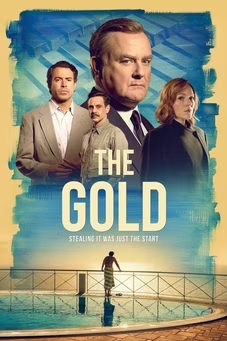 New Season
- Drama

Hugh Bonneville stars in a crime drama inspired by one of the largest robberies in British history.
 New Episode
- News and Public Affairs

Top journalists deliver compelling original analysis of the hour's headlines.

 New Season
 New Episode




 New Episode
Support for PBS provided by:
Buzz in Birmingham is a local public television program presented by APT