Prairie Sportsman
Adopt a Drain and Aquatic Invasive Species Detectors
Season 17 Episode 7 | 27m 46sVideo has Closed Captions
Host Bret Amundson explores community-driven efforts to protect water quality.
Host Bret Amundson visits Hasenbank Park in Woodbury where he learns how this innovative green space helps improve water quality. He also learns how citizens can help protect Minnesota’s waters through the Adopt-A-Drain program, and volunteers work to monitor invasive species through the AIS Detectors initiative.
Problems playing video? | Closed Captioning Feedback
Problems playing video? | Closed Captioning Feedback
Prairie Sportsman is a local public television program presented by Pioneer PBS
Production sponsorship is provided by funding from the Environment and Natural Resources Trust Fund and Shalom Hill Farm. Additional funding provided by Big Stone County, Yellow Medicine County, Lac qui...
Support provided by:


Prairie Sportsman
Adopt a Drain and Aquatic Invasive Species Detectors
Season 17 Episode 7 | 27m 46sVideo has Closed Captions
Host Bret Amundson visits Hasenbank Park in Woodbury where he learns how this innovative green space helps improve water quality. He also learns how citizens can help protect Minnesota’s waters through the Adopt-A-Drain program, and volunteers work to monitor invasive species through the AIS Detectors initiative.
Problems playing video? | Closed Captioning Feedback
How to Watch Prairie Sportsman
Prairie Sportsman is available to stream on pbs.org and the free PBS App, available on iPhone, Apple TV, Android TV, Android smartphones, Amazon Fire TV, Amazon Fire Tablet, Roku, Samsung Smart TV, and Vizio.
Providing Support for PBS.org
Learn Moreabout PBS online sponsorship(bright music) - [Bret] On today's "Prairie Sportsman."
We visit a unique park designed to handle stormwater runoff and learn how the Adopt a Drain program helps improve water quality on our lakes.
- [Sofie] This is just water that's going straight into the storm drain.
It's not being filtered or anything, it's just going right into the local waterway.
- [Bret] Then, we meet volunteers in the fight against aquatic invasive species through the AIS Detectors Initiative.
- When I retired, I wanted to give back, and so my give back came in the form of trying to preserve our lakes, rivers, streams, watersheds.
(water splashing) - Tiny.
Welcome to "Prairie Sportsman."
I'm Bret Amundson.
This show is all about Minnesota's outdoor opportunities and the science and management behind those opportunities.
We got another great show for you starting right now.
(bright music) (bright music continues) (bright music continues) - [Narrator 1] Funding for "Prairie Sportsman" is provided by the Minnesota Environment Natural Resources Trust Fund, as recommended by the Legislative Citizen Commission on Minnesota Resources.
By Mark and Margaret Yackel-Juleen on behalf of Shalom Hill Farm, a retreat and conference center in a prairie setting near Windom, Minnesota.
On the web at shalomhillfarm.org.
By the Friends of Prairie Sportsman.
To become a friend of Prairie Sportsman, visit pioneer.org/prairie sportsman.
Stories about aquatic invasive species are brought to you by the aquatic invasive species task forces of Meeker, Yellow Medicine, Lac Qui Parle, Swift and Big Stone Counties.
- Well, last year I was visiting some family in the Twin Cities.
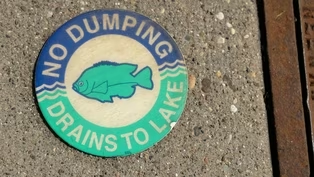
I was taking Tiny for a walk when I noticed a sticker near a storm drain.
Well, after passing a few of these markers, I decided to go down the drain to see where they went and to learn what this was all about.
(mellow music) Twin cities residents are no strangers to summer thunderstorms.
Well placed downspouts and gutters help direct heavy rains from homes and developments all across the metro.
Water's directed into the streets and then funneled into storm sewers.
But what happens after that?
- Not many people know this, but actually our storm drains don't get filtered.
All that water goes directly into our closest body of water.
- Well, one location in Woodbury has been working hard to clean up that runoff before it gets into the lakes.
In this case, Powers Lake.
(gentle music) - Generally speaking, once the storm runoff goes down a drain, it could either go right to lake, river, wetland.
Sometimes it'll go through a series of ponds, stormwater ponds or other constructed stormwater best management practices like infiltration or filtration basins.
- Now, what happens when it rains and water goes into those storm drains along the side of the road?
Well, it ends up in a pond like this.
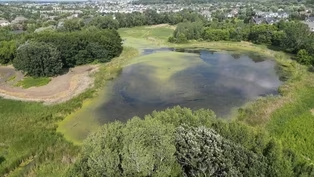
This lake was essentially created when this development was built.
It controls flooding and collects all that storm water runoff.
But where does the water go when this lake gets too high?
Well, it eventually drains into another wetland, which is nearby Powers Lake, one of the cleanest lakes in the area.
To keep that lake from being contaminated by pollutants that have drained into this lake, they've installed a new water treatment facility.
(upbeat music) - Right now we're standing atop the overlook at Hasenbank Park.
The unofficial new highest point in Woodbury.
We're intercepting water, storm water runoff that leaves Fish Lake, which is a large wetland, highly enriched with nutrients like phosphorus that impact water quality, lead to algae blooms.
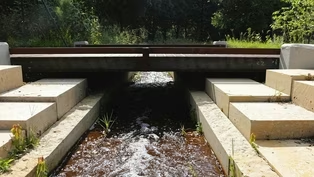
- What happens is when Fish Lake gets too high, it goes into this outlet through a lift station that pumps the water through a pipe up into the new water treatment facility that uses nature with a little helping hand from us to clean that water naturally.
(water pattering) Now, how does Mother Nature clean up this water?
Well, once it goes through that pipe and comes up into this water treatment facility, it goes into one of three ponds, and then once the water gets into those ponds, it naturally drains into the soil.
If this first pond gets too full, it spills over into the next one.
If that one gets too full, there's a third one to catch all the water.
- And all the while that's happening, water's soaking into the ground.
We've got plants that are more, I'd say wetland, wetland pallet of plants that are planted in these basins.
And so they're up taking nutrients and doing their whole process.
And that water then soaks into the ground, gets into our kind of superficial groundwater layers where eventually, it will just travel to Powers Lake.
But when it gets there, it's cooler, it's cleaner, you know, it's contributing to all kinds of other biological processes.
- And it's not just the water that's being cleaned up here, a lot of work has been put in to restoring native grasses and pollinators, as well as planting oak trees to bring back that oak savanna landscape that was once here.
- It was just an old fallow brome field before the project.
We've, you know, the whole grounds here are in the process of being restored into native prairie, all native plants.
So seeing the insects come and birds that come after those insects, so really it's a whole kind of food chain thing that we're seeing here.
And also paired with Hasenbank Woods that's right next to us as well.
We've been working for many years to improve the quality of that woodland.
It was overgrown with buckthorn and we've got a lot of dead ash trees in there.
We've been doing some canopy thinning, clearing out some space for the mature oaks that are there, getting some new oak regeneration in the woods.
- [Bret] You've used some goats.
- We have had goats out here, absolutely.
None this year, but in the past couple years and probably in the future we'll get 'em back out.
Residents love to see the goats.
- [Bret] While there's three different aspects to this project, the process is simple.
They're letting Mother Nature do most of the work.
But how did this whole thing get started?
- This project specifically, the watershed district approached us about a regional best management practice for Powers Lake, specifically because it is such a clean water body.
Previously, this land was open field, owned by the city, along with some wooded areas and a trail running through it.
- [Bret] Today, the park has numerous trails and during my time there I saw dog walkers, hikers, bikers, joggers, and more.
- Even before the stormwater park, like we like to call it internally, was here, there was a high use already because of the Hasenbank Woods where we were doing some native vegetation restoration there.
- And we do see, you know, ducks using the ponds.
There's a family of mallards here that have been here all summer with babies, so that's kind of fun.
- [Bret] b While seeing wildlife like this gives you an immediate look into the benefits of Hasenbank Park, the overall goal may not be as noticeable right away.
- It was a large investment for the watershed district in terms of capital dollars.
But the, again, the estimates that our engineers have come up with about the amount of phosphorus this project can remove from runoff to Powers Lake is quite significant.
And we do hope to see some notable improvements, hopefully, in the first couple years of operation.
Our project funding specifically comes from the stormwater utility fee, so that's localized in this district that we're in.
It's largely, you know, Woodbury and parts of Cottage Grove, little bits of some cities we have on the fringes of the watershed, Oakdale and Lake Elmo, et cetera.
- [Bret] When did this project get completed and has there been any way to maybe track some results?
- Started, I think back in maybe 2021 or '22 with planning, construction was kinda late '23 all the way through this spring in 2025.
And the lift station that we have that does all that pumping, it tracks how much water is pumped through the system.
So we know how many gallons of water, how many millions of gallons of water really is what it is.
- [Bret] Seeing a project like this where you can track the results, see the progress and use it for recreation, it's just gonna be better for everybody.
- And this project paired perfectly with that because it further immerses folks into something that you don't always see, which is storm water.
- [Bret] And that brings us right back to where we started.
Where's this water coming from and where's it going and how can you help keep it clean?
- So here's a storm drain.
They can look many different ways, but in Minnesota this is pretty common.
As you can see, we got grass here.
We would definitely wanna keep those grass clippings out of the drain if you're mowing your lawn.
Just sweep 'em into your yard instead of into the street.
This is just water that's going straight into the storm drain.
It's not being filtered or anything, it's just going right into the local waterway.
So the Adopt a Drain program is designed for residents who have storm drains near them out on their street.
- Another thing that residents could do, in addition to adopting a drain is having, making sure that their lawn is properly maintained.
So not over applying fertilizers, not blowing your leaves or your grass clippings into the street.
A lot of benefit for our surface waters.
- Things that we aim to keep out of the storm drains are trash, brown leaves, green leaves, grass clippings, dog poop, fertilizers, salt in the winter, and other things like that.
Those are our main polluters.
- [Bret] When you adopt a drain, how is it a, like a year long commitment?
Is it forever?
What's the commitment for those that maybe have a fear of it out there?
- Yeah, we try to keep it pretty low responsibility, but once you adopt a drain, it is yours until you decide to un-adopt it.
But it's really easy to un-adopt if you move or if your circumstances change.
Some people adopt many drains, but you can just adopt one too and that's.
We ask people to estimate the amount of debris that they cleaned and then we're able to see how much our participants have removed from what would otherwise be going into our local waterways, which is pretty powerful.
- [Bret] So far in Minnesota, there's been over 28,000 drains adopted by over 16,000 people who've collected nearly a million pounds of debris.
- Adopt a Drain ended up in Woodbury, it started off as a pilot project with Hamline University and East Metro Water Resources educational partners.
It's a way to get outside and give back to your community.
I feel like that's a lot of the reasons why we're seeing folks come in, whether it be girl or boy scout troops, company outings, just a family wanting to get outside and bond over a common goal of clean water.
A lot of people care about their clean water.
And not only just Woodbury, but we are in the land of 10,000 Lakes.
- Really, the purpose of these projects, trying to improve water quality is to help improve the clarity of the lakes as well, reduce the algae blooms.
That helps not only with biological processes in the lake, when we have a lot of algae blooms, sunlight doesn't reach as far into lake as we'd like it to see.
That can limit the growth of native aquatic plants, rooted aquatic plants in the lake.
And also for folks who are on the lakes, right, canoeing, kayaking, you know, their enjoyment of these water bodies is gonna be improved by having that cleaner, clearer water.
So it's really twofold, you know, human enjoyment, wildlife enjoyment and functionality.
- [Bret] Now, getting people excited about cleaning up their grass clippings or learning more about stormwater runoff, it's not easy.
So to draw more attention to the Hasenbank Park project, they enlisted the help of some artists.
- Aaron Dysart and Christopher E. Harrison, they're both outta Minneapolis, local artists.
We've got one installation from Chris Harrison.
It's a set of concrete gears that kind of move through the first basin.
It allows for an interactive approach when water levels are a little lower in the basin than they are today.
You know, tried to tell the story about some of the active processes, right, the mechanical processes that are involved with this.
And Aaron Dysart has two sculptures here.
One is a kind of a representation of a large oak tree.
The other, a representation of, kind of a root system and a large purple cone flower all made out of steel pipes that kind of tell the story of how water moves through the ground, through trees, through evapotranspiration and through plants as well, putting water back into the ground through their root systems as would happen in a natural prairie.
(gentle music) - [Bret] What's the future of this site look like?
- I think yet, to be told, we've got a lot of trees planted here.
We're gonna see them grow, we're gonna see the prairie plantings mature.
You know, that's only just gonna add to the beauty and you know, environmental usefulness of this site.
- [Bret] Clean water is good for everybody.
Finding a site like this in the heart of a metropolitan area is just gonna increase those long-term benefits for humans, for wildlife, and for the environment in general.
- One of the most unique things that we did during our planning phases for this project was rather than having a civil engineer design a project, the lead for our engineering team was a landscape architect.
And so I think with that, we got a whole lot more organic structures and shapes into the park design.
- Well, here's what you can do.
If you feel like you're stuck in a concrete jungle, go to a park like this, get outside and immerse yourself in nature.
And if you wanna help clean up the water in your area, consider adopting a drain in your neighborhood.
(bright music) For much of its history as a state, Minnesota struggled with invasive species in its waters.
From common carp to starry stonewort, these unwelcome guests have created havoc in our underwater ecosystems.
- There's a long list, unfortunately, of aquatic invasive species we're concerned about and many more on the doorstep.
Back in 2012, the state of Minnesota said, enough's enough.
We need to innovate, we to develop new solutions to these growing problems.
Folks were using the best available tools at the time and it just frankly, wasn't working.
So the state invested in creating the Aquatic Invasive Species Research Center, really, a first of its kind in the country, here at the University of Minnesota.
We have, I'd argue probably the most multifaceted and aggressive invasive species program of any state.
- [Bret] Part of the strategy in Minnesota's battle against aquatic invasive species, or AIS, is the training of concerned citizens through a program at the Minnesota Aquatic Invasive Species Research Center and the University of Minnesota extension, known as AIS Detectors.
(gentle music) - The public's essential.
It's cliche probably, to say it's an all hands on deck situation, but it truly is.
So one of the ways that we've been engaging in the public is through our citizen science program called AIS Detectors.
There's almost 600 of them around the state who have volunteered to take a class.
They signed up for a test, to learn more about invasive species and be these resources in the community.
They actively participate in volunteer opportunities and have themselves made a difference in their local areas.
- [Bret] One person who joined the ranks of Minnesota's AIS Detectors is retired veterinarian Ingrid Bey.
- Got a stick in your mouth?
When I retired, I wanted to give back and I didn't know at the time, what form of giving back that would be.
And then I realized that our lakes were being threatened by all these aquatic invasive species.
And so my give back came in the form of trying to preserve our lakes, rivers, streams, watersheds.
And I love being outside, I love the natural world, and I have a biology background.
Good boy.
So it was sort of like a perfect fit for me.
So this is beautiful Kabekona Lake.
It's about a 2,400 acre lake in Hubbard County.
It's known as a really good walleye lake and it is pristine.
And as far as we know, it is AIS free.
- [Bret] A graduate of the AIS Detectors program, Ingrid serves on the Kabekona Lake Association, the Hubbard County Coalition of Lake Associations and the MAISRC Advisory Board.
In addition to all her administrative service, she also takes a hands-on approach when combating AIS.
(bright music) - So a common way that we and professionals look for aquatic invasive species, more specifically vegetation, is by a method called rake toss.
It's a double-sided rake that's on a long length of cord.
So you throw the rake out into the lake and let it drop to the bottom, and then you pull it back in, and you look through all the vegetation.
And this is where it's very helpful to know the native vegetation 'cause you're looking for invasive species, but you'll get a large pile of beautiful native aquatic plants.
So for example, our native milfoil, Northern watermilfoil, which is a beautiful plant, looks very similar to Eurasian watermilfoil.
If you find something that you're concerned about, you can submit it to the AIS specialists, either through the county or through the DNR, and then there's a thing called EDDMapS online.
And if you take a good picture and you submit it to EDDMapS, that's the best way for the specialists to try to sort out if it really is an invasive species or not.
- [Bret] While the work they do is serious, the volunteers on Kabekona Lake have a lighthearted moniker.
- We call ourself the Kabekona Aquatic Vegetation Surveillance Team, otherwise known as the rake tossers.
And we just ask the people who are participating and volunteering that they go out once in July and once in August and do their rake tosses and keep checking the lake.
- [Bret] So far, the rake tossers have been met with good news.
(water splashing) - Well, Kabekona Lake, we do not have AIS at this time.
The challenge is to not get AIS - [Bret] In this age of aquatic invasives, lake associations can play a pivotal role.
- I think lake associations are really important because they bring a sense of community to a lake and that we're all in this together.
Lake associations have become more important than ever because of the financial aspects of treating AIS.
And typically, once AIS is discovered, people look toward the lake association for help.
If people are willing and able to know that they may need to build up their financial situation for their lake association, they're gonna be ahead of the curve.
- [Bret] While Kabekona Lake is still free of invasives, the threat appears to be closing in.
- We have neighboring lakes that, just this summer, were found to have starry stonewort.
And that kind of ups the ante for us because AIS is primarily spread through boater movement and boater traffic.
And so now I think we're going to be even more vigilant.
In the event that would get AIS in Kabekona, I think we're ready to hit the ground running, and probably sadly we've learned from other lakes who've gotten AIS.
But I think we're ready to move if we need to.
- [Bret] The foresight of the Kabekona Lake Association could be critical if invasives are ever found in the lakes waters.
- The impetus for starting AIS Detectors was to increase this capacity for surveillance of aquatic invasive species.
With any invasive species, the best outcomes are possible if you have early detection.
If you find these populations when they're relatively small, the management toolbox is so much better and the outcomes are so much better.
- There's several lakes that found starry stonewort very early, so a very small amount of starry stonewort in the lake.
And they were able to go out and use divers to hand pull these small patches of starry stonewort, plus or minus a copper algaecide.
And they followed the biomass, and each month they got less, and less and less.
And then each year they got less, and less and less.
So, although we can't use the word eradicate, it has definitely been controlled as opposed to a lake that has, well, Benedict Lake for example, they have seven acres of starry stonewort, compared to Garfield Lake that has 0.18 acres of starry stonewort.
So you might say that they found it early in Garfield and were more hopeful then that they can at least control it so that the lake can continue to be enjoyed by anglers and boaters and recreational people, and people who just like to get out in nature and enjoy the lake.
- [Bret] While Ingrid is monitoring lakes in the northern region of the state, another partner in the fight against AIS is working to make a difference in the Twin Cities Metro region.
Former University of Minnesota, Tony Brough serves as the Aquatic Invasive Species Program Coordinator for Hennepin County and oversees a wide range of efforts.
- We work with partners, local partners, we leverage what they're already doing and making it better.
And that's what's so fantastic about this funding is it's all going to projects on the ground.
Specifically, we've done a lot of work with access redesign.
First thing is creating the space away from the access.
Here's where you can go, you can take your time, do what you're supposed to do, and you go here.
So we put stop bars in the asphalt and we don't paint 'cause paint kind of goes away after a year.
We use thermoplastic pavement marking, which I get to use a blowtorch, so it's quite fun.
And you melt it right into the asphalt and it stays bright for 10 to 15 years.
And so most people would come and we're getting 90% of more stopping at these stop bars, at these lines.
And right at that line we put signs, very short like, did you clean?
Did you drain?
And then, thank you.
And then the last thing is to be high level is we can put tools right there to make it easier for them to drain their water, to remove the weeds.
And that's the three tools, kind of in our toolbox.
And so this is a long-term play.
We're not just trying to prevent zebra mussels that's in Minnesota already to come into this new lake.
How can we also prevent this next thing from even getting to Minnesota?
- [Bret] Although the battle against invasives may never end the efforts of MAISRC researchers and concerned citizens are yielding positive results.
- Statewide, you think about, you know, there's just another new report of a zebra mussel in a lake in Minnesota.
But I can tell you over the last decade, we bent that curve, the rate of infestation, the spread of infestation has slowed in Minnesota.
And that is attributable, I'd argue, to the state's investment, that local capacity and the research informed tools that they're using on the landscape.
We have made a difference.
- My hope for the future of Minnesota's lakes is that we can preserve the lakes that are pristine.
We know some lakes are fairly permanently damaged, but if we can preserve what we have, that's our gift to future generations, and that's on all of us.
- It's so simple.
Don't spread water, don't spread plants.
Once you got that, how do you make sure you don't do it and it'll just become normal.
Because we care about our legacy and our lakes, and what we have in Minnesota here is something a lot of states don't have.
It's worth protecting.
(bright music) - [Narrator 2] We can stop aquatic hitchhikers from infesting more lakes and streams by cleaning up everything we pull out of the water.
It's a simple drill.
Clean in, clean out.
Before leaving a water access, clean your boat and water equipment, remove and dispose of all plants and aquatic species in the trash.
Drain water from your boat, ballast tanks, motor, live well and bait container.
Remove drain plugs and keep drain plugs out while transporting equipment.
Dispose of unwanted bait in the trash.
To keep live bait, drain the water and refill the bait container with bottled or tap water.
And if you have been in infested waters, also spray your boat with high pressure water, rinse with very hot water, dry for at least five days.
Stop the spread of AIS.
(gentle music) (gentle music continues) - [Narrator 1] Funding for "Prairie Sportsman" is provided by the Minnesota Environment Natural Resources Trust Fund as recommended by the Legislative Citizen Commission on Minnesota Resources.
By Mark and Margaret Yackel-Juleen on behalf of Shalom Hill Farm, a retreat and conference center in a prairie setting near Windom, Minnesota.
On the web at shalomhillfarm.org.
By the Friends of Prairie Sportsman.
To become a Friend of Prairie Sportsman, visit pioneer.org/prairie sportsman.
Stories about aquatic invasive species are brought to you by the aquatic invasive species task forces of Meeker, Yellow Medicine, Lac Qui Parle, Swift and Big Stone Counties.
(bright music)
Adopt a Drain and Aquatic Invasive Species Detectors
Video has Closed Captions
Preview: S17 Ep7 | 30s | Host Bret Amundson explores community-driven efforts to protect water quality. (30s)
 New
NewVideo has Closed Captions
Clip: S17 Ep7 | 12m 24s | Researchers at the Minnesota Aquatic Invasive Species Research Center work to restore native plants. (12m 24s)
 New
NewVideo has Closed Captions
Clip: S17 Ep7 | 12m 23s | A sticker near a storm drain prompts Amundson to view projects aimed at reducing stormwater runoff. (12m 23s)
Providing Support for PBS.org
Learn Moreabout PBS online sponsorship
- Science and Nature

Explore scientific discoveries on television's most acclaimed science documentary series.

- Science and Nature

Capturing the splendor of the natural world, from the African plains to the Antarctic ice.












Support for PBS provided by:
Prairie Sportsman is a local public television program presented by Pioneer PBS
Production sponsorship is provided by funding from the Environment and Natural Resources Trust Fund and Shalom Hill Farm. Additional funding provided by Big Stone County, Yellow Medicine County, Lac qui...