
Maui residents face health struggles years after wildfires
Clip: 8/26/2026 | 8m 15sVideo has Closed Captions
Maui residents face health struggles 3 years after wildfires
Just over three years ago, the deadliest U.S. wildfire in more than a century devastated the Hawaiian island of Maui. New research suggests the toll of the disaster may be far greater than the lives lost and property burned. Stephanie Sy reports with support from the National Press Club Journalism Institute Public Health Reporting Fellowship, funded by the Common Health Coalition.
Problems playing video? | Closed Captioning Feedback
Problems playing video? | Closed Captioning Feedback
Major corporate funding for the PBS News Hour is provided by BDO, BNSF, Consumer Cellular, American Cruise Lines, and Raymond James. Funding for the PBS NewsHour Weekend is provided by...
Maui residents face health struggles years after wildfires
Clip: 8/26/2026 | 8m 15sVideo has Closed Captions
Just over three years ago, the deadliest U.S. wildfire in more than a century devastated the Hawaiian island of Maui. New research suggests the toll of the disaster may be far greater than the lives lost and property burned. Stephanie Sy reports with support from the National Press Club Journalism Institute Public Health Reporting Fellowship, funded by the Common Health Coalition.
Problems playing video? | Closed Captioning Feedback
Where to Watch PBS News Hour
PBS News Hour is available to stream on pbs.org and the PBS app.
Providing Support for PBS.org
Learn Moreabout PBS online sponsorshipAMNA NAWAZ: Just over three years ago, the deadliest U.S.
wildfires in more than a century devastated the Hawaiian island of Maui.
New research suggests the toll of the disaster may be far greater than the lives lost and property burned.
Stephanie Sy reports on a landmark study aiming to track how the wildfires have continued to affect survivors' health long after the flames are gone.
STEPHANIE SY: Four days a week, this Lahaina food bank opens its doors to survivors of the Maui wildfires.
MARIO ACOSTA, Lahaina, Hawaii, Resident: The houses in front of us are burning already.
STEPHANIE SY: For many, like Mario Acosta, the memories of August 7, 2023 are still fresh.
WOMAN: Can I take a ride from you?
I'm sorry.
Take a ride.
Thank you.
STEPHANIE SY: A video taken by a stranded stranger he and his wife picked up as they were trying to escape the inferno captured that harrowing day.
MARIO ACOSTA: When we saw the fire beside us, we were waiting for the traffic to move on.
My wife wants to jump to the ocean.
I told my wife, no.
And then the traffic suddenly moved and then we were able to get away a little bit from the burning buildings beside us.
STEPHANIE SY: The Acostas have lived in Lahaina for over a decade, working in hotels.
The home they were renting for about $1,000 a month burned down, and they can now only afford a single room without a kitchen.
What have been your biggest struggles since the fire?
MARIO ACOSTA: All the expenses and things like that, because it went up.
All the prices went up too.
STEPHANIE SY: How are you doing, like, with your mental health at this point?
MARIO ACOSTA: It's really hard because it really was terrifying.
STEPHANIE SY: The memories of the ferocious wildfire are still raw for so many survivors, and many are still struggling, struggling with things that were hard before the wildfires, namely the cost of living on this beautiful island, which has only escalated in the last three years.
RUBEN JUAREZ, University of Hawaii: People in the lower-income brackets who are often the people who were workers in Lahaina serving tourists are definitely the ones who are -- we are seeing right now and are the most affected.
STEPHANIE SY: The University of Hawaii's Ruben Juarez and Alika Maunakea conducting a study on the lasting impact of the disaster on survivors' physical and mental health.
The wildfire exposure study, known as MauiWES is one of the biggest and most diverse studies of its kind in the country's history.
It shows recovery has been uneven.
RUBEN JUAREZ: It's housing security, food and income security, social support, and access to care.
Those individuals who have these four traits are significantly better off than those who don't.
STEPHANIE SY: Beginning six months after the fires, they started health screenings for more than two thousand participants, including mental health assessments and lung and cardiovascular tests.
NANCY GARNETT, Maui, Hawaii, Resident: I cough every day, and I'm not a cougher.
It depends on what kind of day it is.
If it's windy and dry, ah, I don't even want to be out here, but I am breathing it in.
STEPHANIE SY: Initially, more than 40 percent of survivors, like Maui resident Nancy Garnett, reported experiencing respiratory issues weekly.
Now, three years after the fires, one in five adults continue to have below expected lung function.
Those participating in the study are also tested for exposure to heavy meddles like arsenic and lead, which can be released in urban fires and may pose health risks.
It's a concern expressed by many in Lahaina.
KE'EAUMOKU KAPU, Na Aikane O Maui, Hawaii, Resident: It took me about I would say maybe three, four weeks to go through the rubble.
STEPHANIE SY: Native Hawaiian historian Ke'eaumoku Kapu ran a cultural center which was destroyed in the fires.
For weeks, he searched through the site to salvage precious objects and artifacts.
KE'EAUMOKU KAPU: Not knowing at the time that you got toxins you got to worry about, you got asbestos, you got arsenic, you got all this lead paint and all that.
You could actually smell a stench in the air.
STEPHANIE SY: State health officials say the burn zone has been safe for residents since the fire's debris and ash were removed in September 2024.
KRISTA WOODWARD, Lahaina, Hawaii, Resident: It was a really difficult night.
We cried and just watched the town burn from the beach.
STEPHANIE SY: The study has also highlighted the fire's mental health toll on victims, like Krista Woodward, an artist based in Lahaina.
Her home of 26 years burned down with the town.
The studio where she worked on her glass art was also reduced to rubble.
KRISTA WOODWARD: It's definitely hit a nerve to look there every time I come.
STEPHANIE SY: And three years later, she's struggling to rebuild.
Her new house was less than halfway done when she says a contractor ran away with her money.
KRISTA WOODWARD: I was experiencing this heaviness, like I was moving underwater.
I was easily overwhelmed.
And my focus, I - - it was -- it wasn't like it was before.
STEPHANIE SY: Woodward was diagnosed with PTSD, which puts her among the one in five survivors experiencing symptoms of the disorder, according to the study.
CHRISTOPHER KNIGHTSBRIDGE, Maui Wildfire Exposure Study: We're still not in a recovery stage, but we're still in a crisis stage.
STEPHANIE SY: Christopher Knightsbridge is the study team's mental health lead and treats survivors.
He found that levels of anxiety and depression are worse for those still struggling to meet their basic needs.
CHRISTOPHER KNIGHTSBRIDGE: Even now, in therapy, a lot of the times, it's -- the stuff we're working on isn't their underlying traumas from that horrible day.
It's just like, how am I going to feed my family?
STEPHANIE SY: Those immediate needs have spurred the MauiWES study to go beyond data collection and connect the community with care.
RUBEN JUAREZ: We not only measure.
We intervene.
Just to give you a very simple statistic, about 40 percent of individuals that we recruited into the study didn't have health insurance when they came in.
One year later, we were able to link them to different charitable insurance programs, including Kaiser Permanente, and we were able to cut the uninsured rate by half.
STEPHANIE SY: Still, access to medical care remains a hurdle for Lahaina's health recovery.
The fires destroyed medical facilities and led to physician flight.
Today, Maui County needs 41 percent more physicians in order to meet its residents' needs.
KRISTA WOODWARD: I'm doing great.
STEPHANIE SY: After signing up for the study, Krista Woodward was eventually able to get a weekly appointment with Christopher Knightsbridge.
She says the sessions have been a lifeline.
KRISTA WOODWARD: It brought me so much peace to know that I was experiencing common PTSD as the result of a horrible disaster, and it was normal and it was treatable and over time I would heal.
STEPHANIE SY: Back at the food pantry for Lahaina fire survivors, this assistance is another kind of lifeline for Mario Acosta.
MARIO ACOSTA: It really means a lot for us this kind of resources.
STEPHANIE SY: But it can't address all his needs.
He's still triggered during wildfire season.
MARIO ACOSTA: Even only if I smell a few smoke, it's really scary, especially our experience, when we were -- almost get burned alive.
STEPHANIE SY: He thinks about the neighbors that didn't make it out alive.
MARIO ACOSTA: Three of them got burned in the fire.
The one beside us got burned in the fire.
They're gone.
They're gone.
STEPHANIE SY: More than 100 people perished in the fires.
The losses were staggering.
And so many of the Lahaina fire victims continue to live with the harms suffered that day.
For the "PBS News Hour," I'm Stephanie Sy in Lahaina, Hawaii.

Custody fight erupts after surrogate refused to get abortion
Video has Closed Captions
Custody fight erupts after surrogate refuses abortion for baby with heart condition (4m 56s)
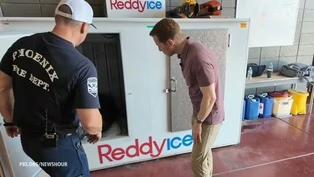
How bags of ice are helping save lives in Phoenix
Video has Closed Captions
In one of the nation's hottest cities, bags of ice are helping save lives (3m 36s)

How data centers became a major issue in the midterms
Video has Closed Captions
How data centers became a major issue in the midterms (8m 2s)

Martina McBride shares her favorite Dolly Parton memories
Video has Closed Captions
Martina McBride shares her favorite Dolly Parton memories (5m 56s)

Meta case puts focus on youth mental health, Colo. AG says
Video has Closed Captions
$17B Meta settlement puts focus on youth mental health crisis, Colorado AG says (7m 14s)

Trump faces backlash from ranchers over plan to import beef
Video has Closed Captions
Trump faces backlash from ranchers over plan to import beef (6m 55s)
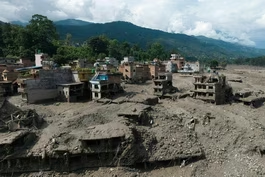
Wall of mud and debris floods communities in Nepal and Tibet
Video has Closed Captions
Wall of mud and debris floods communities in Nepal and Tibet (2m 35s)
Providing Support for PBS.org
Learn Moreabout PBS online sponsorship New Episode
- News and Public Affairs

Today's top journalists discuss Washington's current political events and public affairs.

- News and Public Affairs

FRONTLINE is investigative journalism that questions, explains and changes our world.
 New Season

 New Episode
 New Episode
 New Episode

 New Episode
 New Episode
Support for PBS provided by:
Major corporate funding for the PBS News Hour is provided by BDO, BNSF, Consumer Cellular, American Cruise Lines, and Raymond James. Funding for the PBS NewsHour Weekend is provided by...