
Meta case puts focus on youth mental health, Colo. AG says
Clip: 8/26/2026 | 7m 14sVideo has Closed Captions
$17B Meta settlement puts focus on youth mental health crisis, Colorado AG says
Meta agreed to pay up to $17 billion in a settlement, putting to rest a trial where dozens of states accused it of deliberately endangering children through their platforms. The company behind Facebook and Instagram agreed to implement digital guardrails for minors and is asking other social platforms to do the same. Geoff Bennett discussed more with Colorado Attorney General Phil Weiser.
Problems playing video? | Closed Captioning Feedback
Problems playing video? | Closed Captioning Feedback
Major corporate funding for the PBS News Hour is provided by BDO, BNSF, Consumer Cellular, American Cruise Lines, and Raymond James. Funding for the PBS NewsHour Weekend is provided by...
Meta case puts focus on youth mental health, Colo. AG says
Clip: 8/26/2026 | 7m 14sVideo has Closed Captions
Meta agreed to pay up to $17 billion in a settlement, putting to rest a trial where dozens of states accused it of deliberately endangering children through their platforms. The company behind Facebook and Instagram agreed to implement digital guardrails for minors and is asking other social platforms to do the same. Geoff Bennett discussed more with Colorado Attorney General Phil Weiser.
Problems playing video? | Closed Captioning Feedback
Where to Watch PBS News Hour
PBS News Hour is available to stream on pbs.org and the PBS app.
Providing Support for PBS.org
Learn Moreabout PBS online sponsorshipAMNA NAWAZ: Welcome to the "News Hour."
Social media giant Meta has agreed to pay up to $17 billion in a settlement, putting to rest a trial where dozens of states accuse the company of deliberately endangering children through their platforms.
GEOFF BENNETT: The parent company of Facebook and Instagram has agreed to implement new digital guardrails for minors.
The company says it will enforce a two-hour daily time limit for users under 18 years old, implement a nighttime block on the apps from midnight to 6:00 a.m., mute notifications and restrict usage during school hours.
They're also asking other social platforms to do the same.
C.J.
MAHONEY, Chief Legal Officer, Meta: The framework we have negotiated will empower parents to easily manage their children's access to our platforms.
But this framework will only work if all our peers join us.
Because teens move fluidly across dozens of apps, we need an industry-wide solution.
We therefore call on our industry peers, TikTok and YouTube, to implement this new framework right away.
GEOFF BENNETT: The settlement signals a turning point for the social media industry, but Meta still faces multiple lawsuits from school districts and individuals.
We're joined now by Colorado attorney General Phil Weiser.
Welcome to the "News Hour."
Thanks for being with us.
PHIL WEISER (D), Colorado Attorney General: Great to be with you, Geoff.
GEOFF BENNETT: So Colorado is one of the principal states that brought this suit, and you accused Meta of knowingly designing products that hooked children and that put profits ahead of their well-being.
You finally got Meta to trial.
Why settle now, rather than let a jury decide whether Meta broke the law?
PHIL WEISER: We obtained the type of protections, and you outlined them very well, protecting kids' ability (AUDIO GAP) protecting kids' ability to concentrate in school, limiting total time on the platform, removing harmful features, like what's happening right now.
And it's not going to wait for years in appeal.
So given that this case was always about protecting kids and getting these protections in place, we took this remedy as the best way to protect kids.
GEOFF BENNETT: Do two-hour time limits, mandatory breaks, nighttime restrictions, do that -- does that address the underlying design, or are you simply putting guardrails around a product that remains addictive?
PHIL WEISER: Our goal is to address the features that feed addictive behavior, having productive pauses, something that is built into this.
Having a cap on total time, not having notification alerts, getting people to go back on the platform, all that is going to make a difference.
I recognize that we have got a major challenge, because this is a crisis of youth mental health that's been fueled by social media use, where kids have been often going down dark holes, getting dangerous content.
This is the first step to address that crisis, to change behavior.
And as you noted in the lead-in, we need more companies to get on board, YouTube, Snap, and TikTok, and we're going to work hard to make that happen too.
GEOFF BENNETT: Well, right.
Part of Meta's payment is contingent on TikTok, YouTube, Snapchat adopting similar protections.
Are you trying to use this settlement to establish a new industry-wide standard?
And if those companies don't follow Meta's lead, are they next?
PHIL WEISER: They're next.
We're ready to go to court against other companies too.
For those who didn't believe our capacity to hold a company this big to account, take a look at what just happened.
We were in this court case.
By all accounts, we had Meta on the ropes.
That's why they're making such meaningful concessions, and the settlement is so much greater than what we might have gotten even after a litigated judgment.
And if YouTube or TikTok is unwilling to come to the table and do something on the order of what we just got here, then we will take them to trial too.
GEOFF BENNETT: How do you make sure Meta actually follows through?
Who is policing compliance in this instance?
PHIL WEISER: It is essential that the requirements are enforced, and that's why we have an independent auditor who's going to be able to oversee Meta's compliance with these requirements.
To the point that you noted earlier, it's very important to me as someone who's a parent who worries about kids not sleeping, I do not want any of these notification alerts or other ways to get kids awake at night, not sleeping.
If Meta violates that requirement, we're going to come down on them.
This is not an option.
It's a mandate.
It's enforceable by a court.
And with the aid of this independent auditor, we're going to hold them to it.
GEOFF BENNETT: Meta still gets to use personalized recommendations and targeted advertising, which is the heart of its business model.
How much of this settlement really changes the financial incentives that you argue helped create the problem in the first place?
PHIL WEISER: This settlement makes meaningful progress to protect kids on many fronts.
Let me mention one I haven't talked about yet.
Because of the opportunity to get good kids hooked at a young age, Meta marketed to kids under 13, signed them up and kept them, even knowing that they had 12-year-olds, 11-year-olds, 10-year-olds on the platform.
That was part of a strategy fueled by a decision to make money and to put profits over kids' health.
We're changing all that.
We're forcing them to use age assurance to not allow young kids access to this platform.
We're forcing them to have time limits to stop the amount of time that could be hours and hours and hours.
It's going to eat into their profits.
It's going to hurt their business model because we're putting kids' safety first.
GEOFF BENNETT: You have compared this fight to big tobacco.
That settlement fundamentally changed an entire industry.
What makes you confident this agreement will do the same for social media?
PHIL WEISER: I want to emphasize that the case that we're talking about is a multistate bipartisan case with essentially every single state in the union.
This is a statement.
Among others, it's a statement to Congress.
Congress needs to take what we have done here and impose it across this industry, making clear that, in the United States of America, we're putting kids first.
I recognize this is too late for many kids who we have lost to suicide, self-harm, whose mental health is in much worse condition because of social media.
I'm committed to doing everything we can going forward to fight for our kids' future.
And this step promises just the sort of change we saw with tobacco, which can include widespread relief across the industry and congressional legislation.
This is the start of how we start protecting our kids.
GEOFF BENNETT: Colorado Attorney General Phil Weiser, thank you for joining us this evening.
PHIL WEISER: Thanks for the time.

Custody fight erupts after surrogate refused to get abortion
Video has Closed Captions
Custody fight erupts after surrogate refuses abortion for baby with heart condition (4m 56s)

How bags of ice are helping save lives in Phoenix
Video has Closed Captions
In one of the nation's hottest cities, bags of ice are helping save lives (3m 36s)

How data centers became a major issue in the midterms
Video has Closed Captions
How data centers became a major issue in the midterms (8m 2s)

Martina McBride shares her favorite Dolly Parton memories
Video has Closed Captions
Martina McBride shares her favorite Dolly Parton memories (5m 56s)
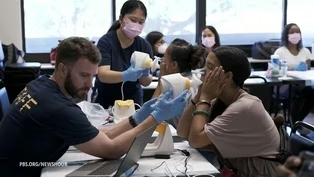
Maui residents face health struggles years after wildfires
Video has Closed Captions
Maui residents face health struggles 3 years after wildfires (8m 15s)

Trump faces backlash from ranchers over plan to import beef
Video has Closed Captions
Trump faces backlash from ranchers over plan to import beef (6m 55s)

Wall of mud and debris floods communities in Nepal and Tibet
Video has Closed Captions
Wall of mud and debris floods communities in Nepal and Tibet (2m 35s)
Providing Support for PBS.org
Learn Moreabout PBS online sponsorship New Episode
- News and Public Affairs

Today's top journalists discuss Washington's current political events and public affairs.

- News and Public Affairs

FRONTLINE is investigative journalism that questions, explains and changes our world.
 New Season

 New Episode
 New Episode
 New Episode

 New Episode
 New Episode
Support for PBS provided by:
Major corporate funding for the PBS News Hour is provided by BDO, BNSF, Consumer Cellular, American Cruise Lines, and Raymond James. Funding for the PBS NewsHour Weekend is provided by...