
After the Fires: Rebuilding with Resiliency
Season 8 Episode 1 | 25mVideo has Closed Captions
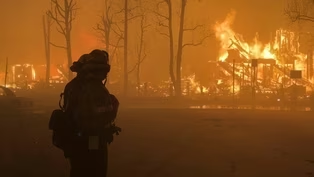
After the devastating L.A. fires of January 2025, what’s being done to rebuild smarter?
After the devastating L.A. fires of 2025, we explore what’s being done to rebuild smarter and with greater fire resiliency in mind so homes can survive future wildfires.
Problems playing video? | Closed Captioning Feedback
Problems playing video? | Closed Captioning Feedback
Earth Focus is a local public television program presented by PBS SoCal
After the Fires: Rebuilding with Resiliency
Season 8 Episode 1 | 25mVideo has Closed Captions
After the devastating L.A. fires of 2025, we explore what’s being done to rebuild smarter and with greater fire resiliency in mind so homes can survive future wildfires.
Problems playing video? | Closed Captioning Feedback
How to Watch Earth Focus
Earth Focus is available to stream on pbs.org and the free PBS App, available on iPhone, Apple TV, Android TV, Android smartphones, Amazon Fire TV, Amazon Fire Tablet, Roku, Samsung Smart TV, LG TV, and Vizio.
Providing Support for PBS.org
Learn Moreabout PBS online sponsorshipNarrator: In January of 2025, not one but two enormous wildfires erupted in the Los Angeles area.
Fueled by tinder-dry conditions and driven by Santa Ana winds approaching 100 miles per hour in some places, the blazes exploded across the West LA neighborhood of Pacific Palisades and the foothill community of Altadena, near Pasadena.
In all, 31 people died and thousands of homes were incinerated in what experts say is the costliest fire disaster in American history, with damages in the tens of billions of dollars.
Man: This program was made possible in part by a grant from Anne Ray Foundation, a Margaret A. Cargill Philanthropy.
[Excavator humming] Narrator: Now attention has turned to the long, hard job of rebuilding and answering these questions.
Is it possible to design and build homes that are truly fireproof, structures still standing after the next catastrophic blaze?
And as climate change makes our world hotter and drier, why do we persist in building homes in places threatened by fire?
Karl: This is a plumber's torch.
It'll get up to about 3,700 degrees.
And-- Karen: And a wildfire is only about 2,000.
Karl: Two thousand.
It smolders and it'll burn out the foam on the first few layers.
The cement that surrounds the foam beads stays intact and dissipates the heat like a radiator.
So you see Karen is not moving her hand.
Imagine a fire or you throw a piece of lumber in there, this would've ignited by now.
Karen: In January, I was actually just getting ready to do a major remodel on the house.
I was waiting and waiting and waiting for my permit, and then the fire happened.
So instead of doing a major remodel, I'm now building from the ground up.
David: I lost my home in the fire, and I'm also a builder, so we've been helping a lot of people through Rebuild Altadena and kinda moving forward in this whole process post-fire.
We're rebuilding this home with wood as traditional stick built, uh, because the local workforce knows how to build with wood.
We've been building with wood in North America for over 200 years.
If we built with other materials, the local workforce and the inspectors may not even know how to inspect it.
So it's important for us to build with wood and get neighbors, family, and friends back home.
Mayor Bass: With so many homes and businesses lost, we are already putting plans in place to make sure that we aggressively rebuild.
My office is leading the city effort to clear the way.
Red tape, bureaucracy, all of it must go.
Char: You know, the fires in January, as horrific as they were, as traumatic as they were, were also entirely predictable.
We built these landscapes to burn because they were in fire zones.
[Siren wailing] Man: November 1961, the disastrous Bel Air/Topanga Canyon fire forced hundreds of families to evacuate their homes.
The fires raged for four terrible days.
Char: If you wanna think about incentives, at the moment a disaster explodes, and then its aftermath, what are we asking people and helping people to do?
By and large, the goal is, as it was in 2025, when the mayor and the governor said, "We will rebuild as fast as possible.
We will rebuild without regard to environmental regulations.
We will clear the way so that you can get back to your homes."
That's an amazing incentive.
Why would you not then try to do what it is that they're allowing you to do?
Until you ask yourself, "If it just burned, what are the odds of it burning again?"
And I would say the odds are really high.
Karen: This is completely different than wood or stick frame, or also steel frame building.
Basically, they're four-foot long blocks, 12 inches high, ten inches thick.
They're made of 85% to 87% expanded polystyrene and 13% to 15% cement.
They weigh 47 pounds each, so I can actually lift one.
[Chuckles] Going forward, I think every developer should be building with this.
Every new community should be building with something that's not gonna burn, whether it's this material or other concrete-based materials.
David: This is a fire-resistant material that we're putting into all of our homes.
It's gonna protect your home and create a 90-minute wall, right, to protect your home from fire for 90 minutes versus-- Man: And how does that compare to, um... David: Regular CDX plywood is about 30 minutes, right?
So, you know, this protects your home up to 90 minutes, uh, from the fire getting in, and I don't believe fire or ember will last more than 90 minutes.
Rita: Resilience, to me, is just really about the ability to withstand these shocks and stresses, or be able to recover from them quickly, right?
So ideally, when you're talking about building materials, you have something that is built in a way that is either going to completely withstand, um, some kind of disaster like that.
So, when the fire--if you're using, uh, fireproof materials, uh, that's ideal or it's, again, something, um, that you can rebuild quickly, right, um, in terms of like a community overall.
[Saw buzzing] [Nail gun clicking] Karen: I completely understand why people are rebuilding with wood.
Most architects and contractors don't know how to build with alternative materials, so that's their go-to.
I mean, it actually makes me cringe when I see the wood frame construction, just because I've been trying to get this word out, you know, since the beginning of the year, and I just feel like I haven't had the chance to educate people and let them know that, you know, they can build with something that's not gonna burn down next time.
Pat: You can't say fireproof anything.
No one can.
So we say fire-resistant, but it does have a four-hour fire rating.
And in extreme firestorms, it doesn't degrade.
It won't blow up.
It won't burn obviously.
If your roof were to burn, these walls will stay standing and can be rebuilt upon, so you don't lose your own home.
Rita: I don't think that there is one magic bullet where we should be prescribing, uh, specific building materials and, uh, designs across the board necessarily.
I mean, again, within reason.
We should be giving guidance and offering people resources to help them make decisions.
Whether it's a fire or it's an earthquake or it's a flood, um, the reality is, especially with climate, we probably are going to be encountering more scenarios in the future with Los Angeles, where we are having to rebuild or rethink our community development and design.
Char: What if we incentivize, not rebuilding but not building, So part of that could be, I could come to a person whose home has been burned out and say, "Look, you could rebuild, but what if I offered to buy your property as a willing seller, not eminent domain, pay you at market rate?"
Now you have an option.
Rita: I think that we do need to bring that into the conversation about whether we should be rebuilding.
This is another reason why we should be continuing these conversations outside of the immediate urgency of an-- of, you know, an emergency or disaster when people are really just fully focused on bringing their lives back to some level of normalcy.
We need to start bringing that conversation to the table of, like, where exactly should we be building and developing, and are some of the places that we developed in the past still appropriate given the way things are changing in the future?
Char: Since 2003, we've had 19 of the 20 largest fires in the state, 18 of the 20 most destructive, and 13 of the 20 most fatal.
That's data that is fully driven by climate change.
Why build back in the ways that we have?
Why allow those houses to be rebuilt two, three, four times after fires?
Which is a question about insurance, but also about our political lives.
Why replicate it?
Human beings are creating fire.
We bring fire into these landscapes and then we are consumed by it.
Roberto: Hi, everybody.
My name's Robert Leon.
I'm with Rebuild Altadena.
Uh... Narrator: As people look to make their homes more fire resilient, like those attending this fire rebuilding fair in Altadena, the work doesn't end with residential design and construction choices.
It also extends to front and backyards and the kinds of trees and vegetation people choose to plant around their homes.
To fortify such defensible space, is it time to restrict what kind of landscaping people place around their dwellings, even in neighborhoods that have never burned?
Some are saying yes.
Rich: When I saw the fire start and I saw the smoke coming over our neighborhood, I knew from experience that where the smoke goes is where the fire goes.
Noah: There are three main ways that a home can burn.
Flames, embers, and heat.
Rich: My neighbor's yard caught on fire two doors away and we tried to fight it with a garden hose, and it was too hot.
The winds were too fierce.
There's too many embers.
And it was at that point I knew we weren't gonna stop it.
Oh, it's still hard to talk about.
And I witnessed my neighbors' homes burn down.
Immediately after the fire when it's fresh on your mind, that's when we need to really look at how it impacted us, our neighbors, our friends, and look at our own property and realize this can happen.
It did happen.
Can this happen to me?
Noah: Fire experts over the years have developed two main lines of defenses to protect homes from these threats.
One is home hardening, so the things that you can do to the home itself.
And then you have defensible space what you can do to the yard itself to reduce the chance of your home igniting.
California over the years has developed stricter standards closer and closer to the homes.
Uh, it has Zone 2, which was developed in the '60s, out a hundred feet, where, uh, you have to space out all of your trees.
You can't have any dead vegetation.
It has Zone 1, which introduced in around 2006, this is 30 feet out from the home.
And then the strictest is Zone 0 within the first five feet of a home.
And the most controversial, um, proposal in Zone 0 is whether or not you can have any kind of living vegetation at all.
So this would mean that you couldn't have any shrubs, you couldn't have flowers or cactuses.
You can't even have grass within the first five feet of your house.
Tracey: What is Zone 0 going to do to the aesthetics and the charm and the basic livability of our communities?
I truly believe that my vegetation saved my structure.
When we were here that night and the homes around us were burning, those hedges saved my life.
I hid in those hedges.
I still had water in the hoses.
My husband was on the roof.
I was in the backyard.
The home behind us was fully engulfed and collapsing on itself.
It rained sheets of flames down on us.
But because I had those hedges, I was protected.
It goes against every part of my experience fighting this fire to think that if I had not had those hedges, I would have been burned and I would've been in greater danger.
Noah: Zone 0 and all of the defensible space requirements apply to areas that have very high fire hazard, and the state maps these out.
And over the years, they've been increasing the amount of land that's in these areas.
In California, this is about 6 million acres of urban developed areas.
So we're talking about millions of Californians that within a few years will have to implement all of these Zone 0 regulations and requirements.
Rich: Bougainvillea, very flammable up next to the house.
Rosemary, any plant that's got that oil that smells good, they burn very hot and very fast.
We're not saying you don't have to--you can't have it.
We're just saying don't put it right next to your house.
Put it far enough away, when it burns, it's not gonna set the house on fire.
Cyndi: Well, the rules as they stand call for the removal of all vegetation within five feet of any structure in the very high fire hazard severity zones, um, with some exception for trees.
And in Los Angeles, where we have very small lots, particularly in this neighborhood, like Silver Lake where I live, that means the removal of quite a bit of vegetation.
And in Silver Lake in particular, we stand to lose by, um, some estimates up to 18% of our tree canopy.
So if you--if I look out my window, most of the vegetation I see would be at risk of removal under the Zone 0 rules.
A lot of it would be under threat for sure.
And all of the benefits that come with that vegetation, so the cooling effects, the biodiversity, the hedges in the neighborhood, these are like condos for birds.
We see the birds coming in and out of these hedges all the time.
They're privacy, security, beauty, aesthetics, pollution mitigation, you know, there's just so many impacts that this vegetation has and it would be a massive removal of these plants.
Noah: There's a lot of competing values here.
If all you care about is wildfire risk reduction, you can just pave over everything and nothing's gonna ignite.
But people care about the plants that they have.
They like living in an ecosystem.
On top of that, removing all this vegetation is not cheap.
It can often cost thousands of dollars for people.
And so if you're suddenly gonna impose this requirement and there's not a lot of ways for people to get financial support to do that, that's another burden that exists on people.
Rich: So I have heard the statements that, you know, that a hedge had saved the house because it blocked the embers.
You can't really say that unless you were there.
You know, I witnessed the homes in my neighborhood burn.
I've been on many strike teams and watched how homes burned.
It's very difficult to come in afterwards and say, "Oh, that's what happened."
Bottom line, for whatever reason, it didn't meet the requirements for combustion.
Um, I had one lady say, "Hey, the one house on the block survived because the hedge was there."
Well, what about the other 40 houses that have hedges that didn't survive?
That, to me, is not a good ratio.
Noah: Scientists are still trying to figure out how effective Zone 0 is and what different proposals here might actually be the most effective.
There's been a lot of studies in these big fire labs where, you know, they'll reconstruct homes inside a lab.
They have these big fans and they'll create a fire and ignite a structure, and just look at what happens.
But when we step away from the lab and look in the real world, the picture is much more complex.
And a lot of these steps reduce the risk of your home burning down in a fire, but they don't bring it down to zero.
Tracey: There are aspects of Zone 0 that absolutely make sense.
Wood fencing, the gates up against the house, those can be replaced with masonry walls, steel gates, and non-combustible hardscape around your home.
So those applications, I completely support.
Rich: The more time that passes after the fire and the further you are from the fire, you start to become complacent again.
It becomes a story in the past.
The challenge is keeping it fresh in your mind and to learn of what happened and how you can protect yourself and, uh, continue to take that action.
So it's more than just your own property.
It's also your neighbor doing what they can so the fire doesn't start on their property.
It's a community issue.
We don't wanna be that first house in the community that sets the rest of them on fire.
So if I do the home hardening and the vegetation management on my property, I'm ensuring that my house doesn't catch on fire so it won't set my neighbor's house on fire.
But if my neighbor has vegetation and their house catches on fire, it can burn mine down.
So we're protecting each other.
Narrator: No matter what precautions we take, big fires will inevitably erupt in the future, threatening lives and properties.
And water will be key to fighting those blazes and minimizing the damage.
But is Southern California's water infrastructure up to the task of battling the kind of fire that doesn't just threaten to engulf a single house or even street, but an entire community?
Ricardo: This is my home.
Man: Your home, which isn't here anymore.
Ricardo: Yeah.
Sorry.
It burned on January 8th, uh, 2025.
I was right in front of my house when I saw it burning.
The firefighters apparently did not have enough water to protect my home.
And it's very sad, um, seeing the house burn right in front of you.
Don't think we had enough water.
Houses that had water were able to save their homes.
I wanna learn more about what happened, how did this happen, how did the city let us down.
Francisco: One expert put it to me.
These systems are built to deliver drinking water.
They are not built to battle large wildfires.
I've been reporting on the water problems that happened during the January wildfires when people encountered a lack of water from fire hydrants and that made it tougher to fight the fires.
Firefighter: Make [indistinct] more pressure.
Francisco: We were hearing about a number of cases where fire hydrants lost pressure and ran dry, and the firefighters were left without enough water to fight the fires.
At the same time, a major reservoir was offline for maintenance.
And it had been a number of months.
There's a lot of frustration in the community, and I've heard from people who say they feel really let down, and they don't understand how more preparations weren't made to have water ready, especially when it was such dangerous fire conditions.
Ryan: The pump was broken on our street.
It was broken for months.
Uh, no one fixed it.
The reservoir, which is really close to us, was empty.
It still is empty.
How could you say you're fixing something and it's still empty?
There are still homes in the highlands, still homes in the area.
You still need to get that filled up.
Saying that you need it to be drinking water is just beyond me, like it's not that hard.
Andres: Having water obviously, stating the obvious, is really, really critical and I appreciate that because the water went off after about three hours.
Pull this up!
There you go.
And I tried to save several houses around here with a bucket, and a shovel, and rake, and anything I can do.
And not having water doesn't work nearly as well.
I wiped out, uh, boots and broke a few shovels just in my ambition to put out fires and it worked.
It did a little bit better than nothing, but water's key.
The fire department hasn't shown up.
I think we saved the house though.
For sure.
All this whole hillside, I put out, Greg and I. There's tons of water in the pools all around here.
And so that was really an underutilized asset and that was a great thing that I was able to use, hence the gas-powered pool pump.
It would've made a monster difference if we had water.
I mean, just based on my own experience.
If we had just hoses that worked, I could've saved probably three or four more houses easily.
Easily.
Francisco: What the experts tell me as far as these water systems is that they are built with fire hydrants that have the capacity to fight one house fire, maybe a group of house fires at the same time, but not enough to battle a wildfire that comes through an entire neighborhood and just levels dozens of homes at once.
There's just not enough water in the system, enough capacity in the pipes.
Janisse: We had a tremendous demand on our system in the Palisades.
We pushed the system to the extreme.
Four times the normal demand was seen for 15 hours straight, which lowered our water pressure.
If there's a message to take away from me today is I need our customers to really conserve water, not just in the Palisades area but the whole system because the fire department needs the water to fight the fires, and we're fighting a wildfire with urban water systems, and that is really challenging.
Francisco: I've been talking with various experts about what are some of the ideas for water systems that could prevent, uh, these types of problems or at least provide more water when it's needed at these critical times.
Man: There's a helicopter there.
He's going to do a drop.
That whole hillside just caught on fire.
Andres: I've heard the fire department in the city just say the water infrastructure is not built for that kind of fire.
I mean, that's a devastating once in 60 years, once in a hundred years fire, so let's just say that's the case.
Then we're left to what we can do ourselves to help ourselves.
This area--the infrastructure just can't be adequate to put out 60 houses that are on fire at the same time.
It's up to individuals and what we--the resources we all have in preparation.
Francisco: Another potential solution would be building more cisterns or small scale reservoirs within neighborhoods, especially as they're redesigned.
There may be park spaces or other areas where a little bit of water could be placed.
It wouldn't need to be drinking water, but it could go through pipes when needed, feed sprinklers, feed fire hoses, and just have more water in the neighborhood.
Another idea that has come out and is being talked about is to have temporary water pipes that can be laid down like a big fire hose and run for miles between a reservoir to a fire zone when it's needed.
Roberto: What you have here is a 1,600-gallon tank feeding into an intelligent pump system with a manually and also automatically operated, uh, sprinkler up there at the top.
Rich: Industry is responding.
And they're responding with things such as, you know, water cannons, and water curtains, and fire doors, and whatever widget, and these are-- these are good products, but they don't replace the basics.
The most successful way to fight fire is to prevent it in the first place.
Now these products that are out there are designed to fight the fire, and they're very effective.
But something can go wrong with them, right?
If we eliminate the fire, we eliminate the threat.
Why go to war if you don't have to?
Ricardo: I do hope that we are prepared for the unimaginable, something that we can never imagine, and I do hope that future generations are more prepared and know that natural disasters happen.
And we do need to be prepared for it.
We do hope to be back soon.
This is our home.
This is where we live and we hope to be back soon.
Narrator: As the people of Altadena and Pacific Palisades continue to rebuild after the fires that took so much from them, it's hoped lessons can be learned.
Lessons that can help save lives and homes in the future.
But one thing is certain, there will be more wildfires.
It's not a question of if, but when.
And failing to prepare for them is an invitation to more loss and tragedy.
Man: This program was made possible in part by a grant from Anne Ray Foundation, a Margaret A. Cargill Philanthropy.
After the Fires: Rebuilding with Resiliency (Preview)
Video has Closed Captions
Preview: S8 Ep1 | 30s | After the devastating L.A. fires of January 2025, what’s being done to rebuild smarter? (30s)
Providing Support for PBS.org
Learn Moreabout PBS online sponsorship
 New Episode
- News and Public Affairs

Top journalists deliver compelling original analysis of the hour's headlines.













Support for PBS provided by:
Earth Focus is a local public television program presented by PBS SoCal