
Aging Wisely: Strategies for Senior Boomers
Season 18 Episode 1805 | 57m 50sVideo has Closed Captions
Advice and resource for optimal physical and financial health for seniors.
The number of senior citizens is growing rapidly. In less than 10 years all Baby Boomers will be 65 or older. We explore the challenges of aging, including risk factors for chronic conditions, eating & exercising for optimal health and how financial planning now can take the worry out of aging.
Problems playing video? | Closed Captioning Feedback
Problems playing video? | Closed Captioning Feedback
Health Matters: Television for Life is a local public television program presented by KSPS PBS
Aging Wisely: Strategies for Senior Boomers
Season 18 Episode 1805 | 57m 50sVideo has Closed Captions
The number of senior citizens is growing rapidly. In less than 10 years all Baby Boomers will be 65 or older. We explore the challenges of aging, including risk factors for chronic conditions, eating & exercising for optimal health and how financial planning now can take the worry out of aging.
Problems playing video? | Closed Captioning Feedback
How to Watch Health Matters: Television for Life
Health Matters: Television for Life is available to stream on pbs.org and the free PBS App, available on iPhone, Apple TV, Android TV, Android smartphones, Amazon Fire TV, Amazon Fire Tablet, Roku, Samsung Smart TV, and Vizio.
Providing Support for PBS.org
Learn Moreabout PBS online sponsorship- [Narrator] Baby boomers are redefining what it means to get older.
On the next Health Matters, we'll find out from health and financial experts what it takes to stay physically and fiscally healthy well beyond retirement.
Plus, you'll meet a fitness instructor, who's not letting the age on her driver's license slow her down.
- I wanna be the female version to Jack LaLane.
I wanna work out until the day I can't.
- [Narrator] Aging Wisely Strategies for Senior Boomers, right now on Health Matters.
- [Male Narrator] Health matters is made possible with the support of WSU Health Sciences Spokane, WSU College of Medicine, and by Providence Health Care.
- You get to give the opportunity to go to that grandchild's soccer game, to go to the daughter's wedding.
It's just amazing.
I mean, to be able to be part of a team that allows someone to have an entire life back is phenomenal (upbeat music) - Good evening, and welcome to Health Matters.
I'm Teresa Lukens.
In the year after World War II ended, nearly 3.5 million babies were born.
That baby boom continued for nearly two full decades until 1964, and finally began to taper off.
Today, there are 73 million boomers.
The oldest are 75, the youngest just a few years away from turning 60.
As they age, this group is facing health, financial, and economic challenges.
Tonight, we wanna help.
Joining us is Dr. Cara Beatty.
Dr. Beatty has been a family physician for 20 years, and in 2020 she joined Providence Medical Group here in Spokane, as the Chief Medical Officer.
Providence Medical Group provides primary and specialty medical care in more than 50 offices across the Spokane area.
Delaney Wakefield is a Clinical Exercise Physiologist and Registered Dietician with St. Luke's Cardiac and Pulmonary Rehab Team.
The group works to empower patients to improve their health through exercise, education, and support.
And Lynn Kimball is Executive Director for Aging & Long Term Care of Eastern Washington.
Aging & Long Term Care works to support older adults and people with disabilities stay in their homes as they age.
Thank you all for being here.
We're gonna talk a lot about this unique group of people.
Dr. Beatty, talk about this age group, some not quite 60 yet, others around 75.
Do you find them to be a healthy group, So this group of people is quite varied, as you may imagine.
Many of them are still staying active and feeling really healthy and having lots of energy, but others are really starting to feel less resilient than they may have previously.
They're starting to slow down a little bit.
They might find that their strength and their ability to exercise is fading a little bit.
And many of them are dealing with or starting to deal with the impact of some chronic disease that gets more common as we all get a little bit older, more at risk of high blood pressure, more at risk of diabetes, perhaps starting to deal with some wear and tear arthritis, a number of illnesses that really start to become more common in this age group.
- Delaney, would you find that to be the case with the patients that you work with?
- Yes, definitely.
We see in our Cardiac and our Pulmonary Rehab Program, we work with patients being referred for both of those situations.
But, you know, as people are starting to age and going further along, we see more of those co-morbidities than seeing not just one of these things.
But, you know, like you said, the hypertension, the diabetes, arthritis, we see kind of a multitude of those different diagnoses.
- And, Lynn, by the time some of the people come to your organization, are they on the older side of that age group?
- We actually serve a really wide variety of ages because it's one of those when you look at long-term care and the need for support to stay at home, aging is a very different process for a lot of people based on their circumstances and their life circumstances.
So people can actually come to our programs and services much younger than baby boomers, because they need that additional help and support.
And that's where we provide a wide variety of programming to really work with people who are feeling good, who are still really healthy, and maybe if they're looking at "Okay, how do I prevent falls?
How do I think ahead about some of these things," as well as serving people who are really experiencing major chronic conditions and just that difficulty managing day to day.
- You mentioned, "thinking ahead," that's something most people have a hard time with.
We're in the moment, we're not thinking about the things that could happen, but that's an important topic to talk about tonight, is making sure you are thinking ahead.
- Yes, so definitely one of the things thinking ahead that we don't often think about with aging is at a certain point many of us actually need support from friends, from family members, or from paid caregivers to really help us stay in our homes and stay well.
And it's something we don't often think about.
And we tend to think about, "No, like, that's not gonna be me."
But if you reach age 65, seven in 10 people will actually need some kind of long-term care at some point in the remainder of their lives.
So we look at, it's not just nursing care, it's not just doctor care, but a lot of times that care really falls to individuals and families and spouses on helping with all of those day-to-day tasks, and grocery shopping, all of those things that really help support an individual to actually stay in their homes and stay in the community.
- Let's talk about some of the health concerns.
Dr. Beatty, you mentioned arthritis.
That's one of the top concerns.
What are some others?
- There is a lot that changes as we age.
We don't heal quite as well.
And we do start to just see some of that wear and tear on our bodies.
So we often see changes in our skin, we're more at risk of developing early skin cancers or even more advanced skin cancers just from exposure to the sun over all of our years.
Our joints tend to get a little bit worn.
And so people often start to have pain and arthritis in their hands, knees, hips, and other places.
Over the years, our bones also get a little bit thinner.
And so we are more at risk of a fracture, and we're also more at risk of a fall, because our balance and some of our other senses just aren't quite as good as they used to be.
And then also over the years, we can start to build up some plaque in our arteries.
And, so we start to see increases in our risk of heart disease and stroke, and also we see an increase in our risk of cancer.
So aging is not for the faint of heart.
And to build on what Lynn says, I think one of the big differences as we get a little bit older, a lot of things that we used to take for granted and be able to do pretty easily now require more attention.
So in our twenties and thirties, we can get away a little bit with maybe not taking care of ourselves, not getting the screenings that we need to, maybe not paying as close attention to our diet and exercise, but as we start to get a little bit older, this is an area our health does just take more attention and that can be really hard.
But it really does help us all to stay well and to stay in our homes and stay active in the ways that we want to.
- And Delaney, by the time you see some patients, they may have done more than they should have done and injured themselves.
It may have to do with a heart condition or stroke.
And so then you're rehabbing, but you can also work with people to try to get some preventative measures in place.
- Yes, definitely.
In terms of exercise, what we want, kind of, the aging population to focus on, there's like kind of three basic parts we want to make sure we incorporate, first being cardiovascular exercise.
So any of that continuous rhythmic movements is gonna really benefit us, anything that gets the heart rate up, the blood pressure up.
The American Heart Association recommends 30 to 60 minutes, five to seven days a week, which ends up being about 150 minutes.
But something I always tell my patients is just move more, sit less.
If we can, just try to incorporate it into your everyday life.
So, it may be a 20 minute walk in the morning, and then you go to the grocery store in the afternoon.
If you head to Costco or something, try to do a lap around Costco before you start picking up your groceries, 'cause look there you just did 15 more minutes of cardio.
So just trying to really incorporate that into your everyday life.
And then a separate piece we wanna incorporate is gonna be strength training, because that's what's really gonna help keep our muscles strong, keep our bones strong.
It really helps us to keep our independence as well, just because we need to be strong all around just to do things like grocery shopping, or getting up off the toilet, right?
We need to have strong legs to be able to do those things.
And so trying to incorporate some strength training two to three days a week can be really beneficial as well, trying to focus on all the different muscle groups, doing maybe picking eight to 10 exercises and going through, doing like 10 to 15 repetitions of that exercise.
And then trying to just incorporate that, like I said, two to three days a week can be really beneficial.
And then kind of adding onto what Dr. Beatty said, the last part to incorporate is really the stretching and the flexibility, especially for our aging population with more of those changes to the joints and like possible arthritis.
A couple days a week trying to do some gentle stretching, that's really gonna help to increase the range of motion around that joint.
It can be really beneficial for them as well.
- And we briefly touched on falls, which can be very big in this age group.
And so a lot of those exercises can also help with balance.
- Mm-hmm.
Yes, definitely.
So the strength training's gonna help with that, but also the cardio, just keeping everything strong.
And then, I always tell my patients doing balance exercises at home, like when you are standing at the counter, chopping up veggies for dinner, just shift your weight back and forth from foot to foot, or maybe lift one foot in the air as you brush your teeth.
Just finding little ways to incorporate it at home can really help to improve the balance.
- And Lynn, talk more about the fall prevention through aging and long-term care, again, a big piece.
- Yeah, we actually, we offer a couple programs, because we saw there was such a need in the Inland Northwest for fall prevention.
We actually, here in Spokane County, we have one of the highest fall rates in the state for older adults, which really, it can result in really, really bad outcomes.
And so that's where we looked at, "No, we need to do some things to help around fall prevention."
And there's other organizations in the community as well.
So we offer a couple of programs.
One is called A Matter of Balance.
It's a evidence-based group class that you do together learning about falls, our attitudes towards falls, what are basic exercises we can do to prevent falls, and how do we work with that fear of falling.
Because the fear itself sometimes can be even worse.
And thanks to the pandemic, we have actually are now offering that virtually.
So we actually have virtual classes we're able to offer, and the first one actually just started this month.
But we also offer another intervention called, Falls Talk, where we're able to have telephone conversations with people one-on-one to talk around their fall risk, what do they have in place, how do you prevent falls, what are things people can do in their day-to-day lives to take action.
- Well, and in fact, Oh, go ahead, Dr. Beatty.
- Oh, sorry.
I just wanna add on to what Delaney and Lynn had to say.
What I have experienced with my patients, and my colleagues described something very similar, is as we get older, exercise can feel tougher.
You're a little more achy, you get a little bit more tired, it takes a little longer to recover, but it seems like a real, for those patients who push through that and stay active and keep on it, they continue to maintain their function for longer.
It can be a vicious circle when you're sore or when you're tired, and so you cut back on your activity.
Then the next time you try it, you can actually do less.
And so my colleagues and I very often notice a real difference between those patients who make a priority of staying active in their overall health for many, many years.
- Well and physical health and mental health for that matter, that can be a huge piece.
And with a population, 73 million, many of those people are going to be dealing with dementia and Alzheimer's, so the physical fitness piece can help.
- Yes, there is really good evidence emerging that exercise of the body and the mind can help to prevent or delay the onset of some illnesses that cause dementia.
And so figuring out a way to incorporate both of those in your day-to-day life can really make a big difference, and it can also help to your point to either prevent or help to mitigate illnesses like anxiety and depression, which we know are particularly common right now.
- What are some of the other things that people can do to stay mentally limber?
- One of the most important things is being connected to others.
And I think that is particularly relevant over this last year, where that has been a real challenge for so many of us, but we know that people stay better physically and mentally when they have those social connections with people that they care about and that care about them.
So, that matters a lot.
And I might put that at the top of my list, but it's also important to do exercises for your mind.
And so reading things that are interesting to you, doing some puzzles that require you to stop and think and literally puzzle things out can make a big difference.
And then, there's some intriguing work going on to look at certain kinds of exercise that might also require you to be thinking as you're doing it.
So learning a new physical exercise can also probably help us to exercise our mind as well.
- And Lynn, I wanna get to you again.
Talking about Medicare and Medicaid, because if we're talking anxiety, those are two topics that I know make me anxious to think about.
My parents went through it.
Talk more about how you help navigate or help people navigate through Medicare and Medicaid.
- Yeah, and that is one of those issues, I don't think anyone that reaches the age of 65 and knows exactly what to do, because the system is convoluted.
So we have a couple different resources that helps.
Our Community Living Connections Helpline can work with individuals who are trying to navigate, figure out next steps, figure out long-term care, how'd you even navigate that system.
We also have a program that's funded through the Office of the Insurance Commissioner in Washington State, called the Statewide Health Benefit Advisors Program or SHIBA.
And so our SHIBA volunteers actually help people with their Medicare coverage.
So navigating how to start Medicare, what do you need to do, how to look at your coverage every year, how do you navigate that.
Because that can be quite a complex issue, and as you encounter issues with Medicare it can be really tricky.
So we have wonderful, wonderful volunteers.
They're trained by the Office of the Insurance Commissioner to help.
And I think one distinction people often get confused about is really when it comes to coverage, what kind of coverage is there and what do we need, and what's covered under what?
And we get a lot of questions around long-term care, and what's covered, what isn't covered.
I think there's a perception that long-term care is covered under Medicare, but really that's short term health.
When you need ongoing care over a long period of time, you're looking at Medicaid, or family supports, or private pay.
So it's really important for individuals as you're planning, and to really take a look at making sure you know, Medicare is not gonna cover your long-term care long-term.
And a lot of people end up in those instances where they have to spend down their resources into Medicaid in order to get help.
So we help people with that whole process, because it is really confusing and it takes some support.
- Well, it's so important too to get the proper information.
We know there are scammers out there that try to take advantage of senior citizens.
And this is one of the areas that they will often try to take advantage of is jumping into this Medicare, Medicaid forum to try to bilk people out of money.
- That's for sure.
And we're publicly funded, so we are unbiased resource and we are happy to help.
So that is one, we don't sell anyone anything, we don't charge for anything.
We are entirely publicly funded.
- Delaney, obviously so much changes as we age including what we need nutrition wise, and how we feed our bodies and nurture them.
Let's talk about that nutrition piece and how it changes.
Do we need to eat less, fewer calories as we age?
Let's start with that.
- You know, it's so individualized with what we need depending on our weight, our height, our gender, our activity levels, all of that, but something that I think is super important as we age to focus on is just making sure that our aging population is eating enough good quality protein, coming from a variety of sources.
I think that's a big piece to focus on, just because as we age, we do see muscle loss, which when we have muscle loss that can lead to things like we talked about, like falls or needing more care like Lynn talked about, if we're not able to do everything ourselves.
So for the aging population, making sure, not just protein, we need a good balance of our macronutrients, you know, our fats, our carbs, and our protein.
But especially for that population, just getting a good balance, eating high quality animal-based protein, if that's what we're having, but also having a variety like our lentils, beans, dairy products, those kind of things, it can be important for the aging population.
Especially with just some of the key nutrients that they may be lower in, in terms of things like in our population, especially in the Pacific Northwest we tend to have lower Vitamin D levels, which when we have lower Vitamin D, that can go along with things like, weaker bones and that sort of thing.
So, if we are getting a variety of those, more plant-based proteins, that can sometimes be a source of the Vitamin D, along with vitamins, like B12, which is super important for our aging population as well.
So, I think it's just important to focus on nutrient dense foods.
So the foods that we eat, the calories that we are taking in, how can we get the most nutrients and the most bang for our buck, basically?
- And Dr. Beatty, are you a fan of supplementing at all with a Vitamin D pill or a calcium pill if there is any question about getting it in our nutritional needs?
- Most people don't need supplements, and most people probably don't need a multivitamin.
I completely agree with Delaney about really focusing on those nutrient rich foods.
That's what our bodies are used to getting our nutrition from, and that certainly works better.
For some patients, just as Delaney said, who might not be getting out in the sun, Vitamin D can also come from sunlight.
And so it's worth, especially if you are at risk of thinning of the bones or osteoporosis, it's worth talking to your healthcare provider about if you should have a Vitamin D blood level checked to see if you need a boost from a supplement.
That's one of the few cases where a supplement might be a good idea for you.
- Okay.
And Lynn, Aging & Long Term Care actually have programs to focus on nutrition as well.
- Yeah, we actually, right now, we're just getting ready for our Senior Farmer's Market Program to start.
So low-income seniors are able to get vouchers for local farmer's markets so they can get healthy produce.
We also help fund programs in Greater Spokane County, Meals on Wheels and other organizations in our rural areas that make sure people are able to get nutritious meals and have that access to nutrition, because it's so, so important.
- All right, and Dr. Beatty, I want to get to vaccinations.
A lot of talk right now about COVID vaccinations, but there are also some other vaccinations that you recommend past the age of 60.
- There sure are.
And I think we often think that vaccinations are mostly for kids, but as we get past 50, we need to start thinking about that again.
And setting the COVID vaccine aside, it's really important of course for everybody to get a flu shot every year, and that becomes even more important as we age, because our risk of getting really sick or hospitalized or even dying from the flu becomes more common as we age.
We also now have some really great vaccines that help to reduce our risk of certain kinds of pneumonia.
And so that is another vaccine that we should all be thinking about.
And then finally, many people are familiar with shingles, which is a really painful blistering rash that we can get.
It's a remnant from our childhood or early adulthood when we may have had chickenpox.
And so there is a vaccine that is really effective at preventing that, that's also very safe.
So all of those, as well as a regular tetanus shot are worth talking about.
- All right.
We are close to wrapping up this segment of the program, but I want each of you to give the baby boomers one last piece of advice before we let you go.
We'll start with you, Delaney.
- I think my biggest piece of advice is just in terms of exercise, find something that you like to do.
We're more likely to do it and stick with it if we enjoy it, if we have support, if we have accountability.
So, just find what you enjoy.
- All right, Lynn?
- Yeah, I would say my piece of advice is talk to family members, talk to your spouse, talk to one another about what your plans are and start planning ahead.
I mean, it's one of those, our families, our community, our church families, our neighbors, we're all in this together.
So think about what help you have even within your friends and other relatives that you can draw on when you need it.
- Very good.
And finally, Dr. Beatty?
- I love what Delaney and Kim had to say, and Lynn had to say.
I would add that find a healthcare provider that you respect and trust, and see them regularly.
Find somebody who wants to get to know you and understand you as a person, and help you both with any illness that you may have, but also who will help you to stay well.
- Well, very, very good advice from all of you.
Thank you for being here.
To learn more about aging and long-term care of Eastern Washington or the programs offered through Providence and St. Luke's, go to the Health Matters page at ksps.org.
And coming up next, the finer points of estate planning, advanced directives, and home travel, and driving safety for boomers.
But first, we wanna introduce you to a Spokane fitness instructor who inspires others and even kicks a little butt on people half her age.
(text whooshing) "Well good morning my party people, how are you doing?
Happy Happy Wednesday" I was a nurse for 28 years.
AT A TIME WHEN MOST PEOPLE WOULD CONSIDER SLOWING DOWN... PAM SMITH IS EIGHT YEARS INTO HER "SECOND ACT" AS A FITNESS INSTRUCTOR.
I think aging is sometimes it's all in your mind THIS 63-YEAR OLD'S CLASSES ARE A GRIND... ONE OF HER REGULARS -AN 18-YEAR OLD- EXPRESSED SURPRISE.
And I said, why?
Cause I'm short.
And she said, no.
I said, because my age and she goes, well, yeah.
And I said, you know, you can be fit any age and your journey needs to start.
And I'm happy that you're here AT ONE POINT PAM WAS RUNNING SEVERAL DAILY CLASSES AT THE YMCA AND SPOKANE FITNESS CENTER...A SCHEDULE THAT WOULD TAKE A TOLL ON ANYONE OF ANY AGE That's why I always say like, at the end of the workout, don't listen to the chatter in your brain because your brain is telling you that, wow, I really can't do this anymore, but you really can WHEN THE PANDEMIC FORCED GYMS TO CLOSE SHE STARTED TEACHING FROM HER HOME ON FACEBOOK,...
WHICH MEANT GETTING CREATIVE.... You can use a can of beans.
You can use a water bottle, you can use a cat, a dog, a small child, whatever you have handy...I mean if you can lift your husband pick him up.
BECAUSE MANY OF HER STUDENTS ARE OVER 50.. SMITH KNOWS THAT THERE MAY BE LIMITATIONS.. Only competing with the person in the mirror, that's what you competing with.
And if it hurts don't do it, then you need to modify.
But that doesn't mean you quit.
AND SHE NEVER DOES...
I enjoy working in my yard.
I enjoy spending time with my family.I am a big water skier.
I love playing on my wave runners.
RIGHT NOW MUCH OF HER DAY IS SPENT HELPING HOME SCHOOL HER 6 YEAR OLD GRANDDAUGHTER I do the morning live classes and I also do her sometimes science and reading.
I'm the physical fitness part of it SMITH SAYS SHE WANTS TO CONTINUE TO BE AN EXAMPLE FOR HER GRAND KIDS.
I just don't, I don't ever find myself really slowing down until the time God takes me home And Pam's best advice is to begin your journey to better health in the kitchen by eating cleaner and finding activities that you enjoy, start slow, and stick with it.
We shift now to some of the other challenges that come with aging.
Joining us is Jessie Kramer, Program Manager of Advanced Care Planning with Providence Medical Group.
She's been a nurse for nearly 12 years, and is passionate about changing the culture around advanced care planning.
She is working to find creative ways to educate and engage the community both in and out of the health care setting.
Kristin Thompson is a VP and Senior Relationship Manager for Washington Trust Bank Wealth Management Group.
She has worked in the industry since 2010, specializing in the administration of special needs trusts.
Prior to beginning her work in the financial sector, she practiced law in the Seattle area for seven years.
And Amanda Frame is the Community Outreach Director for AARP Washington.
AARP is a nonprofit, nonpartisan membership organization with more than 900,000 members in the state.
They work to enhance the quality of life for all as we age, leading positive social change and delivering value to members through information, advocacy, and service.
And ladies, thank you all for being here to talk about some really important topics.
Let's first broaden what we just introduced or know about you in the introductions and talk a little bit more about exactly what you do.
Kristin, let's start with you.
- Sure.
So I am considered a Relationship Manager for Washington Trust Bank.
And what we basically do is we take a look at the entire financial wellbeing for people, as far as current, and in the future.
We help with legacy building.
We help maintain and make sure that estate planning is in place.
And my specialty with special needs trusts is an opportunity for people to plan for caring for loved ones with special needs in the future, or if someone has special needs currently and has a lawsuit settlement, or something where the funds are given to them, we can help administer and keep them eligible for benefits.
So there's a balance of the benefits, and the funds that are available to them either from loved ones or from circumstances in their personal lives.
Okay.
And, Jesse?
- Yeah.
So I'm the Program Manager of Advanced Care Planning with Providence Medical Group.
And I love this role because my goal is very easy to stay within, and that is just to help as many people as possible create their own advanced directive.
A lot of that is removing barriers and perceptions and misconceptions about what this document is and what it isn't.
So I work with the outpatient clinics to help them set up processes to make this smoother for patients.
We also do inpatient consult at Sacred Heart Medical Center for folks who come into the hospital.
And that kind of makes them realize, "Gosh, I need to take care of this."
So that's really what my days consist of.
- And Amanda, most of us have heard of AARP, but there's a lot more to it than I think even those that are members realize.
- Definitely.
Well again, Amanda Frame, Community Outreach Director here in AARP Washington.
And what we're doing here is engaging our 900,000 plus members here in Washington State around issues that matter to them and matter to all of us as we age, whether that's through healthcare, or aging in place, and, you know, thinking about engagements around something that's meaningful to us and also something that's fun and exciting.
And so throughout the year, we're putting together events for folks, and now in the virtual space, especially, to provide our members with something to view on a regular basis.
And I do wanna say that, that is not possible without our almost 1,300 volunteers here in the state of Washington that help to make this work happen.
- So there are 73 million boomers.
They're ranging in age from a few years before turning 60 years old to 75 years old.
It's a broad group.
So, Kristin is on the younger side of the boomers.
They can start doing some of that financial planning and estate planning now, but for the older boomers, is it too late?
- No, it's never too late.
One of the great things that we can do is we can take what assets you have now, we can plug it into our systems and say, "This is what we need to do with investments in order to move you forward, whether you can afford to be aggressive or not based on lifestyle," and we can help with those lifestyle adjustments, as well, so that people can reach their goals.
So it definitely on the younger end of things, now is the prime time to get started and get everything in place, but it isn't too late.
And we can take a look and see what we can do as far as helping make the full picture adjustment, and making sure the estate planning has been updated.
Oftentimes, people will do estate plans and then forget.
They've set it and forget it.
But in all circumstances, it needs to be revisited on a relatively recent or common often basis.
What's the word I'm looking for?
And we can help be that reminder, that trusted advisor, to help remind people to do that, 'cause that's important.
- So where do you even begin with that piece?
How do you find that person that can help lead you through that process and know that it's a good fit for you?
- As far as a financial advisor?
- Yeah.
- Yeah.
So, a good way would just be to use Google.
And that seems so crazy, but there are a lot of financial planners in this community, and most of them are very, very good.
So ask your friends, ask your neighbors if they know anybody.
We're always happy to have people come into Washington Trust Bank.
We have a really great large team with different personalities from each advisor.
And we'll meet with a client and say, "This is a great fit, or you know what, you need to be with this other person, because they have your specialty in mind or that they focus on, or their personality fits you better," or, whatever that might look like.
And especially when we're talking about legacy building, if you have someone who can kind of plug into the family and become a trusted advisor for the family, there's great advantages to that for now, but then also for going forward as well.
- And Jessie, when we first talked about you being on the program tonight, you were so excited to be able to get the word out.
Is it because you get some pushback on this, or people don't understand what advanced directives are?
I mean, just that education piece, that's so important to you.
- Yes.
I think the education piece is so important to me, but also I think there's a lot of misunderstanding that this is a really lengthy, heavy process.
And it really is just thinking about future healthcare decisions, if you have a sudden event, like a serious illness or injury and couldn't speak for yourself.
And so it's just kind of taking a little bit of time to think about what type of care you would want and who you would want to speak for you.
And it really can be that simple, which a lot of people kind of have that already in their heads.
So the document part is not as complicated as maybe people think it is.
- And talk a little bit about that document part.
Does it take a lot to go through?
- So there's different lengths of documents.
They're from as small as two pages to as long as like 12 pages.
So depending on how much information you wanna share, and that changes through our lifetime, when our health changes, when our situations change.
So if you're really just looking to kind of do the bare, you know, the basic, to name a healthcare agent, the two-page document is a great place to start.
And then what I always say is, the document is important, but also having conversations with that person that you name as your healthcare agent, that's really the big value of this.
An advanced directive, it's really your voice when you're not able to communicate, but it's also one of the kindest things you can do for your loved ones.
Because if they're in a situation where they have to be speaking for you, it's gonna be a lot easier for them if they've had some conversations with you about what's important to you.
And if they have a piece of paper in front of them where you've kind of laid out your wishes.
- In fact, what happens if you don't name someone?
- So Washington State, I'm gonna get my little visual aid here.
Can you see that?
Washington State has a hierarchy if you do not name a healthcare agent, and are not able to speak for yourself.
So it goes down the list.
It starts with your spouse or registered domestic partner, then your adult children, your parents.
But I always like to call out that as you go through those lists, any group that have more than one person in it, it's everybody in that group making a decision.
So if it's your adult children, it's all of your adult children, not just the most responsible one, or the one you've had conversations with about this.
And so I just like to make sure everybody's aware of that, because I love my family, but it's pretty hard for me and my three siblings to decide on where to go to eat.
So, you just don't want to put this pressure on them, if you can help it.
- Yeah.
Much better to make that decision ahead of time.
- Right.
- Amanda, we brought you in to talk about some of the safety issues facing boomers.
Fact of life, as we age, we have more tendencies to take falls.
So we wanna talk about home safety and travel, and even when we get to that point where we need to be concerned about driving.
Let's start with the home piece.
If we wanna stay in our homes, there are plenty of things we can do to make it a lot safer.
- Definitely.
And one of the challenges facing older adults is whether their home will age with them.
Many houses and apartments in the United States are designed nowadays for young able-bodied adults, that maybe don't meet the needs of older residents or people with disabilities.
And so most of the housing was built more than a generation ago and serving populations of family households generally consisting of two parents or at least two children.
And so there's many ways that you can do small modifications to your homes and changing a few things here and there to really make it safe, such as a single lever faucet, something easy for everyone to do.
As we age, we need more lights to navigate through our homes, so whether you're putting in new light bulb fixtures or adding in lights throughout on the lower part of your home.
If you have floor rugs in your home, make sure that they're secured with carpet tape to prevent some slipping, rocker light switches that are better than flip switches, door handles that are easy to use.
Also from ability issues, a home should have at least one step-free entrance into your home.
Another desirable feature that a lot of folks like is having a bedroom, full bathroom, and kitchen on the first floor if stairs become an obstacle for them as they age.
So these are all things that we wanna think about.
And we have this great group of volunteer speakers that provides presentations on our HomeFit Program around the state of Washington, and they can provide presentations in Spokane to groups in the area.
And due to COVID restrictions.
we are providing these presentations virtually now on computer conferencing platforms like Zoom.
And we found that to be a great way to really leverage larger audiences and talk about these issues such as HomeFit and home modifications.
So if anyone's interested in participating in one of those presentations or wants to have group presentation to your group, you can easily visit our website aarp.org/WASpeakersHub.
So it's aarp.org/WASpeakersHub.
And just another great resource for folks when it comes to HomeFit modifications - You know, something my family just did was remodeled my parents' bathroom.
And when we did that, we made sure that the door swung out instead of in, and somebody said to me, "Well, why did you do that?"
And I said, "Because if somebody takes a fall or goes down in the bathroom, you can't get to them if they're blocking the door and the door swings in."
And it's those little things that you need to consider for those safety purposes.
So some really great tips there.
Kristin, when it comes to preparing that estate, having everything in order, everything we need to know, there's a lot to consider.
Can you kind of hit some of the finer points of what need to be thinking about when we put together that plan?
- Yeah, so I think your number one most difficult thing typically is going to be who's going to be standing in your shoes?
So who's going to be your representative if you have to file probate?
Who's going to be trustee for any trust that's established through your estate plan?
Who's a guardian for your children?
If you have disabled children, who's going to take over as guardian, legal guardian for those disabled people in your lives, whether they're minors or adults?
A lot of people are dealing with adult children now who have disabilities and serving as guardians.
So who steps into your shoes for that purpose?
So along with the plan, and what goes where, and who gets what, that's usually the easy part.
The harder part is who are going to be those trusted individuals who will follow behind you?
We really encourage as much professional support in those roles as possible.
When you name, for example, you name your sister who would be your child's aunt as the trustee of their trust, it changes that relationship from auntie to trustee.
And sometimes that can be difficult.
And so if you have an estate and a legacy that is sufficient to be able to support the use of a professional, either personal representative to do your probate process at your passing or to serve as trustee, it really does take that pressure off family and allow them to continue to be family, rather than to serve in a fiduciary role, for example.
But that's definitely one of the most difficult decisions that people have.
- And how do you begin to process that?
Some tips on choosing that person and making sure that you have made the right choice?
- Yeah.
I mean, if you're thinking about a family member or a trusted friend, instead of a professional, you want someone who has time.
That's going to be a big piece of it, but also someone who has desire.
So I think just striking up those conversations with someone who you are kind of considering, and just telling them that you understand it's a big job and it's okay to say no.
But don't just put it in your estate plan, and then when you've passed, all of a sudden, it's "Surprise, here's your new role."
Your best bet really is going to have those conversations in advance even though it's hard.
It's really, it's hard for children to have those conversations with their parents.
It's hard for parents to have those conversations with their children, but it really is something that is important to discuss while you're here and able to make those types of decisions, and just push through the awkwardness.
But I do think having those conversations really are 9/10 of the battle.
- Well, and if you can think of it as leaving your family a gift, and Jessie, I see you nodding a lot, because the same thing can apply to the advanced directives and choosing that agent, that health care agent.
- Yes.
And along the lines of what Kristin just said, having the conversation with that agent.
We definitely don't want the agent to find out they're your healthcare agent when you are not able to speak.
So I really echo that, that the conversations, even though they're awkward, even though they're a little uncomfortable, that is so valuable.
And kind of along those same lines, your health care agent does not have to be a spouse or family member.
But in this case, a lot of times, it's easier if it's somebody that's close to you.
There's a couple of things you wanna look for in a healthcare agent.
They need to be 18 or older, which makes sense.
They have to understand and be willing to accept the role.
They have to know what they're getting into.
And, like Kristin said, they have to be able to say no if this is something they don't feel they can do.
They also have to be willing to have conversations with you about the care you'd want.
And these are conversations that are ideally ongoing.
It's not a one and done.
The type of care we want, what's important to me, changes through my life.
So my healthcare agent needs to be someone that I can talk to about that.
And they have to be able to honor my wishes, even if they want something different for me.
And they need to be able to make decisions in stressful situations.
So for some people, they know somebody right away who fits that bill, and it's somebody close to them.
And for some people, it takes a little while to think through who might be the best person to ask to be my healthcare agent.
- Boomers, there isn't any reason that they can't continue to drive well into their 80s and beyond for that matter.
But there are a lot of things to do to make sure that you're doing it safely so that your family doesn't have concerns about you driving, or you're not creating issues, Amanda, for other drivers.
What are some of those safety tips, just so we can be proactive about making sure that we're safe behind the wheel?
- Well, as we all age, you know, we're definitely going to have changes in our health, everything from problems with our vision, to hearing, reflexes, and those are the things that affect our driving skills.
So we definitely need to be conscientious of those.
Some of the things that as we age we should consider when we're driving to be safe on the roads are limiting our driving at night or in bad weather, not driving when it's icy on the roads, snow, rain, those all make it hard for us to drive.
Try and wait until the weather is better.
Same thing with medication, as we start taking more and more medications as we age, we need to mind our medications, and whether they're over the counter or prescribed, if they interfere with our ability to drive.
So read those labels and warnings, and if you have any doubts about those speak with your healthcare provider.
And another thing is getting your vision tested and hearing tested regularly, and making sure that your senses are sharp.
These are key features that you need to make sure to have safety on the roads.
And we also have Defensive Driving courses that AARP offers.
So you can find a safe driving class near you through AARP Smart Driver Course.
Those are offered online, again, and, you know, those keep your knowledge and skills sharp.
And there's laws here in Washington State that changed regarding road safety.
Those will be shared with you in that course.
There's a lot of different things that we can do as we age around driving and safety.
And another thing is technology.
A lot of the cars that we drive now have so many technology features.
And because of that, we have to make sure that we know how to work those technology features.
And, as long as you understand them, you can use them as a backup, but don't rely on them to take control of your vehicle.
- Kristin, getting back to estate planning again, with the healthcare piece, it's just something a lot of us don't think about, including that in our estate and the way we will pay or our family will need to pay for things.
Can that all be included too in notations in your estate as to how healthcare can be handled?
- Yes, so you can have, as part of your estate plan, you would have a will with potential trusts drafted within that will.
You would also have a financial power of attorney in case you're unable to make decisions on your own.
That however would cease to be in effect at your death.
But then you would typically include in that a healthcare power of attorney as well, which could include a directive as Jessie's been talking about.
So that would be kind of the full package.
As far as payment for those things, you would lay out what is an allowable payment out of a trust, for example.
If you wanted to leave funds for your spouse after you passed in a trust, a typical trust will have allowances for health, education, maintenance, and support.
So that's a completely allowable expense out of a trust.
You can also create a living trust, put funds into that trust while you're alive, which would also allow for those types of distributions.
That would be perfectly allowable as well.
So those can all be tools within an estate plan that would help manage some of those healthcare costs as people age, and now as well.
It helps with Medicaid planning, as well, Medicare planning.
Those programs are all part of that process.
Talking through with a knowledgeable estate planner is very important to make sure you're taking full advantage of all of the benefits and resources that could be available to you.
- So if we lay out the professionals that we should tap into, Kristin, are we talking a lawyer for the will piece, a fiduciary or financial planner?
Kind of lay that out for us and how we can bring all these pieces together.
- Yeah, you would have an estate planning attorney who would do the drafting, and then they can facilitate along with you with a financial planner, as far as establishment of any type of trust or anything like that, that would be in place now.
And then the financial advisor could also help with current planning to help get you to that point where that estate plan would come into effect.
So they would work hand in hand to get you to the goal of finalizing and completing the legacy that's being built in your estate plan.
So that would kind of round out the team.
You want a good tax accountant.
They're very important.
CPAs are very, very important in the process, good doctors and, you know, all of that, of course.
So, but as far as that, kind of the three-step process on your financial side, a good estate planner who also has tax and public benefits experience, as well as a financial planner, and a CPA would all be very valuable.
- And of course we want to include the advanced care planning, Jessie.
So where do we begin that process?
How do we find the right person to walk us through, and where can we get more information on that?
- Right.
So this is an area where you don't have to be specially certified to help somebody think about advanced care planning, because it's a really personal decision and personal document.
You do have to, in order to make it a legal document, it has to either be, your signing has to be witnessed by a notary or two witnesses.
So that has to happen when you completed the document.
My first steps, I would say, there's a couple of good websites that have lots of educational resources, as well as the forms, themselves.
Honoring Choices Pacific Northwest and the Institute for Human Caring, and I believe you're gonna put both of those up on your website, they have just a ton of resources.
You can get lost in there.
The Institute for Human Caring has multiple versions of the advanced directive in different languages.
So those are really, really good places to start.
You could also just ask your primary care doctor.
Say, "I'm interested in completing an advanced directive," and they should be able to tell you where to go and what resources they have at that clinic.
And then when you complete your own, just talking to your friends and loved ones about this, it's just such a kind of ball rolling thing.
Once you do it, you kind of realize, "Oh, that wasn't as bad as I thought it would be."
And then I always challenge people to tell one more person about your experience, share what you found, share what you learned, because it really is an act of love to help people complete this document.
- And then finally, Amanda, we are already running short on time, but I wanna make sure that you get in two different programs you've got coming up, one in July, and one this coming October.
- Definitely.
Yeah, we're excited about these two different series we have coming up.
The first is called, Get Fit, Be Well, and that is with the Seattle Storm.
We're teaming up with them to offer a special series of free online events this Summer and Fall, so be on the lookout for those.
With the COVID-19 pandemic, it's challenging us in so many different ways that we couldn't have even imagined, especially when it comes to our physical and mental wellbeing.
And so to help us better cope and rebound from all of these uncertain times, we're launching our series, Get Fit, Be Well.
And we'll be featuring players, coaches, and staff from the 2020 WNBA Champions, the Seattle Storm.
Those include our dance clinic, a Mental and Health Wellness Panel, basketball and fitness clinic, and a panel discussion on social justice and equity.
The other series that I wanted to make sure that I share with you all is our Tip-offs to Rip-offs series.
We are working on this new exciting consumer protection event planned for the Spokane area consumers on October 27th.
So it is a ways out, but mark your calendars and check out our website.
We're calling it Tip-offs to Rip-offs with the aim at helping consumers get a step ahead of emerging scams and frauds that are out there.
And as we've all seen recently, the FTC has announced statistics that's showing Washington State consumers lost nearly $69 million last year, which is double the amount from the year before.
So we know con artists are becoming more and more sophisticated with their tricky pitches, and we're pulling together a great set of partners, including local law enforcement in the Spokane area, and community service organizations, as well as the State Attorney General's Office, BECU, Nomorobo, and all working in an effort to help consumers out there be prepared to watch out for those pitches and protect themselves.
- Yeah, very good information.
And we'll make sure that the information gets on our website as well.
Thank you so much.
An important discussion and great information tonight.
Thanks to all of you.
And that will do it for this edition of Health Matters.
You'll find some of those helpful links on tonight's topic on the Health Matters page at ksps.org.
Be sure to join us for the next Health Matters on June 17th.
Until next time, I'm Teresa Lukens.
Stay safe, and good night.
- [Male Narrator] Health Matters is made possible with the support of WSU Health Sciences Spokane, WSU College of Medicine, and by Providence Health Care.
- [Male Patient] The healthcare team was an extension of your family.
They were more than just service providers.
They actually feel what you feel.
They don't just treat you.
They sort of live with you.
It was as though they were especially assigned to me.
(upbeat music)
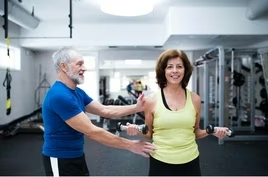
Preview: S18 Ep1805 | 30s | Advice and resource for optimal physical and financial health for seniors. (30s)
Providing Support for PBS.org
Learn Moreabout PBS online sponsorship
- Science and Nature

Explore scientific discoveries on television's most acclaimed science documentary series.
- Science and Nature

"Our New World" reveals Nature's astonishing adaptation abilities and how humans can help it thrive.












Support for PBS provided by:
Health Matters: Television for Life is a local public television program presented by KSPS PBS