Alabama Public Television Presents
The Alabama Games: The Ron Creel Story
Special | 26m 47sVideo has Closed Captions
Profiles Alabama businessman Ron Creel who created and led the Alabama State Games for 40 years.
In 1982, Alabama businessman Ron Creel received a call from the United States Olympic Committee asking him to build a grassroots sports movement in Alabama. So was born the Alabama State Games. What started in 1983 with 600 athletes and 4 sports has grown into 4,200 athletes competing in 25 sports in 2025, making the Alabama State Games the largest annual multi-sport event in the state.
Problems playing video? | Closed Captioning Feedback
Problems playing video? | Closed Captioning Feedback
Alabama Public Television Presents is a local public television program presented by APT
Alabama Public Television Presents
The Alabama Games: The Ron Creel Story
Special | 26m 47sVideo has Closed Captions
In 1982, Alabama businessman Ron Creel received a call from the United States Olympic Committee asking him to build a grassroots sports movement in Alabama. So was born the Alabama State Games. What started in 1983 with 600 athletes and 4 sports has grown into 4,200 athletes competing in 25 sports in 2025, making the Alabama State Games the largest annual multi-sport event in the state.
Problems playing video? | Closed Captioning Feedback
Where to Watch Alabama Public Television Presents
Alabama Public Television Presents is available to stream on pbs.org and the PBS app.
(soft music) You're looking at the person, and I'm not bragging now, I'm giving you facts.
You're looking at the person, Ron Creel, that brought the Olympic soccer to Birmingham.
(inspiring music) (inspiring music continues) This is a story about the Alabama State Games, a nonprofit organization that was founded at the request of the United States Olympic Committee in 1982.
Why was Alabama chosen for this new concept and who answered the call to start this program?
Follow me on this journey as we learn about my father, Ron Creel, Sr., Founder and Chairman of the Alabama State Games.
Ron Creel is a master of everything.
He's almost like Wonder Guy, a sports hero.
He really is.
The moment I met him, I was captivated by his personality, his presence.
He's a person that he's just dedicated to these young people.
He's relentless and he has great vision and he's an organizer.
Ron Creel was the one who had the passion to begin with and he built these games from scratch and he had to claw and scrape and get support.
It's expensive to put these things on.
I claim I'm an Alabamian because my dad was originally from Alabama.
He was from down in Headland, which is in the wiregrass, and he was one of 11 children, six girls and five boys.
Back in those days, if you didn't farm, you couldn't hardly find a job.
So he and his three brothers and one sister and my dad, they got a car and they drove up north to looking for work and they all ended up in Connecticut.
And of course he met my mother and she was from Waterbury and they got married and my dad really missed Alabama.
And every August he took off from his job and we came to Alabama, myself and my three brothers, and I met all his family.
All his brothers, all his sisters, most of 'em were farmers.
We stayed on the farms.
I loved the cattle, the hogs and the cows, and the chickens and all.
And I fell in love with Alabama.
So when I finished high school, Crosby High School in Waterbury, Connecticut in '56, I told 'em I was moving to Alabama.
And so I've been here ever since.
So a few years later I worked down here in Dothan and I decided I was gonna go to Auburn.
And so I went to Auburn University and I graduated in 1962 in business.
I love Alabama and I love the people.
We got great people here with great hospitality and great love.
So my father, Ron Creel, in the early eighties was contacted by the United States Olympic Committee and invited to breakfast to talk about a new grassroots program that the Olympic Committee was trying to get started in all the states.
The vision with the Olympic Committee was to try to get state games to put the Olympic sports in their games and teach young athletes in America about these sports.
And hopefully some of 'em have become real talented.
And as they say, the cream will rise to the top and they'll be future Olympians.
My father asked, "Well, how did you get my name?"
And he said, "We called the governor," and George Wallace was the governor at the time, "and he gave us your name."
Well, how that got started, the fellow's name was Baaron Pittenger.
Baaron was a fine person.
Unfortunately he's deceased now, but now Baaron used to be the athletic director at Harvard.
He was from Massachusetts.
He said, "If you get these games going," he said, "They'll be more popular than the Auburn-Alabama football game," what he told me.
I said, "Now Baaron, you're doing a good job selling me on trying to do these games, but I'm gonna tell you one thing, there's nothing in Alabama gonna be more popular than Auburn-Alabama football game."
I said, "You kinda stretched it there."
I corrected him.
But he called Governor Wallace and they asked him what he wanted to do.
He said, "Now I want you to recommend somebody."
So Governor Wallace told him, and this is what Baaron told me, he said, "If you get Ron Creel to do it, he'll get it done right."
He was in his mid forties and he already had had a successful insurance career.
I was a member of the million dollar round table.
I sold insurance and was very successful in it.
And I rose from an agent to a vice president of the company, Mutual Savings Life Insurance company, which was headquartered in Decatur.
He had had a successful banking career.
He had just sold a bank in Prattville and the governor knew that he had sold the bank and was looking for his next thing to do.
And so it just, the timing was perfect.
A fellow named Jose Rodriguez was the director of the '96 Olympic Games in Atlanta.
And I drove over to Atlanta.
I said, "Jose, would you put some of this Olympic soccer in Birmingham?"
He said, "Ron, I'll be happy to."
Came back and told 'em they were getting Olympic soccer.
'Course they lit up like Christmas trees, you know.
It was difficult.
I mean here it was, was a brand new concept.
Alabama was the second state to start these type games.
It's not like you can say, "Well, this state's been doing it for 10 years or 15 years."
I mean everybody was getting started right at the same time.
Now the two states that started the state games movement in America was Massachusetts and Alabama.
Now Baaron told me, I asked him, I said, "Now why did you choose Alabama?"
He said, "Because Alabama's a great sports state."
And he was referring to Bear Bryant, an Alabaman, Shug Jordan and all, but Baaron was pretty smart.
And I said, "We found out if they had a son born that the daddies puts a football in their crib, you know, right after they were born."
That's what he told me.
And he said, "So we wanted to start games here."
His enthusiasm was contagious because a program of this size, there's no way that one person can do it.
It takes a lot of people across the state of Alabama to be excited and get involved in this program.
And my father was the one that had to sell that initially when there was nothing to show.
And he started it that year.
When I graduated high school, I went to Auburn University and after I graduated from Auburn, I moved to Birmingham.
It was never in my plan to work for my father.
I loved my father, still love my father even after working for him.
But life happens and things happen and he cast a big shadow and I wanted to go out and strike it on my own, so to speak.
And so we always supported the Foundation.
As a high school student, I worked part-time in the summers.
I volunteered a lot and also my daughter participated in the Alabama State Games as a swimmer.
So she was probably 12, 13.
We were in the parade of athletes and I walked with her in the parade of athletes.
It was really amazing.
I got to see it from a parental point of view and just the awe and excitement of all the kids and got to see my daughter win a medal and win ribbons and you know, all kinds of things.
And it was very exciting.
She loved it.
Our family experienced a tragedy.
My daughter, when she was 15, was diagnosed with alveolar rhabdomyosarcoma, which is a very aggressive childhood cancer.
And for 10 months we battled that cancer, but we lost her.
And six weeks before we lost her, we lost her father to a massive heart attack.
23rd of December, go to bed, say goodnight.
Christmas Eve, I wake up, she's in the middle of battling cancer.
I am trying to finish wrapping presents and getting everything ready for our Christmas celebration.
And there's a knock at my door and someone says, "There's a man lying in your driveway."
And it's her father and he has passed.
The six weeks between the time that we buried him, we were still going back and forth to Children's to get her treatment.
She was struggling with the loss of him.
And so I just said to her that regardless of what happened, if she was able to beat the cancer, she would have a parent here.
Or if she went on to be with the Lord, that she would be with Brent.
That put her at ease.
She, you know, had not thought about that.
So I had to tell my daughter that her father had passed and then six weeks later we lost her.
(soft music) My father really helped me while we were battling her cancer.
Because of the volunteer work that he had done, he had been on the cancer board, he'd been on the leukemia board, so he was networked with doctors.
Let me tell you, God blesses you every day.
You know, just like I knew Dr.
Joe Patino, he's world-known.
Four o'clock in the morning my landline, I had a phone next to my bed, you know, when my wife and I were sleeping, he said, "Well, send me all her medical records," which we did.
And he said, "Ron," he said, "I hate to tell you," he said, "There's no cure for that cancer.
All we can hope for, there's a lot of research and going on with the medical profession with cancer."
But we hadn't found the cure yet.
And because, I don't know, to this day, I don't think they found a cure for that cancer.
Probably the best thing he did for me was say that these are your decisions and I trust that you will make the best decision for her.
And whatever decision you make, I will support you.
And I can't tell you how comforting that was.
And he has been true to his word.
I've not had to have any regrets.
I know that there was no stone left unturned for her care and there was nowhere that she was going to be cured.
(soft gentle music) When he asked me to come and work for the Foundation, just a wave of emotions.
My first response was no.
She saw all my blood, sweat, and tears for 42 years, see, and she was a volunteer at all these games.
So there's no one that knew anymore about the games than Laura did.
You know, I needed something to make me get outta bed.
When you lose a child, you're just never the same.
I had been in corporate America for 26, 28 years.
I enjoyed a successful time.
I loved my time in corporate America.
But when that happened, after I took some time off, I went back for probably two or three years, but it just wasn't the same.
And I really needed something to make me feel like I was contributing to something more than just myself.
And so originally said no.
And then it was about a year later, he was in the hospital, he had some kidney stones and I was visiting him.
I was getting ready to leave.
I said, "Well, is there anything that I can get for you?
Like, do you need me to get you some water?"
Like I was wondering what he needed in the moment.
And he said, "Well, what I really need for you to do is to go to work for this Foundation and help me run this Foundation because I'm, you know, needing to retire."
And without even giving it a thought, I said, "Okay, I will do it."
And you know, a great decision it has been.
My dad, Ron Creel says, "Shoot for the moon.
And even if you don't reach the moon, you will grab some stars."
Every day in life you experience something new and also you experience something negative, you know?
And you gotta learn from those experiences.
So every day is a learning day.
If you want to have something great, you gotta reach for the moon.
Even though it's very painful for me to outlive my daughter, you have to use your pain for good.
And so I learned that from him because, you know, as he faced tough situations in his life and there were plenty, he always, you know, found the best way to move forward.
And so we created the Elaine Roberts Foundation and we for 10 years have raised money and raised awareness for childhood cancer research.
We promote the Elaine Roberts Foundation at the Alabama State Games.
We may not reach the moon, but we are gonna get some stars.
And we are going to give the youth in Alabama opportunity and we are gonna give them experience that they can't get anywhere else.
And we are going to help them be good citizens and do good things for the state of Alabama.
Now you've met my daughter.
She's taken over as executive director and I gave her a year to be the executive director to see what she'd do with it.
I knew she was gonna do well.
Now last night at our board meeting, we made her the executive director and CEO as of eight o'clock last night.
Over the years, I have observed him in every aspect of putting the Alabama State Games together, from writing the bylaws of the Foundation to selecting board members to raising money, to getting venues, getting tournament directors and encouraging people to be involved, whether it's volunteers.
For many years this program was run solely on volunteers.
So the officials were volunteering, the tournament directors were volunteering.
I mean, everybody was a volunteer.
The success of the games has not been Ron Creel.
The success of the games is all the volunteers that we recruited and sold 'em on our philosophy.
He put his time and effort, I'm sure some of his money into this program and built the Foundation of what it is today.
I have a great staff.
Now you might say I did good recruiting and got good qualified people.
I would agree with that, but I never take credit for the games.
I give it to the staff.
My name is Laura Creel Burt.
I am President and CEO of the Alabama State Games.
And I wanna welcome you all to our pre-opening ceremony festivities.
I am especially excited about this new program, Grit 101 for teens.
The goal of this program is to offer hope and provide tools for coping with life situations.
This program is absolutely phenomenal.
The Grit program, the Leadership Summit, there's nothing like this anywhere in the United States.
And I'm so proud that State Farm is a part of it.
State Farm, we always try and go to that and they bring motivational speakers and the children respond.
I'm Hadleigh Kate Wiggins.
I'm excited to be here to learn about Grit 101.
Who in this room thinks life can be hard?
Yep, lots of hands, young and old.
And it's important to know that when you're going through hard things, you're not alone.
I would like to introduce Edie Hand.
Edie's program, Women of True Grit, tells women's stories of perseverance.
In an oyster shell, it takes a small speck of sand or grit, and then through irritations it turns into something beautiful.
And that is with us, with our life stories.
You form your own unique pearls of hope for life.
In life, you might have had health issues, you could have had things in your family that weren't right.
It is endurance that makes the difference.
I'm looking forward to eventually bringing it to our community, to helping our kids work through their life lessons in some of the day-to-day stuff they have to deal with.
We learned how to trust in the Lord, but in order for you to get out on your knees and claim that you trust Him, you gotta have some courage.
Trust in the Lord with all your heart and lean not into your own understanding.
In all your ways acknowledge Him and He'll direct your path.
So if we trust in Him, He's gonna direct us, but guess what?
We gotta have the courage to trust in Him.
My father learned while he was out raising money for the Foundation, that not all companies wanted to be involved in sports.
And he had a CEO tell him, "Ron, I'm gonna give you money for your program.
But what we like to give money to is scholarships.
We wanna encourage people to go to school and further their education so that they make good employees for us."
And so my father took that and said, "Well, then I'm going to start a scholarship program and kinda build on the sports aspect, but also give opportunity to these athletes to be able to help with their educational expenses."
And today we have given over $450,000 to 660 athletes to help with their education.
I used to be on the State Board of Education at one time.
That's an elected position.
I have a degree in business administration from Auburn and I have an honorary doctorate degree from University of West Alabama.
And so I know the importance of education.
No other state games in America has contributed the scholarships that the Alabama State Games has.
We had one young lady, she needed money to go to college, so they have the raffle off for the scholarships.
She won and she went to college because the state's games helped her to go.
We had a young man that was a ninja warrior.
That's a sport that we had.
It's on TV, you know, we had that sport and he was really adventurous, you know, and he won a $5,000 scholarship through the raffle.
Well, after the games was over with, he'd never been ice fishing.
He's from the south.
We don't have much ice down here.
In Connecticut, ice fishing is very popular in the wintertime 'cause it's below freezing most of the time.
And he got on the ice and unfortunately this fine young man fell through the ice and drowned.
Of course we sent flowers to his funeral when we heard it.
One of my board members saw it in the paper and called me.
Well, a month after the funeral, I called his parents and I said, "Do y'all have any other children there?"
And said, "Yes, we got three other children."
I said, "Well, the first one that goes to a two or four-year college, you call me."
And I gave him the number, gave my administrator's number, and I said, "We'll give him the brother's $5,000 scholarship."
It changes lives.
People that might not be able to go to further their education have that opportunity through scholarships of the state games.
We've worked hard raising money to be able to do that.
And we're gonna continue doing it, but we know that we're helping to educate people.
It's gonna help the state.
(inspiring music) (inspiring music continues) I hope that every child that comes here walk away with a positive experience.
And I can't wait for the opening ceremony to begin.
Just absolutely astonished at how impressive the opening ceremonies are.
It celebrates everything that's wonderful in America.
I can't tell you any other athletic competition or venue or scheduled event that force everybody from the state to come together.
That's what this does.
Just so beautiful because black, white, whatever, all this other stuff is set aside.
I think that our kids need a whole lot of positive experiences.
They're hungry for some love and this is a way that we can bring it to 'em.
I'm excited to be here at the opening ceremony at the Alabama State Games.
I have the privilege and opportunity to represent baton twirling and I'm excited to be here.
I am proud of my family's legacy and I'm excited to be a part of the Alabama State Games.
By participating in sports and being part of these games, it's something that they can layer on and use for the rest of their life.
We're striving to reach that 5,000 athlete mark and beyond.
But you know, you've got states like Texas who have 6,000 athletes at their track meet and you know, states like California and Florida.
And so not everything that works in Alabama is gonna work in Texas or California or Florida.
But some things that work in Alabama may work in Georgia and some things that work in Georgia may work in Alabama.
So it's a great association.
So yes, there's no telling how many athletes across the country have been impacted by all of this.
Some of these athletes go on to do great things.
Some of these athletes, they're just wanting to be involved.
I mean, it's a unique Olympic moment that they get.
A lot of these athletes are going on to be our bankers and our insurance and some doctors and lawyers and people that we interact with on a day-to-day basis.
And so the fact that we have helped them in some small way is very encouraging.
(soft music) When I think of Ron Creel, the word that comes to my mind immediately is passionate.
He has a huge heart.
He cares so much.
His enthusiasm is contagious.
You don't have to be around Ron Creel long to know he's an optimist, uplifting.
My father took a great leap of faith when he started this Foundation and I know that there is no way, no how, that I could continue the work that he has started without a great faith.
And I depend heavily on God to help me open doors and there are a lot of moving parts.
And he made it look easy.
You don't build a program like this.
It doesn't last 43 years without God being in it.
And we remember that at the Foundation.
Over the next five years, I see these state games blossoming more because the need is there and I think that it will continue in perpetuity as long as we believe that we have been sent here by God, that He has ordained our work, and that it will make a difference in the end.
It is a family affair.
And I would welcome anyone to come to an opening ceremony, be a volunteer.
If you are a business owner or an executive, I encourage you to get involved as a sponsor.
If you will just come and visit the Opening Ceremony one time, you will never want to miss it again.
It is that impactful.
It is that exciting.
Just seeing the kids enjoy, have their moment, and the parade of athletes have their moment, the oath to athletes, the torch coming in.
If you will give it one try, you will never want to not be a part of it.
You think I would've thought that when we started these games that we'd be here today and we'd have over 4,500 athletes?
I'm not a Bear Bryant or a Shug Jordan or a Nick Saban, you know, but I'm a dripping faucet that breaks concrete.
(laughing) (uplifting music) (uplifting music continues) (uplifting music continues) (soft music) (soft music continues) (soft music continues)
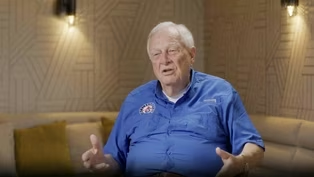
Preview: The Alabama Games: The Ron Creel Story
Preview: Special | 30s | Profiles Alabama businessman Ron Creel who created and led the Alabama State Games for 40 years. (30s)
Providing Support for PBS.org
Learn Moreabout PBS online sponsorship New Season
- Drama

Hugh Bonneville stars in a crime drama inspired by one of the largest robberies in British history.
 New Episode
- News and Public Affairs

Top journalists deliver compelling original analysis of the hour's headlines.

 New Season
 New Episode



 New Episode
Support for PBS provided by:
Alabama Public Television Presents is a local public television program presented by APT