
Aliah Irvine & Kehau Kapua’a: Kukulu
Special | 17m 19sVideo has Closed Captions
Follow Aliah and Kehau as they take on the male-dominated practice of building Hawaiian hale.
Follow Aliah and Kehau as they take on the male-dominated practice of building Hawaiian hale, traditional thatched structures — a personal and political effort as they reclaim cultural traditions nearly lost to colonial erasure.
Problems playing video? | Closed Captioning Feedback
Problems playing video? | Closed Captioning Feedback
Support for American Masters is provided by AARP, The Rosalind P. Walter Foundation, Thea Petschek Iervolino Foundation, Burton P. and Judith B. Resnick Foundation, The Philip and Janice Levin Foundation,...
Support provided by:

Aliah Irvine & Kehau Kapua’a: Kukulu
Special | 17m 19sVideo has Closed Captions
Follow Aliah and Kehau as they take on the male-dominated practice of building Hawaiian hale, traditional thatched structures — a personal and political effort as they reclaim cultural traditions nearly lost to colonial erasure.
Problems playing video? | Closed Captioning Feedback
Where to Watch American Masters
American Masters is available to stream on pbs.org and the PBS app.
Buy Now
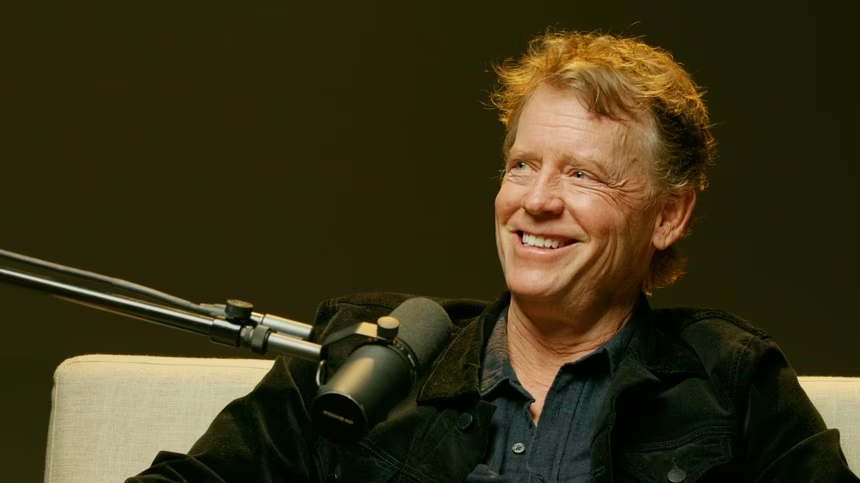
A front row seat to the creative process
How do today’s masters create their art? Each episode an artist reveals how they brought their creative work to life. Hear from artists across disciplines, like comedian Chris Fleming, actor Greg Kinnear, sports journalist Taylor Rooks, and more on our video podcast "American Masters: Creative Spark."Providing Support for PBS.org
Learn Moreabout PBS online sponsorshipMore from This Collection
This documentary shorts series from American Masters and Firelight Media follows emerging cultural icons – creators who bring insight and originality to their craft – on their journeys to becoming masters of their artistic disciplines.
Stankface Standing Soldier: The Rise of Mato Wayuhi
Video has Closed Captions
Watch as Oglala Lakota musician Mato Wayuhi draws on ancestral knowledge to inform his process. (16m 11s)
Warren King: King of Cardboard
Video has Closed Captions
Follow Warren King as he transforms cardboard into intricate sculptures. (15m 40s)
Video has Closed Captions
Poet Cindy Tran found her voice on Yelp and writes about family, identity and belonging. (16m 11s)
Video has Closed Captions
Trumpeter Lani B. Supreme carries forward a musical legacy that transcends generations. (12m 38s)
Hannah Mayree: Songs of Reclamation
Video has Closed Captions
Musician Hannah Mayree organizes workshops and performances celebrating the banjo's Black history. (16m 20s)

Video has Closed Captions
Follow Sudanese musician and ethnomusicologist Alsarah as she leads Alsarah and the Nubatones. (17m 36s)
Video has Closed Captions
Artist Ani Liu creates provocative artifacts at the intersection of art, science and technology. (16m 15s)
Providing Support for PBS.org
Learn Moreabout PBS online sponsorship(bright music) (Aliah speaking indistinctly) (Aliah and Kehau chanting and singing indistinctly) - [Narrator] Aliah Irvine and Kehau Kapua'a are cultural practitioners and two of very few women active in Hawaii's hale building practice.
Their mentor is Kumu Francis Sinenci, who is known for revitalizing the lost practice of hale building.
- A hale is a house.
Most valuable facet of Hawaiian life.
Without the hale, you houseless.
The hale provided rest for the weary bodies, shelter from the elements, and from the kapus and procreation.
(Aliah and Kehau singing indistinctly) (Aliah and Kehau clapping) - All right.
- Okay.
We go harvest, and it's hard work.
We are chainsawing.
We're debarking.
We're carrying big wood.
Sometimes the wood, we're like, wow, we don't know how we're gonna lift it, but it's like our kupunas take over.. and like, they're helping us lift the pohakus, lift the la'au, you know?
And so you can feel our kupuna running through our veins, every time.
You're just in a different realm when we're doing that kind of work.
Because we don't get it from Home Depot, it's harder to find.
But I think within the search of finding the r.. we find who we are.
When you talk about culture, you talk about spirituality, you're talking about identity, all those things are powerful.
- [Kehau] There's a lot of practices that have been lost to us and then we're just piecing them together now to create something whole that can be shared and taught and perpetuated.
We're building a cultural foundation so it can't be taken away again.
(bright music) - [Narrator] Western missionaries arrived in the Hawaiian Islands in 1820.
With the settlers, came devaluation of Hawaiian life and the banning of many cultural practices.
Just a generation later in 1893, the children of those missionaries overthrew Hawaii's queen, banned the Hawaiian language, and dispossessed the people of their lands.
(bright music) (people singing indistinctly) - [Narrator] The 1970s saw the beginning of a Hawaiian cultural renaissance, including restoration of the Hawaiian language and lost arts, like oceanic voyaging and traditional hula.
(bright music) (people singing indistinctly) - [Narrator] This renaissance continued through the 1990s, with the founding of Hawaiian language immersion schools and the restoration of practices, such as agriculture, aquaculture, and hale building.
- I started hale building in 1994.
I've built hales that I didn't know that I built.
Well, I'm getting old too, so I can't keep track.
It's been over 486.
That's the last one I documented.
I've built about 20 or 30 after that, and I don't build 'em just for show.
All my hales are functional.
The traditional Hawaiian architecture.
- [Narrator] Hale have a variety of uses today as gathering places for community events and venues for cultural practices and education.
- But if you don't practice this every day, you're not gonna know how to read and spell.
- [Narrator] Hale are now found in the hearts of community centers and school campuses across the islands, and even found in the hearts of cities.
The builds are major construction jobs, carried out not by typical construction workers, but by cultural practitioners.
It's a multidisciplinary practice that requires a working knowledge of lashing, thatching, weaving, post and beam construction, and traditional Hawaiian stone masonry.
- I prefer that stone to face that way and the inside be part of the well wall.
- [Builder] Okay.
(builders hammering wood) - [Kehau] To remove the 'ili, the bark of the trees, we were using hammers to debark, but we often use just another piece of wood.
The whole process in itself is very holistic, I think, pounding on the wood with sticks, and you hear the beat and it resonates.
(bright music) I dunno, there's something about the frequencies, right?
Like, I don't know about all that, but I know that when we do it, we feel it.
Aliah and I are the monkeys.
That's what we're called.
We like to be up in the high spaces.
We're also some of the smaller hale builder, so we can fit up in the spaces and we don't put too much stress on the frame when we are up there.
I gotta climb up to the top and help patch all these holes up there.
It's super laborious and dangerous.
And risky, yeah, but also super rewarding.
You know, risk to reward ratio is pretty good.
I like being at the top of the hale.
I love the view.
I feel like it's an antenna, right up to the source.
(relaxed music) - [Aliah] I was trying to look for a purpose.
Where's my place?
I'm not a hula dancer.
Definitely n.. Love them.
(chuckles) You know, I grew up surfing and I love planting kalo.
I love all of that.
But where is my role in my culture?
And so when Kumu entered my life, I was like, "Wow, this is it.
I found what I really love to do."
(relaxed music) - I think every Hawaiian is an artist.
I think that that's who we are.
I don't think that we can separate art from practice.
They're innately entwined.
The farmer, his art is making sure the water flows.
I feel like when I paint, I'm building the picture, like I build a hale.
Might be not as physical when I'm painting, but it's still the same process.
I'm gathering, I'm preparing, I'm creating a plan, laying the foundation.
And I am doing one phase at a time.
The part of hale building that I feel most artistic in while I'm doing it is the lashings.
My favorite has to be the ki'i hei, which attaches the lohe lau to the posts.
That one there.
I take a lot of pride in my lashings because it's something I feel that I'm proficient in.
And so I really pay attention to them.
I like to make them nice and neat.
Whenever I do that, I hear in my head, ma'ema'e a mai au, something that was kind of drilled into me as a child is nice and neat.
You might catch me bragging about how, if you see a nice lashing, it's probably mine.
I feel extremely blessed and lucky to do the practices that I have been taught.
But just like anything else that has been colonized, there is a big cloud of misogyny and patriarchy that's prevalent in all of these spaces.
There have been times since I've been in the practice that Aliah and I were the only active Wahine hale builders in Hawaii.
(steady music) (people chanting indistinctly) - It's a male dominant practice, but Kumu has said that the kapus have been lifted.
And so here, auamo kuleana is saying, yes, women are allowed to build hale.
And so he allows women into his pa, which is beautiful.
Some culture practices don't allow that.
I can't speak on the behalf of them, but I have a lot of respect for Kumu.
We're moving away from that mentality.
It doesn't mean that we don't have remnants of those things still clinging to us, but I also believe we're here now.
Sometimes you have to deviate from tradition in order to preserve it.
And the people who wanna do this are gonna show up.
And I believe the people who show up are also being led here by their kupuna.
- Kind of cool, 'cause a lot of us hale builders, you know, we find out that we're connected genealogically, like 'mo'oku'auhau.
So it's like our kupuna are reuniting us back to each other, to kukulu hale, but also, we're building relationships.
We're building connections back to the past and hearing those stories.
It's just amazing that all our kupuna are in this space, whether it's present, past, the future.
We are strong kanaka, and not strong because we're physically strong.
No, spiritually, mentally, physically strong because our kupuna have given us a blueprint of how to live pono.
There's a whole line of people that have come before me, but I'm just blessed to be in this space.
And then hopefully if when Kumu gives me the blessing to teach, then that's how we break those gene.. - [Narrator] Now 83 years old, Kumu Sinenci has established a path of promotion for his apprentices, but has no seated plans for retirement or a plan of succession.
- [Francis] You cannot be 80 and just hop on and build a hale all the time.
- [Kehau] Don't forget to kiss his head when you're pau.
- I think I've contributed something to how my culture.
I could build hales, doing back flips 'til I was 81.
After that, I started slowing down.
So it takes it outta here.
- Kumu has three tattoos, and those three tattoos signify that he is the master hale builder.
- To become certified, at least get one of these tattoos on their hands.
You gotta know the protocol.
(people chanting indistinctly) - You gotta anticipate in helping build about 10 hales before they come really ma'a with the process.
- There's a couple of us that have gotten this tattoo.
You're able to do certain things on how to teach and be an alaka'i.
And so this is kind of like a uniki process.
- To earn your second stripe, you have to be a teacher, demonstrator.
You have to be, you know, all encompassing, in every facet of hale building.
- There's a protocol that Kumu has of, how you can go from one to two, you know, and three is always gonna be him.
- The haumana, to become a master, they have to build their own hale.
You gotta know why you do what you do.
I know you know what you're doing, but you gotta get to the conceptual level of why.
Nobody has these three yet.
But before I hala, somebody gonna get 'em.
- [Narrator] Kehau has been approved to receive the first stripe of her tattoo for over a year.
But so far has it declined.
- It's not that I don't believe in myself.
I think that I just am aware of the gravity of this, for me.
- [Narrator] Aliah hopes to receive her second stripe soon and has taken the initiative to build a hale in her own backyard.
- [Aliah] I started working on this hale about two years ago.
A hale cannot be built by itself.
It's a 'ohana structure.
I was blessed that my uncle, my friends, Kumu and the crew have come and laid their hands and their uhane into this place as well.
So every o'a that was cut, every post that was cut, every leaf that was stashed, it was made with aloha and it was made with intention.
After you're finished with the hale, we bless it.
And so Kumu came, we had a kahu come to bless the hale.
It's about the kakou where, when people see this, like I hope they get inspired, or come, come, come to my house, drink some 'awa, talk story, and we can bring back life into this space which brings our life to our community.
I'm blessed to be able to learn from Kumu and learn from the uncles and aunties and Tiana Henderson and Aida Gais.
It's important for me to say those names because I was not hear by myself.
And right now, as Kumu is transitioning, it doesn't mean the practice is dying.
It doesn't mean the practice is gonna ever fade.
There's people that are gonna take it up and still continue to kukulu.
So it's never gonna die.
The rock wall will fall down one day, kahea, and come back and rebuild it 'cause in the process of building, everybody gains gifts and they come back and build and help restore.
- [Kehau] I absolutely think that it's important for kanaka to take up spaces, for kanaka to take up anything.
Grab a pohaku, do whatever you can to feel connected to Hawaii, to feel like you belong.
It's our duty to learn these things, and I hope that more of us are inspired to do these things, to any practice.
Anything that brings us closer to feeling good here in Hawaii.
The more you do it, the more comfortable you'll feel with it because it's where we belong.
- [Aliah] Being able to connect back into the aina, to the kai, to the elements, it's connecting back to our piko, you know, from the past to the present to the future.
I found my purpose.
I love hale building, but I also think that we all have, you know, different seasons and learning to honor the season that I'm in right now in my alaloa, which is the long journey, and if there's things that come in the future in honoring that too.
And so, I'm super blessed and super honored that our kupuna put me in this season to do hale building, to learn from all these great people and to carry it on, you know?
- [Narrator] The revitalization of hale building, as with many of our restored practices, is about returning to ourselves.
Hale are our most fundamental structures, our homes.
And as we rebuild our past, we build our future.
(bright music) (bright music) (singers singing indistinctly)













Support for PBS provided by:
Support for American Masters is provided by AARP, The Rosalind P. Walter Foundation, Thea Petschek Iervolino Foundation, Burton P. and Judith B. Resnick Foundation, The Philip and Janice Levin Foundation,...