
Lani B. Supreme: Legacy
Special | 12m 38sVideo has Closed Captions
Trumpeter Lani B. Supreme carries forward a musical legacy that transcends generations.
Enter the world of trumpeter, composer, educator, and storyteller Lani B. Supreme (Jelani Akil Bauman) as he carries forward a musical legacy that began with his great-great-grandfather before emancipation. Driven by his family’s craft, Bauman’s music celebrates Black creative expression.
Problems playing video? | Closed Captioning Feedback
Problems playing video? | Closed Captioning Feedback
Support for American Masters is provided by AARP, The Rosalind P. Walter Foundation, Thea Petschek Iervolino Foundation, Burton P. and Judith B. Resnick Foundation, The Philip and Janice Levin Foundation,...
Support provided by:

Lani B. Supreme: Legacy
Special | 12m 38sVideo has Closed Captions
Enter the world of trumpeter, composer, educator, and storyteller Lani B. Supreme (Jelani Akil Bauman) as he carries forward a musical legacy that began with his great-great-grandfather before emancipation. Driven by his family’s craft, Bauman’s music celebrates Black creative expression.
Problems playing video? | Closed Captioning Feedback
Where to Watch American Masters
American Masters is available to stream on pbs.org and the PBS app.
Buy Now
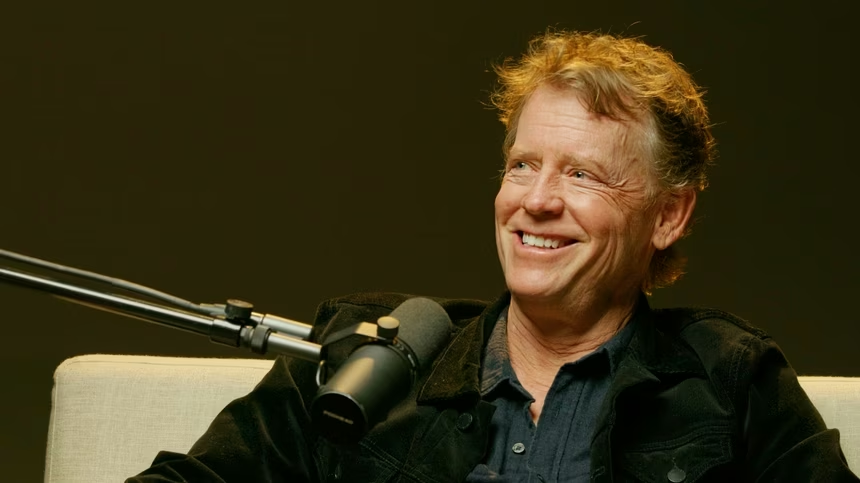
A front row seat to the creative process
How do today’s masters create their art? Each episode an artist reveals how they brought their creative work to life. Hear from artists across disciplines, like comedian Chris Fleming, actor Greg Kinnear, sports journalist Taylor Rooks, and more on our video podcast "American Masters: Creative Spark."Providing Support for PBS.org
Learn Moreabout PBS online sponsorshipMore from This Collection
This documentary shorts series from American Masters and Firelight Media follows emerging cultural icons – creators who bring insight and originality to their craft – on their journeys to becoming masters of their artistic disciplines.
Stankface Standing Soldier: The Rise of Mato Wayuhi
Video has Closed Captions
Watch as Oglala Lakota musician Mato Wayuhi draws on ancestral knowledge to inform his process. (16m 11s)
Warren King: King of Cardboard
Video has Closed Captions
Follow Warren King as he transforms cardboard into intricate sculptures. (15m 40s)
Aliah Irvine & Kehau Kapua’a: Kukulu
Video has Closed Captions
Follow Aliah and Kehau as they take on the male-dominated practice of building Hawaiian hale. (17m 19s)

Video has Closed Captions
Poet Cindy Tran found her voice on Yelp and writes about family, identity and belonging. (16m 11s)
Hannah Mayree: Songs of Reclamation
Video has Closed Captions
Musician Hannah Mayree organizes workshops and performances celebrating the banjo's Black history. (16m 20s)
Video has Closed Captions
Follow Sudanese musician and ethnomusicologist Alsarah as she leads Alsarah and the Nubatones. (17m 36s)
Video has Closed Captions
Artist Ani Liu creates provocative artifacts at the intersection of art, science and technology. (16m 15s)
Providing Support for PBS.org
Learn Moreabout PBS online sponsorship(bright orchestral music) (bright orchestral music continues) Me becoming a musician, I credit that to my father.
Even though I was given a trumpet by my grandfather when I was five years old, I didn't really pursue it seriously, and one day, my dad just came and picked me up.
He unexpectedly brought me to a music store and bought me a trumpet, and that was it.
(solemn trumpet music) So here, we have JB Humphrey and his grandson, my grandfather, Emery Humphrey Thompson, also known as Umar Sharif.
Emery would go on to perform with musicians such as Lionel Hampton, Quincy Jones, Ella Fitzgerald, and Wynton Marsalis.
One of the first solos I ever heard my grandfather play was on the song "After You've Gone' from the groundbreaking musical "Black and Blue."
He's not in the picture, but you can hear him in the pit orchestra.
Man, it's such a masterful solo, where you hear the melody of the song, but you also just hear his improvisation all intertwined, and yeah, that's our next selection that we're getting ready to perform for you.
(upbeat jazz music) (solemn music) Just like my grandfather gave me a trumpet when I was a child, his grandfather, JB Humphrey, gave him a trumpet when he was about the same age.
And I've seen this picture for years, and I always come back to it, 'cause I look at these two men and their contributions to music, and especially New Orleans music, pays so many dividends for the generations they came after.
To see both them documented in a photograph is really profound.
My great great grandfather, JB Humphrey, was born enslaved on the plantation in Sellers, Louisiana, less than an hour outside of New Orleans.
After emancipation, JB returned to many of the plantations in Louisiana and taught music to the children of Black American sharecroppers.
JB Humphrey played the cornet, which is an earlier relative of the trumpet.
His style of teaching was so innovative and so impactful on 19th century Black American musicians, many scholars identify him as the grandfather of jazz.
He made a big emphasis on the rhythmic concept of syncopation, which is very integral to all Black American styles of music.
He took the traditional conventional brass band style, marches that sound like ♪ Bum bum ba da bum, bum bum bum bum bum bum ♪ you know, really on the beat, really predictable routine, where using syncopation brought a new unpredictability to the music and a more danceable aspect that wasn't there before.
(upbeat jazz music) From research and exploring the life of my great-great-grandfather, James Brown Humphrey, I've learned that I share a lot of the same interests and passions as he did in regards to, obviously, music, being an educator, being someone who wants to see social mobility take place within my community.
(bright jazz music) Sports has always been a part of my life, even when I chose to become a musician, and that became my main aspiration, to observe the amount of adversity that a lot of these individuals go through when they put so much time and sacrifice into their craft and still come up short.
All these things were big interests of mine, because the amount of lessons that you can get from sports, to be able to persevere through those types of trials and tribulations and continue to fight, I find so much inspiration in that.
In my opinion, sports is one of the greatest cultural shifters, is the one thing that can really unify this country.
(bright trumpet music continues) I wrote a suite for Big Man that celebrated the 60th anniversary of Cassius Clay at the time, who went on to be known as Muhammad Ali, becoming the youngest heavyweight champion ever.
He defeated Sonny Liston, and at that time, it was recognized as one of the greatest upsets, not just in boxing history, but in sports history.
When we take into context the time of this moment, not too long after the Birmingham Church bombing, this is 1964, the same year as the Civil Rights Act.
A year later, Malcolm X was assassinated.
Bobby Kennedy and MLK were assassinated a few years later, so it's a lot of turmoil going on during this era in history, and for Muhammad Ali to be such a courageous individual, for the first time, we see a Black American athlete who is televised, and he's exuding a high amount of confidence and brashness and just self-belief and pride and not being afraid of being a Black man in the white gaze.
- Yo, I've got the world!
- Wait a minute, Cass.
Wait a minute.
- You must listen to me.
I am the double!
- Now, listen to me.
All right, hold it, ladies and gentlemen.
- I felt that it did something to my spirit, that I wanted to pay homage to him.
I took a lot of time to watching the fight multiple times and analyzing it, watching documentaries about that moment, and even taking the time to actually learn how to box so I can really get in that mindset.
It kind of felt like as if I was a method actor, you know, just really doing the research so you can really bring the sincerity to the work.
(exciting jazz music) (audience cheering) (announcer muffled) - [Announcer] Oh, how fun!
Something is happening, (muffled) going on.
And Cassius Clay has won after six rounds!
America's champion!
Yeah, he's got that.
(siren wailing) - I recently released my debut album, which is entitled, "The Future is Bright: Live at the Brooklyn Museum."
We recorded it in February 2023 at the Brooklyn Museum.
It was something I was very, very patient about, taking a journey and sharing myself in that way.
(upbeat jazz music) I'm very happy with the outcome and the process, and it's just put me on a whole new trajectory of creativity and life overall.
(audience cheering) (upbeat jazz music) Yeah, welcome to this one.
My music is about showing that the past, present, and future all exists simultaneously, and I want my work to express that.
To honor the people who came before me through sound, to me, that means speaking my truth through my soul, through my heart.
It all comes down to my experiences throughout my journey, you know, being from New Orleans, coming from this great long musical artistic lineage, having a early fascination with history from a young age, being captivated by the brilliance of athletes and sports, I choose to embrace all of that.
(triumphant orchestral music) I wanna pass down stories of triumph, self-determination, resilience, courage, self-belief, you know, overcoming self-doubt, being able to deal with adversity and overcome it with high levels of mental fortitude, being able to overcome all of these obstacles in life and to recognize the brilliance and greatness within you.
(triumphant orchestral music continues) My name is Lani B. Supreme, and this is my legacy.
(triumphant orchestral music continues) (triumphant orchestral music continues)















Support for PBS provided by:
Support for American Masters is provided by AARP, The Rosalind P. Walter Foundation, Thea Petschek Iervolino Foundation, Burton P. and Judith B. Resnick Foundation, The Philip and Janice Levin Foundation,...