Call The Doctor
All About Alzheimer's Disease
Season 34 Episode 3 | 25mVideo has Closed Captions
Learn the signs, symptoms, how it's diagnosed, whether you can help ward it off and more
50 million people worldwide are living with Alzheimer's disease and other types of dementia. Sometimes symptoms can be mild. Other cases cause untold suffering, both for the patient and family member and friends. And right now, Alzheimer's is incurable. We talk about signs and symptoms, how it's diagnosed, whether you can help ward it off and more.
Problems playing video? | Closed Captioning Feedback
Problems playing video? | Closed Captioning Feedback
Call The Doctor is a local public television program presented by WVIA
Call The Doctor
All About Alzheimer's Disease
Season 34 Episode 3 | 25mVideo has Closed Captions
50 million people worldwide are living with Alzheimer's disease and other types of dementia. Sometimes symptoms can be mild. Other cases cause untold suffering, both for the patient and family member and friends. And right now, Alzheimer's is incurable. We talk about signs and symptoms, how it's diagnosed, whether you can help ward it off and more.
Problems playing video? | Closed Captioning Feedback
How to Watch Call The Doctor
Call The Doctor is available to stream on pbs.org and the free PBS App, available on iPhone, Apple TV, Android TV, Android smartphones, Amazon Fire TV, Amazon Fire Tablet, Roku, Samsung Smart TV, and Vizio.
Providing Support for PBS.org
Learn Moreabout PBS online sponsorship(paced instrumental music) - [Narrator] The region's premier medical information program, "Call the Doctor".
- [Julie] Worldwide, 50 million people are living with Alzheimer's disease and other types of dementia.
Alzheimer's is a degenerative brain disease and the most common form of dementia.
And with a growing aging population here in Northeastern and Central Pennsylvania, Alzheimer's is something a lot of people want to know about.
Are there ways to predict who will develop these types of brain diseases?
What's new in the research?
And what kind of support is out there now, if your family needs it?
All about Alzheimer's disease now on "Call the Doctor."
(gentle instrumental music) - And hello, and so glad you have joined us for this episode of "Call the Doctor."
I'm Julie Sidoni.
I'm the news director here at WVIA and I'll be your moderator this season.
This episode, as you just heard, is all about Alzheimer's disease.
So many families in this region have dealt with a loved one whose developed Alzheimer's or other forms of dementia, my own family included.
Now, we understand this is a huge topic for 25 minutes.
There's no way we can talk about every detail.
But we have invited some of the area's experts on this topic to help us wade through it all.
Hopefully, we can give you some information that you're looking for on this.
And so, I'd like to start with introducing the panelists here today.
And I'll give you each of a minute or two to tell everyone who you are and what you do, and thank you for all being here by the way, Dr. Dunay.
- Hi, I'm Darlene Dunay.
I'm a solo practitioner in Old Forge, Pennsylvania.
I treat neonates through geriatrics.
I'm certified and a fellow in the American College of Osteopathic Family medicine.
And I've had a wide range of patient diseases and I've had a lot of Alzheimer's experience in the past.
- All right, and Nicole Lipinski.
- Hi, I'm Nicole Lipinski.
I'm the director of the Geriatric Service Line at The Wright Center.
I'm also an RN care manager and we have a program at The Wright Center specifically for Alzheimer's and dementia patients.
And it's modeled after the UCLA model.
- All right, we'll get into that in just a few minutes.
- Thank you.
- Dr. Finney.
- Thanks.
My name's Glen Finney.
I'm a behavioral neurologist.
That word, that part of neurology that studies all those things the brain does that are particularly human, like, language, personality, consciousness.
And the course the diseases that threaten it like Alzheimer's disease and related disorders.
I'm the director of The Memory and Cognition Program for Geisinger Health, a professor of neurology for the Geisinger Commonwealth School of Medicine, board member for the Greater Pennsylvania Chapter of the Alzheimer's Association, and also serve advocacy roles in the American Academy of Neurology.
- We'll start with you since we spoke a little bit earlier about some of those early signs and symptoms and how people may confuse those with symptoms of other things, or perhaps just kind of try to forget that they're even there.
They don't wanna deal with this, which I've seen happen a lot.
- And I mean, who wants to deal with this, right?
So, I hear so many times people just saying, "Oh, I'm just getting older "or my girlfriends or everyone else around me, "they're having the same problems."
Any change in memory, thinking, behavior, you ought to at least talk with your doctor or have someone talk to your doctor for you or your provider, just to make sure things are okay.
And they may be okay and that's reassuring.
But we know that if there are changes, there could be any number of medical reasons.
It's not all Alzheimer's disease.
There's a number of different reversible problems.
Like, people can get thyroid problems causing memory problems.
They can get low sodium in their blood causing memory problems.
There's a lot of different things that we, if we catch 'em early enough, we can help you.
And at the very least we can reassure you.
And at the worst, if it is the start of something like Alzheimer's or another dementia, because not all dementias are Alzheimer's, we can help get you answers as to what's going on and what your options are going forward for care and support.
And while you can still really participate actively in planning your own care.
- So this is not one to self-diagnose.
- [Glen] No.
- You need some help from the experts.
- Yeah, and in fact, people who have these diseases, they often develop what's called anosognosia, it literally means, absence of knowledge of illness.
So, as this disease sometimes impact your memory, it often can impact ability to even see the problem you're remembering the normal function you've had all your life and not remembering how much you're forgetting.
- You brought up a good point earlier, Dr. Dunay, and you mentioned it just then about how people refer to dementia and Alzheimer's interchangeably, and that's not necessarily true.
- No, it's not.
I mean, and dementia is a symptom and that's what people have to realize.
So, it can be caused by enumerable amount things, Which doctor mentioned earlier.
I mean, infections are big, hypothyroidism, metabolite errors.
Sometimes, patients will experience episodes of some paranoia or delusions, and it's not all Alzheimer's disease.
Alzheimer's disease is a progressive disease.
So, I think we need to distinguish when somebody has that dementia symptom, is it really a disease process or is it something that is reversible, that we can treat?
- Are there neurodegenerative diseases that are not progressive, that this is what happens and I'm sorry, this is what's happened, but it won't get as far as it could.
- Kind of depends how you define it.
So, the number two cause of dementia in the United States is vascular dementia.
Which is like maybe by some estimates, 80 to 85% preventable.
And if you can identify the vascular risks and control them, technically haltable.
So, that's from either small blood vessels getting clogged up, often causing what we call, subcortical vascular dementia, which is kind of more subtle or people who have had multiple strokes, multiple infarct dementia.
Identifying and preventing future strokes can prevent that potentially from worsening.
- You brought up a number of different types of dementia, and you has had us to guess how many there are.
- Oh, there's a lot, right?
- Oh, there's over probably close to 20 that we can probably establish.
- Wow, yeah.
- But in elders there's a couple that are the most common.
Once you get over the age of 65, the most common is Alzheimer's disease, which is caused probably, or at least we see two main proteins involved, amyloid, which can build up for decades before you ever have symptoms and tau protein.
Tau is very important for cell function in the brain.
It is critical, but when it gets damaged in a way we call hyper phosphorylation, it can cause damage.
And that's really where we see a lot of the dysfunction in Alzheimer's disease.
But like we said earlier, number two cause of vascular dementia from damage to your vascular system in your brain.
Number three is Parkinson's disease dementia, and a kissing cousin to it, Lewy body dementia, which is very common as well.
And oftentimes we can see more than just one of these developing because these all tend to be age risk diseases that you get more vulnerable to them as you get older.
And you don't always just get one.
We go through a pretty rigorous process in our system, for example, when we are working someone up, make sure there's nothing reversible, like all those lab problems, make sure they're not on brain impairing medications and try and shift them to brain sparing therapies.
And we get a lot of good reversibility of some of that.
And then we make sure we get the great clinical picture.
And make sure we see if there's any evidence for it like strokes with imaging of your brain.
And sometimes we even go as far as looking for biomarkers nowadays.
You can actually check spinal fluid for markers of Alzheimer's disease.
It's not absolute and you got to take the whole picture, but we have a lot of different ways of diagnosing people nowadays.
- So it must be obviously a huge topic in this area.
I know The Wright Center, Nicole, we go to you next as established.
And you're the director of geriatric services there and that's a relatively new program.
Why did The Wright Center decide to make such an investment in this?
- Well, the area that we live in right now has a big population of patients that are 65 and older.
So, we looked at the UCLA model, which I mentioned before.
- Yeah, what is that?
So, this model is Alzheimer's and dementia program, which focuses on the dementia care specialist who runs the program.
And it's typically a nurse practitioner.
So, the nurse practitioner does the appointment with the family and it's a caregiver-patient dyad program where we focus on the caregiver and the patient.
So, the nurse practitioner works with the patient and the caregiver and the patient usually comes to us already diagnosed.
So, they already have a diagnosis and they'll work through a treatment and a care plan.
And then there's a nurse that will help them with the care plan and look at resources in the community.
So, we wanna make sure that not only the patient has resources in the community, whatever they would need, medication management, caregivers in the home and continuous briefs, things like that, anything that they needed, that the caregiver also has all the resources that they need.
Cause sometimes the caregiver isn't really getting what they need.
Caregivers often, their morbidity and mortality.
They have a very high rate and so they need more help than we often think that they do.
- So, the UCLA model then both treats the patient and the caregiver.
- Exactly.
- And do they come in and...
I mean, how does that work?
And is that similar to me just going to my family doctor for instance, or is it more of an overview than that?
- No, it's an hour long appointment where we really look at the whole big picture.
So, there's a pre-visit that's done so that we can gather as much information as we can.
We look at the whole history and during the hour long appointment, we take information from the caregiver and if the patient's able to participate in the appointment, then we really make them part of the care.
And usually they come to us at point when they're able to talk about what they would like for their care.
- Again, another...
There's something else to point out about kind of hitting it early so that the patient can be involved in his or her own care.
- And that's the best thing to do as Dr. Finney pointed out is to come when they're able to discuss what they would like for their care.
- Yeah, and it's such a great program.
What Nicole's talking about.
At Geisinger's Memory and Cognition Program, we're part of a study called D-Care, which is a multi-center, multi-site national study based off of the UCLA model.
We are doing the dementia care specialist arm with our advanced practitioners, Holly Drutarovsky and Alyssa Gurzynski providing those services.
And we've partnered in our region with the Greater Pennsylvania Chapter of the Alzheimer's Association, who is providing another arm of this study, looking at providing similar support and advice and getting that caregiver person that's fighting Alzheimer's or related dementias advice out of our staff in the Alzheimer's Association.
We're looking at different ways, different models.
We can push care out.
And it's so important to get the caregiver involved because we know these diseases do not hit individuals.
They hit families and caregivers oftentimes burn themselves out, trying to take care of their loved one.
And sometimes they're as isolated as the person with dementia.
In fact, sometimes the rate of illness or even death among the caregivers is greater than the person fighting the dementia.
- Because the stress of that is so high.
- Yeah, it is.
- A caregiver burden is extreme.
And like Dr. Finney said, we work very closely with the Alzheimer's Association as well.
And they provide wonderful caregiver support groups.
We do have a caregiver support group at The Wright Center as well, to provide that support.
- What were you about to say, Dr. Dunay?
- Well, the Alzheimer's patients will come in with their caregivers and you'll go through the whole visit with the patient and the caregiver will express all the concerns and you'll take care of the Alzheimer's patient.
And then you ask the caregiver, "When did you get your checkup last?"
Well, that's not important right now.
And so they push themselves off and this is what happens.
And I try to stress to them, it's most important that you take care of yourself.
You can't give care unless you get care.
And I think that's one of the important things.
And that's, I think a big part of your program.
- Yes.
- Even, in order to give the care, you've got to get the care and we gotta get the caregivers involved with taking care of themselves.
That's really, really important.
- We already know these types of diseases are not curable, but can we wade them off?
Is there a way?
I don't wanna say prevent cause I think that's different.
Or maybe prevent is right?
- Well, I think you do wanna say prevent.
- You can prevent Alzheimer's?
- Yes you do (mumbles).
- Potentially, one of the biggest news out of research, I think in the past five or 10 years is identifying modifiable risk factors for Alzheimer's disease and other dementias, and we still need to do the research to prove this, but we've identified the risk factors that are modifiable.
And if we can get in early enough, we might be able to bend the curve on how many people actually end up getting dementia or at least delaying it until it's much further closer to the end of their life rather than hitting their prime retirement years or even younger.
Cause there is, younger onset dementia, including Alzheimer's disease, which can be even more devastating.
Things like good diet, good exercise, avoiding social isolation, that's huge.
Keeping a link to your community, keeping a link to others, being social.
We need that for brain health.
Things like treating midlife depression, treating hearing loss.
That can be very socially isolating as well.
These are things that have been identified.
There's some diets out there that have been showing some evidence of helping reduce risk.
So, the more we add those up, it might be like what happened with heart disease a few decades ago.
We found things that if we do a little, they had little effects, but when you start to add them up over years and decades, we found benefit.
Even nationwide, there was an important study called the MIND SPRINT study, that was looking at blood pressure in people older.
And they found even modest increase in blood pressure, increased their risk of having cognitive changes.
And we actually lowered the entire nation's standards of what high blood pressure is based off that study.
- Wow.
So, there are things people can do.
What they've heard about the games or the crossword puzzles or things like that, things to keep your mind sharp.
Does that actually work?
- It does.
You need to have exercise both for the mind and for the body.
It's has to be a combination.
So, I think exercising your mind is a great important thing for people to do.
Puzzles, word games, board games.
Anything that could... Card games I have taut people to play solitaire if you're by yourself.
That that's a game.
- But better get into a group game.
So you're not alone.
- Yeah, that's true too.
- But I will say this much, and you wanna push it even further, intellectual activity is also important for brain health.
And I think there's two main strategies, you wanna practice what you wanna keep.
The closer you get to the real world activity.
The more likely you are to sustain that ability.
But you also wanna get outside of your comfort zone, learn something completely new.
If you've never taken a foreign language, take a foreign language.
If you've never learned a musical instrument, learn a musical instrument.
Something so far outside of your comfort zone, that it forces your brain to learn like a young brain.
And that may actually have things like, releasing growth factors in the brain and other health benefits above and beyond.
- Anecdotally, what can you tell me?
obviously without specifics, what can you tell me about patients you've seen or the families you've helped if they come to you.
Is it true that if they come to you at a certain point in the disease, you can help them even more?
Is it ever too late to come forward with help?
What's the final thought you would like people...
I shouldn't say final thought, but what is a thought that you would like to leave with people here about what they can do.
Because it feels like a very helpless situation, right?
I'm gonna sit here and watch this person fail.
- Well, the earlier they come, the better chance you have of being able to slow the progression of their disease.
So, earlier is always better because you can get involvement with group activities, exercise, diet, medications.
The medications that are out there for Alzheimer's dementia and Alzheimer's disease don't stop the disease, but they can slow the progression.
But if you don't start them early on, they'll probably have no effect because they're limited in the amount of time that they're going to work.
So the earlier someone presents to their physician or to their provider, the better they will get a chance of extending their life and enjoying their life.
- I think the critical thing is keeping quality of life and safety up.
And that the earlier you get in the better, but that is true throughout the entire course.
Even in late stages, there's a lot can do to try and help caregivers to navigate safety issues.
Sometimes there's issues with aggression unfortunately, that you have to have help with.
And trying to strike that balance between helping and hurting.
I do wanna say one other thing that I think is important is that everyone, as they get older may need to double check these things and get had access to care and support services.
And I think it's especially important that we're doing more to reach out to people who have faced previously, barriers to getting help in healthcare or reasons that actually make them more liable to having health problems.
For example, under represented minorities in the Latinx community, the Black community, the LGBTQ community, people who have sometimes because of demographics or socioeconomic, have faced more social isolation, more quite frankly bad experiences with dealing with healthcare or other organizations and have skepticism about what could actually be offered.
And we really need to be both reaching out to those groups for care in dementia and before, as well as listening to those groups to how we can better serve them.
Cause I heard you say earlier that trust is obviously a big factor with anyone, but particularly an older adult, whose mind is not where it was.
I imagine that you see a lot of the trust type issues with that.
- Yeah, and the other thing is we do have to get people who have been traditionally underrepresented in healthcare and in this domain more involved, you heard me saying we and them or us and them.
But really, we should all be we.
And we need more people from a diversity that represents our entire community involved in both providing care and accessing care.
- One of the things that we found, and I know Dr. Duney does this as well, is that a nurse practitioner will go to the homes and she'll do home visits for people that are not comfortable with coming to the clinic.
So, that's been very successful in making people comfortable and you can get the whole family together and they're able to help with the visit as well.
In the home setting we can see what's actually going on, especially if there's behaviors that need to be addressed.
- Like a house call, really.
- Yeah.
- Well, and I think that that's really important because when you go to the homes of some of these patients, you can see what their living circumstances are.
You can see maybe there's some durable medical equipment that maybe they could have at their availability that they've never thought about asking for.
So, you can see a lot out there.
You can actually kind of even like, take a peek in the refrigerator.
Like, "What do you got to eat today?"
And see what they're eating.
See how many meals or wills they haven't eaten or they've thrown in the garbage.
So, I think it's important that you can tune in to these patients because that's sometimes where the trust is too, because they trust me cause I've been their doctor for a long time.
So, they're okay for me to come to their home.
- Right.
- But if I wanted to send a social person to their home, that they didn't know, they wouldn't wanna do that.
So, that's where the trust comes in.
- I imagine that's even more difficult when you have someone maybe who lives alone or doesn't have a family around them.
- [Duney] Oh, absolutely.
- Who isn't there to pick up on maybe some of those early cues or doesn't have someone to say, "Eat the food in the fridge."
How do you reach out to people like that, Nicole?
- So, we do chronic care management, which we have a nurse manager to help with their care.
We do have a lot of families that live a distance, so, they're living on their own.
So, they have a care manager that will help to make sure that the family's apprised of what's going on in the home.
And there comes a time when, and I think we talked about this a little bit before, when they may have to leave their home and it becomes a better situation if they are in an environment like an assisted living or a nursing home.
But we try to keep them at home as long as they can.
But if a family's not in the area, then we will work with them and they'll have a care manager to help manage their care.
- So, we have just a few minutes left here.
If there's something that you would like to say, like people to know, if there's some new research of or whatever the case may be, whatever information we can help people with that you might know from your respective organizations.
- Yeah, I think the most important thing I would want people to be left with, is not to just accept things and not just look the other way.
If you're seeing changes in yourself or someone you love talk to your health provider, get checked out because there's more and more we can do.
And as mentioned, there's more and more we can do earlier and get involved in research, participate in research on how do we fight these diseases.
Get involved in your advocacy organizations like the Alzheimer's Association, sometimes fighting against these diseases can be very rewarding.
- I think patients should not just accept that they're getting old.
It's a bad word.
I never use it in my office.
- [Julie] Old.
- We mature.
We do not get old, okay?
It's a bad word.
I don't let anybody say that because then when they think that it's okay, that what they're doing because, "Oh, it's age related."
No, there's no such thing.
Your mind is an open arena.
You don't have to pretend and get old.
So, we just get mature.
- [Julie] I like that.
- [Duney] Yeah.
- And I think it's very important for caregivers to make sure that they have as much help as they need and to take care of themselves.
- That's probably a bigger part of the battle than anyone knows, the caregivers.
- [Glen] Yeah.
- All right.
Well, I thank all of you for joining us.
A lot of insight here today.
And we could sit here probably for another hour and still not get through everything that we have to get through, but I appreciate your time.
And I appreciate your willingness to share some of this info.
Of course, if anyone has particular questions for these doctors, of course, we can get those questions to them.
So, don't hesitate to reach out to us here at WVIA.
But for now, that is going to do it for this episode of "Call the Doctor."
If you missed a portion of the show, you can catch it on replay.
That schedule is available online at wvia.org.
And you can watch it online or you can find it at the WVIA mobile app.
I'm Julie Sidoni.
Thank you for watching.
And from all of us here at WVIA, we'll see you next time.
(active upbeat music)
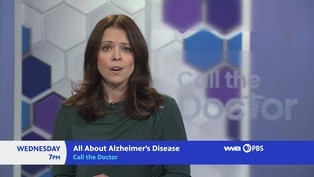
All About Alzheimer's Disease - Preview
Preview: S34 Ep3 | 30s | Watch Wednesday, March 16th at 7pm on WVIA TV (30s)
Providing Support for PBS.org
Learn Moreabout PBS online sponsorship
- Science and Nature

Explore scientific discoveries on television's most acclaimed science documentary series.
- Science and Nature

"Our New World" reveals Nature's astonishing adaptation abilities and how humans can help it thrive.












Support for PBS provided by:
Call The Doctor is a local public television program presented by WVIA