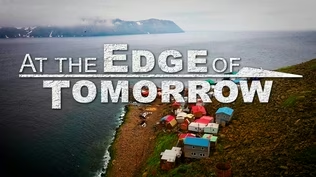
At the Edge of Tomorrow
Episode 2: All On the Line
Episode 2 | 56m 46sVideo has Closed Captions
The WWII landing craft is launched and docked with a bill that could sink the business.
It’s on the line: the village faces the dateline. Cliff Johnson’s business is on the survival line. Life-changing upgrades move at a snail’s pace, hampered by the delayed WWII landing craft. Climate change will open resource development, but the Ukraine war cancels Arctic cruises. The landing craft is finally launched, but with a bill that could sink Cliff. A legacy of Cold War pollution surfaces.
Problems playing video? | Closed Captioning Feedback
Problems playing video? | Closed Captioning Feedback
At the Edge of Tomorrow is a local public television program presented by AK
At the Edge of Tomorrow
Episode 2: All On the Line
Episode 2 | 56m 46sVideo has Closed Captions
It’s on the line: the village faces the dateline. Cliff Johnson’s business is on the survival line. Life-changing upgrades move at a snail’s pace, hampered by the delayed WWII landing craft. Climate change will open resource development, but the Ukraine war cancels Arctic cruises. The landing craft is finally launched, but with a bill that could sink Cliff. A legacy of Cold War pollution surfaces.
Problems playing video? | Closed Captioning Feedback
How to Watch At the Edge of Tomorrow
At the Edge of Tomorrow is available to stream on pbs.org and the free PBS App, available on iPhone, Apple TV, Android TV, Android smartphones, Amazon Fire TV, Amazon Fire Tablet, Roku, Samsung Smart TV, and Vizio.
Keep Exploring
Related to This Episode
Providing Support for PBS.org
Learn Moreabout PBS online sponsorship(helicopter engine whirring) (wind whistling) - First day on the job, out here in Little Diomede.
All right, here's the excavator in action here.
It's crazy work out here without the ton of machinery to choose from, but you gotta work with what you got.
Pretty cool we're out here moving dirt.
Basically, every load that comes through, dirt gets pushed up, and we can see bones from all different types of marine animals.
(laughs) That's a skull.
Tools, produced by the people of this land.
And I even found a nice walrus penis, an oosik.
(man laughs) It's a great day.
(upbeat music) - [Narrator] The story of the Arctic is that of its people.
It's about resilience.
It's about making things work and doing the best you can, where you are, with what you have.
(music continues) To live here means adapting to continuous change, shortages, often harsh and rapidly shifting weather and seas, vast distances, and barren landscapes.
It's a striking land, but it's a dangerous beauty and one that does not forgive mistakes.
It is one of the most isolated, remote, and poverty-stricken regions in America.
But economic opportunity will come.
Climate change will open the Arctic to shipping.
Open waters will provide access to the vast resources of Western Alaska.
Someday in the future, the world will look at this time as the start of the next chapter in the history of the Arctic and its people.
(music continues) (seagulls squawking) (torch hissing) - Yeah, we had a little bit of a problem here a couple days ago.
We were cuttin' out some steel on the stern, and they cut into the wrong space.
- They were cuttin' into the room that we were usin' as a storage room with all of our personal gear, a bunch of food.
- Clothing and supplies and stuff they were storing.
And it caught on fire.
- [Man] Jesus (beep) Christ.
- It's pretty intense.
- It happened so fast, there really wasn't a lot of time.
We couldn't get to the stern of the boat.
It was fully engulfed in smoke.
- [Cliff] Fire burned for about an hour.
- It's pretty hard to see that.
- Just watchin' it, watchin' all the fire trucks get here, everything just up in smoke.
- [Man] Oh, yeah.
- The whole main level got gutted.
The pilot house, the wheelhouse, captain state room, everything got gutted.
There's nothin' left.
- [Man] Look how hot that son of a (beep) got.
(mellow music) - It's pretty nuts.
- [Cliff] Just a big setback.
It's gonna be time and money and loss of use.
- But the main thing is no one got hurt.
That's the biggest thing, is no one got hurt.
(machinery whirring) - Lost a lot of stuff in that fire.
- [Man] I feel like we're starting over now.
We were hoping to be in the water by now, heading north to get our project started, and so it adds a lot of pressure to upcoming schedules.
- We'll keep pluggin' away.
We'll get this thing done and get it launched and get up to Nome.
And we'll get up to Diomede and get the work done we gotta get done.
- [Micah] Nothin' slows us down.
We just, we look at it as another obstacle, and we're gonna jump over this one, for sure.
- It's gonna set us back probably a month.
Once we had the fire, it just opened up a whole 'nother series of events that just seemed to snowball, repairs and structural and steel replacement and a whole 'nother set of inspections, all the deferred maintenance that we could have scheduled out at a longer term.
It was like a different project at that point.
Damn, we're in the tent.
- [Man] Huh?
- I said, "We're in the tent."
- [Man] Oh, (beep).
- Well, I guess that's a good thing.
It's not under four feet of snow.
- It was devastating, the effects of that spiraled after that.
(car beeping) Is he here?
Here he is!
(beeping continues) Hey, how you doing?
- What up, man?
Hey, the boys are back.
- The boys are back.
- [Man] The boys are back.
(Cliff laughs) - [Man] That guy is so awesome.
The boys are back.
- [Man] After a week or two, it just became apparent that the boat's not gonna be ready.
- [Cliff] Under the tent, which is a good sign.
And we just finally pulled the plug and said, "Let's just try and get through the season, and that's what we ended up doing."
- [Man] We spent a month alone just getting another boat ready to go.
(upbeat music) (machinery beeping) - We've been in Nome for about a week now.
Since the boat, down in Seward caught fire and we can't use it anymore for the rest of the season, we're using this boat right here behind me, called the Tivoli 2.
(music continues) - Today, I'm painting the other side of a boat, which is probably the first and last time I'll do this the whole season.
- We've made arrangements to use this boat this season, so we can run our freight to Diomede.
We're settin' up the airbags now, getting ready to raise her up, get the blocks out from under her and drag her over to the harbor.
A lot of work, a lot of moving parts, but you got to put the boat in the water so Cliff and I can shave our beards.
We've been growing for two months.
The deal was is we don't get to shave until we put the boat in the water.
Today's the day.
We're shaving.
(upbeat music) - [Man] Diomede's, it's such an isolated place that very little effects the way they live.
I mean, when we told them about the fire, they were like, "Okay, well, what's the next plan?"
Well, they were just countin' on us that we're gonna be able to do it.
- When the first early man came out here, he had to learn how to do stuff.
Here, it's same way.
It's passed off from generation to generation.
- We're at the Little Diomede power plant.
And I'm changing oil.
There's no back-up power.
Our generators back there don't work.
This one blew out, not too long ago.
As you can see, there's a hole right there.
And this one here's too small to power the whole village.
(dog barking) The whole village is off, dead, quiet.
- If you want a really working community that comes from broken, infrastructure has to be in place before you can go forward with anything else.
- This place, as you can see, nothing's flat here.
That makes it more difficult to work with.
And it's all solid rock out here.
Everything is all done by hand.
- Taking that oil filter out.
Last week, we were having some bad power problems.
We had no linemen here.
But someone who had a little experience went to go climb the poles, fix what was, I don't know what the problem was.
- To go forward with anything that is gonna be a benefit to your community takes work.
- [Brendon] Okay, one more round.
- [Frances] Takes time, takes energy.
- There's projects going on.
I'm going to be on the electrical power upgrade this summer.
We also have two or three new generators coming.
(beep) - It takes a lot of you, but it also gives back to the things that are really necessary.
- I'm just resetting the hours.
(generator whirring) Woo!
Woo!
It's always nerve-wracking 'cause I don't know if the battery's gonna die out, so it won't charge back up without power.
Like what just happened earlier, I was scared I wouldn't get the generator on so I went to go charge the battery with a little juice it had.
Yeah, it does feel good (laughs).
- For Diomede, I would consider it in development, on a local level, with I think all the right people now we need for us to go forward.
Wouldn't be able to do it on our own.
- [Cliff] Hello?
Hey.
Good morning.
- Contract with Clifford- - Paduvic Construction's calling me.
They're getting out of Diomede right now.
- He's one of the workers here that's trying to help.
- We bought their leftover materials from them building the clinic, 'cause they've already been bought and paid for and shipped there.
Hey, Tim.
- [Robert] Try to improve what Diomede's all about.
- We're going to Diomede today, yeah.
- [Robert] And try to improve their life.
- We were already in dire need for better electricity, better water, and housing.
- Sure, you guys wanna split the...
Okay, thanks, man.
All right, bye.
Apparently there's some people out there today who are trying to get back, including some contractors.
And they wanna split the charter with us.
(upbeat music) - 122 miles of straight line from Nome being here, Little Diomede out here, and Big is right there.
It's probably three times the size of it.
- One charter is $13,000.
- Weather dictates everything about when you fly.
They deal with bad weather in their entire lives out there.
So, if I can't come for a solid week, they understand that.
- The needs are so high.
- All right, where's everybody that's going?
- We've been waiting- - Anybody else in there?
- A long time for it, too.
- All right, let's walk.
- Diomede, yes, have gone a long way but still have way more to work towards.
(engine whirring) - I'm happy with what we have, but with the things that are going now, that's going to make a big change for the community.
- There's a lot of changes going on now.
(control speaking indistinctly) - This is actually gonna happen.
- We have to improve our life.
- [Frances] Everything feels like a dream.
Everybody's coming, and everything is happening.
(upbeat music) - This is all new to us.
- Doing what we're doing may be small to this world, but it's really big for Diomede.
(music continues) (engine whirring) - Welcome to Diomede.
- Thank you.
- All right.
- [Both] All right.
(engine drowns out speech) See ya.
(music continues) How ya doin'?
- Good.
- Good to see ya.
- Good to see you.
- All right?
- I got it.
(man speaking indistinctly) - I'm good, yeah.
(music continues) All right, I made it, finally.
(music fades) (seagulls squawking) (waves splashing) - [Robert] No other place in the world like here, at the edge of tomorrow, right next to Russia, in America, America itself, right next to Russia.
- So let's talk about Russia for a few minutes.
They have much more Arctic-facing landmass than the United States and Alaska does.
We bump against them there, and we try and be as cooperative as we can.
But there are different interests in play.
- There's a lot of interest and enthusiasm for the Arctic with climate change, with the melting of the Northwest Passage and the ability of vessels to transit through.
- [Woman] Dave Karp, thank you for your- - [Man] It's sort of a tourism renaissance.
- [Woman] Dave Karp- - The plan was to have about 22 passenger vessels coming through the port of Nome.
(shots firing) Subsequent to that, the invasion of the Ukraine by Russia resulted in a number of those trips being canceled.
As demand increases for village tourism, the caution is warranted, given the global situation.
I think the broad perception is that cruising in Russian waters is something that they've literally steered away from.
A lot of these travelers are European, and a lot of those purchase decisions were being made right when the war broke out.
- When you think of Alaska and Western Alaska, it's not that we are the end of the earth, even the edge of something else.
We are actually right in the center.
It is our position that makes Alaska important.
So, whether you're talking about contact, exploration history, European exploration history, whether you're talking about the world wars, there's all these little pockets of Western Alaska that have experienced these episodes of history.
In some places, that history is kind of passed on and moved forward, where in other places, it's still very much happening.
When Seward purchased Alaska from Russia, it was because he looked at a map and he saw the Aleutian islands, and they reached out like a friendly hand to Asia.
The 19th century was all about the Pacific, looking at this big, global lens.
- But, nonetheless, they call this Russian America.
There's a long history of them coming over here.
And they still see us as having been dominated, if you will, by them at some point in the past.
- After World War II, when Churchill famously describes Stalin's activities in the Soviet Union- - [Churchill] An iron curtain has descended across the continent.
- The wall, the descent of the Iron Curtain, the military leaders really thought that if Russia was going to invade, they'd come right through Alaska.
- During the Cold War, our region was viewed as a strategic location for the U.S. government to establish military bases and operations out of our proximity to Russia.
- [Man] They respect strength.
They don't respect weakness, and they will push against it.
- This was an enormous effort designed to protect the rest of the country, massive build-up.
And they weren't thinking about Alaskans or their impact on the native people at all.
They also set off nuclear bombs, like in Amchitka.
- Three, two, one.
(control speaking indistinctly) - [Katie] And then you had Operation Plowshare.
- [Reporter] A 100 kiloton nuclear explosion excavated more than 6,000,000 cubic yards of earth in a matter of seconds.
- Alaska became an experiment ground in Project Chariot.
They were gonna set off nuclear bombs and create a harbor out near Point Hope, without really any thought to the local people, it's effect on the environment.
- As a child, I knew that if we stopped at Northeast Cape on any of our boating trips, not to drink the water from any of the streams or rivers, not to pick any berries and eat any greens from there.
There are numerous sites like that in the Bering Strait region.
- We have over 700 former and currently used defense sites, and many of them are on the coast of the Bering Sea, the Chukchi Sea, and the Beaufort Sea, all across the Arctic.
And these were established as distant early warning sites during the Cold War, basically, to keep an eye on Russia.
But these sites are extensively contaminated.
The military left these sites with a massive legacy of pollution that includes PCBs and solvents, heavy metals, pesticides, and in some cases such as on Sevuokuk at Northeast Cape, massive fuel spills.
- Now we have a cancer crisis.
(intriguing music) My name is Viola Vi Waghiyi.
I'm the daughter of the late John (indistinct) Waghiyi, from Sivuqaq, our traditional name for St. Lawrence Island.
I was selected for the Biden and Harris administration White House Environmental Justice Advisory Council.
There was a massive fuel spill, 160,000 gallons at one time.
The ice turned yellow.
The birds turned yellow.
The seals turned yellow.
The (indistinct) river used to have one of the most abounding salmon fishery.
They've been decimated.
There's no more fish.
And this is resulted in our people not being able to provide food for their families.
And the cancer crises we're seeing now today, are in majority of our elders that were children at Northeast Cape.
It's not a matter of if we'll get cancer, but when.
These are our basic human rights that are being violated.
It's the polluters that need to be held accountable.
Enough is enough.
- I think it's important for the U.S. and Russia to view the Bering Strait region as a zone of peace.
- Having the international date line right in front of us a mile away, and having Russia two and a half miles away, I mean, that definitely adds to the intrigue about it.
And there seems to be no end to the history here, and there's no end to the future when you talk to the locals.
I mean, they've been dealing with Russia right there since they were born and they have relatives across there and they can't see them and they...
It's just a, it's a really intriguing thing that in itself is a whole story.
- [Man] Man, they had a bunch of people out there.
- [Cliff] There's always activity across there watching us.
I assume they got the big binoculars, and they're seeing what we're doin'.
- That tower out there- - Vehicles screwing around.
- [Man] That road up there, right?
They'll drive like Humvees up.
- [Cliff] All of sudden a helicopter flies by.
- [Man] You can see a dog running around, too.
- At first, you don't quite understand what's going on, but then if you just look around at the locals, I mean, it's just everyday life.
I guess, until the Russians come over and land on this beach, I guess we don't have to worry about it too much.
(man speaking faintly) If we don't keep pushin', and if we don't have a good, firm schedule, then we won't be able to get the boat launched and get everything in place in time to head to Nome and head to Diomede.
- [Man] Look at those strangers.
- [Cliff] How you doin', man?
- Good.
How are you?
(man laughs) - How you doin', brother?
- Good.
- How you doin'?
- Good.
How you doing?
- How you doing, man?
- I see you're in the tent over here.
- Yeah.
- You guys got all kinds of (beep) going on here.
- [Man] Yeah, we're so full we don't have one cart to spare.
- [Man] Wow.
- [Cliff] Well, that's good.
- We're gonna be rampin' up.
We'll have like a 150 employees and there's gonna be a crew dedicated to the Kayak.
- [Man] Yeah.
- I mean, obviously, we want to get as soon as we can, but we've had some developments and some extra work that we got now.
And so, I'm about ready to make commitments on barging that we got to know, between us, what the schedule's gonna be and how that's all gonna play out.
It's super critical that we make sure everything's on schedule and if we don't push, it'll just slip and we'll end up with another season like we had last year to where we didn't have the Kayak.
(mellow music) - [Man] Loading you up, dude?
You ready to go to Diomede for the first time?
- Yep.
Been pissin' rain for about the past week or so, so I haven't been able to do much with anything.
Today's our first sunny day in literally, probably months.
- [Man] Little Sunday afternoon.
And bacon, and bacon.
- [Man] This is what a full car looks like.
- [Man] And bacon.
(music continues) - We're just waitin' for some safety supplies for the Tivoli 2.
(men chattering) (man laughs) And then I'll be heading out to Diomede soon.
(music continues) - [Cliff] The work we're doing in the region, it's needed.
It's important work that nobody else is doing.
Russian trading bead?
- [Man] Mm hm.
- You don't find very many of these, huh?
How many times you seen people- - That's the first time I found it.
- I remember talking to somebody who had some last year but, like, two.
I enjoy the people.
It reminds me of some of my childhood.
If you're from Alaska, and you grew up in a village, you remember the way it was when you were a kid and we didn't have running water until I was in grade school.
And then time goes by and you realize there's still people living without fresh drinking water and it's kinda hard to believe.
And so, when I walk around Diomede, everybody knows who I am.
Everybody's happy to see me.
Everybody feels like, "All right, we're gonna do this.
We're gonna accomplish what we've been talkin' about for years."
And so I feel that is a sense of reward.
- [Man] All right.
You were looking?
- Yep.
Yeah, nice one, huh?
Nice female.
- [Man] Since you are Native, you can buy it as is.
- I know, yep.
Just cut it off.
I got some ooka at home.
- Yeah, the people are awesome.
I mean, it's an amazing place.
It's one of those places that if you've accomplished something there and you wanna go back and do more, 'cause they completely, absolutely deserve it.
I never felt like that in any other village.
(engine whirring) - [Melanie] Negative health conditions in communities that don't have water and sewer- - [Man] Welcome to Diomede.
- [Cliff] Yeah, right on.
Thank you.
- [Melanie] It's something that Kawerak has been advocating for.
- [Chris] The school, right?
Okay.
- You want- - You got it?
- No, I got it.
- You got it?
- [Man] Yeah, I got it.
- One of the things that Kawerak does is when development is proposed- - All this stuff is new.
- [Melanie] We ensure that the permitting agencies are coming and meeting with the communities that could be impacted, environmental analyses are conducted and shared with the people.
(engine whirring) - Well, thank you for having this out here today and for participating.
I don't usually get this big of an audience (chuckles), so I'm a little out of my element, but if you bear with me a little bit, I am the Tribal Affairs Program Director for Kawerak, and I have been for the last 12 years.
The Helmsley Charitable Foundation had been doing international travel with doing water and sewer in third world countries.
And, when COVID hit, and they couldn't travel overseas, they decided maybe they needed to look at Alaska as an opportunity to work on water and sewer projects.
And so, long story, we just negotiated and was successfully granted $20 million.
Norton Sound was to help- - Diomede's tribal council has got the resources now for the time being.
They've got the motivation.
They've got the right people that wanna do it.
So, this is a good opportunity.
- This is amazing.
It truly is.
- Our company, Northern Marine, we have a large landing craft.
We had it in the shipyard.
We were about five days from being launched.
It caught on fire.
So, that boat won't be available this year.
We found another boat.
It's in Nome.
- Cut.
- We're gonna start hauling material, start hauling gravel and concrete, and start making trips.
We anticipate we're gonna have probably 18 trips.
The Kayak is twice the size of the boat that we have in Nome.
You could actually take the boat in Nome, put it on the deck of the Kayak.
- Gettin' ready to load the first load of stuff onto the Tivoli 2 to haul out to Diomede.
- We're gonna have a lot of activity in the next few days.
When you go down the list of items here, it's the new store, the water catchment.
We're gonna fence this whole thing up.
We did discover a bunch of water coming down to the actual foundation site.
We know we can't stop the water.
So, in order for us to build the concrete foundation and the footers we need to divert it, capture it, and pump it either to the water treatment or back up to the ocean.
Out the building, go up the hill, clinic's here.
- [Man] Yeah.
- [Man] There's a lot of planning in the last 20 years, and not much action.
- [Man] Yeah.
- There's been studies and plans and water plans and sewage plans, sewer and water plans, drilling.
There's just study after study after study, but nothing ever gets done.
All the way out to the water, to the ocean.
- [Man] Mm hm.
- [Cliff] What's the depth we need to have here?
- Probably four to six feet.
They do these big studies, get tens of thousands of dollars, and then most of the time, the guy who actually makes the decision never sets foot in the village.
- Wanna keep going in that site, and a new dump burner, incinerator.
- Yeah.
When you look, what has been done is very little.
You all go and spend a lot of money and don't even get much in return, really.
With me, I come out and assess the situation and recommend the solutions, that a guy like Cliff, who can actually make these things happen under less than ideal conditions.
- Can't get stuff here.
You can't get in with a helicopter, like us today barely got here.
And barges can't land.
And then everything is triple and quadruple the price.
There's nowhere to stay, nowhere to live.
It's a tough place to work.
This is a nice summer day in Diomede (chuckles).
Nice summer day here.
(upbeat music) 'Bout as good as it gets.
- The CARES Act American Recovery Program, this year, this allows the tribe with a budget that's subject to change to do 15 homes this year to be remodeled.
- We're going through each individual house, trying to look and see the actual need of what we're gonna have to do.
Yeah, we've gotta fix this because it's leaking.
It leaks inside.
(person knocking) Some of these houses need flooring.
Some need Arctic entryways.
- Hello.
- Hi.
- [Cliff] Just about all of them need windows.
- [Frances] They're gonna assess your house.
- [Man] Yeah.
- [Cliff] We're gonna try and build some bathrooms out.
There's a lot of mold issues, obviously, ventilation problems.
All right.
- Hello.
- [Cliff] How're you doing?
- [Man] All right.
- [Cliff] Is there any water leaking in the house?
- [Man] Over here when it rains.
- [Cliff] Some of 'em, the rooms are molding enough to where they don't stay in 'em, they don't sleep in 'em.
Roof patch, ventilation.
This would be a perfect candidate for a actual addition too.
How many people live in here, right now?
- There's four people.
- Okay.
Adults and kids, or a mix, or?
- [Frances] Two adults and two adult kids.
- Yeah, they're 27 and 25 years.
- You see their small bathroom?
Right here.
- [Cliff] We gotta plan power for them, though.
- Yeah, there's a lot of these that we don't even use anymore.
You see how bad they look?
- We'll surface mount a new conduit.
Okay.
Very good.
Thank you.
- Oh, yeah.
- See you.
Yeah, there are some pretty old houses here and there's not many places that don't need work.
They've been doing with what they have.
They've patched in what they can patch and jacking and keeping things the best they can.
(upbeat music) - We're heading out tonight.
I'll be in Diomede tomorrow afternoon and so will all this cargo.
- Frances?
- Yeah?
- Attic vent.
- [Frances] Okay.
- The attic is closed off, so there's condensation building up in that space 'cause it's so warm in here and cold outside, so the insulation gets wet, and it drips.
- Cold.
It gets cold in the houses sometimes.
- There's some mold around the house, and that could be fixed, hopefully.
I grew up in this house, but it's just the roofing of the house that needs to be fixed.
The windows, for sure.
Some are broken, can't open.
- Countertops, new range outlet, new bathroom, fix the leaking.
And it needs quite a bit of electric.
(upbeat music) - We got a boatload of stuff, material, equipment, tools, tanks.
And we are goin' to Diomede.
(music continues) - You can tell it lit on fire.
That's why that's all black, it's from the smoke.
Smoke damage from the fire.
Easy one.
Kitchen, bathroom.
This is a perfect candidate for sheet rock.
'Cause it'll be like, be easy to make it like brand new.
- Had the first shift last night until about six in the morning.
And we're just outside of Tin City and Wales.
Luckily, we have a beautiful day today.
Really sunny out and nice.
It's really beautiful out there.
Makin' this whole trip not too bad.
(upbeat music) - We have seven in this house and another baby on the way.
- Our window right there, when it's wintertime, and the wind's blowing this way, we always have lots of snow piled up inside.
- [Cliff] Inside?
Yeah.
- [Frances] A really poor house.
(upbeat music) (dog barking) - Just a little update here.
We got a little weathered off our course.
Cool thing about a landing craft is it can pull right up to the beach and anchor down.
So, while I got some free time, I'm gonna go and explore this coast a little.
(music continues) - And there's a elder, Roger Kunayak.
- Well, I've been living here for 36 or 37 years.
- [Robert] Living in a house that was built in 1920s, and hasn't been torn down.
- [Cliff] So, when was this house built?
- Huh?
- When was this house built?
- 1919.
- Wow.
- By Otto Okpealuk and his sons.
- This house is old, even before my time.
- We need heavy equipment level, maybe three of 'em to level this house up.
It's still real good.
I think you can buy 4x4s and 2x4s.
And we could land some logs around the world to our beach down here.
(waves splashing) - Is there water leaking anywhere?
Well, we could level it, level it, plywood the inside, plywood the floor.
- [Roger] Yeah.
- Plywood the ceiling, paint it, put in electrical and countertops and- - I got only one plug-in left right now.
I just- - You have the bathroom over there.
- [Roger] For my electric, I use one plug-in.
Nothing's working in here.
- [Cliff] Yeah, we'll fix that, too.
All right, this one's gonna be a priority.
- [Roger] Mm hm.
- Do you have somewhere to go and move out for awhile, while we fix it up?
- I will have him - Yeah?
- come to our house, yeah.
I do worry about him 'cause of his age.
How old are you now?
How old are you now?
- Huh?
- [Woman] How old are you now?
- I am 70 years old.
I'll be 71 in August.
- I'm concerned about the house, 'cause it's leaning more this side, this way.
When I first came, it was kind of straight.
But, now, the house is turning.
And I'm kind of concerned because the drum, that I noticed the house is going towards the stove oil, and it's dangerous.
- All right.
- Thank you.
- Goodnight.
- Yeah.
- Yeah, it's a big fix, all this.
See this is gonna be hard to do to make it all weather proof, so it's a project all by itself.
- Is it big money?
- Yep.
But once it's level and square in the inside, it'll work.
- I look at this list and I am impressed beyond belief what has been achieved here between the tribe and the city and the corporation and all the projects that are going on.
And that is just, it's very exciting.
And Cliff is here and it's just...
This is amazing.
- Nobody's workin'.
How you doin'?
(man speaking faintly) Oh, yeah.
- How are you?
- Oh, not too bad.
- Like we've been sayin' and talkin', this boat has been the key the whole time.
This place never stops.
It's a relief knowing that JAG is on board with our schedule.
Whoa!
After meeting with JAG, it put a lot of things to bed that we have been thinkin' and talkin' about.
I'm pretty optimistic.
- Don't grab me.
- It's gonna be funny.
- Don't grab me when you go down, all right?
I think I saw something over there.
(upbeat music) - [Cliff] There's a lot to do here.
- Oh, we made it to Little Diomede, so we're gonna be dockin' up here and unload over the next couple hours.
I don't... (singer singing in foreign language) - [Cliff] Not much has happened since we left.
It pretty much looks like it did.
(singer singing in foreign language) - Oh (beep).
(singer singing in foreign language) - We got a new roof, new walls.
We had new counters, new power panel in here.
We had... Oh, this thing was almost done.
And now it's like we didn't even do anything.
♪ Hey, hey, hey, hey, hey ♪ - Here it is, another drop off.
Windier today.
Let's get it done.
(music continues) (engine whirring) (singer singing in foreign language) Pose to the camera.
- Hey, oh!
♪ Hey, hey, hey, hey, hey ♪ - You don't realize how big she is until she's out of the water.
She's awesome.
She's beautiful.
I can't wait to get her back.
(singer singing in foreign language) - Super busy.
Wake up, work, eat some dinner, and then go right to sleep after.
♪ Hey, hey, hey, hey, hey, hey ♪ Almost done with the floor for the store.
Everyone here is super nice.
Having a blast.
I love it out here.
It's awesome.
- Time's moving by out here.
We're enjoying this nice, glassy, calm morning, as you can see.
This is about as still as I've ever seen it out here.
♪ Hey, hey, hey, hey, hey ♪ (upbeat music) (singer singing in foreign language) ♪ Hey, hey, hey, hey, hey, hey ♪ - Counter all the way around this side.
Then there'll be a peninsula that comes out and then the counter come all the way around that way.
So he's separated.
Captain's share is separated with an arm rest and a bench seat.
So you have another radar here, auxiliary crew here, boat captain here, and electronics and gear on this side.
Now, we know what we gotta do, right?
We know our schedule.
We know what we gotta do to get this done, and I'm confident we can do it.
It's a good feeling to be here and be back on the boat.
It was almost like a dream, like it wasn't real that we still had this boat, and it was still here.
But it feels good to be back on board and knowing that we're gonna get started, and I feel good about it.
- I don't think we could be at any better place right now than here.
- Yeah.
We expected that there wasn't gonna be much done until this winter and now the push is to get it done in the next two months.
Hey, man.
Nah, just pullin' into Seward.
(laughs) I know the feeling, man.
I was thinking you and I and Micah would go to lunch, but, I mean, I don't give a (beep).
We can even keep it super, super informal and there's nothing between you and I that we're hiding.
There's nothing between Micah and you and I that are hiding, so, I mean, (beep) rip the band-aid off.
Let's just (beep) talk about it.
I don't know how much of our budget we've gone over, but at least six times, and two years later, I think, the lost revenue in the... And the lost time and the additional money and time spent.
- [Man] I'll send him an email.
- [Cliff] Yeah, it's a significant amount of money that we're over.
- [Man] Things are in motion.
- [Cliff] I'm not sure how we're gonna pay for it all.
- [Man] So we can keep that avenue goin'.
- Yeah, we're upside down quite a bit.
The boat was never supposed to be this big, huge project.
I mean, we bought the boat for a reason and we got it for a good price, and it needed some work.
We planned on doing that work.
We had a nice tidy little budget.
- We had about six to eight items on that list to accomplish and we would have been underway.
Then the fire.
Once the fire happened, it changed everything.
We had to gut it.
We had to get all the damage off, which opened up other items.
We went from six to eight items to... Hell, I think we're up to, like, 70, 75 items.
Financially, it damn near bankrupted us.
It still can.
We just don't know yet.
- Everything just took so much longer than anybody anticipated.
(sighs) Looks good.
It's clean.
- [Man] Yeah.
- It's ready to go.
And now we've got a pretty hefty bill with the ship yard, and we have to figure out how we're gonna pay it.
(machinery whirring) Yeah, the Kayak is done.
- The boat is finished.
(switches flicking) - Let's check upstairs real quick.
- All we got to do is get her out and start working.
And unfortunately, we've missed two seasons now.
- Yeah, that's the unfortunate part.
The season is over.
It's September.
And now the boat's ready.
Yeah, we'd have to fuel up and have a couple more guys with us but literally, you could put on $90,000 worth of fuel and head north.
But at this point, we're not even gonna launch it.
We're gonna stay tied up at the dock probably until May of next year.
If everything goes we'll have a boat that's ready to go.
- We need to figure it out, and we need to figure it out very soon.
- I mean, in the next couple of months, this thing's gotta be resolved and we're either are gonna have a boat, or we won't.
Yeah, we've lost the season.
- Well, this is it.
Back to movin' stuff.
- This season was especially tough, probably the toughest season I can remember ever having.
We made seven trips to Diomede in our smaller vessel, the Relentless.
- We're back in Little Diomede.
- We were able to get gear, personnel, to the island.
We got mobilized.
And we started working on the Native store.
(all exclaiming) And we did a lot of work on some of the houses there.
- They're all workin' on putting on a roof.
(hammer tapping) (mellow music) - [Man] We got the store all shelled in.
We got the roof on.
We got everything kind of closed in there, so that we could start working on the inside.
(saw whirring) - Is that your puppy?
- Oh, puppy!
- [Man] What's her name?
- There's still a lot that needs to be done but I think we're at a point now where we really need the Kayak to push forward with everything else.
- [Man] We ant really accomplish what we need to without it.
- Can't use a helicopter to get 20-foot beams there.
And I can only hold so much on the Relentless.
If we had the Kayak this summer, we would for sure be further along than we are right now.
- Waitin' for the barge.
- [Man] We'd be pretty close to completed on the store, and majority of the homes coulda been done.
- Seems like the main phrase echoed throughout Northern Contractors, Northern Marine, waitin' for that barge.
- And we would've moved on to other projects.
We would've started work in other villages.
We would've done work for other companies, hauled freight for other companies.
- Work to be done out here, so we're out here.
- Financially we would've been a lot better than we are now.
- We're (beep).
- [Man] (beep) gorgeous out here.
Unbelievable.
- So we did out best and we got it done, but we need the Kayak.
- Yeah, the Kayak is a critical piece of our whole business.
We can't really accomplish what we need to without being able to control the logistics.
We actually got a priest to come down and bless the boat the day we put it back in the water.
- May all who use this boat be kept safe in the name of the Father, the Son, and the Holy Spirit.
Amen.
- [Cliff] And we finally cut off the name on the stern, the Ghost.
We cut that off and repaint it.
Ah, why is this open?
- [Man] We are really at a fork in the road, right now, with our business.
(drill whirring) - We could end up finding some financing for the boat, and pay our bill at the ship yard, or we could end up in maybe a partnership.
We guess, the worst case scenario is we could have to sell the boat and start over, or come up with a different plan.
I don't know.
(upbeat music) - If we can try and hang on to her at least till May, till we can get her out and start working, once we do that, we'll be okay.
But things are very stressful right now.
(music continues) - If we lose the boat, that's not gonna stop us.
I mean, we'll find another boat, or we'll find another way.
I think I'm pretty well committed in this business.
(levers clicking) (music continues) - [Man] I'm through this with Cliff 100%.
We've given it everything we've got, never thought of quitting.
- [Cliff] We're not gonna stop.
If we lose the boat, we're gonna keep goin'.
It's a significant challenge, where we're at right now but it's not gonna stop us from doing what we do.
(upbeat music) (hatch closes) (upbeat music) - And so we're up here reviewing some of the work we did at Roger's.
Put this huge land beam in, brought the house from probably about right here is where it was sitting.
And we raised it all the way up to this level, built him a new stair case, new little mini-deck.
We're gonna go talk to Roger here.
(man knocks) - [Roger] Come in.
- Hey, Roger.
How you doin'?
That's a drum, right?
- [Roger] That's my drum.
- Wow.
(Roger speaking indistinctly) - Just need to get some walrus skin over this, right?
- Yeah.
- When we raised this up, did you notice it in here?
- Yeah, I- - You can feel the difference?
- I can.
- Yeah, you don't have to walk uphill in your own house anymore, right?
(Roger laughs) - [Roger] I said I was real happy.
I was real happy because (speaking faintly).

- Science and Nature

Explore scientific discoveries on television's most acclaimed science documentary series.

- Science and Nature

Capturing the splendor of the natural world, from the African plains to the Antarctic ice.












Support for PBS provided by:
At the Edge of Tomorrow is a local public television program presented by AK