Prairie Sportsman
Along the Gunflint Trail
Season 17 Episode 2 | 27m 46sVideo has Closed Captions
Travel Minnesota’s iconic gunflint trail and visit the Chik-Wauk Museum and Nature Center.
Host Bret Amundson travels Minnesota’s iconic gunflint trail where he visits fishing guide Jessica Berg-Collman of Seagull Creek Fishing Camp and he stops in at the Chik-Wauk Museum and Nature Center to experience the history, culture, and wildlife of the boundary waters.
Problems playing video? | Closed Captioning Feedback
Problems playing video? | Closed Captioning Feedback
Prairie Sportsman is a local public television program presented by Pioneer PBS
Production sponsorship is provided by funding from the Environment and Natural Resources Trust Fund and Shalom Hill Farm. Additional funding provided by Big Stone County, Yellow Medicine County, Lac qui...
Support provided by:


Prairie Sportsman
Along the Gunflint Trail
Season 17 Episode 2 | 27m 46sVideo has Closed Captions
Host Bret Amundson travels Minnesota’s iconic gunflint trail where he visits fishing guide Jessica Berg-Collman of Seagull Creek Fishing Camp and he stops in at the Chik-Wauk Museum and Nature Center to experience the history, culture, and wildlife of the boundary waters.
Problems playing video? | Closed Captioning Feedback
How to Watch Prairie Sportsman
Prairie Sportsman is available to stream on pbs.org and the free PBS App, available on iPhone, Apple TV, Android TV, Android smartphones, Amazon Fire TV, Amazon Fire Tablet, Roku, Samsung Smart TV, and Vizio.
Providing Support for PBS.org
Learn Moreabout PBS online sponsorship(bright music) - [Bret] On today's "Prairie Sportsman", we're on the Gunflint Trail, catching up with fishing guide Jessica Berg Coleman of Seagull Creek Fishing Camp.
- [Jessica] I spent a lot of days on the floor in a boat, sleeping on life jackets.
- [Bret] Then we visit the Chik-Wauk Museum and Nature Center to get a look at the history, culture, and wildlife of the Gunflint Trail.
And Nicole Zempel shares the value of the sow thistle.
- I utilize the green leaves.
- Good job.
All right, welcome to another episode of "Prairie Sportsman", where we celebrate Minnesota's great outdoors.
(bright music) (inspiring music) - [Announcer] Funding for "Prairie Sportsman" is provided by the Minnesota Environment and Natural Resources Trust Fund, as recommended by the Legislative-Citizen Commission on Minnesota Resources; by Mark and Margaret Yackel-Juleen on behalf of Shalom Hill Farm, a retreat and conference center in a prairie setting near Windom, Minnesota, on the web at shalomhillfarm.org; and by the Friends of Prairie Sportsman.
To become a friend of "Prairie Sportsman", visit pioneer.org/prairiesportsman.
(gentle music) - Welcome to "Prairie Sportsman".
I'm Bret Amundson here in Grand Marais, along Lake Superior's North Shore.
Now, behind me is a road that you can take about 60 miles, almost to the Canadian border, called the Gunflint Trail.
(intriguing music) Winding up the Gunflint Trail offers a glimpse of days gone by, a simpler time when people lived off the land, stayed off the grid, and lived life in the outdoors.
(wondrous music) What's now a paved National Scenic Byway was once a well-traveled path used by fur traders traveling to Lake Superior by foot or by dogsled.
- Well, it's worth the drive, and I would say enjoy the drive up the Gunflint Trail.
It's 60 miles, and people say, "Is it actually a trail?"
Well, no, it used to be a trail.
It's had a long, long history before automobiles were even invented.
This month we've seen so many moose.
I always tell people, they always ask, "Where can I see a moose?"
And in the summer, if you look out into the water as you're driving up, typically where you'll see them, they need, there's nutrients they need in water-based plants.
So they're often in the water eating and probably getting away from the bugs.
So somebody yesterday came by and saw some bear cubs and a mother bear.
You're really at the end of the road, as far as you can go in Minnesota.
It has had a reputation where we are as the... used to have the longest school bus ride in the state of Minnesota.
So it's a long way from everything, but worth the visit.
- [Bret] Named after the chert of flint stone that was used in early firearms, the Gunflint Trail is littered with frontier-era history.
It's one of my favorite places in Minnesota, and my annual trips on the trail began at age 11 and continue to this day.
My story's familiar to many who've traveled to this region to fish, canoe, camp, or just get away from it all.
Today the trail has resorts scattered along its route, tucked away in tall pines, nestled along shorelines of deep lakes carved out of the Canadian Shield by glaciers.
Walleye, smallmouth bass, lake trout, northern pike, and stream trout like rainbow and brook trout are common here.
You can even find lakes with a unique splake hybrid.
(epic music) While many visitors trailer their own boats and spend time in the elements solo or with friends and family, others look to local guides for expertise.
One name has been a staple near the top of the trail: Mike Berg at Seagull Creek Fishing Camp.
Mike's history dates back to the days of Gordy Poehls.
While Mike stays busy these days, he has passed on the tradition of guiding on the Gunflint Trail to his daughter.
(upbeat music) - And then Gordy Poehls a legend up here.
He's the one who taught my dad pretty much everything he knows about the lake and the area and fishing.
Whenever I'm struggling on the lake, I just come in and read Gordy's articles; some really good stuff in there.
- I'm just gonna learn a little something myself.
Read that later.
- There's some good stuff in there.
- What's this one right here?
- That's my "Star Tribune" article.
So that was written last year by Tony Kennedy.
He came up here and I put him on his personal best walleye.
He got a 29 and a half.
But it's kind of funny, there's not a single fish picture in the article, and it was about fishing.
(upbeat music) - Jessica had a love for fishing at an early age, getting hooked by both her father and her mother.
So you grew up in a fishing family; this is kind of natural for you.
- Yes, hardcore fishing family.
I spent a lot of days on the floor in a boat, sleeping on life jackets and dissecting minnows on top of the cooler next to my hot dog that I was eating for lunch.
- Was anybody ever worried that you'd hate fishing because you were around it so much?
- No, I don't think anybody was worried, but they definitely let me find it at my own pace, like, the passion for it.
When I got older, eventually I was like, "I gotta get my own boat," 'cause I want to do this way more than I'm able to do it.
'Cause my dad, guiding full time, it's not like I can just go out with him whenever I want.
He fishes every single day like I do now.
But other than that, it was just whenever my mom had the itch to go fishing, she'd come and pull me out of school sometimes if the weather was gonna be right, and we would just go and fish a lot in the summer.
We'd come and camp up here, camp on an island for days at a time with our four huskies and just fish hard.
I definitely discovered my own passion for it a little bit later on 'cause I did the whole college stuff and traveling and... (energetic music) - [Bret] College and traveling is an understatement.
You wouldn't expect a girl who grew up playing with minnows on the Gunflint Trail to go to college in Hawaii.
- So when I first went to college, I went to MSUM Moorhead; absolutely hated it.
I mean, it was flat, and it was windy, and there were no trees, and there were no lakes.
So I talked to my advisor, and she's like, "Well, have you ever heard of national exchange programs?"
So I was like, "Hmm, okay, so Alaska or Hawaii?"
And I went back and forth and back and forth, and finally I ended up choosing Hawaii and went to school out there.
Did that for a year, 'cause that's the maximum you can pay the in-state tuition.
But after that year was up, I was not ready to be done.
I needed to do way more out there than I had time for, so... - [Bret] Now her days are filled with time on the water in Northern Minnesota that comes with dealing with live bait, boat maintenance, and bringing anglers young and old out for a chance to catch a walleye, lake trout, or smallmouth bass, which can be a lot of fun, except when you're trying to catch walleyes.
- I already took it a little bit better.
I always tell people to wait for that confidence tug when you're Lindy rigging, that one tug that's a little bit stronger and harder than the rest of the tugs for that bite.
And then you know the... like that right there, that was the confidence tug.
There we go.
- [Bret] We don't have a net.
- No, I got one.
I got it.
Oh, are you kidding me?
Wow.
- [Bret] Nice fish.
It's the wrong species.
- [Jessica] Wrong flavor.
- [Bret] When Jessica first started guiding, she wasn't quite sure how it was gonna go.
- I was really excited, but I was kind of skeptical, too.
Like, so you're telling me people my dad's age that have been fishing for 40 years are gonna hire me.
You know, I was, what, 26 when I started to take them out for a full day of fishing and pay me money to do it.
Like, okay, we'll see.
But then I ended up getting all sorts of bookings, like bookings for experienced fishermen, bookings from families, bookings from, you know, husbands and wives who were up here vacationing who wanted to try something different.
And I gained a lot of really interesting clients that way.
The youngest kid on my boat to get a hawg, 28 inches or bigger, is 11 years old.
I put a dot in the release column.
If it's a hawg caught in my dad's boat, he puts a dot in the date column.
- [Bret] Is he ever gonna retire?
- He probably will not, unless his body tells him he needs to.
- Do you think you'll take over the business?
- I mean, I would definitely like that.
And I have about 90% of my clients are repeat clients every year.
So I think this year I'm only taking two groups that I've never met before.
And this is only year three of doing that.
So I already have that clientele built up, and they know, like, if they don't take those dates for next year right away, like, they're gone.
It is an obsession.
I mean, you know, you're an outdoorsman.
I was more worried about if I could keep up with my dad.
- [Bret] Based on her experience, is the guide life for everybody?
- I mean, you don't know unless you try, honestly.
Like, and you don't even have to get the expensive gear.
You don't gotta go out and buy a LiveScope.
You can just get out and fish, just like what we're doing: rod in your hand, fish.
You don't know if you like something until you try it.
Sauerkraut, I hated sauerkraut since I was a kid.
I tried it at Thanksgiving last year.
I loved sauerkraut for the first time in my life because I tried it as an adult.
So even if you think it's, like, a farfetched dream, like, I never thought I would like sauerkraut in a hundred years.
It was... I still don't like the smell of it, but now I like the taste of it.
- [Bret] While our time on the water today was cut short by a thunderstorm, I really just wanted to hear Jessica's story.
- That's my favorite part of fishing is the challenge and the hunt, because when you do get that trophy walleye, that 32-inch walleye, it just makes it that much more worth it and that much more enjoyable because you worked your butt off for it and then you got rewarded.
- The Gunflint Trail Historical Society said, "Wouldn't it be great to have a museum and nature center that we can showcase this amazing area?"
- Most would look at the sow thistle as a useless weed.
Plants, they all have their special unique gifts.
(gentle music) - [Bret] It is no secret that the Gunflint Trail is rich with history, and tucked away at the top of the trail is a place where that history is preserved and on display.
(gentle music) - We're at Chik-Wauk Museum and Nature Center.
It's at the very end of the Gunflint Trail, 60 miles up from Grand Marais, Minnesota.
It's really at the end of the road.
And so it's really an amazing place.
(gentle music) I tell people you could actually spend several days just at the museum.
There's so much information and videos to see and a collection of, again, artifacts going back 10,000 years.
So a lot to see and do.
(gentle music) The first paleo-indigenous people came from the west, maybe crossing the Bering Land Bridge, and there's been people here ever since.
And then the fur trade happened; we've got artifacts of that.
And then logging happened in the mid-1800s.
And then after that, mining, there were some minerals discovered, never profitable.
There's a mine called the Paulson Mine just seven miles from here.
And then the last kind of human activity was resorts and tourism.
A lot of history, and we've collected a lot of that history.
(gentle music) One of the original Hamm's Beer commercials was filmed right here.
There's a commercial that we actually have here also showing the actor canoeing with his pet grizzly bear, actually a famous, famous commercial.
♪ Hamms, the beer you've been looking for ♪ (gentle music) - We have a replica cabin from 1950, an American Plan cabin, which means you took your meals in the main lodge.
We have a trapper's shack exhibit building just set up like an old trapper's shack.
(gentle music) We have a new exhibit on all the fires that have happened in the Boundary Waters and how that has changed the landscape over time.
So yeah, just a few of the items that you'd want to come up and check out.
(gentle music) - All right, so one of the things you can do here is really learn what life was like back in the day, maybe as in the time of the voyageurs and the French fur traders.
And this allows you to try to see if you're as strong as a voyageur by lifting the equivalent to what their packs are.
And you can do two different weights here.
The bottom one is the equivalent of one pack, but normally they'd lift two or carry two packs; portage two packs.
So let's see if I can carry one of the voyageurs' packs here, or at least lift it.
Too tall for this one.
All right, so then, strong.
I think I might've broke it.
- So this started as a resort in the early 1930s.
This building, the main lodge, is on the National Historic Registry And there's a little story: they built a lodge, and the night before the grand opening, a dog knocks over a kerosene lantern and the lodge burns to the ground.
So they had to rebuild, and they rebuilt it out of stone by hand, getting stones from the area.
And then they were able to open.
I think the first year of operation of this was in 1934.
It primarily catered to people that liked to come up and fish and operated as a resort until the late 1970s.
After that, the Forest Service purchased the resort in the early 2000s.
The Gunflint Trail Historical Society said, "Wouldn't it be great to have a museum and nature center that, you know, we can showcase this amazing area?"
And so they approached the Forest Service.
At that time, there was just this current building we're in, which is the main lodge of the resort.
It was just being used for storage and other things.
And so the board of trustees actually approached the Forest Service saying, "Could we put a museum in there?"
And then quickly they said, "We want to be more than just a museum."
And so the concept of having also a nature center took root.
(light music) - The Nature Center focuses on the natural history of the Gunflint Trail.
So we've got information on... we've got kind of different stations around the whole place.
So there's a section focused on plants, insects, birds, weather.
So we've got mammals and then fish and water, so kind of divided up into little sections.
But truly there's information in here about lots of different things: geology of the region.
Natural history is the theme, but there's a lot more to it than just that.
(light music) We do have some more hands-on things, and those are geared more towards children, but honestly, adults will do them too and enjoy it.
So we oftentimes have crafts.
We have maybe a coloring page to do.
You can touch the pelts.
You can also use our microscopes.
The microscopes are a big hit.
So there's a lot of different things like moss, lichens, little bugs like a dragonfly you can look at under the microscope.
(light music) One thing that kids love is we have dip nets and some containers and magnifying glasses, and the lake is just right outside the door.
And so they can take the nets, sometimes they even take their shoes off or have water shoes, and they'll walk into the water, they'll look through the gravel or look in the plants.
They'll find frogs.
They catch dragonfly larvae or little whirligig beetles, and they love that.
We have a screen that shows trail camera videos.
We have 10 trail cameras set up on-site, and so the videos are really cool.
We have bear, moose; lynx are common on there, but it's just fun.
People will sit there and watch, see the different animals that come through.
(lynx vocalizing) - So a lot of people come in the nature center because they hear about the state record walleye, and they're looking around the wall like, "Oh, where's the walleye?
Where's the walleye?"
And I'm like, "Well, I have the splake."
- [Mark] It's no longer the state record.
It was the state record splake.
- No one really cares about the splake as much as they care about the walleye.
So then I tell them to go to the watercraft building and see the walleye.
(lively music) - People come from all over just to see that fish, which was just donated a couple years ago.
So that's worth the trip in itself if you like to fish.
On loan from the family, we have Justine Kerfoot's canoe that she used her entire life.
She was the owner of Gunflint Lodge.
We have a freighter canoe from Benny Ambrose, who was the last person, along with Dorothy Molter, to be allowed to live in the Boundary Waters.
(lively music) And then we have a collection of motors there, one of which was owned by Hubert Humphrey, Vice President of the United States.
So it was his personal motor that he used coming up here.
(lively music) Also up at our watercraft building, we have an exhibit outdoors of lost resorts, those that have closed down.
And there's a lot that have, you know, were here and aren't here anymore.
(gentle music) We also have five or six miles of hiking trails, which has a vista of 360 degrees around the area.
You can see into Canada; you can see surrounding lakes.
So that hiking is another attraction that people come sometimes just to hike.
We're also kind of known as a Dark Sky headquarters of the Gunflint Trail, and so we have a camera on top of the museum that takes time-lapse photography every night, checking out for Northern Lights and all that good stuff at night.
(gentle music) We stay pretty busy.
We have over 9,000 visitors this summer.
We just had a couple celebrating their 60th wedding anniversary, and they did their honeymoon here at Chik-Wauk in, I think it was, 1965.
And so they were remembering their cabin and where they stayed.
(gentle music) We open Memorial Day, and we stay open seven days a week daily until the third week in October.
(gentle music) You know, I think that one of the biggest things that I hear is as people are leaving, I hear, "That was a lot more than I was expecting."
So it's a long way from everything, but worth the visit.
(gentle music) (lively music) (light music) - So I am standing by actually a very gorgeous sow thistle.
Most would look at the sow thistle and want to eradicate it or just look at it as a useless weed.
In my world, there is no such thing as a weed; there is only native and non-native plants.
They all have their special unique gifts.
Now, the sow thistle is actually not a true thistle.
The scientific name is one I cannot pronounce, but it does translate into "sow" and "thistle".
So it was called the sow thistle because of the milky-like substance that does come from the stem of the leaves and from the stem itself.
This is actually the perfect stage for harvest.
And you can see it actually resembles a dandelion, and at different stages of growth, resembles some other common greens as well.
What I do with the sow thistle is I utilize the green leaves.
And before I do that, it's important just to kind of milk the stems.
And you can see the white, milky substance that comes out, but also the stem is hollow.
But even cutting it, the white milky substance is getting all over my knife.
But you can see that there.
So if you are gonna utilize the stem, just make sure that you milk it.
That substance is mildly toxic.
People have actually used it traditionally in the removal of warts.
What I do, though, is I stick straight to the greens, and I'm going to use those like I would any other leafy green.
The whole plant is edible.
It can be eaten cooked or raw.
I like to use the leaves because there is a bitter component to them.
And again, I love my salsas.
I like to just throw them, chop them up, throw them right into my salsas.
You can cook them down, kind of gets like a spinach.
You can incorporate that into pastas, soups, stews.
So really any way you want to use the green, use it.
And an ID characteristic of this plant is that the leaves attach right to the stem.
So to use the stem... and the flowers are edible as well.
But really, you're going to, again, milk the white substance out of that.
If you're cooking it down, it pretty much takes care of itself.
The stems, they're a little bit woody, but if you chop them up finely or you can go lengthwise, they just wilt down.
And you can use that just like you would the leafy greens as well.
But for me, I do tend to stick to the leafy greens.
And the flowers resemble a little bit like a dandelion.
Right?
Except the main difference is you get a lot of different flower heads at the end of a stem.
You can do a lot of things with those.
You can fry them up, you can saute them, you can deep fry them; you can do all kinds of things.
Research their nutritional benefits and your mind will be blown.
(bright music) - [Announcer] Funding for "Prairie Sportsman" is provided by the Minnesota Environment and Natural Resources Trust Fund, as recommended by the Legislative-Citizen Commission on Minnesota Resources; by Mark and Margaret Yackel-Juleen on behalf of Shalom Hill Farm, a retreat and conference center in a prairie setting near Windom, Minnesota, on the web at shalomhillfarm.org; and by the Friends of Prairie Sportsman.
To become a friend of "Prairie Sportsman", visit pioneer.org/prairiesportsman.
(charming music)
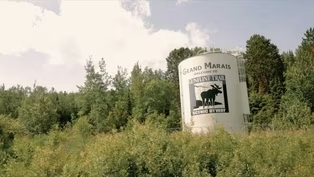
Video has Closed Captions
Preview: S17 Ep2 | 30s | Travel Minnesota’s iconic gunflint trail and visit the Chik-Wauk Museum and Nature Center. (30s)
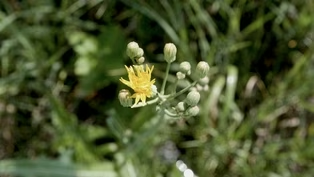
Fast Forage: Sow Thistle, Harvesting Nature’s Bounty
Video has Closed Captions
Clip: S17 Ep2 | 3m 55s | Forager Nicole Zempel explains how to identify the Sow Thistle. (3m 55s)
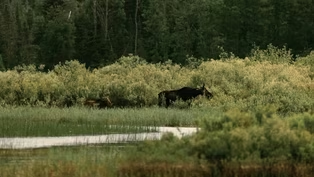
Video has Closed Captions
Clip: S17 Ep2 | 10m | Host Bret Amundson takes us on a journey north from Grand Marais to meet Jessica Berg-Collman. (10m)
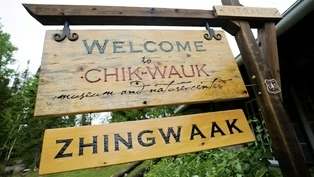
Video has Closed Captions
Clip: S17 Ep2 | 11m 36s | We visit the Chick-Wauk Museum and Nature Center. Chick-Wauk began as a resort in the 1930s. (11m 36s)
Providing Support for PBS.org
Learn Moreabout PBS online sponsorship
- Science and Nature

Explore scientific discoveries on television's most acclaimed science documentary series.

- Science and Nature

Capturing the splendor of the natural world, from the African plains to the Antarctic ice.











Support for PBS provided by:
Prairie Sportsman is a local public television program presented by Pioneer PBS
Production sponsorship is provided by funding from the Environment and Natural Resources Trust Fund and Shalom Hill Farm. Additional funding provided by Big Stone County, Yellow Medicine County, Lac qui...