
Alyssa Maurice; Michelle Nunn
9/26/2026 | 26m 46sVideo has Closed Captions
Alyssa Maurice; Michelle Nunn
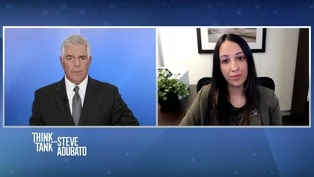
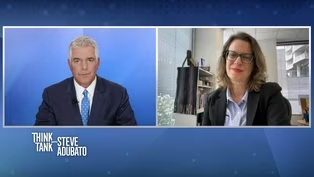
Alyssa Maurice, Assistant Director of the Hughes Center for Public Policy at Stockton University, analyzes pressing public policy issues such as secure elections, social media use for minors, and data centers in NJ. President & CEO of CARE, Michelle Nunn, talks about the organization’s efforts to provide aid, advocacy, and hope to people impacted by conflict in Gaza, Sudan, and around the world.
Problems playing video? | Closed Captioning Feedback
Problems playing video? | Closed Captioning Feedback
Think Tank with Steve Adubato is a local public television program presented by NJ PBS
Alyssa Maurice; Michelle Nunn
9/26/2026 | 26m 46sVideo has Closed Captions
Alyssa Maurice, Assistant Director of the Hughes Center for Public Policy at Stockton University, analyzes pressing public policy issues such as secure elections, social media use for minors, and data centers in NJ. President & CEO of CARE, Michelle Nunn, talks about the organization’s efforts to provide aid, advocacy, and hope to people impacted by conflict in Gaza, Sudan, and around the world.
Problems playing video? | Closed Captioning Feedback
Where to Watch Think Tank with Steve Adubato
Think Tank with Steve Adubato is available to stream on pbs.org and the PBS app.
Providing Support for PBS.org
Learn Moreabout PBS online sponsorship- [Narrator] Funding for this edition of Think Tank with Steve Adubato has been provided by New Jersey Sharing Network.
The New Jersey Education Association.
PSE&G.
Powering progress.
Atlantic Health System.
The Turrell Fund, a foundation serving children.
Robert Wood Johnson Foundation.
Working to create a future where health is no longer a privilege, but a right.
The Fund for New Jersey.
EJI, Excellence in Medicine Awards.
A New Jersey health foundation program.
And by Myron and Elaine Adler private foundation, in support of the Adler Aphasia Center.
Promotional support provided by BestofNJ.com.
All New Jersey in one place.
And by The Chamber of Commerce Southern New Jersey.
[MOTIVATIONAL MUSIC] - Hey everyone, Steve Adubato.
We kick off the program talking about a whole range of issues involving public policy and polling of public policy and where we are with our elections should we trust?
A lot going on.
We're joined by Alyssa Maurice, who's assistant director of the Hughes Center for Public Policy at our higher-ed partner at Stockton University.
Alyssa, good to see you.
- You too, thank you for having me.
- Alyssa, I know there are a couple of polls that you and your colleagues at the Center have worked on.
One having to do with social media, young people in social media and their mental health.
The other one involving data centers, AI data centers.
But I want to kick off with this.
We're taping on the 22nd of July.
It'll be seen later.
All right, this is "New York Post".
Don't worry, I have "The New York Times" here somewhere as well, right?
It's in both papers, it's everywhere.
Whole discussion about, and trust me, there's a question here, whole discussion, "Hey," President Trump, "The election was rigged.
2020 was stolen.
We need to question our elections.
People are voting or shouldn't be voting."
And I was all about to do a segment talking about how our elections are run really well and there's no reason to be concerned.
As we do the program today, Governor Sherrill admitted yesterday that the state of New Jersey through the Motor Vehicles folks, registered at least 6,600 non-citizens to vote, because of a software glitch in at least 400 of those cast-a-ballot.
Now, the president and many who question our elections, saying, "You see?
We told you."
Put this in context for us please, Alyssa.
- Yeah, you're absolutely right that it is a really unfortunate revelation from Governor Sherrill out of New Jersey.
Any instance- - Yes, yes, the governor said it happened in the previous administration under Governor Murphy.
But I'm sorry, go ahead, Alyssa.
- Any instance of voter fraud, or error in our voter rules is extremely serious.
It should be investigated as the governor said, so that these mistakes never happen again.
So, I don't want to be dismissive of that at all.
It's extremely concerning to hear that 400 non-citizens did vote within this period of a year where the software error was in effect.
But I do think it's important for elected officials to be very precise in how they talk about this issue, focus on exactly what happened and the impact of it.
The potential damage to our democracy of sensationalized rhetoric around this, or making unsubstantiated claims is really twofold.
For one, it can impact voter participation.
As you pointed out, President Trump for many years now has sown doubt about the security of our elections.
And many voters out there may be wondering, "Why would I bother if the whole system is rigged?"
So, elevating unsubstantiated claims of widespread fraud can really undermine voter confidence.
So, that's one concern, discouraging democratic participation.
Another issue is that sensationalized claims can be used as pretense for more federal interference in our elections.
Major- - Hold on a second.
When you say for more federal interference, the president says passed this voting act.
What's it called?
The SAVE America Act?
I'm not sure what it's called this week.
But all we're doing is making sure the people who vote, are the people who are supposed to be voting.
The federal government needs to be more involved.
And if you don't, New Jersey and other states do that, we're going to start pulling.
If you don't go along with what we want you to do, we're going to pull funding.
But last time I checked, the law says that the states administer elections, not the feds.
Why is the fed-state issue regarding elections so important, Alyssa?
- You're exactly right that President Trump has made it clear he wants to nationalize elections.
He's made a stance on that very clear.
And agencies like the Justice Department, the FBI, Homeland Security have taken steps to try to assert more federal control over state-run elections.
It's important for people to know, the Constitution gives authority over elections to the states, not the federal government.
So, Americans vote in as many as 10,000 different election jurisdictions.
Elections in this country are entirely decentralized, which may make things more complicated, but this system adds security.
Because of this decentralized system, it would be very hard, nearly impossible to systematically rig an election or alter outcomes.
Because so many jurisdictions are involved.
So, I think what would really help ease doubts among the American people would be for them to learn more about how votes are cast and counted at the local level, learn about all the people involved in that process on both sides of the aisle.
I really think that's the antidote to a lot of misinformation going around about this.
Democracy needs informed citizens.
- So how about this one?
Stockton Poll found that 91% of New Jersey voters believe that social media, is negatively impacting our children's mental health.
A, how accurate do you believe it is?
B, why is it so significant?
- Yeah, so, just to talk a little bit about our methods just to instill that confidence in your viewers, we use probability-based sampling.
So, that random selection helps ensure that we have a representative sample that is demographically aligned with our target population, which is all residents or registered voters depending on the poll.
So, unlike those election polls that are candidate preference polls trying to gauge the electorate for an upcoming election, we don't have to make educated guesses about who's going to show up to the polls.
We are trying to model the all registered voters, or all residents in New Jersey.
So, we have great benchmarks to know what that population looks like.
So, it's very different from those pre-election polls, which are trying to guess the electorate.
- Which and are often wrong by the way.
But that being said, this poll, the results, 91%, 91% of New Jersey voters believe social media, is negatively impacting children's mental health.
Why do you believe, Alyssa, those poll results, or how should they impact public policy in your view?
- Yeah, so, we knew that this was a big focus for Governor Sherrill, both as a candidate on the campaign trail and since she's taken office.
There has also been a slate of bills recently proposed in the state legislature to regulate online platforms in a number of ways.
And Sherrill has signaled support for these safeguards.
So, we thought it was important and timely to understand where New Jerseyans stand on this and if they think that is an appropriate role for the government.
And we found really strong support for these legislative guardrails.
75% said stronger regulations are needed, even if they limit some online freedoms.
Only 17% said online freedom should be prioritized, even if that means fewer restrictions.
We found broad support for proposals that are being considered in New Jersey.
93% favor requiring social media companies to meet stronger data privacy standards for minors.
88% support requiring social media companies to display warning labels on content that could negatively affect children's mental health.
And 79% were in support of increased funding for school-based mental health services in New Jersey.
So, really broad support across parties and across all demographics really.
And I think it's driven by exactly that finding that you started this segment with that 91% think these social media platforms, are playing a major role in the mental health challenges that we see today.
- P.S., to find out more about that poll and other polls taken over at the university, at the Hughes Center for Public Policy, the website's coming up right now.
How about this one?
A Stockton poll found that 56% of voters would support banning data centers in their community.
This has to do with artificial intelligence and the energy that is required to manage what's needed to make AI work, I guess.
These data centers, 56%, are they saying they're against illicit data centers, or are they saying, "I'm just against it if it's near me?"
- Well, yeah, that is a great question.
Because we often see that in public opinion, right?
They might be supportive of something.
But when those projects begin to materialize in their own communities, we see public opinion shift.
We saw that with wind turbine.
- Often known as NIMBY, Not In My Backyard, so- - Right.
- "I don't care if there's a toxic waste site and just not here."
Is this the same thing in your view?
- Well, we would need to do some more polling, I think some more follow-ups to try to tease that out a bit.
But I will say we did see broad concern about the environmental impacts of data centers and about the potential impact on utility costs.
So, we saw vast majorities were worried about those issues, even before the question on whether they would support data centers in their own communities.
So, we have to remember this is coming at a time when many are already struggling with rising utility bills.
It's already a very hot topic in the state.
So, many are looking at these data centers and understanding the surge in demands that they may lead to and thinking, "I don't want to take that risk."
I will also mention the findings on AI in general.
Because I think growing anti-AI sentiment is also a factor that's driving this backlash against data centers.
New Jersey voters are very wary of the growing reliance on AI.
And they're really bracing for labor market disruptions.
So, 74% think AI will ultimately eliminate more jobs than it will create.
And we see this anti-AI sentiment at the national level too.
Polling supports that at the national level.
So, I think that's also in the mix here of what is driving this pushback against data center development here in the state.
- Listen, before we let you go, why polling?
Why public policy for you?
-I think it’s so important, it's such an important piece of these policy discussions.
I really think they should have a voice in this.
And in order for our elected officials to act on behalf of the people, they need to know what they think.
So, I really do, I just believe there's a lot of value in it.
- Alyssa, it's the first time you have joined us.
It will not be the last.
Your voice is important, compelling information and really good stuff.
Alyssa Maurice, who is the assistant director at the Hughes Center for Public Policy at Stockton University, one of our higher-ed partners.
Alyssa, thank you so much for joining us.
We appreciate it.
- Great to be with you, thank you.
- You guys stay with us, we'll be right back.
- To watch more Think Tank with Steve Adubato, find us online and follow us on social media.
- We are honored to be joined by Michelle Nunn, who is the President and CEO of a terrific organization called CARE.
As their website is up, Michelle's gonna tell us a little bit about the organization.
Michelle, welcome to the program.
- Thank you so much for the opportunity.
- CARE was established back in 1946.
- That's right, that's right, it was just- - Right after World War II.
- Just after World War II, a couple of Americans who said, "We're not gonna stand by and watch people starve in Europe, and we're gonna do something about it."
And they actually invented the world's first care packages, which stood for something like cooperative assistance and relief in Europe.
And they figured out how to get 15,000 care packages from Philly to Le Havre, France.
And that became a part of a movement where over 100 million care packages were delivered.
And we now serve, you know, the continued legacy of that work is reaching 60 million people last year in 100 plus countries.
- How'd you get into this?
- You know, I have always been an admirer of CARE, but I've spent most of my career in the civic sector.
And over 10 years ago, the opportunity to save lives, defeat poverty, be a part of this extraordinary mission that centers women and girls and families around the world came up.
And I can't think of anything that's more important.
- So CARE does its work in a variety of countries, correct?
- That's right, over 100.
- Let's focus on Gaza.
Describe for us the suffering going on in Gaza.
- Yeah, it is hard to put words to the threshold of suffering that has happened over these last few years in Gaza and that continues.
And so if you think about two million people in the most concentrated and dense place on earth, and then you reduce that to a third of that land size, and that's where all of the population, those two million people are now existing.
And then you compound that with over, you know, 70,000 people killed, hundreds of thousands that have been injured, a system that is still heavily reliant upon food that comes in very limited and constrained environment, a food security situation that labels insecure almost 2/3 of the population.
And then you think about, you know, what does that look like for one family?
As an example, one of the women that CARE serves there, Diana, was telling us that she and so many women can no longer breastfeed because they themselves have faced such a threshold of hunger that their children can no longer get the nutrients that they need.
And not to mention school, shelter, and just basic capacity for people to have access to health, as an example.
Tens of thousands of people that are waiting for evacuations.
So it's a very, very complex and also challenging humanitarian situation.
- At the same time, there've been significant humanitarian aid cuts.
- That's right.
- Describe those cuts.
Where the cuts come from and what has been the impact of those cuts?
- Yeah, well, the US government itself has cut an extraordinary amount of its funding.
Now, America has always been a generous nation over these last 80 years of, for instance, CARE's history post-World War II, and the US was supporting almost 40% of the broader humanitarian infrastructure.
Now, if you think about that from a percentage perspective from a GDP, that was not outsized from, and many other countries actually were giving more at a ratio, but it's been an important player and that was dramatically cut, you know, in the early days of the administration, has been gradually, there have been some restoration of that, but still significant cuts.
And those have now been continued and extended by other countries throughout Europe and around the world.
So what we're seeing is the greatest sort of percentage cut in humanitarian aid in the last 80 years.
And at the same time, as you well know and as you've articulated, you have needs that are increasing and growing.
So it's a great disconnect between needs and resources.
- So CARE does not get involved in politics?
- That's right, we're nonpartisan, yep.
- However, CARE has a need to communicate to the federal administration, the Trump administration, what the impact of these cuts is on innocent women, children, others in places like Gaza, correct?
- Yeah, we think it's our duty to bear witness to the impact that cuts around the world are having, you know, both from the US government and other governments.
And to also say that, you know, we believe that with the restoration of investment and resources, not only will we meet our human obligations, our humanitarian obligations, but it also supports our security, economic, national health security.
We see this in an Ebola crisis so vividly.
And so, you know, that is our opportunity to speak.
And we believe that there is bipartisan support.
And we also believe that we need to rebuild that constituency and have the American people, you know, to really tell their policymakers that we believe that an investment of less than a penny on a dollar to ensure that we, you know, again, show global solidarity, invest in meaningful solutions, impact and save lives, millions of lives on an annual basis is a worthy investment.
- The website's up again.
People want to be helpful.
They go on the website.
The obvious one is contributing money.
Anything else they can do?
- Absolutely, I mean, obviously even, you know, $10 makes a difference and I think we don't want people to lose sight- - Michelle, explain to folks what 10, sorry for interrupting.
Someone says, oh yeah, Michelle said $10 makes a difference.
Explain to folks the difference it makes.
- I mean, look, $10 and over a period of months can feed literally dozens of families in places like Sudan and places like Gaza and can make a meaningful difference.
You know, hundreds of dollars can ensure that someone receives a secondary education.
Imagine the extension of that and the change that that means in their lives and trajectory or provide basic water and food and nutrition to someone and health services.
So, you know, every dollar counts.
But I also, as you said, it's also about people lifting up their voices.
And, you know, quite simply, if you go on our website, you can also learn, how can I tell my policy leader, whoever that might be, a legislator in Congress, the administration, that, you know, we believe in America's generosity, we believe in America's leadership in the world, and we believe that, you know, an investment, a right-sized investment in strategic ways around our economic international security and our humanitarian mandate is really one that we stand behind.
- You know, so you mentioned water.
First, help us understand the water situation in Gaza and then the lack of homes.
Homes have been destroyed.
- Yeah.
- Where are people living?
- You know, I was in Gaza, you know, almost five years ago, and I will tell you then that there were issues with water.
I mean, just people having the access to just clean their hands, their bodies without getting a rash because the water was so problematic.
And now imagine that, you know, so much of that is now they're dependent upon, you know, bottles from outside.
What we need to do and what CARE is helping to do is to replace and support the capacity for Gaza to support itself.
And that means that there's desalination plants, there's water, that water basically facilities that CARE and others are helping to support.
But that is, I mean, again, the most basic possible human need is the capacity for people to have water.
And then you extend that as you said- - What about homes?
Sorry for interrupting, Michelle.
If the homes are destroyed and thousands of homes have been destroyed, where are they living?
- Most everybody in Gaza has been displaced more than once and many, multiple, multiple, multiple times.
And that means now that many of them continue to live in, you know, tarps, under tarps.
And you know, as one of our partners, one of the people that's receiving service from CARE said, you know, our family wants to have a place to have privacy so that my wife is not going to the bathroom in the open, you know, that our family have the most basic things that most people take for granted.
And so shelter is a huge issue, food is a huge issue, water is a huge issue.
And not to mention, for instance, that there's been disrupted education for several years now for, you know, Gaza's children.
- Meaning they're not in school.
- Meaning they have not been able to attend school.
And so again, these are the things that we need to find some way of enabling the people of Gaza to be restored to the basic human dignity and the basic capacity to live lives that so many of us have the good fortune of taking for granted.
- A couple minutes left.
You mentioned Sudan.
I don't, and I'm embarrassed and I'm remiss.
I don't understand enough about the situation in Sudan.
I also know I'm not alone.
- You're not alone.
Yeah.
- Where is the Sudan?
What is the crisis in the Sudan and what is CARE's connection to trying to be helpful?
- Yeah.
Well, you're definitely not alone.
And it is the world's largest humanitarian crisis, yet it is one that receives only a modest level of attention.
So grateful to you for asking the question.
There are almost 34 million people that need assistance in Sudan, so it's hard to get your mind around that.
There are over 11 million people in Sudan that are displaced.
This is the result of a internal conflict, but with a multiple set of external actors as well, very complex.
But what I can say is that it is funded at a very low threshold in terms of the humanitarian need versus the resources that are being made available.
- Funded by whom, Michelle?
- Well, you know, I mean, there are a series of institutional donors and the US continues to play some role here.
Other European governments as well.
CARE has over the last couple of years, you asked about CARE's role.
We've been there for decades and we have reached over three million people over the last two years.
And so, you know, we run 80 health clinics, and there's a whole network of local.
I mean, these are people that are supporting their neighbors and supporting one another in the most difficult circumstances.
We're helping to just help them run the kinds of kitchens that will enable them to feed people.
But it's also a moment of great danger for many people.
You will continue to hear the threshold of violence that exists for so many women, especially gender-based violence, but civilians that are in the crosshairs here.
And so, I mean, what CARE is advocating for is- - Crosshairs of a war going on between rival factions.
- That's right, that's right.
And so what CARE is calling for is more attention from the global community that would manifest in more resources and investment for humanitarian assistance to actually ensure that the warring parties allow for humanitarian access and that needs to be enabled by, you know, global leadership and presence.
And then ultimately, I think the arbitration of a diplomatic solution that would bring peace to the people of Sudan.
- Michelle Nunn is the President and CEO of a terrific organization called CARE, making a huge difference with the need even greater than what they can provide.
Question is, what will the rest of us do?
Which is why the website has been up of CARE to try to find a way to be helpful in our own way.
Hey, Michelle, thank you, let's continue.
Let's make sure we have a conversation in the future and we appreciate everything you and your colleagues do.
- Steve, thanks so much for the opportunity.
- Yep, I'm Steve Adubato.
We thank you so much for watching and we'll see you next time.
- [Narrator] Think Tank with Steve Adubato is a production of the Caucus Educational Corporation.
Funding has been provided by New Jersey Sharing Network.
The New Jersey Education Association.
PSE&G.
Atlantic Health System.
The Turrell Fund, a foundation serving children.
Robert Wood Johnson Foundation.
The Fund for New Jersey.
EJI, Excellence in Medicine Awards.
A New Jersey health foundation program.
And by Adler Aphasia Center.
Promotional support provided by BestofNJ.com.
And by The Chamber of Commerce Southern New Jersey.
- To watch more Think Tank with Steve Adubato, find us online and follow us on social media.
- At the Turrell Fund, we know that all New Jersey families deserve access to affordable, high quality childcare.
Early childhood education supports healthy brain development and provides essential support to power the economy, enabling parents to work, businesses to operate, and communities to thrive.
The Turrell Fund is proud to be part of Start Strong NJ, a statewide initiative to put affordable, high quality childcare within reach of all New Jersey families.
Learn more at TurrellFund.org and StartStrongNJ.org.
Alyssa Maurice analyzes elections, data centers, & more
Video has Closed Captions
Alyssa Maurice analyzes elections, data centers, & more (12m 11s)
CARE's efforts to provide aid to Gaza, Sudan, and more
Video has Closed Captions
CARE's efforts to provide aid to Gaza, Sudan, and more (14m 26s)
Providing Support for PBS.org
Learn Moreabout PBS online sponsorship New Episode
- News and Public Affairs

Top journalists deliver compelling original analysis of the hour's headlines.
 New Episode
- News and Public Affairs

FRONTLINE is investigative journalism that questions, explains and changes our world.

 New Episode
 New Episode
 New Episode
 New Episode
 New Episode
 New Episode


 New Episode
Support for PBS provided by:
Think Tank with Steve Adubato is a local public television program presented by NJ PBS