
JFK, Part 2
Season 25 Episode 11 | 1h 52m 42sVideo has Closed Captions
Night 2 of "JFK," a biography of one of our most popular and most mourned leaders.
Scheduled for broadcast around the 50th anniversary of President John F. Kennedy's assassination, this biography provides a fresh look at an enigmatic man who has become one of the nation's most beloved and most mourned leaders.
Problems playing video? | Closed Captioning Feedback
Problems playing video? | Closed Captioning Feedback
Corporate sponsorship for American Experience is provided by Liberty Mutual Insurance and Carlisle Companies. Major funding by the Alfred P. Sloan Foundation.
Support provided by:


JFK, Part 2
Season 25 Episode 11 | 1h 52m 42sVideo has Closed Captions
Scheduled for broadcast around the 50th anniversary of President John F. Kennedy's assassination, this biography provides a fresh look at an enigmatic man who has become one of the nation's most beloved and most mourned leaders.
Problems playing video? | Closed Captioning Feedback
Where to Watch American Experience
American Experience is available to stream on pbs.org and the PBS app.
Buy Now
Related to This Episode
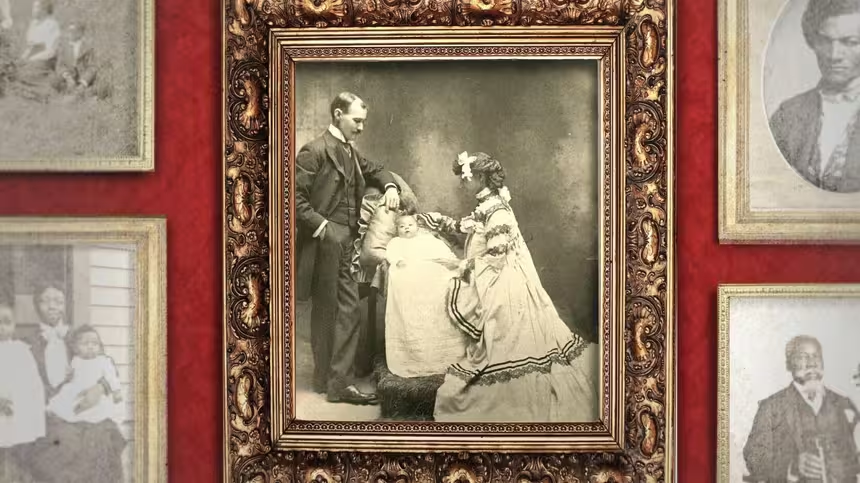
When is a photo an act of resistance?
For families that just decades earlier were torn apart by chattel slavery, being photographed together was proof of their resilience.Providing Support for PBS.org
Learn Moreabout PBS online sponsorshipMore from This Collection
In this award-winning collection, explore documentaries, biographies, interviews, articles, image galleries and more for an in-depth look at the history of the American presidency.
Video has Closed Captions
“JFK” presents a fresh look at the life and legacy of America’s 35th president. (1h 52m 43s)
The Presidents: George H.W. Bush (Part 2)
Video has Closed Captions
Part of the award-winning The Presidents collection. (1h 20m 59s)
The Presidents: George H.W. Bush (Part 1)
Video has Closed Captions
Part of the award-winning The Presidents collection. (1h 51m 19s)
Video has Closed Captions
Part of the award-winning "The Presidents" collection. (1h 52m 37s)
The Presidents: Reagan (Part 2)
Video has Audio Description
Ronald Reagan left the White House one of the most popular presidents of the 20th century. (1h 53m 50s)
The Presidents: Reagan (Part 1)
Video has Audio Description
A biography from American Experience's collection of presidential portraits. (1h 50m 17s)
Video has Audio Description
Follow LBJ from rural Texas to his ascendancy to the presidency after the assassination of JFK. (1h 50m 24s)
Video has Audio Description
Part of the award-winning The Presidents collection. (1h 50m 37s)

Video has Audio Description
A look at the US vice presidency, from constitutional afterthought to position of political import. (52m 36s)
Video has Closed Captions
Part of the award-winning The Presidents collection. (2h 47m 5s)
Video has Audio Description
Part of the award-winning The Presidents collection. (1h 44m 52s)
Video has Audio Description
Part of the award-winning The Presidents collection. (2h 16m 40s)
Providing Support for PBS.org
Learn Moreabout PBS online sponsorshipTonight... WOMAN: He loved being president.
MAN: Kennedy set so much in motion in such a short time.
MAN: Everybody went to bed wondering what was going to happen the next day.
MAN: We're talking about nuclear war.
WOMAN: Jackie had never accompanied Jack on a domestic trip.
This was her first one.
Part two of "JFK," on American Experience.
Previously on JFK... KENNEDY (on tape): Like many decisions in life, a combination of factors pressed on me, which directed me into my present profession.
EVAN THOMAS: There stirred in him a little quiet, and maybe even more than quiet, rebellion.
ROBERT CARO: There was something in Jack Kennedy, sick as he was, in pain as he was, that made men want to follow him into battle.
ROBERT DALLEK: He's seen as a kind of carpetbagger.
He didn't live in Boston.
His opponents attack h for being a rich boy.
You can never defeat the Communist movement in Indochina until you get the support of the natives.
TIMOTHY NAFTALI: He sent the signals of the kind of person who suspected that his time on earth was limited.
If elected to the United States Senate... THOMAS HUGHES: Lyndon Johnson looked at Jack as a person who picked and chose what he would like to do in the Senate.
Kennedy was the troubadour who came to play before the banquet and left before the dishwashing began.
SALLY BEDELL-SMITH: They were so beautiful and they were so young.
She wrote in her diary that she had an intimation that Jack would have a profound and possibly disturbing effect on her life.
She was going to be marrying a man who was known for his womanizing, and that it was unlikely that he would stop.
I am introducing a resolution... NAFTALI: He was willing to take a risk.
"Are we going to be on the right side or the wrong side of history?"
HUGHES: His independence meant a lot to him.
w Kennedy uld ke people guessing.
CARO: Jack Kennedy could learn on the run.
He's learning that politics is changing.
DALLEK: He's only 43 years old and a woman says to him, ys "Young man, it's too soon," and he says, "No, ma'am, this is my time."
I am today announcing my candidacy for the presidency of the United States.
DAVID NASAW: He was the representative of the new, young, vibrant generation, and Jack ran on that theme and ran hard.
The United States looks tired!
NEWS ANCHOR: There he is, the next president of the United States.
Now my wife and I prepare for a new administration and for a new baby.
NARRATOR: The biggest day of John Kennedy's life to date, Inauguration Day, 1961, dawned gray and frigid.
700 trucks were already out on the streets, clearing eight inches of new-fallen snow from the east front of the Capitol.
As the skies began to clear, 20,000 spectators crowded in to await Kennedy's arrival, ,0 and the news professionals hauled a bouquet of cameras onto a temporary structure rising high above the other onlookers.
EARL WARREN: You, John Fitzgerald Kennedy, do solemnly swear.
I, John Fitzgerald Kennedy, do solemnly swear.
That you will faithfully execute the office of president of the United States.
That I will faithfully execute the office of president of the United States.
It was bitterly cold, and Kennedy made sure, even though nobody knew he was wearing thermal underwear, he made sure that he would take off his topcoat.
He could show somebody who was vital and young.
So help you God.
So help me God.
(crowd applauds) ROBERT DALLEK: When Eisenhower left, at that juncture he was the oldest man in the country's history to have served in the White House.
Kennedy coming in was the youngest man to ever have been elected.
And so Kennedy wants to underscore that.
He wants to emphasize the new, the innovative.
Let the word go forth from this time and place, to friend and foe alike, that the torch has been passed to a new generation of Americans, born in this century.
RICHARD REEVES: Kennedy understood something that is not so obvious, and that is that words are more important than deeds.
You can't govern 300 million people, or 180 million when Kennedy was president, by doing things.
You can only do it by rhetoric.
NARRATOR: President Kennedy was talking to Americans that day, and to the world.
He meant to reassure historic allies and to exalt the virtues of democracy for new governments emerging in Africa, Asia and the Americas.
s. He also had a direct and pointed message for Soviet leader Nikita Khrushchev.
(crowd applauds) Let every nation know, whether it wishes us well or ill, that we shall pay any price, bear any burden, meet any hardship, support any friend, oppose any foe, to assure the survival and the success of liberty.
JULIAN BOND: There was enormous optimism.
He was young, personable, attractive.
He appeared to be friendly and disposed toward people of color.
r. And so there's great hopes that new things would happen.
KATHLEEN KENNEDY TOWNSEND: His inaugural speech was how we as a nation are going to be great.
The New Frontier.
He was willing to challenge people.
And I think each one of us wants to be challenged.
We want to think that our life has a mission.
And he understood that and reached out to it.
And so, my fellow Americans, ask not what your country can do for you, ask what you can do for your country.
(crowd applauds) (lively big band music playing) NARRATOR: The new first couple glided through a half-dozen ceremonials, including a gala produced by the president's friend Frank Sinatra showcasing the brilliant sparkle of American celebrity.
ca Jacqueline Kennedy wore white gowns to almost every event: her choice.
♪ A cottage small is all I'm after ♪ ♪ Not one that's spacious and wide... ♪ NARRATOR: Inside the gala and the balls, among the colorful and garish gowns, Mrs.
Kennedy stood apart.
♪ Some like the high road, I li the low road... ♪ BEDELL SMITH: Jackie once said that she would like to envision herself as a sort of art director of the 20th century, suspended in a chair over everything else and orchestrating how everything would look.
Everything was a scene to be staged.
REEVES: People suddenly see this glamorous young couple from the upper class, who are almost impeccasse in everything they do in public, ar and we want to be like them.
This is the new America.
♪ When the saints come marching in!
♪ (applause) NARRATOR: If his youth gave him pause, John Kennedy didn't show it.
He appeared to be fearless.
He ignored anyone who said it was too dangerous for a president to speak off the cuff and held the first live televised press conferences in the White House.
He would keep them up throughout his presidency.
REPORTER: Congressman Alger of Texas today criticized Mr.
Salinger as a, quote, "Young and inexperienced White House publicity man," end quote.
(crowd laughing) And he questioned the advisability of having him visit the Soviet Union.
I wonder if you have any comments.
I know there are always some people who feel that Americans are always young and inexperienced and foreigners are always able and tough and great negotiators.
an Now he also, as I saw the press, said that Mr.
Salinger's main job was to increase my standing in the Gallup polls.
nd Having done that, he's now moving on... ow (crowd laughing) ...to improve our communication.
BEDELL SMITH: Jack Kennedy did have what he called the "great man" theory of governing.
And he felt that a leader with the requisite intelligence and persuasive powers, which included charm, I suppose, could have an impact.
And he tried to model himself along the lines of leaders that he admired who had had that kind of impact.
NARRATOR: John Fitzgerald Kennedy demonstrated that this was his presidency from the start.
He appointed Republicans to head the Department of State, Treasury, Defense and the CIA, and when progressive Democrats complained, he waved them off.
He also waved off critics who said that his 35-year-old brother, Bobby, was too inexperienced and named him attorney general.
He peopled his White House staff with brainy and confident young men, and he wasn't shy out taking charge.
EVAN THOMAS: The Kennedys were part of that faith, that belief, born of the New Deal, of winning World War II, this sense that America's time had come.
We had the best, the brig est, the smartest, and if you just get enough of those guys in one room, everything will be clear and all problems will be solved.
There was sort of a gleeful amateurism to them, this faith that if you're smart and vigorous and aggressive isgg and ambitious, well, things will follow.
This was a dangerous formula, I should say, but it was attractive at the time.
The system he worked out was kind of a spoke and wheel so that he was in the center, he was the hub, and out to the spokes we the State Department, the national security adviser, whatever.
And to get to each other, they had to go through him.
BEDELL SMITH: In a way, it was quite improvisational.
na And he encouraged a lot of clashing ideas.
He would sometimes give the same assignment to different people and see what they came up with.
TIMOTHY NAFTALI: He wasn't bringing people together in a room to hammer out a consensus.
He was bringing ople in a room to give him the best information so that he could make the decision.
The problem with this system was it depended on the president asking the right questions.
If the president was distracted or tired, the system wasn't going to work well.
KENNEDY (on tape): Why does a politician continually raise his sights, and leave a job that represented complete satisfaction at one time for a higher position?
Question.
Paragraph.
Part of the reason lies in the normal desire to move ahead, comma, perhaps a more important part lies in the recognition that, uh, that a greater opportunity to determine the direction in which the nation will go lies in higher office.
I've come to understand that the presidency is the ultimate source of action.
(Dictaphone clicks off) NARRATOR: There was a lot on the young president's plate when he stepped into office: a weak economy, a trade deficit, ominous stirrings in the civil rights movement.
Kennedy wasn't pushing hard on his domestic agenda.
He wanted federal investment in education, a minimum wage bill, maybe guaranteed health care for the elderly.
Memorandum to David Bell, Bureau of the Budget... mo NARRATOR: What truly engaged John Kennedy at the beginning of 1961 was the increasing Soviet menace.
Like most Americans, the president was worried engagement with the Russians might spark a hot war or nuclear catastrophe.
But Kennedy did not want to appear afraid di to face down Nikita Khrushchev.
The soviet premier was making noises about annexing democratic West Berlin and actively aiding anti-colonial movements ac in the Congo, Laos and Vietnam.
Khrushchev was even making a play in America's backyard.
He had been an ardent supporter of Fidel Castro in the two years since the revolutionary had taken power in Cuba, just 90 miles from the U.S.
mainland.
THOMAS HUGHES: Khrushchev, as a kind of inauguration present for Kennedy, had given his big speech about national wars of liberation being the future extension of Communist influence.
Kennedy made everybody read this.
It was required reading in the first weeks of the administration.
Kennedy definitely bought this idea of Communism on the march, that we were in this twilight struggle, that we had to face off against the Communists everywhere, that it was this almost sacred duty to face up against the Communist menace.
Eisenhower's formula had always been all or nothing: face off against the Cmunists and say, "We're going to go to nuclear war or nothing."
Kennedy thought the smarter ing to do was to bouwilling to fight small wars.
It wass alled "flexible response."
The idea was you can't just threaten nuclear war every time.
Kennedy bought into this idea that you could fight small wars, win them, check Communism that way.
NARRATOR: In early April 1961, just a few months into Kennedy's presidency, Nikita Khrushchev announced the latest Soviet triumph: the first manned flight into space.
Kennedy watched as the Soviets heralded their stunning achievement to the world, just as he was deciding whether or not to execute the most aggressive anti- Communist plot available to him: the takedown of Khrushchev's in the Western Hemisphere.
The plan for an armed overthrow of Fidel Castro in Cuba was a holdover from the Eisenhower administration.
More than 1,000 U.S.-sponsored Cuban exiles were already in Guatemala training for the invasion when Kennedy took office.
At a meeting the day before his inauguration, Kennedy had spent little time asking the outgoing president about Cuba and walked away with the idea that prospects for success were good, that national security required action.
THOMAS: Theyedere a little bit ships passing in the night when they met at the White House in December and then in January 1960, '61.
And it's too bad.
They needed to have a better conversation than they did.
Eisenhower should have said to Kennedy, "Hey, ta it easy on this.
"Make sure you really talk to the generals before you invade Cuba."
But he didn't.
This really was a CIA operation.
And there was a man named Richard Bissell who ran Covert Operations at the CIA.
Very ambitious, very aggressive, wanted to be head of the CIA, was basically banking on success in Cuba carrying him there.
And what Bissell was selling was the invasion of Cuba, that they wereoing to get rid of Castro, but also a whole world of covert action: that by subterfuge, the United States could get its way in the world.
And the Kennedys fell for Dick Bissell.
The only National Security Council meeting that I attended was the meeting at which the president discussed the Bay of Pigs.
And I remember Allen Dulles, the director of the CIA, said that once the invasion began, there would be a national uprising.
There was absolutely no doubt in his mind, nor, I think, as we left that day, in the president's mind, that once the invasion was underway, that there would be a popular uprising among the Cuban people.
th REEVES: Kennedy had a real respect for the people in the intelligence agency and made the obvious assumption they knew what they were doing.
NARRATOR: The president wanted to believe he could have it both ways.
He hoped to overthrow Castro without leaving behind American fingerprints and without poking a finger in Khrushchev's eye.
THOMAS: Kennedy does have some qualms about the invasion plan.
It's a little bit too loud and noisy, as they say, and he wants to tone it down.
So like a politician, he looks for a compromise.
"I want something quieter.
"I want you to go on a beach, "in an area which is far away from an urban center, "so that this is not picked up.
"Set up a camp on Cuban soil "and then establish a government there, "and make the government there responsible for air attacks "so th it's viewed as the Cubans... "Okay, we're helping the Cubans, "but it is ultimately the Cubans fighting for the Cubans.
Can you do that?"
"Yes, Mr.
President."
THOMAS: The fact that the military's signing off on it just means what they're really saying is, "This is a CIA operation.
It's their problem if it fails."
Kennedy is not sophisticated enough, not experienced enough to understand that.
ANNOUNCER: The assault has begun on the dictatorship of Fidel Castro.
Cuban Army pilots opened the first phase of organized revolt with bombing raids on three military bases... NARRATOR: The invasion unraveled from the start.
The initial air campaign on April 15, 1961, was a disaster, and a very public one.
ANNOUNCER: In Havana, acting foreign minister Olivares shows diplomats rockets fired from the Cuban raiders which he claims have U.S.
markings.
NARRATOR: Kennedy sent his ambassador to the U.N.
to make a hasty and formal denial of U.S.
involvement in the initial air strikes.
ADLAI STEVENSON: The United States has committed no aggression against Cuba and no offensive has been launched from Florida or from any other part of the United States.
NARRATOR: By the time the American-trained and equipped invasion force began its cruise toward the tiny Caribbean island the following day, the coup in Cuba was a poorly kept secret.
MICHAEL DOBBS: The exiles landed in small boats at the Bay of Pigs, o which is a very remote part of Cuba, not near any town at all.
The Cuban authorities had heard about the invasion, and they were able to surround this exile force very quickly, isolate them ankill them, capture them., And that put the president in a very difficult position.
Either he had to commit U.S.
forces to rescue this abortive invasion force or he had to deny all connection with it.
NARRATOR: While the remaining Cuban exile force dug in, the CIA and the military begged Kennedy to commit more troops, or at least okay powerful air strikes in support of the invaders on that beachhead.
The president demurred.
NAFTALI: The facts on the ground got worse and worse and worse for the exiles who had invaded with U.S.
support.
It was a total disaster.
NARRATOR: There was no popular uprising in Cuba.
Castro bragged about his stunning defiance of the United States.
His popularity in Cuba soared.
Nikita Khrushchev wagged his finger at the new American president, who had been defeated ha and caught in an embarrassing lie.
Ofhe 1,400 Cuban exiles who made the attack, 1,200 were killed or captured.
Many of the survivors were headed for firing squads.
NASAW: The Bay of Pigs is the low point not only of the Kennedy presidency but maybe of any presidency.
As Jackie says, she had never seen her husband as distraught, as defeated.
She caught him a couple of times just weeping.
eThis is a decision-making that depended on the guy in the middle asking the right questions and getting the right answers, and it failed.
And he knew who was at fault.
He was pretty depressed, sitting in his office, saying, "How could I be so stupid?
c Why did I listen to those people?"
NASAW: And as the days went on, he didn't feel better.
He couldn't get himself out of this depression, he couldn't rouse himself.
At one point, Bobby came to Jack in the Oval Office and said, "Let's call Dad.
He'll make us feel better."
THOMAS: Right after the Bay of Pigs, Kennedy calls President Eisenhower and asks to meet him at Camp David.
And Kennedy says, "What went wrong?"
And President Eisenhower starts quizzing him.
He said, "Now, when you met about this, "did you meet in a big group and have a true back-and-forth, "or did you meet with people alone, one on one, and not really have a full debate?"
And it comes out in this meeting that Kennedy never really talked to the generals about what they really thought.
And Eisenhower kind of shakes his head and says, "You know, next time, you're going to have to do better, Mr.
President."
DALLEK: It humbled him, but most important, it made him deeply skeptical of taking advice at face value from people who were supposed to be experts in the military, in the intelligence community, in the CIA.
And he realized he had to make critical evaluations of what people were telling him, and he had to be skeptical.
He decided to set in motion really a revival of his administration, and it leads him to decide to do the sort of unprecedented: to have a second State of thenion speech.
Kennedy's trying to revive his presidency after the Bay of Pigs.
HUGHES: Kennedy was always being confronted at the wrong time with the wrong problem.
And he regards all these things as terrible, competitive distractions.
REEVES: He learned about the Freedom Riders when he got his New York Times that particular morning, and there was a picture of the bus burning innniston, Alabama.
And his response was, "What the hell is this?"
NARRATOR: In mid-May 1961, a group of Americans trying to focus attention on the illegal segregation of interstate bus lines in the South ran into more resistance than they'd expected.
White supremacists in Alabama had firebombed one passenger b the protesters were on and beaten them bloody.
John Kennedy was ten days away from a major address to Congress; he was also busy preparing for his historic summit with Nikita Khrushchev, which was just three weeks away.
He didn't want America's race problems to be splashed all over the press of the world, and therefore, out of the blue, learning about it, I answer his call on the phone when he suddenly discovers the Freedom Riders are riding into daer.
And he said, "Get your friends off those buses.
Find a way to stop it."
JULIAN BOND: There's a feeling that the Kennedy administration wants to treat the civil rights movement generally, the Freedom Riders particularly, as an irritant.
"These are people getting in our way.
"These are people upsetting our plans.
"These are people who are taking attention away from what we want to do."
REEVES: At that time, a Democratic president was totally at the mercy of Southern Democrats.
They ran the Congress.
And they were segregationists.
And he did not want to lose control of Congress over, you know, a few black kids.
NAFTALI: That was the battle in 1961 he didn't want to fight.
And the president and Robert Kennedy reacted to this by saying, "Not now."
It's politically understandable, but historically, it's inexcusable.
NARRATOR: Kennedy was wary of sending federal troops to protect the Freedom Riders; he knew it would inflame white Southern Democrats.
Justice Department officials called the protest leaders and warned them that the United States government m could not assure their safety if they continued and asked them to stand down.
BOND: The optimism that had enveloped the Kennedys, I think, from Election Day forward began to diminish, Ed it kept going down and down and down and down and down.
NARRATOR: The Freedom Riders refused to suspend their campaign, though they held out little hop.
"This goddamn civil rights mess," Kennedy complained.
He tried to satisfy both sides.
He sent his attorney general brother out to make statements chastising both the Freedom Riders and their attackers.
He dispatched a Justice Department aide, a Southerner named John Seigenthaler, to try to keep a lid on the situation and to explain to local authorities al that it was their duty to protect the protesters from the white mobs.
This assignment landed Seigenthaler in a parking lot of the Montgomery bus station, where the local police strefused to stand between the Freedom Riders and a group of armed and angry segregationists.
SEIGENTHALER: There were people there that day who would have killed those kids just because they were black.
I mean, they were intent on maiming and crippling and killing.
I think the violence visited on the Freedom Riders that day in that Greyhound parking lot in Montgomery shattered those hopes that the administration could somehow navigate through the troubled waters of race in the South.
Certainly they understood that there were going to be problems.
But this was one that required federal intervention; this was one that required sending in 400 marshals one afternoon.
And once that was done, the idea that you were going to be able id to navigate those troubled waters, you realized that was probably a false hope.
reob (applause) NARRATOR: Once the federal marshals were in place in Alabama, Kennedy changed the subject from civil rights.
When he addressed a rare joint session of Congress four days later, the president mentioned civil rights only glancingly.
He would not say a single word about the Freedom Riders.
"These are extraordinary times," Kennedy explained, "and we need to keep our eye on the most important issue: the global struggle for freedom."
KENNEDY: The great battleground for the defense anexpansion of freedom today is the whole southern half of the globe: Asia, Latin America, Africa and the Middle East, the lands of the rising people.
Their revolution is the greatest in human history.
NARRATOR: To promote the cause of democracy around the world, he asked young Americans to join the newly formed Peace Corps, and he asked Congress for money to aid emerging nations.
He also called for a bold new move into the heavens.
KENNEDY: Finally, if we are to win the battle that is now going on around the world between freedom and tyranny, the dramatic achievements in space which occurred in recent weeks should have made clear to us all, ld as did the Sputnik in 1957, the impact of this adventure on the minds of men everywhere who are attempting to make a determination of which road they should take.
I believe that this nation should commit itself to achieving the goal, before this decade is out, of landing a man on the Moon and returning him safely to the earth.
NARRATOR: The moon-shot had less to do with science and discovery en than it did with projecting to the Soviets American resolve.
Kennedy was scheduled to take his first overseas trip within a week of that address to Paris, Vienna and London.
The most important leg was Vienna, where the president would be meeting face-to-face with Nikita Khrushchev.
Kennedy was very confident of his own charm and whatnot, and he expected he could seduce Khrushchev.
SALINGER: The President and Chairman Khrushchev understand that this meeting is not for the purpose of negotiating or reaching agreement ag on the major international problems... NARRATOR: Kennedy had a big agenda in Vienna.
He wanted to persuade Khrushchev to back off in West Berlin, to join him in decelerating weapons programs, and to suspend nuclear testing.
SALINGER ...and a general exchange of views on the major issues which affect the relationships between the two countries.
NARRATOR: The nuclear stand-down was the president's highest priority.
DALLEK: Kennedy had a meeting with his chiefs early in his presidcy in which they describe to him the plans for a nuclear war in which they would kill 175 million people, devastate every major city in the Soviet Union and China.
And as he walks out of the room, he turns to Dean Rusk and he says, "And we call ourselves the human race."
If there was anything that horrified him in that presidency, it was the thought of having to pull that nuclear trigger.
cy ANNOUNCER: Paris, the city of light, outdoes itself in the warmth and splendor of its welcome to President and Mrs.
Kennedy, heren route to the fateful Vienna meeting de with Soviet Premier Khrushchev.
French president de Gaulle, remarkably relaxed and cordial, greets the visiting Americans... BEDELL SMITH: There was a great deal of interest in that first trip.
Jackie understood this.
She studied very hard.
She studied State Department documents.
She hired a tutor to brush up her French.
And when they arrived in Paris, people went wild.
(applause) I do not, uh, think it altogether inappropriate to introduce myself to this audience.
t I am the man who accompanied Jacqueline Kennedy to Paris, and I've enjoyed it.
(laughter and applause) NARRATOR: The success of the sit-down with Khrushchev in Vienna us was up to the president himself.
There were two long days of meetings on the schedule, and Kennedy's serious health problems had flared again.
Kennedy had wrenched his back on a trip to Canada several weeks before they went to Paris and was in a lot of pain, more pain than usual.
He had enlisted the services of a controversial doctor.
h REEVES: Max Jacobson, Dr.
Feelgood, who was unofficially his doctor, was flown over with his wife, the only two passengers on a chartered plane.
And then they were kept in the hotel where the Secret Service was so that the more mainstream doctors wouldn't know that Kennedy .
DALLEK: Bobby Kennedy cautioned his brother against letting this guy, who some said was a quack, letting him shoot him up with these kinds of painkillers, and uh, "Do you know what's in these injections?"
And Jack said, "I don't care if it's dog piss.
It makes me feel better."
BEDELL SMITH: A half-hour before he was due to meet with Khrushchev, Kennedy summoned him to his room and asked him to give him a big injection, because he knew he was going to be faced with a long meeting with Khrushchev and he wanted to be able to withstand that length of time without suffering the kind of back pain that he had been enduring.
NARRATOR: Dr.
Feelgood's cocktails were a potent mix of painkillers and amphetamines.
Nobody but Jackie and Bobby knew about the injectio, and nobody on the staff suspected.
HUGHES: Despite all the briefings about what a crude, emotional peasant Khrushchev was, Kennedy couldn't have been prepared for what he was up against.
Khrushchev thought of him as young, weak, ineffective, and probably a pushover.
And Kennedy defended himself limply.
NAFTALI: Khrushchev wanted Vienna to be humiliating for the American president.
That was the goal.
There was nothing that Kennedy could say or do at Vienna that would have derailed Khrushchev's strategy.
Kennedy walked into an ambush.
What he hopes to do is work out some kd of accommodation with Khrushchev over Berlin.
ThusSoviets are chagrined by the fact that Berlin is a corridor of escape for people from the Eastern European satellite countries; that they're running out of there, fleeing Eastern Europe, where Communism is in control, to go to the West.
And Khrushchev is embarrassed by this.
NARRATION The Soviet premier was matter-of-fact in his presentation to Kennedy about Berlin.
He was ready to unify the city under the control of his ally East Germany and to erase any U.S.
and NATO presence in the city.
DALLEK: By the end of the meeting, Khrushchev says, "We're going forward.
You press us, that's your problem."
And Kennedy said, "It's going to be a very cold winter."
DOBBS: Khrushchev talked about nuclear weapons in a very informal way that worried Kennedy.
Kennedy, when he came out of that meeting with Khrushchev, was really shaken.
I will tl you now that it was a very sober two days.
There was no discotesy, no loss of tempers, no threats or ultimatums by either side, no advantage or concession was either gained or given, no major decision was either planned or taken.
No spectacular progress was either achieved or pretended.
NAFTALI: He assumed certain things about Khrushchev that proved to be wrong.
"If this guy doesn't share my concern about nuclear danger, how am I going to deal with him over Europe?"
There was no ground that he could see for compromise, and that left Kennedy in a very dangerous situation.
It left the country in a dangerous situation.
NARRATOR: The president found it increasingly difficult to read Nikita Khrushchev in the months after Vienna.
The Soviet leader kept Kennedy off balance.
He backed off on his Berlin threat, building a wall around the Soviet-controlled sector of the city to stem the flood of defectors, but leaving in place the post-war agreements between East and West.
Then, in spite of Kennedy's direct warnings, he restarted Soviet nlear testing.
(explosion) lo NAFTALI: Khrushchev's decision to resume testing in summer of 1961-- not just any kind of testing; he decided to detonate the largest bomb ever detonated before-- put Kennedy in a difficult position.
He has many advisers who are arguing, "You've got to resume testing," and he doesn't want to do it.
'v And he keeps putting it off, hoping that something will happen in the negotiations with the Soviets.
"The nuclear scientists are arguing that you need to do it.
"We're going to make bombs better and more effective, more efficient."
It'And Kennedy is much lessrt thinterested in all of thatmb.c than he is in ying to keep the world away from the brink of nuclear war.
NARRATOR: Kennedy believed he had to show strength, and asking Congress to fund an increasing buildup of military capabi tweapons syinems wasn't enough.
He decided to make a stand in a country in Southeast Asia few Americans had ever heard of: Vietnam.
The Communist-backed Viet Cong appeared to be winning there.
DALLEK: ere were people urging Kennedy to understand that if the Viet Cong guerrillas succeed in South Vietnam, it's going to be seen as a model for guerrilla warfare in other developing nations.
And so beating back this insurgency not only saves Vietnam from Communism, but it's going to discourage the guerrilla campaigns in other Third World countries.
Having suffered setbacks and not ousting Castro from Cuba, having sort of lost the debate, so to speak, in Vienna with Khrushchev, being under the gun in relation to Berlin, he feels he can't step aside on Vietnam, however marginal it may be in his own mind and in the minds of some others telling him that this piece of territory is not all that important to America's strategic security.
NARRATOR: Kennedy was wary of being drawn into another debacle like Bay of Pigs.
He asked the secretary of defense, Robert McNamara, d his only trusted military adviser, General Maxwell Taylor, to give him a reasonable plan.
He wanted them to assess the U.S.
's chosen ally there, President Ngo Dinh Diem, to determine the popularity of his South Vietnamese government and the strength of his military.
He asked brother Bobby to stay in the loop, too.
NAFTALI: Maxwell Taylor and Robert McNamara lay out for Kennedy in late 1961 a set of proposals to manage the problem in South Vietnam, and that involves sending troops.
The understanding is that those troops will not engage in combat.
Kennedy wanted it to be South Vietnam fighting South Vietnam's war, with American help.
THOMAS: And the idea is that guerrilla fighters are going to win the hearts and minds of the populace against the Communists, that they're going to fight fire with fire, they're going to fight dirty if they have to, but they're also going to build schools and hospitals.
And the Green Berets get started in the military.
The regular military doesn't really like this very much, but Bobby Kennedy likes it and the Kennedys generally like it, and they go to demonstrations of Green Berets swinging from the branches and jumping from trees.
And it becomes a kind of fad, but really informs our early Vietnam policy.
We would go in there to fight a guerrilla war.
His preference is to use covert action and the CIA to build up allies in a state and let them fight the overt military conflict.
Kennedy was on the forefront of believing that these paramilitary activities were a better use of force and American special forces officers could help as advisers.
HUGHES: The more Kennedy talked about counterinsurgency in his press conferences, and the more the line was set that the Russian challenge was going to be informal warfare, the more everybody sort of climbed on board that boat.
Bobby had a green beret on his desk in the Justice Department to symbolize where our hearts and minds were.
NARRATOR: The pressures of the presidency were taking a heavy toll on Kennedy's health.
He required as many as seven injections of Novocaine in his back in a single day and was still often unable to bend over to put on his own socks.
He was on codeine, Demerol and methadone for pain, corticosteroids to control his Addison's disease, paregoric for his bad digestion.
He sometimes needed Nembutal to help him sleep.
His nights were often long and uncomfortable.
When the 44-year-old president was feeling down or awake and pacing in the middle of the night, he would pick up the phone and call New York or Palm Beach or Hyannisport and hear the friendly voice of Joe Sr.
BEDELL SMITH: He didn't intrude on specific policies, but the fact that he was there, that he could share his experience and his point of view was very important to Jack.
And in December of 1961, he had a debilitating stroke and never regained his power of speech.
Kennedy would continue call him on the phone and would sort of fill him in on events and people and things that were happening, but all that he heard at the other end of the line were sort of guttural grunts in reply.
When somebody proposed writing a book about the first Kennedy year, he said, "Why would anybody want to write a book about disasters?
d, "I've lost Bay of Pigs.
"I had a terrible confrontation with Khrushchev in Vienna.
The Berlin Wall went up."
He sees his first year as a pretty miserable experience, and there's no significant gain that he can point to either on the domestic or the foreign scene.
And so he's badly frustrated.
NARRATOR: She didn't talk much or give speeches.
Politics unnerved her.
She was shy to begin with and unsure how to find common ground with most of her fellow Americans.
But once Jacqueline Kennedy settled in as first lady, she came to appreciate the singular advantage of life in the White House: she could be walled away from the general run of voters and still satisfy their hunger for her.
Jackie was a great student of 18th and 19th century Europe, and she really set out to create a kind of court in the White House.
Her dress designer, Oleg Cassini, even said that she wanted to create a Versailles in Washington, and part of that was not only to project elegance, but it was also to kind of raise the game and put a premium on celebrating beauty, first of all, and a level of intellectual engagement, and celebrating artists and writers and performers in ways that hadn't been done certainly in the Eisenhower administration.
NARRATOR: John Kennedy's taste ran more to political biography and spy novels, Sinatra and show tunes.
So Jackie learned to strike hard bargains, like the time the president sent his press secretary, Pierre Salinger, to ask her to attend a publicity event he couldn't make.
Salinger failed.
Jack Kennedy said, "I'll try."
He went up.
He was upstairs for 20 minutes, and he came back down and said she was going to do it.
And Salinger said, "What did you have to give her?
A new dress?"
And he said, "Worse than that.
Two symphonies."
NARRATOR: Jackie Kennedy spent much of her time and energy in the first year restoring the White House.
She raised more than a million dollars for the project, hired an expert on American antiquities and decorative arts along with her favorite interior designer from Paris, and remade the stodgy old pile.
Her passion for the project was evident, which Dr.
Martin Luther King learned when a Kennedy aide, Harris Wofford, sneaked him into the private residence for a meeting with the president.
WOFFORD: Kennedy had to tell King that there would be no effort to get a civil rights bill through the first Congress, s and it was a great concern as to how King would take this.
And we got in the elevator to go up, and it went down instead, and Jacqueline Kennedy got on, in jeans and soot on her face.
And I introduced her to Dr.
King, and she said, "Oh, Dr.
King, "I just wish you had been in the basement with me this morning "looking at Andrew Jackson furniture.
You would have been thrilled down there."
And we got off, and she said, "But you have other things to talk to Jack about, I know."
And I thought to myself, "She sounded a little wacky.
A little bit charming, but wacky."
King was completely mellowed by it.
He said, "My, wasn't that something?"
NARRATOR: The first lady was so pleased with the results NA that she agreed to unveil her handiwork to the American people in an hour-long television special: "A Tour of the White House with Mrs.
John F.
Kennedy."
Mrs.
Kennedy, I want to thank you for letting us visit your official home.
This is obviously the room from which much of your work on it is directed.
Yes, it's attic and cellar all in one.
BEDELL SMITH: She prepared assiduously for the day of shooting.
The shooting took seven hours.
There were eight cameras.
The producer, Perry Wolff, was amused that between takes, she smoked almost nonstop.
And he saw that every time she smoked, she took her cigarette and she dumped the ash on the beautiful tapestry bench that she was sitting on.
But she performed impeccably.
CHARLES COLLINGWOOD: Mrs.
Kennedy, do you spend a great deal of time in the Lincoln Room?
We did in the beginning.
It was where we lived when we first came here, when our rooms at the other end of the hall were being painted.
I loved living in this room.
It's on the sunny side of the house, and one of Andrew Jackson's magnolia trees is right outside the window.
BEDELL SMITH: That night, Perry Wolff stayed around and showed them some of the early rushes.
And when the lights came up, Perry Wolff told me that he looked over at Jack and he saw a look of pure adoration and admiration.
s NARRATOR: Wolff would later recall sitting behind the couple in the darkness, watching Jacqueline in an unguarded moment rest her head on her husband's shoulder as they watched her performance.
"There was an exchange of affection," Wolff noted, "that belied many of the stories I had heard."
DALLEK: The fact of the matter is that even though he loves her, it doesn't deter him from having affairs.
THOMAS: John F. Kennedy, for all his many, many qualities, was reckless about his womanizing.
It's a long list of all different kinds: society matrons, 19-year-olds... I mean, it just went on and on.
BEDELL SMITH: He was abetted by two of his closest aides, Ken O'Donnell and Dave Powers.
And also, most of the people who covered the White House in the press were well aware that Kennedy was engaging in private sexual escapades in the White House, in Palm Springs, in Malibu, in New York, and even during one of his summit meetings with Prime Minister Harold Macmillan in Nassau.
NARRATOR: Kennedy could be frank and self-aware about his behavior.
Once, when a friend asked why he took the risk, he said simply, "I guess it's because I just can't help it."
You didn't raise the question of the Kennedy women anywhere around, I mean, although everybody knew what was going on.
The press was totally compliant with this, and Kennedy felt he could depend upon them all.
NAFTALI: There was a code among the political press not to speak of it, partly because it was mutual assured destruction.
Everybody had a secret.
It wasn't that everyone had decided that this didn't matter.
It was simply that everybody had dirt on everybody else.
And Kennedy was very comfortable in that environment, and that environment had protected him.
BEDELL SMITH: Jackie did understand that this was an aspect of him that there was nothing she could do about.
And she made her peace with it.
It sort of gave her a pass to go out and spend a lot of time in the country.
She took off on extended vacations.
e went to Italy for a long time.
She basically every summer would spend her time in Hyannis er a good distance from the Kennedy compound and enjoy her solitude there.
NARRATOR: Jack was happy to join his wife, his daughter Caroline, and his son John Jr.
in Hyannisport when he could.
But politics kept him on the road much of that summer and into the fall, with midterm elections coming up.
BILL LAWRENCE: Mr.
Kennedy figures that by the end of this campaign alone, he will have traveled almost as far as all the presidents in this century combined in midterm elections.
President Kennedy has deliberately, directly placed his personal prestige squarely on the line.
He has taken this dangerous political gamble because the fate of his legislative program for the next two years hangs in the balance.
By the summer of 1962, the Kennedy administration had achieved very little.
The four major initiatives, they were blocked by Southern conservatives, and so he's not able to get anything significant passed.
NARRATOR: Midterm elections were always nerve-wracking for a sitting president.
And Kennedy had a personal stake in 1962: his 30-year-old brother, Ted, was running for his old Senate seat in Massachusetts.
The Republicans spent that campaign summer taking pages from the old Kennedy playbook, attacking the president for being weak on Communism.
Kennedy was trying to project strength.
The president let the press know about the newly operational nuclear-armed missiles in Turkey, which were pointed at the Kmlin.
He maintained absolute silence on the historic and crucial back-channel exchange of personal letters he'd opened with Nikita Khrushchev.
Only Bobby and a few of his closest aides knew about that.
The president had also entrusted his brother with the continuing problem of Fidel Castro and Cuba.
You would think that the Bay of Pigs was purely chastening, that it would cause them to see a yellow light and slow down, but actually, the Kennedys hit the gas.
They go faster.
They start Operation Mongoose to try to get rid of Castro.
Bobby Kennedy essentially takes over overseeing Covert Operations.
HUGHES: Bobby was an unremitting enthusiast about covert activities and kept pressing everybody.
I think they had weekly meetings.
Tuesday, I think, was the chosen day for Mongoose meetings, and there would be representatives from the Pentagon, from the CIA, from the State Department who'd go to thhee meetings, and they'd all be hectored by Bobby to do more.
And he would use his crudest expressions to tell them they weren't doing enough and they should get on the ball.
Bobby would say there is no higher interest in the entire United States government than getting rid of Castro.
THOMAS: Now, there were already assassination plots underway that started in the Eisenhower administration, but they pick up a little bit of momentum under Bobby, bb all sorts of crazy stuff of using organized crime to kill Castro, to cause what the CIA called "boom and bang" on the island of Cuba to try to disrupt Castro.
None of this stuff works.
It's a complete failure.
DOBBS: It was the most disastrous foreign policy combination you could imagine, because it wasn't effective enough to actually overthrow Castro and it demonstrated to the Russians that they had to do something very dramatic if they were going to save their Cuban ally.
NARRATOR: Kennedy had insisted, on the record, that his administration would never stand for Soviet nuclear weapons in Cuba.
And Khrushchev had privately and secretly assured Kennedy the Soviets had no such plans.
But American reconnaissance flights had returned from Cuban airspace with photographic evidence: the Soviet missiles were already in country, waiting to be mated to nuclear warheads.
NAFTALI: It's very bad.
It's bad on several levels.
This whole back-channel operation is going to collapse if he can't even believe what the Soviets are telling him S on something as important as this.
He made it clear to the Soviets that this would not be acceptable, and yet they did it anyway.
DOBBS: The president is furious.
He realizes that he's been lied to by Khrushchev.
Kennedy called his closest advisers together and they met in the Cabinet Room of the White House.
There were two questions: one, were the missiles ready to fire?
And the second question was how they were going to react.
The initial advice is, "Attack!
Bomb!
Go in!
"This is intolerable.
We've got to bomb Cuba or invade it."
It's very aggressive.
And his brother Robert, the attorney general, wants to stage a provocation.
He says, "Let's sink the Maine or something" as an excuse to invade.
NARRATOR: In the first meetings of the President's Executive Committee, the Ex-Comm, the analysts all believed the Soviets were still a number of days away from having operable nuclear weapons in Cuba.
They couldn't even be certain the warheads were there yet.
Kennedy set the Air Force, the Navy and the Marines to contingency preparation, but he refused to green-light a military strike that first day, and the president let it be known that he wanted this kept quiet.
He didn't want the Soviets backed into a corner or the American people in a panic while he decided on the next move.
It's hard to realize how frightened they were.
They really thought that war was near.
Jack stayed cool.
He was grim about it, but he was not panicked.
NARRATOR: Kennedy kept his announced schedule, including a meeting with the Soviet ambassador, at which he revealed nothing.
He went out to dinner.
He traveled to Connecticut and Illinois for campaign events.
...the right decision is Democratic.
Thank you.
NARRATOR: Five days into the crisis, with more Soviet ships steaming toward Cuba and the joint chiefs pushing the president to begin bombing the island nation, Kennedy was still insisting on restraint.
The president settled on an idea Secretary of Defense Robert McNamara had suggested in an early meeting.
Kennedy instructed the Navy to set up what he called a "quarantine" around Cuba and to turn back all Soviet vessels.
In a private letter on October 22, 1962, Kennedy told Khrushchev that he would protect the U.S.
and its allies by doing "whatever must be done."
Later that evening, the president went public in a nationally televised speech to alert the country to the danger at hand and to demand the immediate removal of all Soviet missiles in Cuba.
It shall be the policy of this nation to regard any nuclear missile launched from Cuba against any nation in the Western Hemisphere as an attack by the Soviet Union on the United States requiring a full retaliatory response upon the Soviet Union.
DOBBS: Part of Kennedy's motivations during the missile crisis was also shoring up his domestic political position and showing that he could be tough with Khrushchev without plunging the whole world into a nuclear war.
That was the fine line that he was trying to tread during the missile crisis.
I'd hate like heck to see us go to war, but if it's necessary to prevent a nuclear war, I think the action has to be taken.
Well, I think it's high time we stopped Russia from having things their own way.
NARRATOR: President Kennedy was not certain how to proceed.
He lacked good low-level aerial photos of the Soviet missile site, so he kept dispatching U-2 reconnaissance planes ai on dangerous missions within range of anti-aircraft guns in Cuba.
And even if the missions were successful, there would still be more questions than answers.
DOBBS: The CIA told him that there were 8,000 Soviet technicians in Cuba.
In fact, there were 43,000 heavily armed Soviet soldiers on Cuba at that point.
The Soviets possessed, in addition to these longer-range missiles that could hit the United States, they also possessed shorter-range tactical nuclear weapons that could have been used to wipe out the U.S.
naval base at Guantánamo or a U.S.
invading force.
Kennedy didn't know any of that.
HUGHES: He gets bad advice from everybody-- ESl of his appointees, his chosen advisers-- and they're all over the place, and they change their own views frequently.
But in each case, Kennedy was delaying.
DOBBS: His experience in the military made him even more skeptical and more cautious than he might otherwise have been.
MAN: Two... one... zero!
DOBBS: Kennedy's nightmare scenario during the missile crisis was that war would start without either him or Nikita Khrushchev really wanting it.
Somebody would make a mistake, and there would be a spiraling chain of events that would quickly get out of control.
NARRATOR: On October 24, two days after Kennedy's public warning to Khrushchev, new U.S.
reconnaissance photographs revealed that work at the missile sites in Cuba was accelerating.
Kennedy understood he had to allow the joint chiefs to put the military on a hair trigger.
The Air Force's Strategic Air Command went on high alert.
The president also understood the chance of unintended action sparking a war grew by the hour.
There was no hotline between the White House and the Kremlin, no opportunity for real-time dialogue between himself and Khrushchev.
Both men were talking tough, but they were both sending other, less-martial signals, hoping those signals would get through the noise.
Khrushchev ordered early on his missile-carrying ships to turn back from Cuba because he wanted to avoid an immediate confrontation with the president.
And at a certain point, he decided to offer a trade-off.
He said that, "I'm willing to withdraw my missiles from Cuba if you withdraw your missiles from Turkey."
And at one point, all of Kennedy's advisers are against accepting that deal.
e only man in the room who thinks this is a way mout of the crisis is the president himself.
NARRATOR: In the private residence, Jackie Kennedy remembered, "There was no waking or sleeping."
And her husband had upped his daily dose of steroids An to keep his Addison's under control.
Everybody went to bed night after night that last week wondering what was going to happen the next day, and the joint chiefs were busy planning to strike the Soviet Union and Cuba on a moment's notice.
General LeMay, sure enough, was true to form all the way through the Cuban missile crisis.
I mean, let's unleash the nuclear weapons that he had his SAC command roaring around, ready to go, any day, any minute.
DOBBS: Kennedy came under a lot of criticism both from the military and also congressmen who were briefed on the crisis who felt that he should be taking tougher action against Khrushchev.
And his reaction essentially was, "Well, they're not the ones making the decision."
ROBERT CARO: What you see in the Cuban missile crisis is Jack Kennedy pulling the nation back from the edge of war.
We're talking here about nuclear war.
NARRATOR: Kennedy made one overriding calculation: that Nikita Khrushchev was as horrified at the prospect of nuclear Armageddon as he was.
The president let that calculation-- his alone-- be his guide, and he gambled on it.
HUGHES: He gave Khrushchev space.
He gave him space when other people were unwilling to give him any space at all.
NARRATOR: Kennedy had already pulled back the quarantine line to delay confrontation.
And on October 25, against the advice of the Ex-Comm, he instructed the Navy to allow a Soviet l tanker to breach the quarantine and enter the port in Havana.
But on the 12th day of the cris, Saturday, October 27, things started to go awry.
Black Saturday was probably the day the world came closer than ever before or since to a nuclear war.
Many things started happening on Black Saturday, including a U-2 spy plan stumbling over the Soviet Union, which Kennedy reacted to that by saying, "There's always some son of a bitch that doesn't get the word."
Both leaders, Khrushchev and Kennedy, were beginning to lose control over their own forces.
NARRATOR: The Soviets seemed intent on testing the quarantine line that Saturday.
A U.S.
ship dropped depth charges on a Soviet submarine in the Caribbean, and, most harrowing, an American spy plane on a mission over Cuba fell off the radar.
CARO: You hear the moment on the tape.
A messenger comes into the room.
You hear Jack Kennedy, for a moment, he's flustered.
We have said that if Russia shoots down one of our U-2 reconnaissance planes, we will immediately retaliate.
We'll immediately bomb that missile site that took out the plane, and then we will prepare for an all-out invasion.
ll And you hear in the background this chorus of voices, "We said we'll retaliate.
We have to do it right now."
CARO: You know what Kennedy says?
He says, "Well, let's take a break, gentlemen."
Time and again, when the hawks in that room, when the joint chiefs of staff are insisting on invading, Kennedy pulls them back.
He says, "Let's go to dinner now "and talk about the Jupiter missiles.
Let's talk about a trade."
NARRATOR: Kennedy could see the chance for a peaceful solution was slipping away, so he chose the person he most trusted, brother Bobby, to take an urgent message to the Soviet ambassador in Washington.
He was proposing a way out, which involved the U.S.
giving up a set of redundant weapons: the newly installed Jupiter missiles in Turkey.
allKennedy repeats his demand for Khrushchev to pull out, says that time is of the sence.
If Khrushchev pulls his missiles out of Cuba, the U.S.
will over the next few weeks pull its missiles out of Turkey.
The president was willing to back down, pull out the American missiles from Turkey, but only if that was kept secret.
CARO: The Strategic Air Command bombers are circling over the Arctic, waiting for the "go" signals.
Other bombers in the United States, they're being handed their target packets to bomb Russia the next day.
In Florida, the Fifth Marine Expeditionary Force is readying for the invasion-- an invasion, war.
If Russia's drawn into it-- and it will be, these are Russians on Cuba-- nuclear war.
RADIO ANNOUNCER: This is Radio Moscow.
Premier Khrushchev has sent a message to President Kenneru today.
The Soviet government has ordered the dismantling of weapons in Cuba as well as their crating and rern to the Soviet Union.
CARO: Khrushchev accepts.
And he signs his telegram, "With respect, Khrushchev."
KENNEDY: Progress is now being made towards the restoration of peace in the Caribbean.
And it is our firm hope and purpose that this progress shall go forward.
We will continue to keep the American people informed on this vital matter.
Thank you.
DOBBS: The outcome of the missile crisis was more than dumb luck.
I think had somebody else been in the White House Wh at that point as president, the outcome could have been very different.
I don't want to praise the president too much.
I think he made many blunders.
But he managed to get the Soviet missiles removed from Cuba, and he did so without triggering a nuclear war.
It was not self-evident that that would happen.
NAFTALI: Did he do a victory dance in public after Khrushchev withdrew the missiles?
No.
And he was very explicit about why not, and he said it to his team.
"Don't embarrass him.
"Don't humiliate him.
"We won.
It's good enough."
NARRATOR: Kennedy was not so bashful about using the outcome of the missile crisis to maximum domestic political effect.
The president invited a few of his closest reporter friends to the White House for private briefings on the events in Cuba.
Then he demanded a chance to amend and improve their stories about the crisis.
The administration never did disclose the secret trade-off of U.S.
missiles in Turkey.
ff Instead, under the president's direction, they embroidered the already-fanciful tale of the U.S.
Navy turning back Soviet ships: the "eyeball-to-eyeball" oconfrontationd between the president and Khrushchev.
DOBBS: That never happened.
Khrushchev had already decided to turn his ships around and turned them around the previous day But it helped them build up this myth of the president as the determined leader facing down his opposite number in the Soviet Union.
That was politically useful to the Kennedys for some time.
as NAFTALI: The Cuban missile crisis establishes Kennedy's credibility at home.
He can now talk to the American people in different terms.
He's now earned his spurs as a cold warrior.
He has actually crossed the threshold of credibility on national security affairs.
The Cuban missile crisis was a game changer for his presidency.
NARRATOR: He entered the second half of his term with a new kind of confidence.
Kennedy's Democrats had held on to all but four House seats in the midterms and maintained a healthy majority.
His youngest brother, Teddy, had won election to the Senate, where Democrats had gained a few seats.
Three in four Americans approved of the way President Kennedy was handling his job.
He was popular enough to bridge the yawning gap between politics and celebrity.
(audience laughing) VAUGHN MEADER (as KENNEDY): Next, uh, next question.
NAOMI BROSSART (as JACKIE): Yes, I should like to ask a question about... MEADER (as KENNEDY): Would you identify yourself, please?
BROSSART (as JACKIE): I'm your wife.
NARRATOR: A comedy album by a little-known impersonator named Vaughn Meader was the hit of holiday season 1962.
BROSSART (as JACKIE): Yes, I should like to ask the following question: (speaking French) MEADER (as KENNEDY): No, speak English, Jackie.
NARRATOR: The First Family sold a record-breaking seven-and-a-half million copies in just six months.
REPORTER: Mr.
President, it's been a long time since a president and his family have been subject to such a heavy barrage of teasing and fun-poking and satire, and now a smash hit record.
Can you tell us whether you read and listen to these things and whether they produce annoyment or enjoyment?
(laughing) Annoyment.
No, they produce... Yes, I have read them and listened to them.
Actually, I listened to Mr.
Meader's record but I thought it sounded more like Teddy than it did me.
(crowd laughs) NARRATOR: The president understood political gold dust when he saw it, and Caroline and John were impossible to miss.
He occasionally snuck his favorite photographers into the White House for photo ops when the first lady wasn't around to run interference.
JOHN JR.
: Hello!
KENNEDY: Why do the leaves fall?
Why does the snow come on the ground?
JOHN JR.
: Because it's winter.
KENNEDY: Why do the leaves turn green?
JOHN JR.
: Because it's spring.
KENNEDY: And where do we go on the Cape, Hyannisport?
(John answering softly) KENNEDY: In summer.
(John Jr.
laughing, answers softly) NARRATOR: John Kennedy had come to fatherhood relatively late, but he clearly enjoyed the role as he enjoyed being an uncle and, with Joe Sr.
debilitated, the Kennedy family patriarch.
KATHLEEN KENNEDY TOWNSEND: He wanted us to come over to the White House.
He's mbrother Joe's godfather, and I was always looking at the first edition of books and the scrimshaws and the prints that my brother Joe would get.
So I thought he was a really, really thoughtful godparent and took it seriously.
SANDER VANOCUR: Have you found that there's any way to break through to Mr.
Khrushchev, to make him really aware that you are quite sincere and determined about what you say, sir?
Well, it's difficult.
I think you see the Soviet Union and the United States so far separated in their beliefs, we believing in a world of independent, sovereign, different, diverse nations, they believing in a monolithic Communist world, and you put the nuclear equation into that, uh, that struggle, that's what makes this, as I said before, such a dangerous time, and we must proceed with firmness and also with the best information we can get and also with care.
NARRATOR: In the first months of 1963, the president was determined to use his increased standing with the American public to take a chance: wito att Apt to remake the frayed relationship with the Soviet Union.
But other events crowded him.
Despite rosy r horts from his closest advisers, things were not going well in Vietnam.
The man whose government Kennedy was backing, Ngo Dinh Diem, had dwindling popular support there.
Diem's army in the field appeared incapable of holding off the undertrained and barely weaponized North Vietnamese Communists, and this despite the fact that Kennedy had quadrupled the number of American troops in Vietnam in little more than a year to nearly 12,000.
Many of these "advisers" were doing actual fighting and dying.
Kennedy was not happy that this was making news.
The issue of segregation, in Alabama in particular, was a loaded powder keg.
And the new governor there, George Wallace, was waving a match.
I draw the line in the dust and toss theI auntlet before the feet of tyranny and I say segregation now, segregation tomorrow, and segregation forever.
(crowd cheering) NARROR: Wallace had won the goveorship by running against what he called "federal intrusion" by the "integratin', scalawaggin', carpet-baggin' liars."
Once in office, he kept his white supremacist supporters stirred to a foaming rage.
But the integrationists in Alabama were no longer in a mood to back down.
We informed the White House that we would be starting a movement there.
And for us, the issue was that there had been 60 unsolved bombings that were black people's homes, who were bombed for nothing.
Almost any night, somebody might drive through that neighborhood and throw a stick of dynamite on a front porch, or a Molotov cocktail.
NARRATOR: That April, the movement launched a series of boycotts, sit-ins and marches protesting segregation and "the blatant misuse of loca.
"This is," the activists proclaimed, "Birmingham's moment of truth."
The growing protests drew reporters and photographers from around the country.
Kennedy would not take a public stand against segregation there, not even when Police Commissioner Bull Connor began filling the city jails with marchers.
On May 2 alone, Connor arrested nearly 1,000 children who had joined the protest.
The next day, almost 3,000 high school students marched into the streets of downtown Birmingham.
YOUNG: We were in the process of dispersing the crowd, because we did notant any violence.
And so my back was turned to Bull Connor and the dogs, because we were trying to get the young people to move out of the park and go back to the church.
And then all of a sudden, the fire hose starts and the dogs come charging.
(dogs barking angrily) Jack Kennedy was very conscious of images.
When the television cameras and Life magazine arrived down South, that's the moment when the federal government cannot sit back.
NARRATOR: Kennedy still shied away from taking a side.
The president deputized a Justice Department official to go to Alabama and help get a deal to end "the spectacle," as he called it.
But he refused to push Congress to solve this problem once and for all by passing federal civil rights legislation that applied everywhere in America.
The solution, he insisted, would have to be worked out by Birmingham itself.
The protesters did agree to take a break as negotiations began, but as soon as a tentative deal was reached, the segregationists started a new firebombing campaign.
Kennedy sent 3,000 federal troops to the city to keep the peace.
He wasorried, he said, that "the Negroes will be uncontrollable."
This government will do whatever must be done to preserve order, to protect the lives of its citizens, and to uphold the law of the land.
NARRATOR: The president was vague on just what that "law" was.
He still didn't ask Congress to consider a civil rights bill.
Kennedy appeared, like the white moderates Martin Luther King despaired of, "more devoted to order than to justice."
Kennedy was anxious to pivot back to his preferred agenda: the relationship between the United States and the Soviet Union.
On June 10, 1963, Kennedy stepped to the podium at American University to make what he hoped would be the signature speech of the first term of his presidency.
Today, the expenditure of billions of dlars every year on weapons acquired for the purpose of making sure we never need them is essential to the keeping of peace.
But surely the acquisition of such idle stockpiles, which can only destroy and never create, is not the only, much less the most efficient, means of assuring peace.
He calls on the Americans and the Soviets to recognize that they need to think in terms of a new day in this cold war conflict; that the world is too much hostage to these nuclear weapons; that it is so impermissible to think of having this kind of all-out conflict.
REEVES: Kennedy gave, certainly intellectually, one of the best speeches ever given by an American president, and that was that maybe we got off on the wrong track, and maybe the cold war is not necessary.
I mean, it raised the most basic questions about, "Why are we doing this?"
KENNEDY: History teaches us that enmities between nations, ac as between individuals, do not last forever.
No government or social system is so evil that its people must be considered as lacking in virtue.
Among the many traits the peoples of our two countries have in common, none is stronger than our mutual abhorrence of war.
This was the first time an American president said the Soviets are like us.
It was the first time he asked the American people to think beyond stereotypes and the cold war and think about the fact that this was a matter of the future of the human race.
NARRATOR: The American University speech got big play behind the Iron Curtain the next day, but in the United States, more dramatic events were leading the national newscasts.
As governor and chief magistrate of the state of Alabama, I deem it to be my solemn obligation and duty to stand before you, representing the rights and sovereignty of this... NARRATOR: Alabama, in the person of its "Segregation Forever" governor, was back in the news.
George Wallace was making a show of bcking black students from attending the state university there.
st WALLACE: The illegal and unwarranted actions of the central government on this day, contrary to the laws, customs, and traditions of this state, is calculated to disturb the peace.
NARRATOR: Kennedy had been ignoring Vice President Johnson's advice to look Soutrners "in the eye" and tell them that integration was a "moral" and "Christian" issue.
Watching Wallace's posturing, Kennedy decided, for the first time in his career, to risk his political standing in the South by taking the side of integration.
There was an argument in the White House between Sorensen, Bobby and the president.
And the president said, "I want to go on television tonight and talk aut this."
They didn't want him to.
President Kennedy decides to go on national television that night and give a speech calling for a civil rights act to end discrimination in the South.
We are confronted primarily with a moral issue.
It is as old as the Scriptures and is as clear as the American Constitution.
The heart of the question is whether all Americans are to be afforded equal rights and equal opportunities.
NARRATOR: John F. Kennedy finally called for federal legislation ending segregation.
KENNEDY: Next week I shall ask the Congress of the United States to act, to make a commitment it has not fully made in this century to the proposition that race has no place to in American life or law.
It's done in such a hurry-up fashion that when the TV lights go on and Kennedy begins to read his speech, it's not finished.
One of the most important speeches of his presidency, he's winging it for the last third.
We have a right to expect that the Negro community will be responsible, will uphold the law.
But they have a right to expect the law will be fair, a that the Constitution will be colorblind, as Justice Harlan said at the turn of the century.
This is what we're talking about, and this is a matter which concerns this country and what it stands for, and in meeting it, I ask the support of all of our citizens.
Thank you very much.
NAFTALI: May and June of 1963 are a pivot in the Kennedy presidency because it's the first moment that he's willing to use the presidency as a bully pulpit to shape public opinion, to lead public opinion, and that's when presidents are at their greatest.
NARRATOR: The president flew across the Atlantic that summer with the wind at his back and the eyes of the world upon him.
One of the first stops was the city he'd protected from Soviet domination: West Berlin.
DALLEK: He goes in June of 1963 on something of a victory lap.
It's quite triumphant.
KENNEDY: All free men, wherever they may live, are citizens of Berlin, and therefore, as a free man, I take pride in the words, "Ich bin ein Berliner."
(crowd cheering) HUGHES: The Berlin speech and the million Germans that came out to hear him had a profound effect.
This was Kennedy the statesman and the politician combined.
And he says to Sorensen, "We'll never have a day like this in our whole political lives."
DALLEK: And then of course he goes to Ireland, where he is feted as the prodigal son who has returned home, who comes back to his roots.
KENNEDY: George Bernard Shaw, speaking as an Irishman, summed up an approach to life.
Other people, he said, "see things and say, 'Why?'
"But I dream things that never were, and I say, 'Why not?'"
The problems of the world cannot possibly be solvewo by skeptics or cynics ve whose horizons are limited by the obvious realities.
We need men who can dream of things that never were and ask, "Why not?"
(applause) We came home after that, at the Cape, this "big house," we call it, which is where my parents lived.
And we went to the big house for movies on the weekends.
So we called Jack out when he came back from Ireland, and we said, "What's the movie for the weekend?"
He said, "Well, you come over and see.
I thought you'd all want to see the trip to Ireland."
So we all sat and watched his trip to Ireland.
It was fantastic.
We loved it, we clapped, and everything was wonderful.
And then the next night he said, "I thought maybe you missed a little bit of the trip t" Then we said, "No, no, that's fine."
We went back, saw it again.
And the third night, Sunday night, he said, "Just to cover it completely, we'll just have one more look, my trip to Ireland."
I mean, he was so happy.
He loved being president.
Yes, he did.
He loved being president.
Yesterday, a shaft of light cut into the darkness.
Negotiations were concluded w on a treaty to ban all nuclear tests in the atmosphere.
NARRATOR: Kennedy and Khrushchev negotiated an agreement on a nuclear test ban in July of 1963, just six weeks after the American University message.
It was a limited agreement and still had to be ratified by the Senate, but it was an agreement.
REEVES: No one ever thought that you could get any kind of treaty yo involving nuclear missiles, and Kennedy and Khrushchev did it.
There'd never been a treaty like it before.
NAFTALI: The nuclear test ban proved two things: One, that you could actually have an agreement with the Soviets; and two, that you could convince the Soviets to take a step-- granted, not a huge step-- towards a more peaceful world where there was less danger of nuclear war.
DALLEK: He had used the power of his office to face down the Soviets in the missile crisis.
He had stood up to them.
He had recouped the setbacks he had suffered over the Bay of Pigs and over the Vienna summit, and he was on his way to a second term that could lead maybe to some kind of détente with the Soviet Union.
NAATOR: His closest friends said Jack Kennedy seemed more settled thk they'd seen him in years.
Jackie Kennedy would say it was the most time the family ever shared.
BEDELL SMITH: Jackie was pregnant with their third child that they were very excited about.
And that summer up in Hyannisport, they spent a lot of time together, and their friends commented on how close they seemed.
And then Jackie went into labor prematurely in August and had Patrick, who was suffering from hyaline membrane disease, which at that point was extremely serious.
tr They took him to Boston and Jack sat there in a chair outside this hyperbaric chamber and waited.
SALINGER: Patrick Kennedy died at 4:04 a.m.
The strain of the baby's attempts to breathe, with the problems with his lungs, caused his heart to expire.
The president, his brother the attorney general, and the president's friend Dave Powers were with the baby when he died.
BEDELL SMITH: They celebrated their 10th anniversary in September, and she wrote to a friend who had introduced them.
It was a kind of bittersweet letter because she said that she felt that Jack could have had a full and vital life without being married to her, but to her, being married to him and loving him was everything.
So it was clear that she was very much in love with him, and in many ways, they did draw closer together.
REPORTER: Mr.
President, Dr.
Teller, in urging the Senate to reject the nuclear test ban today, said that it weakens American defenses and thus invites attack.
Now, to anyone who works in the laboratories today, a 30-megaton weapon is perhaps not as sophisticated as a 60- or 70- or 80-megaton weapon, but it's still many, many, many times, dozens of times stronger, than the weapon that flattened Hiroshima and Nagasaki.
How many weapons do you need and how many megatons do you need to destroy?
I said in my speech what we now have on hand without any further testing will kill 300 million people in one hour, and I suppose they can even improve on that if it's necessary.
NARRATOR: The president understood he still had plenty of rough water ahead.
Ratification of the test ban treaty was not assured.
Civil rights legislation was jammed up in committee; a simple vote on the House or Senate floor seemed unlikely.
Vietnam was a mess.
Diem's government had squandered what little popular support it had.
Its military was still unable to stand up to the Communist-led North Vietnamese.
American casualties were on the rise, and American reporters on the ground were starting to tell that story to their readers back home.
(automatic gunfire) NAFTALI: Kennedy's got this problem.
He doesn't want the Viet Cong, which are the Communists there, to win.
But what do you do if the government you're supporting, and the government whose army you are supplying, is corrupt?
THOMAS: Different parts of Kennedy's own government are telling him different things.
Some people are saying we should get rid of Diem, have a coup d'état; other people are saying that's a terrible idea.
Kennedy has basically lost control of the Vietnam policy-making part of his government, and he knows it.
KENNEDY (on tape): Monday, November 4, 1963: Over the weekend the coup in Saigon took place, culminated three months of conversation about a coup, comma, a conversation which divided the government here and in Saigon.
NARRATOR: The president had set in motion the overthrow of Diem without really thinking through the consequences.
Three days after the event, in which Diem and his brother were assassinated, Kennedy was still trying to make sense of it.
KENNEDY: I feel that we must bear a good deal of responsibility for it.
The way he was killed made it particularly abhorrent.
The question now is whether the generals can stay together and build a stable government.
NARRATOR: Kennedy was finally beginning to understand how risky was his investment in Southeast Asia.
The president's instinct was still to exert control without calling attention to it.
He told his ambassador in Saigon, Henry Cabot Lodge, that the U.S.
was going to "intensify our efforts" to help the new government there.
His military leaders called for more American ground troops, sanctioned to fight against the Communist North.
Kennedy wanted to weigh all the options, from a troop increase to a troop withdrawal.
(marching band drumming) NARRATOR: John Kennedy's prospects for a second term looked good in the fall of 1963, despite the problems in Vietm.
But there was work to be done, particularly in Texas, the state that had been crucial to his victory in 1960.
The 1964 election-- his reelection-- was just a year away, and it wasn't going to be easy to campaign openly for civil rights legislation and still win majorities in the South.
The state party in Texas was already beginning to fracture, so the president decided to mend some political fences and fundraise with conservative governor John Connally.
NAFTALI: He needs Texas.
He's got to win Texas again, and he's got to raise money for the campaign.
Jacqueline doesn't really want to go, but he's asked her to come with him.
BEDELL SMITH: Jackie had never accompanied Jack on a domestic trip.
This was her very first one.
They decided to take little three-year-old John with them on the helicopter to Andrews Air Force Base, and he cried when they left, and Kennedy gave him a big hug.
CARO: As Air Force One is heading toward Dallas, : the weather clears.
And one of Kennedy's aides, Larry O'Brien, says, "Kennedy weather."
It's a glittering, bright Texas sun, so everything's shining, ev: Air Force One, the great silver plane.
The door opens, and it seems like the Kennedys are gleaming.
ANNOUNCER: There's Mrs.
Kennedy, and the crowd yells, and the president of the United States.
And I can see his suntan all the way from here.
CARO: The plan was for them to get right into the car, but the crowd is so excited along the fence, they're all reaching out to try to touch this beautiful couple.
And they walk along.
How could they resist?
They get into the car and the motorcade pulls out for Dallas.
The Kennedys are in the first car; in the jump seats are John Connally and Nellie Connally, his wife.
Down the sidewalks, from the curb to the buildings, are crammed solid with people.
From every window, people are reaching out and yelling and screaming.
Every time Jackie waves, the crowd presses forward, and every time Jack waves, they press forward so that the motorcade has to go slower, from 20 miles to 15 miles to ten miles to five miles.
Nellie Connally turns to the president and says, "Mr.
President, you certainly can't say that Dallas doesn't love you."
And she says Jack Kennedy looked at her and gave her this big smile.
ANNOUNCER: This is Edwin Newman in the NBC newsroom in New York, this information from Dallas.
Two priests who were with President Kennedy say he is dead of bullet wounds.
This is the latest information we have from Dallas.
REPORTER: What is your feeling right now?
I really couldn't say, really.
Right now, I just don't know what to do.
Was there much emotion among the congregation?
There was.
It really was amazing to see the number of men who came into the cathedral sobbing, almost convulsed with sorrow, anguish.
But all we can do now is pray for him, and that's about all we can do.
An entire loss to the world, it's hardly believable.
♪ ♪ ♪ ♪ (drums playing funeral cadence) (drumming fades away) (silence) (soft music playing) THOMAS: Jack Kennedy was the most glamorous, attractive president of the United States we've ever had and that we'll ever have.
That alone holds your fascination.
And he had enormous promise.
Now, it was unfulfilled.
It was not realized.
He probably wasn't as great as he appeared to be.
But he sure felt that way.
BEDELL SMITH: He is, as is always the case with people who die at a young age, he's fixed in everybody's mind in the way he looked, in his "viguh," in his sense of humor, in his informal style.
NAFTALI: Kennedy set so much in motion in such a short period of time that the outcome of each narrative was unclear.
WOFFORD: We will never know whether he would have been a great president.
I'd bet on him, but we didn't have that chance.
♪ ♪ ♪ ♪ ♪ ♪ ANNOUNCER: This program is available with PBS Passport and on Amazon Prime Video.
♪ ♪












Support for PBS provided by:
Corporate sponsorship for American Experience is provided by Liberty Mutual Insurance and Carlisle Companies. Major funding by the Alfred P. Sloan Foundation.