
The Presidents: George H.W. Bush (Part 2)
Season 20 Episode 10 | 1h 20m 59sVideo has Closed Captions
Part of the award-winning The Presidents collection.
This biography examines the life and career of our 41st president, from his service in World War II to his days in the Oval Office with the fall of the Berlin Wall, race riots in LA and the breakup of the Soviet Union.
Problems playing video? | Closed Captioning Feedback
Problems playing video? | Closed Captioning Feedback
Corporate sponsorship for American Experience is provided by Liberty Mutual Insurance and Carlisle Companies. Major funding by the Alfred P. Sloan Foundation.
Support provided by:


The Presidents: George H.W. Bush (Part 2)
Season 20 Episode 10 | 1h 20m 59sVideo has Closed Captions
This biography examines the life and career of our 41st president, from his service in World War II to his days in the Oval Office with the fall of the Berlin Wall, race riots in LA and the breakup of the Soviet Union.
Problems playing video? | Closed Captioning Feedback
Where to Watch American Experience
American Experience is available to stream on pbs.org and the PBS app.
Buy Now
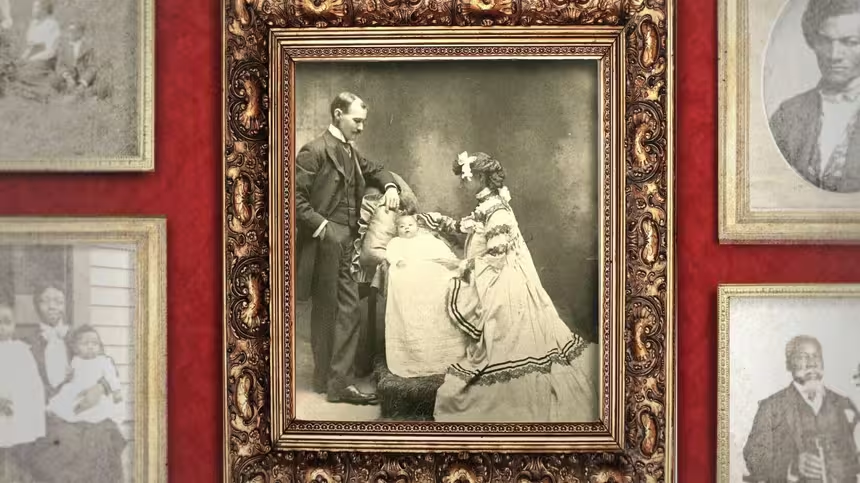
When is a photo an act of resistance?
For families that just decades earlier were torn apart by chattel slavery, being photographed together was proof of their resilience.Providing Support for PBS.org
Learn Moreabout PBS online sponsorshipMore from This Collection
In this award-winning collection, explore documentaries, biographies, interviews, articles, image galleries and more for an in-depth look at the history of the American presidency.
Video has Closed Captions
Night 2 of "JFK," a biography of one of our most popular and most mourned leaders. (1h 52m 42s)
Video has Closed Captions
“JFK” presents a fresh look at the life and legacy of America’s 35th president. (1h 52m 43s)
The Presidents: George H.W. Bush (Part 1)
Video has Closed Captions
Part of the award-winning The Presidents collection. (1h 51m 19s)
Video has Closed Captions
Part of the award-winning "The Presidents" collection. (1h 52m 37s)
The Presidents: Reagan (Part 2)
Video has Audio Description
Ronald Reagan left the White House one of the most popular presidents of the 20th century. (1h 53m 50s)
The Presidents: Reagan (Part 1)
Video has Audio Description
A biography from American Experience's collection of presidential portraits. (1h 50m 17s)
Video has Audio Description
Follow LBJ from rural Texas to his ascendancy to the presidency after the assassination of JFK. (1h 50m 24s)
Video has Audio Description
Part of the award-winning The Presidents collection. (1h 50m 37s)
Video has Audio Description
A look at the US vice presidency, from constitutional afterthought to position of political import. (52m 36s)
Video has Closed Captions
Part of the award-winning The Presidents collection. (2h 47m 5s)
Video has Audio Description
Part of the award-winning The Presidents collection. (1h 44m 52s)
Video has Audio Description
Part of the award-winning The Presidents collection. (2h 16m 40s)
Providing Support for PBS.org
Learn Moreabout PBS online sponsorshipNARRATOR: For much of his life, George Herbert Walker Bush had been the loyal lieutenant, serving in the Navy, Congress, the United Nations, the Republican National Committee, China, the C.I.A.
and as vice president.
NICHOLAS BRADY: When you go back and see what he's done, I don't think there was anybody who came to the job better trained.
NARRATOR: He would call on all of his experience to end the Cold War without a shot being fired.
After the wall came down, America's 41st president would face more challenges... around the world... (crowd cheering, gunshot) ...and at home.
He would forge an international coalition to battle Saddam Hussein in the first crisis of the post-Cold War world.
GEORGE H.W.
BUSH: Iraq will not be permitted to annex Kuwait.
And that's not a threat, it's not a boast.
It's just the way it's going to be.
BRENT SCOWCROFT: A number of years we heard, "Why didn't you finish the job?"
We don't hear that anymore.
NARRATOR: His actions as commander in chief would propel him to unprecedented popularity, with approval ratings even higher than the man he had dutifully served.
Yet the president who united much of the world would lose the support of his country and divide his own party.
RICHARD VIGUERIE: I think he betrayed the Reagan Revolution in many ways.
NARRATOR: His defeat by a less experienced challenger would leave him bewildered and worried that history would pay him little heed.
COLIN POWELL: To go from Desert Storm to losing an election, never thought it would happen.
It hurt a lot.
He didn't think that the American people would turn so quickly.
TIMOTHY NAFTALI: He was an emotive and emotional leader... (voice breaking): ...handle victory... NAFTALI: Much more emotional than people thought.
NARRATOR: Tonight, the story of George H.W.
Bush continues on "American Experience."
NARRATOR: "I read ten or 15 letters," President Bush wrote in his diary Christmas Eve, 1990, "all of them saying, "'Take care of my kid'... "some saying, it's not worth dying for gasoline.
"Then I sit here knowing "that if there is no movement on Saddam's part, we have to go to war."
JEB BUSH: The weight of the world was on my dad's shoulders, and the decision had already been made, or was in its final stages.
And so here we were having Christmas, family Christmas, at a time that, uh, the people would come in to brief the president of the United States about, uh, this upcoming action.
And it was just a very unusual time.
NARRATOR: "Dear George, Jeb, "Neil, Marvin, Doro: "I guess what I want you to know as a father is this: "When the question is asked, "'How many lives are you willing to sacrifice?
', "it tears at my heart... "I look at today's crisis as good versus evil.
"Saddam cannot profit from his aggression "and from his brutalizing the people of Kuwait.
"So dear kids, batten down the hatches.
I'm the luckiest dad in the whole wide world."
EVAN THOMAS: George Bush was the last gasp of the "Wise Men."
He's right out of that tradition, literally and figuratively.
Andover and Yale, this deep sense of duty to serve, serving in peace and war, making some money, but then, going in for a long period of public service.
RICHARD NORTON SMITH: I wouldn't call him the last of the Wise Men.
I think he is, uh, the heir to that tradition.
But the Wise Men never had to run for office.
That's the difference.
They didn't have the scars of running for office.
I think he is this curious combination of, uh... of qualities.
Someone who... has a discomfort with the grubbier side of politics, and yet, forced to wallow in that for much of his career in order to have a shot at doing what the Wise Men would do.
(cheers and applause) (applause, cheering and whistling) ♪ ♪ (squeaking) (explosion) NARRATOR: On August 1, 1990, George Bush's national security advisor informed him that Iraq's Saddam Hussein had invaded neighboring Kuwait in a dispute over oil.
Iraq had the fourth largest army in the world.
BRENT SCOWCROFT: Well, it's interesting.
I told him about it at night, and we scheduled an NSC meeting for early in the morning before he left for Aspen.
It wasn't a decision meeting.
But the sort of mood of the meeting was, well, it's a fait accompli.
It's taken place.
We can't do much about it.
It's halfway around the world.
And sort of, how do we adjust to it?
BUSH: Yeah, Helen?
HELEN THOMAS: Do you contemplate intervention as one of your options?
We're not discussing intervention.
I would not discuss any military options, even if we'd agreed upon them.
But one of the things I want to do at this meeting is hear from our secretary of defense and others.
But I'm not contemplating, uh, such action.
SCOWCROFT: And so when we got on the plane, and I said, "Mr.
President, I was very disturbed at that meeting."
And he said, "What do you mean?"
And I said, "The next meeting we have when we get back, "would you let me speak out first and say what the importance of this was?"
And he said, "Why don't I do it?"
And I said, "No, because if you do it at the outset, "you'll stifle debate.
And you want to... you want to have the debate."
But right at the beginning, he made it quite clear, while he didn't say so that early, that this was an unacceptable action.
NARRATOR: At a conference in Colorado, Bush met an old ally.
MARGARET THATCHER: George Bush just said to me, "Margaret, what is your view?"
And so, indeed, I told him that aggressors must be stopped, not only stopped, but they must be thrown out.
An aggressor cannot gain from his aggression.
He must be thrown out, and really, by that time, in my mind, I thought we ought to throw him out so decisively that he could never think of doing it again.
We find his behavior intolerable in this instance, and so do the rest of the United Nations countries that met last night.
And reaction from around the world is unanimous in being condemnatory.
NARRATOR: Secretary of State James Baker was in Moscow with a new ally.
For the first time since 1945, the U.S.
and the Soviet Union lined up on the same side of an international crisis.
JAMES A. BAKER, III: We met at the airport in Moscow, and that to me is when the Cold War really ended, when you had the American secretary of state and the foreign minister of the Soviet Union standing shoulder to shoulder in condemning the action of a Soviet client state, and even agreeing, I think at that time, to put an arms embargo on Iraq.
(birds singing) NARRATOR: Bush had asked the United Nations to impose economic sanctions on Iraq.
At a weekend meeting at Camp David, he decided to offer U.S.
forces to Saudi Arabia to protect its oil fields.
When he returned to Washington, he had made another decision.
DORO BUSH KOCH: I watched Dad get out of the helicopter, and there was this smoldering intensity to him.
He knew that he needed to kick Saddam out of Kuwait, and, um, yet I don't think he knew at that point exactly how he was going to do it, but, um, there was this sort of focused, intense, um, demeanor that was very different.
This will not stand.
This will not stand, this aggression against Kuwait.
(reporters clamoring) I've got to go.
I have to go to work, I got to go to work.
TIMOTHY NAFTALI: He led with his gut, with his instincts.
George Bush was emotive and emotional, an intuitive, instinctive leader, much more emotional than people thought.
SCOWCROFT: I was surprised that he spoke out that quickly, but his mind had been made up that... one way or another, the Iraqis had to leave Kuwait.
Now, that statement, "This will not stand," doesn't translate into how we're going to make it not stand.
Is it going to be sanctions?
Is it going to be U.N.
coalition action?
Is it going to be unilateral U.S.
action?
And what exactly is it we're going to do?
NARRATOR: Bush dispatched Secretary of Defense Dick Cheney to Saudi Arabia to convince the Saudis to accept American forces.
Despite a pointed warning the U.S.
forces would desecrate the Muslim holy land, the king accepted the U.S.
offer.
Osama bin Laden, the 33-year-old Islamic radical who issued the warning, was placed under confinement.
The operation to protect Saudi Arabia was called Desert Shield.
BUSH: At my direction, elements of the 82nd Airborne Division as well as key units of the United States Air Force are arriving today to take up defensive positions in Saudi Arabia.
To assume Iraq will not attack again would be unwise and unrealistic.
If history teaches us anything, it is that we must resist aggression or it will destroy our freedoms.
Appeasement does not work.
As was the case in the 1930s, we see in Saddam Hussein an aggressive dictator threatening his neighbors.
NARRATOR: Bush's international contacts from his days at the United Nations, the C.I.A., and eight years as vice president were vast.
He put his Rolodex to work and talked to 29 heads of state in the first week.
SCOWCROFT: He has enormous people skills.
He likes to reach out and to talk to people and understand where they're coming from, what they think, what their problems are.
And he used to pick up the phone and call foreign leaders, sometimes on specific issues, but frequently not with anything in mind, just "How are you?
How are you getting along?"
and so on.
I had studied political science.
This wasn't what presidents of the United States did.
What a waste of time of presidents of the United States.
I realized that what he was doing was building relationships.
He was very attentive to building relationships before you had to ask someone to do something hard.
NARRATOR: In the midst of the crisis, Bush departed for his family compound in Kennebunkport, Maine.
He had vacationed there every summer of his life except one during World War II.
He did not let the Gulf crisis keep him from the place he referred to as his "anchor to windward."
JEB BUSH: There is a timelessness to the place about how you treat others, how you love your family, how you recharge your spirits.
There is something that is timeless.
And it's just downright spectacularly beautiful as well.
NARRATOR: His mobile phone, Rolodex, and staff traveled with him.
Even while fishing for bluefish, Iraq was rarely out of his mind.
SCOWCROFT: We were out there for four hours, so we really talked about the world and what was happening to the world.
We discussed how it could change, and in the sense of building this "new world order" where small countries could feel safe from aggression by other countries, and where, where the U.N.
Security Council could behave the way its framers thought: the countries with the power could use it to preserve a stable and peaceful world.
NARRATOR: Some felt Bush should return to the White House.
He was reminded of the Iran hostage crisis and how President Jimmy Carter's attention, he recalled, "was controlled by thugs.
"I was absolutely determined that the American people would be spared this a second time."
(birds chirping) ♪ ♪ BARBARA BUSH: He plays at 6:00 so that it won't bother the other members of the club, when nobody else was there.
But he loves life, he loves the boat, he loves to play golf.
He used to love tennis beyond belief.
I mean, he played all those things and he played them at full speed.
(engine starting) (revving) BILLY BUSCH: The president loves to drive his boat, just absolutely loves to get in his boat and go, and he loves to fish, loves to be out on the water.
Even, even if the fishing's not good, it's just great to be on the water.
Maybe it's, um, like a freedom.
President's on his own, driving his own machine, no one else to say, "Do this."
It's his.
The part that my dad likes the most is the coming back part, where he's going 50-60 miles an hour in this cove, pulls back on the velocity, and makes this turn that is spectacular, and... scares the living heck out of everybody that's never done it before.
Very strong fish, stronger than he looks like just from looking at him.
(laughter) MARLIN FITZWATER: We used to play tennis when it was 95 degrees, and we'd finish two sets and I'd say, "Mr.
President, I can't go on anymore, I just can't do it," and he'd say, "Oh, yes, Marlin, come on, one more-- one more set."
And I remember he says, "Don't worry, you stand at the net and I'll just play everything behind you," and I thought, "Oh, my God, don't let anybody see this."
And so suddenly the president's feet are going back and forth, back and forth behind me, and I'm not even moving.
And finally I just said, "I cannot do it, Mr.
President."
He said, "Yes, you can, Marlin, you stay right there."
I mean, he was just the most competitive man.
(applause) BUSH: Iraq will not be permitted to annex Kuwait.
And that's not a threat, it's not a boast.
It's just the way it's going to be.
(applause) NARRATOR: Kuwaitis detailed the horrors of Saddam Hussein's occupation to a Congressional panel.
AL-SABAH: They have resorted to acts of mass executions, they have resorted to mass acts of rape, and they have resorted to mass acts of looting and pillaging of my country.
BUSH: And that's what we're dealing with.
We're dealing with Hitler revisited-- a totalitarianism and a brutality that is naked and unprecedented in modern times-- and that must not stand.
NARRATOR: Bush had little faith economic sanctions would convince Saddam Hussein to withdraw from Kuwait.
In early November, he doubled the size of the forces committed to Desert Shield.
BUSH: After consultation with King Fahd and our other allies, I have today directed the secretary of defense to increase the size of U.S.
forces committed to Desert Shield to ensure that the coalition has an adequate offensive military option should that be necessary to achieve our common goals.
NARRATOR: He would now have enough military might to force Saddam to withdraw.
ROBERT McNAMARA: The point is it's going to be bloody.
There are going to be thousands and thousands and thousands of casualties.
NARRATOR: Members of Congress were shocked that Bush had acted on his own.
They opened hearings on the possibility of a war in Iraq.
Even the architect of the Vietnam War favored economic sanctions instead.
Who can doubt that a year of blockade will be cheaper than a week of war?
Of course there are no guarantees on economic sanctions.
There are also no guarantees on war.
NARRATOR: If attacked, Saddam Hussein threatened to use Western hostages as shields.
Are you getting your milk, Stewart?
NARRATOR: If attacked, Saddam threatened to attack Israel.
Israeli citizens prepared for chemical warfare.
The Iraqi leader had not hesitated to use chemical weapons in the recent war against Iran or against his own people-- Kurds in Northern Iraq.
Yet now even Iran backed Iraq and threatened holy war against the U.S.
if Iraq were attacked.
NEWSCASTER: Tonight in a televised speech written by Saddam Hussein and read by his spokesman, the Iraqi president again called for the Muslim world to unite in a holy war against America and its allies.
(man speaking Arabic) "We are the ones who scared America," chant the soldiers, "and if death comes our way we will not be scared."
NARRATOR: Some feared a war in the Persian Gulf could escalate into World War III, especially if Israel responded to an attack.
BUSH: An Iraq permitted to swallow Kuwait would have the economic and military power as well as the arrogance to intimidate and coerce its neighbors, neighbors who control the lion's share of the world's remaining oil reserves.
We cannot permit a resource so vital to be dominated by one so ruthless, and we won't.
(applause) NARRATOR: The uncertainty of war and a spike in oil prices had already taken a toll on a fragile U.S.
economy.
BAKER: I went to him and I said, "Mr.
President, you know that this has all the ingredients "that have brought down "a couple of former presidents.
It's got $50 oil, body bags," and he said, "I know that, Jimmy, but we're going to do what's right.
"This is clearly in the national interest, and whatever happens, so be it."
He was determined to do what was right, notwithstanding the political consequences.
NARRATOR: In his domestic policy, Bush had also done what he thought was right, regardless of the political costs or, his critics charged, the cost to taxpayers.
Bush had signed legislation to help Americans with disabilities and initiated plans to clean up America's polluted air.
During President Reagan's term, we did try to revise and improve on the Clean Air Act, but President Reagan was adamantly opposed to it and we couldn't get any traction.
When President Bush took office, he said he wanted clean air legislation.
That completely changed the dynamic.
The debate changed from "Will there be a clean air bill?"
to "What will be in the clean air bill?"
NARRATOR: These programs would be costly.
Bush was already committed to solve the savings and loan banking crisis he had inherited from Reagan at a cost of more than $125 billion.
All these commitments exacerbated a growing budget deficit.
RICHARD DARMAN: At that time, revenues were around 19% of gross domestic product.
And expenditures, spending, was around 23%.
So there was a gap of four, approaching five, percent.
And it was projected to stay that way for a long time and then start rising as the Baby Boom generation would retire.
And everybody agreed that that would be unsustainable.
The argument was what to do about it.
NARRATOR: Bush considered breaking his campaign pledge not to raise taxes.
"This could mean a one-term presidency," he confided to his diary.
"But it's that important for the country."
DARMAN: He knew there was enormous political risk, and he was prepared to pay the price for what he thought was the right thing to do in the circumstances.
MITCHELL: Dick Darman, a very smart fellow.
Able fellow.
Came to see me several times.
And he suggested that we have a high-level negotiation, from which, he said, "A tax increase would emerge."
I said, "Well, how's it going to emerge?"
And he said, "Well, it'll just emerge."
And I remember he made a fluttering motion with his hands.
Well, we were very suspicious because, at about the same time, the president's chief of staff, Governor Sununu, said, "Well, if there's any negotiations, "in the negotiations the Democrats will propose tax increases and the president will say no."
So it was kind of a mixed message.
I'm not as much of a gentleman as the president is when it comes to hardball politics.
I would have made sure that the country knew that the taxes were Mitchell taxes and Foley taxes, not Bush taxes.
NARRATOR: At a meeting on June 26, 1990, of top Senate and House leaders from both parties, the Democrats agreed to spending cuts and Republicans agreed to raise taxes.
Read my lips... No, no, no new taxes!
NARRATOR: George Bush began to pay the price of his dramatic campaign promise.
MAN: Aren't some voters going to feel you broke your promise, sir?
WOMAN: When the budget negotiators meet tomorrow, they'll begin discussing what this means for the average family, whether it's higher taxes on gasoline, liquor, inheritance or on the wealthy, and whether Social Security increases and farm subsidies are cut.
RICHARD VIGUERIE: I think he betrayed the Reagan Revolution in many ways: by new government programs, greatly increased government spending.
But the most visible break with Reagan was, uh, "no new taxes."
It'll be one of his legacies that he will have to carry always, that he lied and betrayed.
Because he didn't raise taxes kicking and screaming.
He seemed to be very comfortable doing it.
If you thought the problem had to be addressed, and you go back and look at how the economy was at that point in time, and you look at the problems that were out there-- savings and loan, Third World debt, and a burgeoning deficit-- you'd say, "Well, I guess we got to deal with it, the cards as they're dealt."
NARRATOR: After three months of bargaining, the budget negotiators had a deal.
The bipartisan team was ready to announce it.
Everyone, including the Republican whip, Newt Gingrich, a movement conservative, seemed to be on board.
SUNUNU: I had contacted Gingrich to make sure he was comfortable.
He said he wasn't thrilled with it, but he would support it.
We had touched base with everybody that was part of the team and gotten their agreement that even though they weren't thrilled with it, they would support it.
(camera shutters clicking) NARRATOR: As he had for the Persian Gulf crisis, Bush forged a coalition, this one a bipartisan team of quarreling politicians.
BUSH: The bipartisan leaders and I have reached agreement on the federal budget.
Over five years, it would reduce the projected deficit by $500 billion.
That is half a trillion dollars.
NARRATOR: One key player on the team never made it to the Rose Garden.
Newt Gingrich had bolted.
GINGRICH: I have to look at this as an independent member of the Congress and as an independent member of the Republican leadership.
And I have to say as an independent person, is this something I can go home in good conscience and say, "This is the best we could do for the next five years, and I can defend it"?
My personal belief is no.
NARRATOR: Bush was holding his international coalition together.
He failed to hold his own party together.
When Democratic Senator Richard Russell failed to support Lyndon Johnson on the Vietnam War in 1963, LBJ faced him down.
SMITH: Lyndon Johnson in that situation would have said, "Do what I want or I'll cut off your balls."
It's hard to imagine George Bush threatening anyone.
And it is in some ways a sad commentary on the office of the presidency itself that that is deemed a weakness, a shortcoming.
NARRATOR: When Bush realized his budget agreement was going nowhere, he appealed to the American people.
BUSH: I ask you to take this initiative.
Tell your congressmen and senators you support this deficit reduction agreement.
In my district as of a few minutes ago, we had 775 calls today, 83% against the agreement.
And a group of eight economists, seven of whom had served in the Reagan administration, came out and said that this particular agreement would not be good for the American economy.
NARRATOR: Newt Gingrich may well have advanced Reagan's cause.
George Bush may well have helped save Reagan's reputation.
NAFTALI: Had Bush not cleaned up the savings and loan mess, had he not cleaned up the budget problem by breaking his "no new taxes" pledge and raising taxes, Ronald Reagan would be associated with an economic collapse in the United States.
Instead, because George Bush was willing to give Americans strong medicine, Bush gave Reagan a different legacy.
(applause) NARRATOR: Only two days after the president's appeal, the House voted the budget agreement down.
60% of House Republicans followed Gingrich in what one reporter called a "collective nervous breakdown" in the G.O.P.
Gingrich's revolt launched him on a path to become Speaker of the House.
It also gave the majority Democrats their way on the budget bill.
Bush was forced to sign a bill that raised not the gasoline tax he and Republicans had favored, but an income tax on the rich.
MITCHELL: What we were trying to do was to pass a budget that was good for the country, that didn't involve us taking the political rap for the difficult part of it.
And in that sense, we were able to accomplish that.
Read my lips-- no... SMITH: George Bush said what he had to say to win the 1988 election, and consequently paid an enormous price.
So how do you weigh, in the scales of history, his performance?
The fact that in a rather craven way, he did what his political advisors said was necessary to win, or once he had won, he in effect put his presidency at risk by doing what his conscience and his economic calculations told him was necessary?
There's the Faustian bargain of George Bush's presidency.
(crowd cheering and applauding) NARRATOR: Congress cut a deal with Bush on the budget, but still balked on the use of force in Iraq.
It would be easier to get Congressional support, Bush concluded, if the United Nations were on his side.
(gavel bangs) The result of the voting is as follows.
NARRATOR: On November 29, Secretary Baker made his case for the use of all necessary means to evict Iraq from Kuwait if it did not withdraw by January 15, 1991.
The draft resolution has been adopted as Resolution 678-1990.
That U.N.
vote was very important.
But if you ask me whether we would have done it without the vote, we probably would have.
Because we felt we had the constitutional authority and power to do so.
But it was really important to try and get the rest of the world behind us.
NARRATOR: After the U.N.
backed the use of force, Secretary Baker made his case to a reluctant Congress.
PAUL SARBANES: It seems to me you have placed us on a course to war.
Now this, uh, buildup now of the force almost takes you irresistibly down the path of going to war.
BAKER: Politically, Mr.
Chairman, we must stand for American leadership, not because we seek it, but simply because no one else can do the job.
And we did not stand united for 40 years to bring the Cold War to a peaceful end in order to make the world safe for the likes of Saddam Hussein.
MAN: How's it going?
How much longer?
How's it going?
NARRATOR: Congress was still resisting when Secretary Baker met with Iraq's foreign minister in a final attempt at diplomacy.
BAKER: Ladies and gentlemen, in over six hours, I heard nothing that suggested to me any Iraqi flexibility whatsoever on complying with the United Nations Security Council resolutions.
NARRATOR: Only then, on January 12, 1991, did Congress narrowly approve the use of force to evict Saddam Hussein from Kuwait.
How did we finally win a vote in the House and the Senate when we were a Republican administration with a Democratic Congress?
We won a vote because we went out and we got the rest of the world to support us.
So we could go to a senator and we could say, "Senator, you mean you're not going to support "the president of the United States, but the president of Ethiopia is going to support him?"
And it was very, very effective.
♪ ♪ KOCH: It was a snowy weekend at Camp David.
A lot of the kids were there and... the idea was for Dad's friends to sort of take his mind off a little bit of what was going on, but of course his mind was on it every minute.
NARRATOR: Barbara Bush invited close friends, the Heminways and the Schwarzeneggers.
Well, Barbara called up and said "the president needs some comic relief," if you want to put it that way.
"Come on up to Camp David."
He said, "Spike, let's take a walk around the perimeter.
I've got to get out and get some air," and so we started to walk around, and then he looked over at one of the military police over there who guard Camp David, and he had tears in his eyes, and he said, "Spike, those are the kids I've got to send to war, and I don't want to do it, but I have to do it."
NARRATOR: That weekend, Bush called congressional leaders to thank those who voted for the war for their votes, and to thank those who voted against it for their consideration.
BUSH: Just two hours ago, Allied air forces began an attack on military targets in Iraq and Kuwait.
NARRATOR: At 9:00 P.M.
on January 16, 1991, President Bush announced the start of the Gulf War.
BUSH: These attacks continue as I speak.
Ground forces are not engaged.
Five months ago, Saddam Hussein started this cruel war against Kuwait.
Tonight, the battle has been joined.
(explosion) NARRATOR: For 38 days the U.S.
Air Force led the operation, now called Desert Storm.
(helicopter whirring) Then the coalition launched a ground assault.
Coalition forces quickly evicted the Iraqi army from Kuwait.
(explosions) They crushed 46 Iraqi divisions.
Much of the elite Republican Guard escaped back to Baghdad.
Others were caught on what became known as the "Highway of Death."
Bush chose to stop the slaughter.
He ended the war after four days.
The ground offensive became known as the 100-hour war.
Be home soon.
(humorless laugh) NARRATOR: Despite warnings of a blood bath, the death toll among Americans would number 303, with fewer than 500 wounded.
Yet Saddam Hussein remained in power.
BAKER: Well, the war was stopped because all of the president's political and military advisors told him that he had achieved the war aims that were laid out.
We had achieved what the U.N.
Security Council resolution, uh, asked us to do and authorized us to do, that is, kick Iraq out of Kuwait.
And every one of the president's advisors advised him that it was time to end it.
SCOWCROFT: We did not know what would happen if we went on into Baghdad.
It would have been simple to do.
But we would have been occupiers in a hostile land.
Our troops would have been sniped at and so on.
And we had no exit plan.
How do you get out once you've occupied the country?
Another consideration that we took into account, as a military matter, is we did not want to totally destroy the Iraqi army.
And you can guess why: Iran.
We did not want Iraq laying prostrate before Iran.
And so it was always our intention to leave Saddam Hussein with enough of an army that it would not be a threat to its neighbors anymore, but it would not leave him totally vulnerable to Iranian misadventure, keeping in mind that that Iraq-Iran War had only ended three years earlier.
SCOWCROFT: We were trying to set a pattern for behavior in the post-Cold War world.
We were operating under a U.N.
mandate.
If we said, "Okay, we've fulfilled the mandate but now we want to go on and do some more," that's a bad precedent to set for people relying on the United States to do what the U.N.
mandates and not further.
(horns honking, person ululating) BUSH: For the sake of our principles, for the sake of the Kuwaiti people.
We stood our ground.
Because the world would not look the other way, Ambassador Al-Sabah, tonight Kuwait is free.
(applause) NARRATOR: The end of the Gulf War was the high point of the Bush presidency.
His approval ratings reached 89%-- at the time, the highest in the history of presidential polling.
MORGAN FREEMAN: Mr.
President, you set down ideals and standards that because they were carried on... NARRATOR: A few days later, Bush attended a tribute to President Abraham Lincoln at the theater where he had been shot.
If they could stand where I stand now, their message would be overwhelmingly simple.
Thank you, Mr.
President.
And thank you, Mr.
President.
(applause) (whistling) ("Stars and Stripes Forever" playing) NARRATOR: Americans celebrated a victory that seemed to put an end to the national self-doubt that had lingered since the Vietnam War.
But George Bush was not elated.
Intelligence reports had predicted the Iraqi military would overthrow Saddam.
That had not happened.
BUSH: You know, to be very honest with you, I haven't yet felt this, this wonderfully euphoric feeling that many of the American people feel.
And I'm beginning to.
I feel much better about it today than I did yesterday.
But I think it's, it's, um, it's that I want to see a... an end.
You mentioned World War II; there was a definitive end to that conflict.
And now we have Saddam Hussein still there, the man that wreaked this havoc upon his neighbors.
We have our prisoners still held.
We have people unaccounted for.
NARRATOR: The days of "phone calls to foreign leaders, "trying to keep things moving forward, managing a massive project," were over, Bush wrote in his diary.
"I don't know whether it's the anticlimax "or that I'm too tired to enjoy anything, but I just seem to be losing my perspective."
SCOWCROFT: Would have been great to have a formal surrender and all of that.
And it just sort of ended.
And it really didn't end, because Saddam right away, as soon as he'd put down the uprisings in the country and he started using his helicopters.
And then he was a thorn from then on.
So it never really was over.
And that gave President Bush a sense of being unfulfilled.
(shouting) NARRATOR: Within days after the cease-fire, Saddam Hussein's Sunni Republican Guard brutally suppressed an uprising by Iraqi Shia in the South.
(people screaming) Then they suppressed an uprising by the Kurds in the north.
During the war, Bush had encouraged such uprisings as a way to topple Saddam.
BUSH: There's another way for the bloodshed to stop.
And that is for the Iraqi military and the Iraqi people to take matters into their own hands and force Saddam Hussein, the dictator, to step aside, and then comply with the United Nations Resolutions and rejoin the family of peace-loving nations.
NARRATOR: Some felt U.S.
support was implicit in Bush's statement.
Bush did not.
BUSH: But do I think that the United States should bear guilt, because of suggesting that the Iraqi people take matters into their own hands?
With the implication being given by some that the United States would be there to support them militarily?
That was not true; we never implied that.
NARRATOR: In coming months, many questioned Bush's decision not to go to Baghdad to take out Saddam Hussein.
LARRY KING: America has growing doubts about our victory over Iraq.
MAN: Was it all worth it?
Should U.S.
troops march on Baghdad and finish the job that we should have finished six weeks ago?
MAN: If we were prepared to use force to drive Saddam Hussein from power, it would be over probably in four days, no more than four weeks.
Some people said, "Why didn't you guys take care of Saddam "when you had the chance?
Why didn't you go to Baghdad?"
Well, guess what.
I got that question a lot when I used to go out and speak.
Nobody asks me that question anymore.
We heard no... no rumbles of discontent at all.
They emerged shortly after, and then for a number of years we heard, "Why didn't you finish the job?"
We don't hear that anymore.
In recent months, nobody's been asking me about why we didn't go to Baghdad.
Pretty good idea now why Baghdad should always be looked at with some reservations.
♪ ♪ NARRATOR: After the Gulf War, Osama bin Laden left Saudi Arabia vowing revenge against the United States for defiling Saudi soil.
After the Gulf War, George Bush amassed all the political capital a president could have.
No one knew he would not be able to use it.
SMITH: By the spring of 1991, the Bush presidency was something of an exhausted volcano.
George Herbert Walker Bush had fulfilled his historical role.
He was left with the infinitely, to him, unappealing option of... (chuckles) defining a domestic sequel to the end of the Gulf War that would unite this fractious conservative coalition.
And, um, and then he was playing to his weaknesses.
NARRATOR: The rest of Bush's presidency would be a steady decline.
In May 1991, Bush's health became a concern.
He developed a shortness of breath while jogging at Camp David.
He had heart arrhythmia and an overactive thyroid, diagnosed as Graves' disease.
Members of his team began to wonder if he would have the strength to endure another presidential campaign.
His dealings with Soviet President Mikhail Gorbachev came under attack.
When Bush met with the Soviet leader to sign an important arms control agreement, he was criticized for "clinging to Gorbachev" when he should have been courting Boris Yeltsin, president of the Russian Parliament, who was more committed to democracy and free markets.
"My view," Bush said, "is you dance with who's on the dance floor.
"Especially if your dance partner controls more than 12,000 nuclear warheads aimed at you."
The treaty Bush signed with Gorbachev would eliminate almost 5,000 of them.
Well, I am very pleased to announce that I will nominate Judge Clarence Thomas to serve... NARRATOR: In the summer of 1991, Bush tried to appeal to his political right, which he had largely neglected, by appointing conservative justice Clarence Thomas to the Supreme Court.
And the fact that he is Black and a minority has nothing to do with this in the sense that he is the best qualified at this time.
ANITA HILL: After a brief discussion of work, he would turn the conversation... NARRATOR: This backfired amid charges of sexual harassment by a former employee, Anita Hill.
He spoke about acts that he had seen in pornographic films involving such matters as women having sex with animals.
PEOPLE (chanting): 26 weeks is not enough... 26 weeks is not enough... NARRATOR: A sluggish economy nagged at Bush.
America's wonderful, ain't it, Mr.
Bush?
Maybe you'll be unemployed.
Thank you.
(overlapping chatter and applause) Lay off Bush!
DARMAN: People were very worried about getting displaced from their job as 40- to 55-year-old workers, and being unable to find new jobs.
People were worried about long-term care for their parents.
People were worried about their own health insurance.
There were a lot of things that contributed to a sense of economic insecurity.
BUSH: People are hurting.
And they're hurting here in New York, and they're hurting across this country.
And families trying to make ends meet, proud Americans trying to keep their dignity when they lost their jobs.
And I don't know any American who sees this happening who is so callous that he cannot feel or she cannot feel a tug in her heart, who doesn't want to reach out actually and hold out a hand and try to... try to help these people.
NARRATOR: Bush believed there was little he could do.
Jobs were going overseas and would not return.
The onset of globalization helped push the unemployment rate to 7.4%.
Bush was not willing to extend unemployment benefits for fear of increasing the budget deficit.
When he tried to encourage consumer spending to spur the economy, the press saw him as unsympathetic to those without money to spend.
BUSH: Sorry we're holding up your shopping... FITZWATER: The problem was that when you would ask him to do something symbolic, like going down to this little town near Camp David and showing concern for the economy, he saw it as not being true, as not real.
And, uh, what was real to him was, he needed to buy some gifts for his grandkids.
And so in his mind, that was a far more realistic thing to do.
BUSH: Yeah, we got a guy that's that age.
FITZWATER: And it's just one of those things where it ended up working against him.
WOMAN: Paying cash?
BUSH: Cash.
Cash.
Well, I don't normally have any, but I just got replenished for the occasion.
(orchestra plays "Stars and Stripes Forever") NARRATOR: When Bush flew to Tokyo with American automakers in an effort to create more jobs, he soldiered on despite a case of the flu.
At a formal state dinner, he got sick on the Japanese prime minister.
"These last two months have been the worst of my presidency," he told a friend.
"And the last year has been the worst of my political career."
Things would not get any better.
(applause) The next month, he was skewered for seeming out of touch at a grocers' convention.
(beep) He marveled at new technology that could read a shredded bar code.
Pass the product across the... Just like that?
NARRATOR: "The New York Times" said he didn't know how an ordinary check-out counter worked.
MAN: Mm-hmm.
GREEN: The story stuck because it fed in with what was being argued by his opponents, both on the far right and in the Democrats, that Bush had lost touch with the American people.
NARRATOR: In October of 1991, the cascade of ill fortune literally hit home.
A nor'easter, the perfect storm, lashed Bush's house at Walker's Point in Kennebunkport.
♪ ♪ ♪ ♪ HEMINWAY: He had all his memorabilia in there.
And to see it in rubble, and this... With rocks and water and seaweed-- it's just... It was terrible for everybody.
(camera shutters clicking) BARBARA BUSH: It, um, was devastating.
But life goes on and, you know, a lot of people's homes were hurt, all the way up and down the East Coast.
And, uh, we had another home-- the White House, temporarily-- and so we could... we could survive.
A lot of people had a lot more trouble than we did.
MAN: Mr.
President, did you give any thought to, perhaps, after two storms in 13 years, of moving to higher ground, or are you determined to come back here?
We'll be here.
We'll be here.
It means something to us.
It means something to us.
It's our, uh, family's strength.
Be careful getting out this way.
(orchestra plays Soviet national anthem) NARRATOR: Bush could take some comfort on Christmas Day 1991 when the Soviet Union dissolved.
Mikhail Gorbachev's last phone call as president was to him.
Da, George... (speaking Russian) (Gorbachev speaking Russian off-screen) GORBACHEV (translated): I said that I will be stepping down, that I will be resigning, and Bush, at that time, thanked me for very fruitful work that we did together in international affairs, in building the bilateral relationship.
And he said that he felt that I had made a great, decisive contribution to positive change in the world.
RICE: That last phone call from Gorbachev to President Bush is, to me, still one of the most remarkable things in history.
That the general secretary of the Communist Party of the Soviet Union, the president of the great Soviet Union, in its dying moments, would choose to call the president of the United States.
It says that, I think, Gorbachev needed affirmation that what he was doing was right, to let the Soviet Union die a peaceful death.
(translated): We had a very good and serious and friendly conversation, and at that time, President Bush gave me serious moral support.
RICE: I talked to President Bush about that on a couple of occasions.
And what's very funny is that he didn't see it as particularly extraordinary.
And that says something about his modesty and about his humility.
BUSH: I'd like to express, on behalf of the American people, my gratitude to Mikhail Gorbachev... NARRATOR: If ever anyone needed a big win, it was George Bush.
Yet that Christmas, he did not talk of winners.
Instead, Bush televised his thank-you note to Gorbachev.
BUSH: This struggle shaped the lives of all Americans.
It forced all nations to live under the specter of nuclear destruction.
That confrontation is now over.
(applause) NARRATOR: A month later, he did talk of winners.
It was the beginning of a presidential election year.
But the biggest thing that has happened in the world in my life, in our lives, is this.
By the grace of God, America won the Cold War.
(cheers and applause) NARRATOR: Still, Bush called no attention to his role in helping shepherd the Soviet Union out of existence without a shot being fired.
And I have an announcement to make.
Uh... (applause, cheering and whistling) I want to continue serving as your president four more years, so from this moment... (loud cheering and whistling) NARRATOR: The fact that he waited until February 1992 to announce his candidacy led some to believe he was not interested in a second term.
Bush would campaign without Lee Atwater, the bare-knuckled campaign advisor who had masterminded his success four years earlier.
Atwater had died of brain cancer.
GREENE: The death of Lee Atwater was the most important event in the Bush campaign of 1992.
It took out of the mix the one person who could make George Bush fight and make George Bush see the logic for negative campaigning.
SMITH: I don't think you can exaggerate the significance of what was lost to the Bush presidency when Lee Atwater died.
It's as if one lobe of the president's brain was, uh... was removed.
The political part.
And for someone who was already, in many ways, uncomfortable with the demands of the political presidency, it was a crushing blow.
NARRATOR: Chief of Staff John Sununu, who had delivered New Hampshire for Bush in '88, was forced to resign at the end of 1991.
He had used presidential planes for personal business, including trips to his dentist.
DEMONSTRATORS (chanting): We want Bush!
We do!
We want Bush!
We do!
No protectionism.
NARRATOR: The Republican Party continued to fracture.
In New Hampshire, Bush was challenged by Pat Buchanan, a conservative talk show pundit and former aide to presidents Nixon and Reagan.
PEOPLE (chanting): Four more years!
NARRATOR: Buchanan hammered Bush for raising taxes.
It was not some liberal Democrat who declared, "Read my lips, no new taxes"... (laughter) ...and then broke his word to cut a seedy back room deal with the big spenders on Capitol Hill.
NARRATOR: Bush could not campaign on the things in which he took pride-- the Clean Air Act and the Americans with Disabilities Act.
To movement conservatives, they simply expanded government at taxpayer expense.
SMITH: So in addition to Bush's innate modesty, there's also a political imperative.
Bush doesn't want to call that much attention to these accomplishments because, in his political universe, they are the right thing to do, they are the responsible thing to do, they are the establishment thing to do, they are the thing that Prescott Bush would do if he was in the White House, but in the new political era in which George Bush finds himself, they're actually liabilities.
VIGUERIE: They were major liabilities.
And there's few things that send the conservatives up the wall and off the wall more than to be told by establishment Republicans, we can do anything we want.
We can advocate most any policy or program, because we are still a little bit better than the Democrats, so you have no place else to go.
And this angers us.
And so because we felt we had no stake in his presidency, it was easy to oppose his nomination.
GREENE: The Republican Party changes during Bush's administration.
It swings, lurches to the right.
And it's a seismic shift.
And the reason for it is because conservative Republicans were able to position George Bush as having let them down, as having broken the Reagan faith.
And a lot of that's true.
George Bush was a moderate Republican.
He was not a Reagan Republican.
Nice to see you.
Good to see you.
SCHWARZENEGGER: I wanted to vote... at the same time send a message to congress, at the same time send a message to Pat Buchanan-- Hasta la vista, baby.
Thank you.
(laughter) The Buchanan brigades met King George's army... NARRATOR: On February 18, 1992, Bush won the New Hampshire primary, but Buchanan captured 37% of the vote.
(crowd cheering) PEROT: If you, the people... will, on your own, I don't want some... NARRATOR: Two days later, Ross Perot, a Texas tycoon and Bush's old friend, challenged him as a third-party candidate.
PEROT: Number one I'll promise you this, between now and the convention... we'll get both parties' heads straight.
NARRATOR: Bush had problems.
So did Democratic candidate Bill Clinton, governor of Arkansas.
REPORTER: Governor, did you burn your draft card?
No.
There are questions about... No.
Yes, I was Bill Clinton's lover for 12 years.
NARRATOR: Bush thought no politician could survive these accusations.
I would have liked to think that after a 12-year relationship... FITZWATER: I think the president felt at the time that Clinton's record would preclude him winning.
Uh... in this country, we had never really had a candidate who was a... a philanderer and who'd had the marital problems he had, uh, and still win an election.
We certainly never had a president who'd been accused of draft dodging and still be elected president.
And that seemed like pretty heavy baggage.
And so I don't think anybody believed Clinton could win.
(crowd cheering) There is a clear pattern to Governor Clinton's past.
A pattern of deception.
Character does matter.
A pattern of deception is not right for the Oval Office.
(cheers and applause) NARRATOR: Clinton may have had baggage, but he was capable of hitting Bush where it hurt.
You know what George Bush said yesterday to David and Rita Springs?
He said, if you want to get the economy going, go buy a car or buy a house.
It's a good time to buy a car, it's a good time to buy a house.
It's a good time to buy a car or a house because if you're on welfare and food stamps, you can't pay the light bill and be a thousand points of light much less buy a house or a car.
(crowd cheering, band playing) (cheering fades) NARRATOR: In hindsight, the recession was over by the spring of 1992.
Bush's budget agreement was paying off... but so slowly, people didn't feel it.
BUSH: Gross domestic product, GNP is moving.
Uh, industrial production is up.
Payroll employment is up.
So things are turning around, and yet, at this juncture, the American people haven't felt it.
When they do, I expect to see some change.
NARRATOR: In the second quarter of '92, the economy grew more slowly than Bush had hoped.
FITZWATER: Well, the president was getting a report from his economic advisors, and he took a look at the first quarter figures, uh, and the second quarter figures, and it wasn't getting any better.
And he just slumped in his chair, ashen-faced, and said, "What are we going to do about this?
That's the worst news I've ever heard."
(cheers and applause) (cheering) NARRATOR: Bush accepted his party's nomination that August with an appeal to the accomplishments in which he took most pride.
The Soviet Union can only be found in history books.
The captive nations of Eastern Europe and the Baltics are captive no more.
(cheers and applause) And a slab of the Berlin Wall sits right outside this Astrodome.
(cheers and applause) This convention is the first at which an American president can say, "The Cold War is over, and freedom finished first."
(cheering) SMITH: Presidents traditionally, when they run for re-election, particularly in the modern era, uh, make it a referendum on what they've done.
And in 1992, that wasn't enough.
Because what he had done, significant as it might be and historically impressive as it might come to be seen, was irrelevant to what the American people increasingly wanted him to concentrate on, which was pocketbook issues, which was domestic security to match the foreign security to which he had dedicated his presidency.
By universal consensus, Americans were demanding a different kind of leadership, a different kind of agenda, a different kind of government.
And, you know, it wasn't in George Bush to give.
(music playing, thunderous cheering and applause) NARRATOR: "We still had no message, no campaign plan," a Bush aide would write.
"We never did develop an answer to the basic question: Why should George Bush be reelected president?"
Politics is always about-- history is replete with evidence of this-- that you're, you know, it's always about "What have you done for me lately?"
And the shelf life of anything, including the Persian Gulf conflict, was short.
NAFTALI: He never connected with the American people.
They never quite understood what he had done on their behalf.
He didn't know how to sell it, and to a certain extent, he didn't want to sell it, because he didn't think it was right to sell it.
Or when he tried to sell it, he did it wrong.
Uh, George Bush was not his own best friend when he tried to explain George Bush.
There was something about George Bush that always said, "If they'd just pay attention... "if they would listen to me, if they'd see what I've done.
"If they don't pay attention "to the glitz and the glamour of my opponents, "if they weigh my results, they'll know I have a vision.
"And I don't have to tell it to them.
I don't have to stoop to that level."
The problem is that you do have to stoop to that level.
You do have to articulate a vision, particularly when your opposition is holding you accountable for not articulating a vision.
CLINTON: And you have to vote for somebody with a plan.
That's what you have elections for.
People say, well, he got elected to do this... NARRATOR: During a presidential debate in October, Bush seemed disengaged.
MODERATOR: We have a question right here.
WOMAN: Yes, how has the national debt personally affected each of your lives and if it hasn't... His lack of enthusiasm... conveyed to much of the American public a... a lack of appetite, a lack of desire.
GREENE: I was watching the debate with one of my classes, and Bush is sitting, looking completely disengaged.
Did one of these.
He just went... He looked at his watch as if he was completely bored and trying to figure out when his next appointment was.
I jumped up, started yelling at the screen, "The election's over, the election's over."
Bush, in that split second, showed himself to be a candidate who didn't want to campaign.
He thought that his accomplishments would speak for themselves.
You know, if you listened to the Clinton-Gore ticket, the only way they can win is to convince America that we're in a deep recession.
NARRATOR: A week before the election, Bush finally could announce good news on the economy.
BUSH: This morning, the figures were announced for the third quarter of this... of this growth, the gross domestic product.
The third quarter was plus 2.7%.
It grew twice as much... (cheers and applause) NARRATOR: This was the beginning of the economic boom of the 1990s... of the Clinton years.
The good news came too late to save Bush's presidency.
Objective analysts have looked at the Clinton surpluses.
Uh, the Congressional Budget Office, the Senate Budget Committee, some people at the Brookings Institution and others, um, have said that they think that of the policy changes that accounted for the... for the Clinton surplus, roughly 60% came in the 1990 budget agreement, thanks to President Bush.
NEWSWOMAN: An embarrassing revelation for George Bush.
Evidence released for the first time today contradicts his... NARRATOR: After the good news came the bad news.
Just four days before the election, a special prosecutor finally issued his report of the Iran-Contra scandal six years before.
Bush, it seemed, was more in the loop than he had claimed.
NEWSWOMAN: ...with an "Iran-Contra haunts Bush" banner, and from across the river, with a well-placed sign.
BUSH: It's all a matter of public record.
And now, at the last minute, the Friday before an election, you have this charge re-aired by a desperate Clinton campaign.
CARVEY (imitating Bush, on TV): What do you want, you want me to beg?
Okay.
I'm begging.
Please, please vote for me.
Please.
NARRATOR: In the final days of the campaign, Clinton was able to turn the character issue against Bush.
CLINTON: Today's disclosure not only directly contradicts the president's claims, it diminishes the credibility of the presidency.
("Don't Stop Thinking About Tomorrow" playing) (crowd cheering) (cheers and applause) NARRATOR: Bill Clinton won with 43% of the vote.
George Bush got 37%.
Ross Perot claimed 19%.
It was the most decisive rejection of a sitting president since 1912.
GREENE: Bill Clinton did not beat George Bush in 1992.
Pat Buchanan beat George Bush in 1992.
Bush let the right get away.
He let the right be hijacked by Pat Buchanan.
He let the right be hijacked by Newt Gingrich.
He did not cater to them.
He did not consider them to be as important as they had grown to be during the Reagan years.
It was that lack of prescience, it was that lack of understanding the power of the political right in 1992 that cost George Bush the election.
He was bothered that his failure to be reelected in 1992 would lead historians to denigrate-- not only denigrate his presidency-- but denigrate his commitment to the future of this country.
He's not grandstanding here, he's not politicking here.
This is what he was really concerned with.
(loud, overlapping crowd chatter) FITZWATER: And so we were all in the tunnel, waiting to go into the convention hall, and we're all kind of stunned and-and beat up and tired, and the president was in the lead with Mrs.
Bush, and he just turned to everybody, and everybody kind of fell silent.
And he said, "Now, we're going to go out here and do this with dignity and style," and turned around and walked out.
(loud cheering, whistling and applause) Thank you all very much.
Thank you so much.
(crowd chanting) Well, here's the way I see it.
(chanting continues) Here's the way we see it, and the country should see it, that the people have spoken.
And we respect the majesty of the democratic system.
I just called Governor Clinton over in Little Rock and offered my congratulations.
He did run a strong campaign.
I wish him well in the White House, and, uh... Yeah, I'll tell you a term he used to me.
Thought he was a sleaze ball.
He was contemptuous of Clinton.
POWELL: Uh, he said, "It hurt.
It hurts a lot."
As it must have.
"Never thought it would happen.
It hurt a lot."
He didn't think that, um, uh, the American people would turn in that direction so quickly.
It was very disappointing, to put it mildly, that-that he didn't win.
I now think that we were saved the four most miserable years of our life.
(indistinct crowd chatter) I think the press would have been all over him, worse than ever.
And I think the Congress... He never had a Congress, Senate or House.
They would have just clobbered him.
Maybe Newt saved us.
Maybe.
Miserable four years.
(indistinct chatter and laughter) BRADY: After the loss to Bill Clinton in '92, he said, "You know, I think I'm only an asterisk between Ronald Reagan and Bill Clinton."
I said to him, "Just give it time, Mr.
President.
Don't be so hard on yourself."
NAFTALI: People make the argument that Ronald Reagan created Bush.
No.
That's baloney.
The notion of, um, economic prosperity, of constant economic growth, of peace abroad-- all of these ideas that are associated with Reagan's legacy, would have been impossible without George Bush.
His most important contribution was, uh, bringing the Cold War to an end, after Reagan did all of the exciting, glitzy stuff.
And George Bush took us through those next few years, in a way that has produced a Europe that is whole, free and at peace.
SCOWCROFT: This was one of history's major transformations, from one kind of a world to another.
And rarely does that happen, except accompanied by some kind of cataclysm.
It didn't.
Some of it was luck.
A lot of it was the careful, thoughtful, methodical work of a president who saw what he needed to do and worked his way through it.
Not histrionically, not the big guy standing up on the parapet, but just got it done.
SMITH: Certainly no one can see George Bush as an interregnum between the drama of the Reagan years and the roller coaster ride of Bill Clinton.
There is a significant, distinct historical impact that George Bush left upon... not so much the presidency and certainly not on the political culture of his time-- in many ways, he was a victim of that culture-- but he left it on a much larger stage.
He left it on the world stage, which is, as I suspect, the way he would want it to be.
NARRATOR: After four decades of public life, George Bush feels his most important accomplishment is that his children still come home.
The 41st president remains a fundamentally private man.
When Ronald Reagan learned he had Alzheimer's disease, he wrote a letter for history.
He addressed it to the American people.
At summer's end in 2001, nine years after his defeat, George Bush wrote a letter.
He addressed it to his children.
BUSH: "Well, this is my last day in Kennebunkport "after almost five months of great happiness.
"There is something about this place "that gets into one's very soul.
"Don't you agree?
"I had a little plaque made.
"It says C-A-V-U.
"CAVU-- C-A-V-U-- was the kind of weather we Navy pilots wanted "when we were to fly off our carrier in the Pacific-- "'Ceiling and Visibility Unlimited.'
"I will not pass by it without realizing how lucky I am, "for the plaque describes my own life as it has been over the years, as it is right now."
NARRATOR: After leaving office, Bush saw his son George W. get elected governor of Texas and his son Jeb governor of Florida.
JEB BUSH: I felt like he really had a heart for serving, and it's a good model.
Giving back was a measurement or part of being-- still is-- being part of how you define success in life.
I learned that from my dad.
NARRATOR: When George W. was elected president in 2000, it was the first time a father and son had occupied the White House since John and John Quincy Adams almost 200 years earlier.
BUSH: "I used to seek broad horizons in life, "and I found plenty.
"Now I don't care if I can't even see Ogunquit.
Limited horizons are okay by me just so family is in view."
(cheers and applause) "I don't want to sit at the head table "or be honored or get a medal or have stuff named for me.
That's happened."
To say that I am pleased to be here is the classic understatement of the year.
This is any naval aviator's dream come true.
(applause) "And I have been truly grateful, but no more need come my way."
"Your mother and I sit out here "like a couple of really old poops, "but we are at total peace.
"She does crossword puzzles, reads a ton of books, "plays golf, and occasionally gets mildly-- "to use an old Navy expression-- pissed off at me."
BARBARA BUSH: I didn't say what I'm quoted as saying, that dirty dog.
He tells everybody that that's the largest free fall since the 1992 election.
I really didn't say that.
He says it all the time.
Of course I wouldn't say that.
Maybe.
(soft chuckle) BUSH: I can handle it, though.
I fall back on bad hearing and changing the subject.
Both work.
(voice breaking): The true measure of a man is how you handle, handle victory and also... defeat.
NARRATOR: In 2006, as his son Jeb's term as governor of Florida was winding down, Bush was invited to speak to a group of his supporters.
And so my dad saw this crowd of 300 people, and, uh, just, I think, felt so much love for his boy that he just broke down, I mean, uncontrollably.
I normally am, like, second best crybaby, (chuckling): but, uh, I had to keep the place together.
What a guy.
I love him dearly.
BUSH: "Because of the five of you whose hugs I can still feel, "whose own lives have made me so proud, "I confidently tell my guardian angel "that my life is CAVU, and it will be until the day I die."
♪ ♪ ♪ ♪ ♪ ♪ ♪ ♪ ANNOUNCER: This program is available with PBS Passport and on Amazon Prime Video.
♪ ♪














Support for PBS provided by:
Corporate sponsorship for American Experience is provided by Liberty Mutual Insurance and Carlisle Companies. Major funding by the Alfred P. Sloan Foundation.