
Andrew Young
Season 17 Episode 1 | 26m 46sVideo has Closed Captions
Alison talks with civil rights activist and multiple public office-holder, Ambassador Andrew Young
Ambassador Andrew Young has lived many different lives in one. From civil rights champion, to mayor of Atlanta, to the United Nations, and even helping bring the Olympics to Atlanta. Alison chats with Ambassador Young about just some of those roles in the first conversation of the A List's 17th season.
Problems playing video? | Closed Captioning Feedback
Problems playing video? | Closed Captioning Feedback
The A List With Alison Lebovitz is a local public television program presented by WTCI PBS
Andrew Young
Season 17 Episode 1 | 26m 46sVideo has Closed Captions
Ambassador Andrew Young has lived many different lives in one. From civil rights champion, to mayor of Atlanta, to the United Nations, and even helping bring the Olympics to Atlanta. Alison chats with Ambassador Young about just some of those roles in the first conversation of the A List's 17th season.
Problems playing video? | Closed Captioning Feedback
Where to Watch The A List With Alison Lebovitz
The A List With Alison Lebovitz is available to stream on pbs.org and the PBS app.
Providing Support for PBS.org
Learn Moreabout PBS online sponsorshipThis program contains language that may be offensive to some viewers.
Viewer discretion is advised.
On the season premiere of the A-list, I talk with a legendary civil rights leader whose life has been guided b an early lesson from his father.
he said.
So the key to it is don't get mad, get smart.
When you get angry, the blood rushes from your head to your fist and your feet.
You want to fight or run, he said.
But that turns off your mind and you never want your mind turned off.
Your mind is the most powerful and special thing you have.
But if you get angry, it slows down your mind.
So stay calm and, don't get mad.
Get smart.
Join me as I sit down with Ambassador Andrew Young.
Coming up next on the A-list.
Over the course of his 94 years and counting, Ambassador Andrew Young has made an indelible imprint on the life of our country and our world.
He entered the ministry in the 1950s, work that provided a foundation that has carried hi through decades of change making A trusted frien to Doctor Martin Luther King Jr.
Young served as a key strategist and negotiator during campaigns that defined the civil rights movement.
He served three terms as a congressman from Georgia before being appointed U.S.
ambassador to the United Nations by President Jimmy Carter in 1977.
In 1981 he was elected Mayor of Atlanta and was responsible for bringing the Olympic Games to the city in 1996.
Now he continues his work as a champion for human and civil rights through the Andrew J. Young Foundation based right here in Atlanta.
It would be impossible to cover Ambassador Young's lifelong commitment to service in one short interview, but I was fortunate to be able to talk with him about some of the key moments that have helped shape his legacy.
Well, Ambassador Young, welcome to the A-list.
Thank you very much.
And thank yo for having us here in Atlanta.
And I have to tell you, I have waited 30 years to tell you something in person.
Thank you.
God bless you.
Well, thank you for so many things.
But selfishly, I'm saying thank you because if it weren't for you, I would not have had a job in 1996 working for Coca-Cola during the Olympics, because you set the stage quite literally for that to happen.
And so I have been singing your praises ever since.
And finally, 30 years later, I get to tell you in person.
Thank you for doing that.
You know, that's a good way to try to start this interview, because Coca-Cola.
And the Olympics kind of started me off as a child.
Well, tell me about that.
I grew up in New Orleans, and, the Nazi party was on the corner of my house, 50 yards from where I was born.
It was a beautiful international neighborhood.
Except we were the only people of color.
My brother and were the only two black children Two or three black families on the block.
But, There was an Irish grocery store and Italian bar and the Nazi party on the third corner.
And my daddy took me to movies to see the 1936 Olympic Games.
On, what was the international news and whatever it was.
I saw Jesse Owens in Berlin when I was four years old, and my daddy wanted me to see Jesse Owens because when he won the 100 meter dash, Hitler got angry, because he wanted somebody white to win a German, preferably.
And he walked out with his 5000 troops, and my daddy said, watch Jesse Owens.
And I said, he's not doing anything.
He's he's ignoring him.
He said, yeah, you don't get let people like that get you upset.
You don't get mad.
You get smart.
And that's sort of been the motto of my life, since I was four.
So when Billy Payne and others came in to see me as mayor, Asking would I support A group going after the Olympics.
I said, I've been on it all my life.
It was full circle, literally.
because of that, I always wanted to go to the Olympics.
And I follow them pretty well.
And, As mayor, I had been to the United Nations, and I had been to, with Martin Luther King.
And I'd probably been to over 100 countries in the world at that time.
And so I figured this is something we could do in Atlanta.
You know, And, it all worked out.
Well, I want to go back to those New Orleans days, and I want to know about young Andrew Young and what he believed about the world.
Well, I was very well blessed and very.
Today is the 24th of March.
If my father had lived, it would be his 130th birthday.
Well, he was born at the turn of the century.
My mother right after that.
And, so I came along in the midst of the depression.
we raised chickens, because they were rationed.
And you could buy them.
We had a fig tree and two peach trees in my backyard.
And, So figs and peaches to my neighbors, the little, you know, nickel, dime, whatever.
But that kept the neighborhood supplied with fruit.
My daddy was a dentist.
My mother was a teacher.
Did he want you to be a dentist?
My dad.
It was determined tha I was going to be a dentist But I just didn't feel.
I didn't feel like I should be any, anything.
They've kept me in an office all day.
Yeah.
And you went to college when you were 15.
I went to college.
Well, the problem was not college.
College I did okay.
The problem was I went to a nursery school run by my church.
And they taught me how to read and write.
So at six, when, I should have gone in the first grade and public school, because I knew how to read and write.
They put me in third grade.
So here I was, six years old, and most of my classmates were nine, and, to 12, maybe 1 or 2 older.
So I was always I was always smaller, and I was always playing catch up but.
My father was five feet four.
And he said, you, you be lucky if you make five eight.
He said, so h you never going to be big enough to beat everybody or anybody.
He said, but if you use your mind, your mind can help you.
Do better in almost any way, he said.
So the key to it is don't get mad, get smart.
When you get angry, the blood rushes from your head to your fist and your feet.
You want to fight or run, he said.
But that turns off your mind and you never want your mind turned off.
Your mind is the most powerful and special thing you have.
But if you get angry, it slows down your mind.
So stay calm and, don't get mad.
Get smart.
This foundational lesson fro his father would set the course for a lifelong commitment to nonviolent change making.
In 1957, he joined the executive staff of the National Council of Churches in New York.
It was his work here that would eventually bring him back down south and into the heart of the civil rights movement.
So when did you meet Doctor King?
I met Doctor King.
In 1954, when he was in Montgomery.
Okay.
Actually, I met him.
I went up to him, shook hands when he was speaking.
But in 1957.
He was invited to speak at Talladega.
College in Alabama.
They invited him, and then they realized what a busy schedule he had and they thought he might not.
He might have to cancel.
So they called me and asked me to be would I come too.
And it was a it was about a.
200 mile ride drive from Thomasville, Georgia, where I was pastoring to, Talladega, where he was invited.
And, when we met.
We realized that my wife and his wife grew up in Marion, Alabama.
And both of them had gone to the same high school, bu they went to different colleges.
But the same couple, sponsored each of their families.
So what were those times like at the very start of the civil rights movement and not just the headlines that people know about, and not just the walk from Selma, but the discussions, the small moments that you look back on that created big change.
Well, you know, the did, series, documentary series on me and they, they titled it Doing the Dirty Work.
Because that's the way I defined myself.
I, wanted to well, I actually started when we were in New York and, and we were, we saw the Nashville sit in story on television in 1961.
And I'd been working with the National Council of Churches in New York in youth work.
And whe the Nashville sit in story came on, Jane said after the first intermission, she said, I'm ready to go home.
And I said, well, what do you mean?
She said, I said, what do you want me to do?
And she said, I want you to.
I hope you will sell this house.
And, quit the job you have, I'm a very good job with the National Council of Churches and come back.
South.
we don't need to be up north.
We need to be down south.
That's where all the action is.
So talk to me about moving from the faith based to fighting injustice.
It really wasn't any different.
I mean, almost all of th ministers in the movement were.
I was one of the few that did not have a church.
I had and I was really paid by my denomination.
So I was working for the church, but it was, It was an opportunity for me to put into practice nationwide.
And I one of the first assignments I had was to do, we had 13 weeks on CBS television, and I did some work with, well Dick Van Dike just turned 100.
And he was one of the guys that I help.
And I worked with and developing programs for young people around young people's problems.
That, we somehow structured through song spirituals, jazz, hymns.
We had a half hour television show every Sunday morning for about six years.
but we also held some conferences all across the countr where we invited church people from different denominations and different races, creeds to come together for a week of, Bible study and community relations and race relations.
And we didn't talk about it at all.
We just let it happen.
And that's sort of what I was doing, which I thought was very much a part of a movement, So.
But again.
These were not planned careers.
Nobody had ever done this before.
From those early years of th Civil Rights movement to today.
Andrew Young has never let being the first stop him from doing what is right.
Throughout the 1960s, he worked as a key strategist and negotiator for campaigns that led to the passag of the Civil Rights Act of 1964 and the Voting Rights Act of 1965.
In 1972, he was elected to Congress in Georgia's fifth district, where he served three terms before his appointment as the U.S.
ambassador to the United Nations.
He was the first African American to hold the position from the ministry to the picket line, from our nation's capital to the world stage.
Ambassador young has remained steadfast in his commitment to doing the dirty work and the wise words of his father have reverberated in everything he has done.
So when you look back on your very illustrious career.
Right.
The breadth of everything you have done.
Is there something you're most proud of?
You know, I'm always, always ask that.
And.
The two things.
One was, in 1963. right after Birmingham.
I was down in Savannah and Hosea Williams was in jail, and I was going down ther to try to get him out of jail.
And I passed a group of, kids, little kids, 1012.
And they were actually playing, picketing in front of the, Holiday Inn.
And the policeman drove up.
He didn't just scatter them.
He was putting them in jail, and I was on the other side of the street.
And so I crossed over and I said, officer, that these kids are not part of the civil rights movement.
We would never, never have ten year olds out without adults.
I said, nobody knows they're here the whole time.
And I said, I think your making a mistake arresting them.
And he grabbed me an threw me in the paddy wagon too.
It was like a 98 degree in Savannah and in the middle of the day.
And he closed the vent.
And we were in, like, in an oven.
And then the kids started getting restless, and I said, hello, wait a minute.
Calm down, calm down.
We going to the beach.
And I said, how many have been to Tybee beach everybody had been to Tybee beach.
Close your eyes.
We'r right on the edge of the water and we're going to walk out into the water, but only up to our waist.
You know, don't worry if you can't swim.
So I had the kids close their eyes and.
I actually taught those kids into believing that they were in the ocean.
And they started cooling off, and then we started singing Wade in the water.
Wade in the water, children.
And the policemen got so mad that they were panicking that they took us to the jail.
Well that was to me a great victory.
because it told told me that mind over matter is not just a special skill, that my father is available to everybody, and that that's the way that's the difference between an animal and a human being.
At least as far as I can understand.
Human beings.
The other time I was getting beat up in Saint Augustine.
Well, Doctor Kin asked me to stop the movement.
Don't let these people march.
Because there were a couple of hundred Klansmen in the par where they'd been marching and.
We didn't know it then, but we found out later that they had been paid by the sheriff, the klan had been paid by the sherif to beat up these demonstrators.
And, I went out.
He sent me down there to stop the demonstration, but they show didn't want to stop.
He was concerned that, a filibuster was going on.
And if there had bee any act of violence on the part of the black community, it would have killed the civil rights Act of 1964.
And so I was supposed to stop the demonstration, but the people, including a couple of young women who won, is now 101 now, other was 102.
They were the leaders back there in 64.
And, but they didn't want, they wanted to march in the Klan and, and it was almost like they wanted to show that they were not afraid, but the men didn't show up.
And so to be marching with a group of mostly older women and, and young boys, is not a very safe thing.
But I was, I was told not to let them march, but we stopped.
And after they got, they were just across the street from the Klan, a wide street, fortunately.
And they, I said, well, let's pray about this.
I prayed and, I said, nobody has to march.
Really?
Doctor King would have us go back to the church.
And not anybody get in difficulty.
And they started saying, be not dismayed.
Whatever betide God will take care of you.
And I said, oh my goodness, you know, I'm used to God taking care of me on Sunday, but not on the Saturday night in front of a Klan mob.
And so I went over across the street to try to talk to Klan and the sheriff about why we had a right.
And I wasn't arguing with him, but I was just trying to help him to understand that we meant no harm.
And this was a totally nonviolent march.
And while I was there talking to them, somebody a couple of people have it, and they came up behind me and, I don't know what all they did, I got hit and kicke and stomped around by the mob.
I didn't I didn't see it all.
There was no press there, but the the police department had taken pictures.
At about 5 or 6 years later, I saw those pictures where I had gotten beaten up, but We got through the night with no difficulty.
And I can remember.
One of the mob saying, them niggers got some nerve.
And one of these elderly ladies.
I mean, she was 60 some.
Then.
But she's still kickin.
And she said, no, son, you got it wrong.
It ain't nerve, its faith.
And, it was it was that kind of thing that.
it was an exciting movement.
So if you had to go back and talk to little Andy Young right in New Orleans and give him one piece of advice that might prepare him for th life ahead, what would that be?
I dont know how to define it or how to say it but, I really decided when I left college that, having figured I wasted most of my educational life, that, And seeing.
I mean, just coming back with no degree.
With a degree, no purpose.
And climbing caves mountain on, looking around, everything I could see the sky, the cornfields, the trees, the cows, everything had a purpose.
And it suddenly dawned on me.
Whoever made all of this with everything's got a purpose.
And they couldn' have made me to with no purpose.
And I said, I don't need to know what my purpose is.
I just need this when it's my time to do something, it's usually going to be something that nobody else wants to do.
And that's my purpose.
Whatever.
And nobody else wants to do that.
I think needs doing.
I do it the best I can and, I would, tell myself is I'm no trying to tell my grandchildren that you don't have to worry about this.
God put you on this earth for a purpose, and you don't need to know.
What, theres a song, an old Methodist song lead kind with light amid the encircling gloom.
Lead the way.
The path is dark.
And I am far from home.
Guide thou on my feet I do not ask to see the distance.
Seem one step enough for me.
And I should take life one step at a time.
You don't have to see where it's going.
But if you feel like it's the right step and somebody needs to take it, take it and you will be as blessed as and maybe more that I have, Well, I will say that little boy in New Orleans turned into a man who definitely found his purpose.
So I'll.
I'll tell you one day at a time.
You did.
And, two weeks.
I don't know what I will be doing next week, you know, I mean, but today's schedule.
Yeah, well, I'm going to end it the way I started it, talking about full circle, which is to simply tell you, Ambassador Young, thank you.
Thank you for everything.
Thank you.
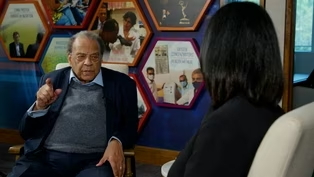
Amb. Andrew Young on his early rise through education
Clip: S17 Ep1 | 1m 53s | Even though he was advanced through school quickly, Amb. Young still remembered his father's advice. (1m 53s)
Providing Support for PBS.org
Learn Moreabout PBS online sponsorship New Season
- Drama

Hugh Bonneville stars in a crime drama inspired by one of the largest robberies in British history.
 New Episode
- News and Public Affairs

Top journalists deliver compelling original analysis of the hour's headlines.


 New Season
 New Episode




 New Episode
Support for PBS provided by:
The A List With Alison Lebovitz is a local public television program presented by WTCI PBS