Prairie Yard & Garden
Andy's Place
Season 36 Episode 10 | 28m 45sVideo has Closed Captions
Andy Kreuzer of Canby shares his gorgeous yard with host Mary Holm.
PY&G visits Andy Kreuzer of Canby and his gorgeous yard where he incorporates his love of history to create interest and implement different plant combinations.
Problems playing video? | Closed Captioning Feedback
Problems playing video? | Closed Captioning Feedback
Prairie Yard & Garden is a local public television program presented by Pioneer PBS
Production sponsorship is provided by Shalom Hill Farm, Heartland Motor Company, North Dakota State University, Friends of Prairie Yard & Garden, and viewers like you.
Support provided by:


Prairie Yard & Garden
Andy's Place
Season 36 Episode 10 | 28m 45sVideo has Closed Captions
PY&G visits Andy Kreuzer of Canby and his gorgeous yard where he incorporates his love of history to create interest and implement different plant combinations.
Problems playing video? | Closed Captioning Feedback
How to Watch Prairie Yard & Garden
Prairie Yard & Garden is available to stream on pbs.org and the free PBS App, available on iPhone, Apple TV, Android TV, Android smartphones, Amazon Fire TV, Amazon Fire Tablet, Roku, Samsung Smart TV, and Vizio.
Buy Now

Visit the Prairie Yard & Garden Website
Do you love gardening? Consider becoming a friend of Prairie Yard & Garden to support this show and receive gifts with your contribution. Visit the link below to do so or visit pioneer.org/donate.Providing Support for PBS.org
Learn Moreabout PBS online sponsorship(ethereal music) (upbeat music) - Last year, my friend Jody Olsen called to say, "Mary there's a yard here in Canby that you should have on 'Prairie Yard & Garden'."
Now, Jodi is a master gardener and has been growing plants for many years.
When she talks about a nice yard, I listen.
So a few weeks ago we took a road trip to Canby to check out that special yard.
I'm host Mary Holm, and come along with me as we all get to explore Andy's place.
- [Announcer] Funding for "Prairie Yard & Garden" is provided by Heartland Motor Company, providing service to Minnesota and the Dakotas for over 30 years in the heart of truck country, Heartland Motor Company, we have your best interest at heart; Farmer's Mutual Telephone Company and Federated Telephone Cooperative, proud to be powering acira, pioneers in bringing state-of-the-art technology to our rural communities; Mark and Margaret Yackel-Juleen in honor of Shalom Hill Farm, a nonprofit, rural education retreat center in a beautiful prairie setting near Wyndham, Minnesota; and by friends of "Prairie Yard & Garden", a community of supporters like you who engage in the long-term growth of the series.
To become a friend of "Prairie Yard & Garden", visit pioneer.org/pyg.
(upbeat music) - It is always so fun to visit people who enjoy plants.
Many of them are so knowledgeable about their flowers, perennials, trees, and shrubs.
And then there's Andy Kreuzer.
He is the first person to tell me he doesn't know what many of the plants are in his yard.
And yet, Andy has the natural talent artistic eye for design, ability to build things, and put them all together to have a beautiful place.
Thanks so much for letting us come to visit your place, Andy.
- Thank you, you're welcome.
I'm glad to have you here.
- Tell us about yourself and your background.
- 'Kay, I was born in Canby, I've lived here for 66 years.
I kinda enjoy building things, doing anything that comes into my mind.
I don't let much stop me.
I was tickled, about 41 years ago, to find this property at an abandoned cattle yard from the railroad, that when the railroad left town I was able to purchase this piece of property for very reasonable.
I built a house here 40 years ago and kinda changed it from an old cattle yard to our little piece of paradise that we enjoy, and hopefully can live here as long as possible.
- Andy, your house is very unique.
- When I came up the idea of building a house, I kinda wanted it to be fairly energy efficient.
So with this property, had a kind of an L-shaped hillside where I could back the house into and protect it from the north and western winds.
Most of the windows, and the garden, and the yard faces the south side.
So I actually get a lot of passive heat by the windows in the front of the house.
- You have a beautiful stained-glass window.
- I actually bought it from my wife.
She used to run an antique shop.
It kinda had a connection with the house.
They were gonna tear down a church in town that was built in 1884, and I hated to see all the lumber go to waste.
So I worked out a deal with the city of Canby to buy the church and take it down myself.
And I built my house with the lumber from this church, which was originally built in 1884.
- How or where have you gotten a lot of the plants that you've used here?
- Well, originally when I built, there was a nursery in town and I did get a lot of the shrubs and trees for some of it through the nursery.
Mainly I had hedges, shrubs, and evergreen plants.
I haven't really had hardly any flowers or regular plants other than, maybe, a few hostas the last five years or so.
This area, this state, has a lot of rocks and there were a lotta rocks by the creek that runs through our yard and from the railroad, and grading the the land to get it kinda suitable for a yard, we ran into lots and lots of rocks so they were easy to find.
My wife talked to me a few years ago how she'd like a flower garden.
I was more the manly thing where I planted shrubs and trees and bushes.
But I didn't really have any flowers, 'cause seemed like flowers were a lotta work and I wasn't too interested in that.
But few years ago, I was getting tired of mowing a corner in our yard because it was kind of a right angle, and hard to mow decent without tearing the lawn up.
So basically, most of this garden was planted in 2019 in late summer - And you've kinda got quite a slope here too.
So how did you handle that?
- I was actually happy, because we're built by the creek, so the house is kinda backed up and a little higher than the rest of the yard because of the flooding on the creek.
So I needed an elevation to change on that to protect us from the flooding, but it also kinda helps with the drainage and has worked out well for the garden, and... - What were some of the other things that you were taking into consideration when you were designing the landscape too?
'Cause you had mentioned, you know, it's so beautiful.
- Well, it just kinda grew organically.
I'd plant a few things here, a few things there, and if I didn't care for it I'd move it around.
But I kinda like to do things without over-planting them.
I tried working with what the yard wanted me to do with it and what felt like it fit in.
So it just basically was dragging a hose around for a few of the landscaping borders, and that.
Other than that, I just didn't want too many straight lines.
So everything's curvy and it's got a little flow to it, I hope.
- How do you keep up with all of the weeding and everything?
- Not very well, it's sitting still so I figure it's good stretching, exercise, and balance, and I don't mind too much getting out other than right above us is a huge silver maple with probably about 2 million seeds every (laughs) about this time of the year that make a challenge to get cleaned up.
And I think because of the dry year last year, the seeds were even worse this year.
I like being out in it now.
Now I'm retired and I have the time, so I'm not pushed so hard so it doesn't bother me.
I enjoy it, actually.
- [Mary] How do you keep up with the watering?
- I do have a sprinkler system, which I got in last year put in, and that has kinda cured it.
And the watering was a challenge when the plants were young the first year since I planted so late.
It was hard to keep them watered enough to keep them to survive.
And then the next year they were still a little tough, but now they're fairly established and it doesn't seem to be as much of a problem.
- [Mary] Would you be willing to kinda take a walk with me and show me some of the features that you've made here in the yard?
- Sure, I'd love to do that.
(calm guitar music) - [Mary] During the pandemic, camping and campfires made a glorious return, and we fell in love again with the outdoor experience of a cool night air, comfy chairs, and delicious food grilled over a roaring fire.
Of course, camping has always been a popular activity here in Minnesota, and many of us are always looking for new and delicious recipes to make for our families and friends.
And you don't need a full kitchen to make many easy and tasty meals when you're outdoors, with ingredients you can find at your local farmer's markets or local producers.
But this's a substitution-friendly recipe.
If you have some picky eaters or can't get some of the vegetables in the off season, go ahead and use spinach, green onion, or whatever you'd like.
Breakfast over a campfire is a great way to start your day, and a succulent veggie and chorizo breakfast hash is one simple meal you and your family can make together over your next campfire.
You may already have what you need with your camping equipment.
Cast iron skillet plate, spatula, and a cutting board and a knife.
For ingredients, it's super easy.
Three to four tablespoons of olive oil; one pound of Mexican chorizo; one medium onion, diced; one medium zucchini or yellow squash; one bell pepper, any color will do; one pound of frozen hash browns; and 1/2 a teaspoon of salt and a 1/4 teaspoon of pepper.
Just like at home, we need to get our skillet warm and oiled.
Then we brown the chorizo in the pan.
Make sure you stir it around to keep it from sticking.
When done, remove from the skillet and place onto a plate until later.
Next we add our onions, and saute them lightly for about five minutes in the juice of the chorizo and the olive oil.
Those flavors go together so nicely!
Add the peppers, zucchini, salt and pepper to the pan and saute until softened.
Move the vegetables to the outer edges of the skillet and add one to two tablespoons of olive oil to the center of the pan.
Then add hash browns, stirring lightly just to combine with veggies and cook without stirring until the underside begins to brown.
Divide the mixture in four sections with a spatula and flip each section to the other side.
Mix in the chorizo to the pan, and stir into the vegetable and hash mixture lightly until combined, and remove from the campfire.
You can top each portion to your liking by adding fresh diced tomatoes, avocado slices, minced green onion, or cilantro.
You can even top it off with an egg or two any way you like it.
This's just a lovely dish, and to minimize your work at camp you can prep a lot of these ingredients at home and bring them in your cooler for the most delicious ingredients around.
Find yours locally by going to minnesotagrown.com.
(upbeat guitar music continues) - I was looking for a couple lights to light up the pathway and I couldn't find anything that I really cared for, and I had a idea in my mind what I wanted.
So I actually just took some cedar 4x4 and 2x4s and pieces and threw together a light out of that and wired it up with 12-volt yard lights.
And turned out pretty much what I wanted.
I'm very happy with that.
- Well, I noticed that you've got some beautiful lamium around your trees.
How did you get started with those?
- I got those from the farm store with a bunch of other plants and planted them in an area by a tree, and they kinda took over it.
They completely pushed everything out and I was having a hard time growing anything under maple tree and an ash tree.
So I kinda moved that around, and it took over and it made a beautiful ground cover for the tree.
- I see that you have a lot of old things.
Did these come from your wife at her antique store?
- No, those are items that the wife kinda complains to me about.
(Mary laughs) I tend to find stuff in the creek that runs through our yard and back, and things that're buried in the mud and by the railroad track.
And I tend to haul them home and throw them out in our garden as a little garden decor.
Some of these things that I've hauled home are part of an old mill wheel that I found back in the crick area, an old axle for probably, like, a mining cart for working on building the railroad, fire brick from a steam engine, axle from a wagon, and...
But I just keep finding odds and ends down in the crick that get washed out and opened up and I haul them home.
And my wife's not too excited about all that.
It's starting to get to be a lotta stuff that I'm bringing back in, but I kinda like the old history that belongs to these items.
And, you know, it's part of our lot with the railroad running through it, and with this lot being a cattle yard that was started in 1879.
- I even see that you have used a bed, or part of a bed, for an arbor or a trellis.
- Yes, that came in quite handy for a trellis.
We actually have a matching one in another spot here in the yard, too, for vines to grow on.
But it's handy and it's cheap.
That's kinda my favorite things.
(Mary chuckles) - And then, did you build the gazebo out here too?
- Yes, I built that gazebo probably 12, 15 years ago.
Originally, we had a gazebo built outta willow branches, kind of a twig structure that was kinda unique, in almost that size, that one of the local artisans built for us.
And I kinda plunked it there because that's a low spot in the yard, and always collected water and the grass didn't grow.
So that's how that ended up being placed there, is just because it was a lousy spot for the yard.
On our headboard and gazebo, we've planted some clematis, which kinda gives a real colorful pop, just like, things climbing up and giving a little height to the garden.
- [Mary] And I know that you've dropped more honeysuckle on there too, I bet you that actually grows pretty quickly to cover that.
- Yes, that honeysuckle, I kinda have to trim back every now and then.
But hummingbirds really enjoy it and it does give a little shade on the south side of the gazebo to keep the gazebo a little cooler.
- [Mary] You've got beautiful planters scattered around by your yard.
Do you do those?
- Both my wife and I throw a few things in the planters and try to get them out just to spice up the corners of the deck and the room, and give a little more color to the area by the house.
- What're some of your favorite plants here in the yard?
- I enjoy the lilies when they kinda explode this time of the year.
Hostas are nice because they don't take a lotta work, and they're so colorful all through the year.
Just plant what I like, and if it works it stays there.
If it doesn't, I try to move it around somewhere where it will survive better.
But I'm learning.
- Well, when I was here before, you mentioned that you actually have a bleeding heart too, and you had quite an experience (Andy chuckles) with that, tell us about it.
- The bleeding heart planted, I think, two or three years ago and that moved along kinda slowly.
But because of the way the spring was, the wet spring, they both exploded and got to be, maybe, six feet around.
And they were beautiful, but they just took over an area of the garden that I wasn't planning on.
So I went out and started trimming the bleeding heart down and I found that I started breaking out within a day or two.
I tend to react to poison ivy and wild parsnips real bad.
And I did the exact same thing with the bleeding heart, which I never knew that caused that.
But I'm a lot more careful now if I have to trim those up.
- (chuckles) Do you divide and move some of your plants around too?
- Yeah, because I'm so inexperienced I tend to plant things a little too close, and then I have spots that I wanna fill in.
So I do change my mind a lot to move things around and try to fill it out, and I'm trying to learn to use the height of the plant and that, and get that balanced out a little better.
So it keeps getting better every year.
- (chuckles) Well, it sure looks good to me right now.
(jazzy music) - I have a question.
What're some of the new apple varieties that the U of M Arboretum has been working on?
- We actually have been in business here at the university, breeding apples for this cold climate for 115 years.
And during that time, we've developed about 28 varieties that're suited to this climate.
Now, some of the older ones you may not know so well, but there is one old one that I think most Minnesotans do know and love, and that's the Haralson apple.
And that we introduced in 1922.
Probably many more people know our newer ones.
The Honeycrisp is very well known in Minnesota, and in fact, around the world.
But we do have the newest one than I can tell you about now, and we've just introduced that just recently.
And that's the Triumph apple.
And Triumph is bred and introduced because of its resistance to apple scab.
So we like to say it's a triumph over apple scab.
And apple scab is the most common fungal disease that we see on apples.
And in fact, for most home orchardists, if you're not spraying your apples you probably will get a little bit of scab on them.
So keep an eye out for that, we're quite proud of that.
We also have dozens more in the pipeline.
So we've got another one that's gonna be coming probably four years behind Triumph.
But we've got the best of intentions and hopes for that one.
And we'll keep you posted when the time is right.
- [Announcer] "Ask the Arboretum Experts" has been brought to you by the Minnesota Landscape Arboretum in Chaska, dedicated to welcoming, informing, and inspiring all through outstanding displays, protected natural areas, horticultural research, and education.
(jazzy music continues) - Andy, as we walked here I saw this beautiful brick behind me.
Where did that come from?
- I picked it up from a house that was being tore down, well, a block or two from here.
Probably chimney brick from the house.
But would've loved to have more of it but I couldn't come up with anymore, so I had to go to a store-bought brick for a lot of my walkways.
- [Mary] Well, but it blends in really nice, and it matches quite nicely.
- Yeah, it does have some of the character of the other, but I would prefer the old brick.
But I use what I can find.
(chuckles) - Tell me about this.
This is very unique, how you have made that.
- I didn't cherish the thought of doing a lot of weed whacking to keep the edges of the little retaining wall, there, kept up.
So I kinda came up with a different idea to make the edge so I could bring my mower up on it and do it without having to try to edge around the retaining block.
And it seems to have worked out pretty well for me.
- [Mary] Do you have trouble with critters here in the yard?
- Oh yeah, we have lots of critters.
(laughs) We like to feed the birds and the stray cats.
So we always have a lot of raccoons, which I don't tend to care much for, but try to put up with them.
And we have deer.
In fact, this morning, I have a squirrel feeder where I dump corn out in the morning for the squirrel, and the deer comes around at about seven o'clock when I go out to feed them.
And the deer was getting kinda mad and coming up right next to our house eating the plants because it wanted the corn out there.
(chuckles) - (gasping) Oh!
- But we've got deer, we've got mink, we've got wood ducks and buffalo-head ducks.
And we've normally got a family of geese that live in the yard in the spring and have their young in the yard.
And we have anywhere from two to 15 deer come through the yard, depending on how the winter is, and that.
But basically, we see deer every day in our yard.
- What do you do to try to discourage the raccoons from getting into your feed?
- They'd climb up the poles that held my bird seed.
So I wrapped the poles of the bird feeder in barbed wire and that still wasn't enough.
I could watch the raccoon climb up there very carefully, but he'd get up to the bird seed.
So now I just take it in at night, it's a lot easier.
(Mary chuckles) - Well, I notice that you also have a split-rail fence.
Is that to help keep the critters out at all, or is it mostly for looks?
- It's mostly for looks, and a little definition between the maintained yard and a area that isn't maintained much at all and just gives us some separation.
- I see this path goes out into the out part of the yard.
What're some of the features that you have out there too?
- Oh, we've kinda taken a path and taken it down to the creek that runs through our yard.
And then I built a small bridge to go across the creek, and usually like to hike on the other side of our yard.
There's a meadow and woods back in there.
And that's kinda where the deer stay in it.
It's just a nice walk in the wintertime.
- How did you build the bridge?
Did you build it in place or did you build it on this side and then lift it into place, or how?
- Bridge kinda came about because I had a bunch of treated lumber.
We were switching from treated 2x6s on our deck to a composite deck.
So I had a lot of pieces of treated 2x6, and I built a couple heavy-duty arches outta the lumber, and then I carried the trusses out there and built the bridge in place on the crick.
- [Mary] You've got a little landing, too, so that you can actually go canoeing, don't you?
- Yeah, we did put a little dock in.
A lot of kids like to fish off the bridge and fish off the dock, and it's one of the deeper parts of the creek.
It's probably three to four feet deep by the bridge and the dock, and... - [Mary] And did you build a patio out there over the crick too?
- Yeah, I was looking for something different to do, and we always enjoyed the water flowing over a little dam that's on the creek, there.
So few years ago I built a patio that shoots out over over the creek, or is above the creek.
- There, again, did you build that first and then set it into place?
Or did you actually get down into the creek and then build it right there?
- Well, the bridge, I had to get down into the creek.
Or actually built a temporary bridge to build the bridge with some planking, and that.
But the deck is actually not on the creek or over the creek.
It's kinda built into the railroad abutment or hillside, and it just shoots out from the high part of the railroad.
So you kinda feel like you're over the creek but you're not actually over the creek.
(Mary laughs) - So what's your next project, or what're you working on now?
- My lilies are kinda getting overgrown, so I wanna split them up.
And there're some areas out in the old part of the graveyard, planting beds, that have been left to go to grass that I'd like like to clean up, and get some lilies and maybe some hostas in there.
Along the creek bed (upbeat music) here by the bridge and by our deck, and basically all around, the buckthorn was starting to take over everything else.
And once it started showing up in the yard it kinda was war on with buckthorn for me.
And last year I took out many a load of buckthorn along the creek, and I know I'm gonna be battling that for year after year.
But at least I've got it back to where I can kinda control it, and hopefully get the upper hand on it.
- Well, thank you so much for letting us come, because your place is just beautiful.
- Well thank you, it's been a pleasure.
(upbeat music continues) - [Announcer] Funding for "Prairie & and Garden" is provided by Heartland Motor Company, providing service to Minnesota and the Dakotas for over 30 years in the heart of truck country, Heartland Motor Company, we have your best interest at heart; Farmer's Mutual Telephone Company and Federated Telephone Cooperative, proud to be powering acira, pioneers in bringing state-of-the-art technology to our rural communities; Mark and Margaret Yackel-Juleen in honor of Shalom Hill Farm, a nonprofit rural education retreat center in a beautiful prairie setting near Wyndham, Minnesota; and by friends of "Prairie Yard & Garden", a community of supporters like you who engage in the long-term growth of the series.
To become a friend of "Prairie Yard & Garden", visit pioneer.org/pyg.
(upbeat relaxing music)
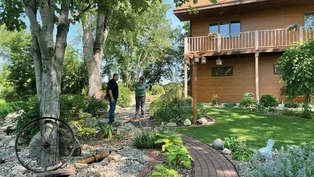
Preview: S36 Ep10 | 29s | Andy Kreuzer of Canby shares his gorgeous yard with host Mary Holm. (29s)
Providing Support for PBS.org
Learn Moreabout PBS online sponsorship

- Home and How To

Hit the road in a classic car for a tour through Great Britain with two antiques experts.












Support for PBS provided by:
Prairie Yard & Garden is a local public television program presented by Pioneer PBS
Production sponsorship is provided by Shalom Hill Farm, Heartland Motor Company, North Dakota State University, Friends of Prairie Yard & Garden, and viewers like you.