
Angkor: Hidden Jungle Empire
Season 53 Episode 2 | 53m 39sVideo has Audio Description
New evidence sheds light on the remarkable life—and mysterious collapse—of the ancient jungle city.
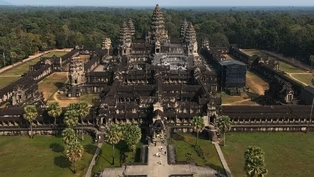
Deep in the Cambodian jungle lie the ruins of Angkor, a marvel of urban engineering and seat of the once-mighty Khmer Empire. New discoveries are revealing how this ancient metropolis was built – and what likely led to its devastating collapse.
See all videos with Audio DescriptionADProblems playing video? | Closed Captioning Feedback
Problems playing video? | Closed Captioning Feedback
National Corporate funding for NOVA is provided by Carlisle Companies and Viking Cruises. Major funding for NOVA is provided by the NOVA Science Trust and PBS viewers.
Support provided by:


Angkor: Hidden Jungle Empire
Season 53 Episode 2 | 53m 39sVideo has Audio Description
Deep in the Cambodian jungle lie the ruins of Angkor, a marvel of urban engineering and seat of the once-mighty Khmer Empire. New discoveries are revealing how this ancient metropolis was built – and what likely led to its devastating collapse.
See all videos with Audio DescriptionADProblems playing video? | Closed Captioning Feedback
How to Watch NOVA
NOVA is available to stream on pbs.org and the free PBS App, available on iPhone, Apple TV, Android TV, Android smartphones, Amazon Fire TV, Amazon Fire Tablet, Roku, Samsung Smart TV, and Vizio.
Buy Now

NOVA Labs
NOVA Labs is a free digital platform that engages teens and lifelong learners in games and interactives that foster authentic scientific exploration. Participants take part in real-world investigations by visualizing, analyzing, and playing with the same data that scientists use.Providing Support for PBS.org
Learn Moreabout PBS online sponsorship♪ ♪ NARRATOR: An iconic temple, the largest religious monument in the world, Angkor Wat is an enduring enigma.
SARAH KLASSEN: The engineering feat of Angkor Wat is unbelievable.
NARRATOR: In the heart of one of the greatest ancient cities ever built: Angkor.
ALISON CARTER: One of the largest, if not the largest, city in the world at the time.
NARRATOR: Home to over 1,000 temples.
KLASSEN: Each new king would try to outbuild the reign before and build a bigger and more impressive temple.
NARRATOR: But then, the temples and the city were engulfed by the jungle.
DAN PENNY: It mysteriously was abandoned.
Well, so the story goes.
NARRATOR: There are few clues... ANDREW HARRIS: Almost every wooden remain-- and the vast majority of structures at Angkor were built in wood-- deteriorate very, very quickly.
NARRATOR: ...and many mysteries.
PENNY: The lack of bodies.
One million people, not a bone, not a cremated remain.
It's fascinating and frustrating.
There's another story there, sitting underneath.
NARRATOR: Now archaeologists are using the latest technologies to reveal Angkor's hidden secrets... CARTER: Sarah took the lidar data.
She used some machine-learning algorithms.
NARRATOR: ...to see through the jungle... KLASSEN: The lidar data is absolutely mind-blowing.
It was all an engineered landscape.
NARRATOR: ...and look into the past... Really, like the pages of a history book.
NARRATOR: ...to find new evidence of a great civilization.
CARTER: They didn't just build Angkor Wat, which is a spectacular temple, right?
Like, they were transforming the entire landscape.
NARRATOR: "Angkor: Hidden Jungle Empire," right now, on "NOVA."
♪ ♪ ♪ ♪ NARRATOR: In the jungles of Cambodia, a spectacular ruin rises from the trees.
This is Angkor Wat.
A 900-year-old temple, filled with intricate carvings and mysterious figures.
It is the largest religious monument in the world and a masterpiece of ancient engineering.
KLASSEN: The engineering feat of Angkor Wat is unbelievable.
It's amazing.
NARRATOR: Angkor Wat is the centerpiece of the ancient city of Angkor, a marvel of vast infrastructure, built with a network of human-made canals and enormous reservoirs.
Angkor was the heart of a wealthy and dynamic empire that thrived for 600 years.
Then, around 1300, suddenly, the building stopped.
This vast, ornate city was largely abandoned.
Why?
Archaeologists like Piphal Heng are trying to answer that question and to understand the people of Angkor.
HENG: Monumental architecture like Angkor Wat has been its signature.
When you talk about Angkor, it's monuments.
Part of my archaeological endeavor is to understand Angkorians people's life.
What did they do?
What was the relationship between the people and the city, the relationship between the people and the temple?
And how did that change through time?
♪ ♪ NARRATOR: The ancient city of Angkor was one of the biggest pre-industrial cities in the world.
Located in Cambodia, in Southeast Asia, its legendary temple, Angkor Wat, is its most iconic structure.
But Angkor Wat is the largest of more than a thousand temples spread across more than 150 square miles.
A lot of these temples have really been left to the jungle.
So trees are overgrowing them.
The vegetation is everywhere.
And when you walk into them, you sometimes feel like you're the first person that's stepped foot in them for over a thousand years.
The temples themselves have a sense of mystery to them.
You don't know exactly what happened here or why they were abandoned.
NARRATOR: This land has been home to the Khmer people for thousands of years, living in small kingdoms often in conflict with each other, until the year 802, when Jayavarman II defeated his rivals and declared himself a god-king in the Hindu tradition, and founded the Khmer Empire.
Nearly 100 years later, the capital of the empire was moved to a new site on a fertile plain-- the city of Ankgor.
Over the next 500 years, the empire became the dominant power in Southeast Asia, ruling over all of what is now Cambodia and much of Vietnam, Thailand, and Laos.
The kings, who were considered holy, ruled both political and spiritual life.
Each successive ruler strove to demonstrate his greatness through major construction projects.
KLASSEN: Each new king and each new reign would try to outbuild the reign before and build a bigger and more impressive temple.
NARRATOR: As Angkor grew, so did the temples, in number and size, until the 1300s, when temple construction abruptly stopped.
Evidence suggests that by the mid-1400s, Angkor stood empty.
PENNY: It mysteriously was abandoned.
Well, so the story goes.
And so this place has attracted the fascination of people from around the world for many, many hundreds of years.
Partly because the city itself is so prodigiously massive, and partly because all of this was apparently left to the jungle by the Khmer.
NARRATOR: The abandonment of Angkor is an enduring mystery.
Who were the people who lived here?
And why did they leave?
The answers are important, not just for the archaeologists who are excavating here.
Many Cambodians identify as Khmer and are deeply invested in this ancient place.
Angkor is central to their heritage, connecting them to their ancestors.
(translated): Angkor holds a profound place in Khmer life.
The very word "Angkor" is deeply rooted in our national identity.
HANG PEOU: Angkor, we can say, for the Khmer people, it's our soul.
Every one of the Khmer people say that.
"We want to see Angkor before we die."
NARRATOR: But the full truth about Angkor and its people has been elusive, because so much of the city has long lain hidden beneath the jungle canopy.
HENG: We only know of Angkor Wat, this one-square-kilometer temple, as being a religious temple, a sacred space.
But were there any people living inside Angkor?
We did not know yet.
We also tried to map the area, and the vegetation was too thick, was overgrown.
KLASSEN: It's incredibly difficult for archaeologists to map the center of Angkor, where all the large temples are, because of all the dense vegetation.
NARRATOR: But now, with the help of new technology, archaeologists are trying to see what has been invisible for centuries.
That's where the lidar data comes in.
NARRATOR: Lidar is a powerful laser technology that has recently become a game changer for archaeologists.
KLASSEN: Lidar has been absolutely revolutionary for our field of archaeology, because it allows us to see the ground floor underneath dense vegetation.
We acquire lidar data by putting a drone or a helicopter or a plane in the air with the lidar device on it.
These devices send out millions of pulses of light.
Most of those pulses bounce off things that we're not interested in, like buildings or trees, but some of them, critically, reach the ground surface.
What we do is, we measure the time that it takes for those ground returns to return to the lidar device, and, using those measurements, calculate distance.
With that information, we can then strip away all the vegetation so we can clearly see these archaeological features.
NARRATOR: The lidar scans revealed the breathtaking size of the city.
KLASSEN: The data was spectacular.
All of a sudden, we could see these elements of the urban space that were completely invisible before.
The lidar data is like the most amazing treasure map, not because we're looking for gold or statues, but because it allows us to ask bigger and better questions about what it was like to live at Angkor.
The amount of detail that the lidar revealed about the landscape is absolutely mind-blowing.
We were able to map an additional 20,000 features.
NARRATOR: The full scale of the city of Angkor is staggering, covering more than 150 square miles, about the size of Denver.
Hundreds of miles of roads and a complex network of waterways and canals connected the city.
Hidden in the data were the keys to knowing how and where the citizens of Angkor lived.
KLASSEN: Because Angkor is built on a floodplain, all of the features were built on mounds.
So when we're looking at the lidar data, we're not seeing ancient houses themselves, but we're seeing the mounds these houses were once built on.
This is Angkor Wat, which is absolutely beautiful in the lidar data.
So these are depressions and elevations in the land that we can very clearly see in this lidar imagery.
But it's almost impossible to see these features on the ground because the vegetation is just so dense.
All of these black dots are house ponds, and beside them are usually house mounds.
NARRATOR: Within the Angkor Wat temple enclosure itself, the lidar revealed more than 200 of these mounds.
Using the lidar maps as a guide, Piphal Heng set out to investigate these sites on the ground.
Those mounds are generally habitation site.
When we saw a similar pattern inside the Angkor Wat enclosure, we started to excavate those mounds.
Turned out that those mound have residential debris: ceramics, Angkorian stonewares, and trade ware from China.
So what we didn't know was, those mound and ponds were arranged into a grid system.
That's when lidar came around.
So here we are in the eastern section of the Angkor Wat enclosure.
What I am standing on now, what had been a house mound, and because of the overgrowth, we can hardly tell the topography change.
But lidar map allow us to pick up just a slight topographic change that allow us to identify whether this area was a mound, a pond to my right.
The lidar data shows that we are standing in an urban block that is replicated into other urban blocks covering the entire Angkor Wat enclosure.
CARTER: You can tell when you're walking around that there's mounds there.
It's really forested, but you can see that the landscape undulates quite a bit.
NARRATOR: Archaeologist Alison Carter has been collaborating with Piphal to try to decipher what life was like at the Angkor Wat complex.
CARTER: The lidar in Angkor was incredibly eye-opening, because you just see that they didn't just build Angkor Wat, which is a spectacular temple, right?
Like, they were transforming the entire landscape.
NARRATOR: And transforming it with extreme precision.
HENG: If you look at the temple structures and align them with the gates of Angkor Wat, you would see that the grid system was actually aligned with the temple.
It was all an engineered landscape.
NARRATOR: The remarkable urban design of the Khmer extended to the even larger royal complex, Angkor Thom.
You can see, this is Angkor Wat.
There's a huge moat that's very visible from the satellite imagery.
And then up here is Angkor Thom.
And you can see the moat of Angkor Thom.
But you really can't see all of that detail that becomes so clear and obvious in the lidar data.
So you can just imagine, when you enter Angkor Thom through these magnificent gates, it would have been a bustling city on either side of you.
NARRATOR: Again and again, the lidar revealed sprawling neighborhoods around Angkor's more than 1,000 temples.
Combining this with the finds from excavations on the ground and new technologies, a team of archaeologists is finally able to crack one of the city's biggest mysteries: the size of Angkor's population at its peak around 1250.
To answer that question of how many people lived at Angkor, we compiled all of the data that we had-- C14 dates, ceramic evidence from excavation, and we used some new, cutting-edge algorithms and machine-learning techniques to try to model the development of the city over time.
CARTER: I was part of a group of people that were working on trying to understand the growth of the city of Angkor.
If you compare, this one is better.
CARTER: That one's better, it's a much bigger piece.
Yeah, so that'll be great to collect from this mound.
(chuckles) CARTER: That's a really good example of how we can bring in good, old-fashioned, on-the-ground dirt archaeology with all of these new technologies.
From our excavations, it seems like there's just one household or family per mound.
We use ethnographic data, then, to estimate that there's about five people in a family.
KLASSEN: Another important piece of data was from inscriptions.
A lot of the temples have foundation dates.
And that was really important to understand when they were built.
NARRATOR: And inscriptions in two of the larger temples provide crucial clues about the population, which are of special interest to archaeologist Andrew Harris.
HARRIS: They actually list the numbers of temple staff.
These include government officials, dancers, laborers, and also, how many people that the temple staff oversaw in the surrounding villages, numbering between 200,000 and 300,000 for both temples.
And then Sarah took that data, the lidar data, she used some machine-learning algorithms.
We brought this all together to try and create a model for how Angkor grew.
NARRATOR: The final estimate from their calculations was staggering.
CARTER: From our estimates, we think, at its height, that it had about 700,000 to 900,000 people living in the greater Angkor region.
That would have made it one of the largest, if not the largest, city in the world at the time.
NARRATOR: The discovery of Angkor's true size was a major breakthrough, but it was all the more impressive because of Angkor's location.
Because the entire city was built on a water-soaked floodplain.
Every year, the rainy season brings massive rainfall and heavy flooding.
My family's connection with Angkor runs deep.
During my childhood, my grandparents and my parents frequent the pagoda in Angkor.
So I've been coming to Angkor since... Yeah, for forever.
Growing up here provide a different perspective on the water.
We have the Great Lake to the south.
The lake level change drastically during the rainy season, particularly around October and November.
NARRATOR: The great Tonlé Sap lake often quadruples in size in the rainy season, flooding vast areas of the countryside.
In the dry season, nearly half the year, almost no rain falls.
Why would the Khmer build in a place with such extreme swings between flooding and droughts?
Water is incredibly important for the Khmer Empire.
Almost everything revolves around it.
NARRATOR: And one of the most important functions was irrigating the main agricultural crop of the empire: rice.
KLASSEN: The economy of Angkor was underpinned by rice agriculture, which is heavily dependent on a stable supply of water.
There's a strong relationship between water, the floodplain, wet rice agriculture, and the early phase of Angkor period.
NARRATOR: As the Khmer Empire and city expanded, controlling the flow of water was key for their economy, trade, and ability to feed a growing population.
But how did they do it?
Visible remnants suggested there had once been a complex water system.
But it took lidar to reveal the full scope of the Khmer engineering.
KLASSEN: So, with the lidar, we were able to create this map, which very clearly shows the layout of the water management system and how water flows into the city, through the city, and then, how there are exit channels to remove excess water.
NARRATOR: The design was both ambitious and ingenious.
A series of massive reservoirs called barays collected water in the rainy season.
KLASSEN: So here at Angkor, we can see the large barays.
Here's the West and East Baray, and then all of these straight lines funneling into the city, these are manmade water channels.
So this is rerouting water from northern areas of Cambodia into Angkor.
♪ ♪ PENNY: The water was captured from natural rivers and moved into storage in these massive reservoirs.
Those barays were really the centerpiece of the whole system.
NARRATOR: The largest baray stretched across more than six square miles.
KLASSEN: All of these features are so big that you can literally see them from space.
HENG: That's the beginning of Angkor's power-- water management.
PENNY: Those reservoirs are fantastically important.
They hold huge volumes of water, which can be distributed in the dry season, if you want a second crop of rice, for example.
So it really kind of super-boosts your productivity in those parts of Angkor which are downstream of those reservoirs.
NARRATOR: And the system extended far beyond the city itself.
KLASSEN: The landscape around Angkor is actually at a slight incline, about one percent, so the East and West Barays can catch water as it comes into the city, hold it, and then redistribute it through the different channels.
NARRATOR: Taming the water was a major feat of urban engineering, with hundreds of miles of canals and reservoirs, all dug by hand.
But the floodplain also created a major challenge for an empire intent on creating monumental architecture.
KLASSEN: It's a bit of a difficult spot for building heavy temples like Angkor.
So in order to do this, they had some really ingenious engineering strategies.
NARRATOR: How did the Khmer manage to build massive stone structures on soft, deep soil surrounded by water?
The first clue may be in the choice of building material.
Hang Peou is the head of APSARA, the organization in charge of restoring the city of Angkor and the surrounding area.
The priority of APSARA, it's about the conservation, how we can preserve the temple without falling.
Before we start to make the restoration, we need to do research.
NARRATOR: The highly decorated walls of Angkor's temples are built of fine-grained sandstone, well-suited for intricate carvings.
But appearances can be deceiving.
Just under the ornate façade lies the first secret of Khmer construction.
Hidden within the walls and foundation are blocks of a rough, porous stone called laterite that can be even lighter than sandstone.
HANG: In term of the weight, it's less heavy.
The core inside they build in the laterite, and then they put the limestone around for decoration.
The whole temple's built in that concept.
♪ ♪ NARRATOR: Using the lighter laterite greatly reduced the load on the soft ground.
But the stone temples are still incredibly heavy.
The stone that forms Angkor Wat, towering over 200 feet high, weighs millions of tons.
And yet, it has survived the wet terrain for over 900 years.
There must be more to the engineering.
But what?
Archaeologist Neth Simon leads restoration teams for APSARA.
Her excavations are focused on understanding the key elements of ancient Khmer engineering.
(translated): As a result of the excavation to see the condition of the foundation, I was able to understand the ancient techniques in building the temple.
We observed that before shaping the temple itself, the ancient builders began by digging down to reach the natural soil.
They then began compacting the soil inside.
(speaking Khmer) (translated): The next step involved filling the foundation with fine, pink sand.
This was followed by the laterite foundation.
Above it, they laid the base layer using sandstone.
NARRATOR: As any trip to the beach reveals, dry sand is soft and shifts easily, while wet sand, closer to the water, holds firm.
Water and sand together can create a solid base for construction.
This could be one reason the temples at Angkor were surrounded by moats.
KLASSEN: Another thing that we can see is that all of these temples have water features around them, so each temple, which is marked in red, they tend to have moats around them.
HANG: They built on the sand layer, and we understand that the sand layers need a lot of the humidity to make it stronger to support the load of the temple.
NARRATOR: The moats were, and still are, key to maintaining the required level of moisture beneath the biggest buildings.
KLASSEN: The water in the moats provides stability to the sand, which allows them to hold the heavy, heavy stone structures up.
NARRATOR: These innovations demonstrate that the Khmer were masters of hydraulic engineering.
As do the hidden features that enabled Angkor's massive reservoirs, the barays, to function.
Cambodian archaeologist An Sopheap and his team are excavating a unique location on the edge of the Eastern Baray, an ancient reservoir long dry and now covered in jungle.
(An speaking Khmer) (translated): Right in front of me is the East Baray, a water reservoir from the Angkor era.
NARRATOR: These are the ruins of an ornate stone pier overlooking the baray.
The Cambodian government hopes to restore the pier and partially repair the reservoir to make it functional once more.
The first step is to understand how both were constructed.
But while excavating the pier and the reservoir wall, they found an unexpected surprise.
AN (translated): At the excavation site I opened here, we found the foundation of the pier, made from laterite rock.
NARRATOR: Hidden beneath the wall of the baray is a laterite stone foundation extending more than 50 feet out into the reservoir.
(An speaking Khmer) (translated): This work is important because it reveals a new discovery.
We had never seen a construction with laterite sloping like this before.
NARRATOR: The next step is to determine if this massive foundation extends along the banks of the reservoir, beyond the area of the pier.
(An speaking Khmer) (translated): We opened another excavation site ten meters to the south and saw the structure continues with four more steps.
But we only exposed a small section to confirm.
In the future, we'll keep excavating to see if the laterite structure surrounds the water reservoir or ends somewhere.
NARRATOR: No one knows yet how far this stone foundation extends around the baray.
(translated): If this structure goes around the reservoir or part of it, it would be a new discovery for the Angkor area.
NARRATOR: The pier itself was a very special structure for Angkor's Hindu god-kings.
(speaking Khmer) (translated): This pier was used by the king to offer alms at the temple located at the center of the eastern reservoir.
NARRATOR: In the middle of each reservoir was an island temple.
The barays were more than just a brilliant piece of hydraulic engineering.
Here's the East Baray.
And you can clearly see both in the mapping and in the lidar data that there's a huge temple in the middle of it.
These large reservoirs were both functional and spiritual.
The kings of the Khmer Empire played both a political and a religious role.
In addition to being head of the army, the king was also a king-god, so head of the religious system, as well.
HARRIS: Every king left an imprint of himself if he was powerful enough to create a mark on the landscape.
Dozens of temples here are reflective of the absolute power over nature, over people, and over the landscape that they manifested during their reign.
NARRATOR: Over the centuries, rulers built larger and larger temples as the Khmer Empire expanded.
Early in his reign, in the 1100s, King Suryavarman II outdid all of his predecessors, building Angkor Wat.
KLASSEN: Angkor Wat was a huge project.
It would involve so many workers and so many craftsmen to be able to build it.
NARRATOR: Dedicated to the Hindu god Vishnu, nearly every surface of Angkor Wat was highly decorated.
Traces of paint found on the carved walls and ceilings hint at its ornate history.
HARRIS: All of the reliefs on the temples were originally painted in vibrant colors.
NARRATOR: Immense carved panels with scenes from Hindu texts run down vast hallways.
Thousands of priests, dancers, and attendants filled the temple and its grounds.
It was a ceremonial center on a grand scale, demonstrating the glory of Vishnu and the power of the king.
CARTER: Temples were not just places of worship.
The kings were also using them to demonstrate their power.
So they probably were really acting as this kind of billboard for the king and the king's power and putting his stamp on the landscape.
NARRATOR: Wealthy and prosperous, the Khmer Empire was an attractive target for neighboring powers.
Carved scenes at Angkor illustrate the story of one major conflict.
In 1177, the nearby kingdom of Cham invaded Angkor in a surprise attack.
To reclaim the city and restore power to the empire would take one of the strongest of the Khmer kings, Jayavarman VII.
HARRIS: In the year 1177, the Chams conquered Angkor and occupied Angkor.
Jayavarman VII made it his vow to reconquer Angkor.
And part of this is depicted through various campaigns of warfare.
This is probably the most elaborate of those campaigns, and it involves a naval battle.
What we can tell here is that one, it was intensive.
It was violent.
You could see the people falling overboard.
Most of them have been stabbed or dead or whatnot.
And a lovely crocodile eating a poor Cham who's fallen overboard.
So, through a series of campaigns lasting several years, he was able to eventually vanquish the Chams.
♪ ♪ NARRATOR: With the enemy defeated and the Khmer back in power, Jayavarman VII would usher in Angkor's golden age.
KLASSEN: During his reign, he gave back to the public in many ways.
He constructed hospitals and he built a number of different temples.
HARRIS: This is a scene of a hospital.
Here you have women giving birth, making medicine.
This was a major point during the reign of Jayavarman VII.
He built, I believe, 102 hospitals across the Angkorian empire.
NARRATOR: Alongside his support of public health, Jayavarman carried on the tradition of his Khmer predecessors-- monumental construction.
KLASSEN: When kings came into power, they all had specific mandates that they had to accomplish.
And a lot of this revolved around temple building.
Angkorian kings had a undocumented habit of trying to one-up their predecessors.
If you think about Suryavarman II, he built the world's largest religious monument, Angkor Wat.
Jayavarman VII left the largest architectural footprint on the Angkorian landscape of any monarch in Cambodian history.
NARRATOR: The pinnacle of his reign was the construction of Angkor Thom, an enormous complex more than five times the size of Angkor Wat.
It is surrounded by eight miles of moat, and at its center stands a temple different from any built before or after-- the Bayon.
The Bayon is not a Hindu temple-- Jayavarman was a Buddhist.
HARRIS: All of the elite temples up until the reign of Jayavarman VII were considered to be Hindu temples of various deities.
KLASSEN: One of the most interesting things about King Jayavarman VII is that he switched the state religion from Hinduism to Buddhism.
NARRATOR: Hindu worship involves a pantheon of gods and observation of rituals set out in the Vedic scriptures, while Buddhism focuses on enlightenment through the teachings of the Buddha.
The Bayon temple towers feature 216 enigmatic faces that may contain a hidden secret.
HARRIS: The faces on the Bayon and the gate are potentially a Buddhist saint or they're the king himself.
And the reason we think it's Jayavarman VII himself is because a number of the images that we know of Jayavarman VII look almost identical to the face towers on the Bayon and on the gates.
NARRATOR: Following the reign of Jayavarman VII, ending around 1218, Angkor was at the height of its size and influence.
What was life in Angkor like at its peak?
Few written descriptions have survived from the Khmer, but historians have one detailed account.
In the 13th century, the emperor of China sent an emissary to Angkor.
HENG: Zhou Daguan was ambassador of Mongolian-controlled China to Cambodia.
He lived in Angkor sometimes between 1296 and 1297, almost one year.
KLASSEN: Zhou Daguan left us a journal, and it's incredibly valuable in terms of the types of details that he wrote about.
I'm not sure if he intended for archaeologists to read this, but it sure provides a lot of information.
ZHOU (dramatized): Around the outside of the city walls, there is a large moat.
The walls of the bridges are made of stone and carved into the shape of snakes.
As an archaeologist, I refer to Zhou Daguan constantly.
He talks about how poor people lived in smaller houses, and their roofs were made out of thatch, but richer people would have bigger houses and their roofs would be made with ceramic roof tiles.
NARRATOR: Zhou Daguan's journal described scenes of everyday life.
ZHOU (dramatized): Their litters are made of pieces of wood that bend in the middle.
A person sits in the cloth and is carried by two people, one at each end.
The parasols are made of a strong, thin, red Chinese silk.
NARRATOR: But how reliable are Zhou Daguan's descriptions?
HARRIS: His descriptions of daily life are actually backed up by a lot of what we see on the walls of the Bayon temple.
Zhou Daguan describes Angkor as a bartering system, and he describes a market day.
He describes how merchants, mostly women, would lay down their blankets and sell their wares.
ZHOU (dramatized): The local people who know how to trade are all women.
Small market transactions are paid for in rice or other grain and Chinese goods.
Larger in size are paid with cloth.
CARTER: There's these bas-reliefs of people cooking and eating food, and then, in our archaeological excavations, we find really similar materials.
When we are excavating an, an occupation area, and you're, like, "Oh, this looks just like what's on the Bayon," like, you can really see how these different sources of evidence come together to give you a more complete picture of the past.
PENNY: That record represents a fantastic contribution to our understanding of the life of the city.
And at that time, the king and the court were very impressive, the city was enormous, and there was clearly a lot of wealth floating around.
ZHOU (dramatized): Above the gates are stone Buddha heads.
One of them is decorated with gold.
In the center of the capital is a gold tower.
HARRIS: Zhou Daguan describes Angkor as a very active, very vibrant metropolis.
He talks about the significant amount of wealth coming out of the palace.
So, Zhou Daguan described the temples at Angkor not as these stone mounds that they are today, but covered in gold and very clearly upkept.
NARRATOR: But that upkeep would not last much longer.
PENNY: Zhou Daguan's record represents the very kind of last gasp of Angkor as a spectacular, opulent, thriving metropolis.
From that point forward, things change dramatically.
(birds twittering) ♪ ♪ HARRIS: This inscription indicates that this temple was the very last Hindu temple that was dedicated at Angkor.
We actually have an exact date for it.
It's the 28th of April, 1295 C.E.
Which was just a year before Zhou Daguan showed up.
As far as we know, there are no temples after this one.
♪ ♪ As the 1300s continue, Angkor starts to decline.
PENNY: We start to see evidence from different sources that population starts to slide.
There are no more inscriptions created, no more temples built.
NARRATOR: Official written histories of the Khmer did not appear again until much later.
HARRIS: There's a bit of a black hole in the historical records from about the 13th century to the 15th century.
So, it's a big gap-- it's many hundreds of years.
NARRATOR: What happened to bring an end to centuries of prosperity and monumental construction?
PENNY: No big city like this one is ever going to have a single reason for its start or its end.
So, in that context and in the complexity of that story, we can start to accept that there's no linear, simple, single explanation for the demise of a place like this, but, rather, a tangle of different explanations that happen to coalesce at a particular point.
NARRATOR: The warm and humid environment of the Cambodian jungle works against the archaeologists trying to shed light on the declining years of Angkor.
HARRIS: The rainforest does not help, because almost every wooden remain-- and the vast majority of structures at Angkor were built in wood-- deteriorate very, very quickly.
NARRATOR: One of the most puzzling aspects of Angkor today is the complete absence of human remains-- no bodies, no burials.
HARRIS: This is a very fascinating thing that's baffled archaeologists for a long time.
There are no funerary remains until much later.
So, for 600 years, one million people, not a bone, not a cremated remain, not a funerary jar, not a trace of a funerary remain.
PENNY: The lack of bodies, human remains, in Angkor's archaeological record is fascinating and frustrating in many ways.
It's very rare for a city which had 700,000, a million people in it, that there are so few bodies.
NARRATOR: What happened to the bodies of the ancient Khmer?
Well, Zhou Daguan, he talks about different burial practices.
ZHOU (dramatized): The body is taken to a remote, uninhabited spot, where it is thrown down and left.
After that, the vultures, crows, and dogs come and eat it.
(dogs snarling, eating) NARRATOR: But the archaeologists at Angkor are struggling to find the location of the "sky burials" that Zhou Daguan described, where the dead are left to the elements and animals.
HENG: He said that they carry the dead outside of the Angkor Thom gates and then left it outside the wall.
But when we look at lidar data outside the wall, would have been just settlements everywhere.
Where was that outside the wall?
♪ ♪ Burials do tell us a lot about health and the individuals.
So, to find a graveyard, or even to find cremated burials, that would be phenomenal for Angkorian archaeology.
But so far, we have not found evidence of a burial ground yet.
♪ ♪ NARRATOR: Without the bodies themselves, archaeologists are searching for other clues, hoping to find out, when did everyone leave?
Dan Penny is focusing on the barays and canals, and the sediments below the surface.
PENNY: The sediment is accumulating at the bottom of these reservoirs, ponds, and so on.
They end up as beautiful little traps for material landing on the surface and then settling onto the sediment, and then being buried by subsequent layers of material.
And so it goes, layer upon layer.
We can come along, hundreds or even thousands of years later, and take these samples and find this undisturbed material which faithfully records the conditions that were occurring when they were deposited.
The moats of Angkor Thom are a fantastic archive.
They've been largely left alone.
So, we can use them as natural archives of change through time.
This core goes all the way back to pre-Angkor.
So, it goes into the alluvial soil beneath the moat, and we get the whole sequence all the way through the rise and fall of Angkor and into the modern day.
NARRATOR: After processing, Dan studies the samples from the sediment layers under a powerful microscope.
PENNY: So this guy here is a pollen grain from a lotus.
This one is a sedge, so it's another aquatic plant.
This is a huge chunk of charcoal, coming out of maybe a domestic fire, someone's fireplace, where they're cooking.
Could be any source, but it's invariably associated with people.
NARRATOR: Radiocarbon dating adds another layer of information.
Most of the work that I do with radiocarbon is actually based on dating the pollen grains themselves.
Each of these pollen grains is about ten to 20 micrometers in diameter.
A micrometer is a thousandth of a millimeter.
So, they're pretty small.
NARRATOR: The types of pollen grains-- found at different depths in the core-- can reveal when the ancient moats were well maintained or filled with weeds.
PENNY: When moats are being maintained, you'll often see species rooted into the sediment at the bottom of the moat, as opposed to an unmaintained moat, which is kind of completely covered by ferns and grasses and other things.
Once management stops, the moats will quickly cover with vegetation.
We definitely find evidence of the water systems not being maintained.
Once they're abandoned, they are permanently abandoned.
And so that represents a very clear horizon for us to, to say, "Hey, at this point, this water feature is no longer being managed."
What we are finding increasingly from a range of different variables, charcoal among them, pointing to a progressive decrease in the intensity of occupation in the very epicenter of Angkor as a city.
All of these things are decreasing progressively through the 1300s.
NARRATOR: What could have happened at Angkor in the mid-1300s that would have caused the Khmer to leave?
KLASSEN: And the reality is that we don't really know what happened.
There are a number of different hypotheses, and probably it was a combination of all of them.
So, we need to cast our mind to what other reasons might there have been for people to start leaving Angkor.
There's another story there sitting underneath, which is far more interesting and far more important.
NARRATOR: Angkor was not the only place to suffer a major population decrease during the 1300s.
The bubonic plague-- also known as the Black Death-- that killed millions in Europe came out of Asia during this century.
The timing fits the abandonment of Angkor, but is there any evidence of a connection?
PENNY: Evidence of a pandemic at Angkor would be revolutionary.
The effect of a pandemic in a pre-industrial city like this one, which was massive and had a huge population, would have been catastrophic and it would likely have led to very rapid depopulation, particularly by those people that can move.
If there's evidence of a pandemic.
I can assure you there will not be.
Because if you, if you have a pandemic here, you will find bodies.
Right?
Because there are 900,000 people here at the peak.
If you had the plague here, it would have been horrific, and there would be no way that, that people would have been able to deal with that much human remains in, in the normal way.
♪ ♪ NARRATOR: If it wasn't a cataclysmic event, could a slow decline have been triggered from within the Khmer Empire itself?
What changed for the Khmer?
♪ ♪ A discovery during the restoration of Angkor's Ta Prohm temple may provide a clue.
(speaking Khmer) (translated): Ta Prohm was constructed as a Buddhist temple in honor of King Jayavarman VII's late mother.
The first step taken by our team was to conduct an initial survey.
Our team discovered broken pieces of a Buddha statue.
Once our team began digging and cleaning, more and more of the statue began to emerge from the ground-- more than 140 pieces in total.
Some of these sculptures were buried, while others were left scattered around the temple grounds.
NARRATOR: Ta Prohm was not the only temple to see this kind of destruction.
HARRIS: So, we're at Preah Khan temple here.
It was dedicated in the year 1191 to Jayavarman VII's father.
What's on the left here is a series of niches where the Buddhas have been completely hacked out.
And we think that this was an act of religious violence.
NARRATOR: What would have caused the Khmer to turn against Buddhism?
HARRIS: We believe that in the 13th century, one of Jayavarman VII's successors, Jayavarman VIII, was responsible for this, and shifted the royal cult from Mahayana Buddhism back to Hinduism.
This act was either due to religious reasons or even political reasons, as a retaliation against the reign of Jayavarman VII.
NARRATOR: After Jayavarman VII's golden era under Mahayana Buddhism, and Jayavarman VIII's Hindu backlash, the Khmer religion changed one last time, to an older form of Buddhism called Theravada Buddhism.
The Khmer Empire was undergoing another major cultural and religious shift.
HARRIS: King Indravarman III essentially switched the entire religious ideology and landscape to Theravada Buddhism, beginning during his reign in the year 1296.
NARRATOR: Chinese ambassador Zhou Daguan arrived at Angkor just as the empire moved to worshipping at Theravada Buddhist temples called viharas.
HARRIS: Zhou Daguan saw this society that was in transition and changing.
Rather than more temples being constructed, it was now vihara and monasteries.
HENG: There were still construction activities after 1295.
The type of structures, the type of temple, changed because of Theravada Buddhism.
Because Theravada Buddhism only require a terrace surrounded by boundary stones, and a Buddha statues, and then wooden upper structures.
So that's very simple.
And that's what could drive a lot of change.
NARRATOR: The age of giant, ornate stone temples was over.
The shift away from huge temples and elaborate ceremony not only meant less construction, but fewer monks, dancers, and religious staff.
All this could have contributed to a shrinking population at Angkor in the 1300s.
But would it have caused the Khmer to completely abandon such a vibrant city?
Or was there another, fatal blow to Angkor?
PENNY: We don't, obviously, have a historical record of climate from Angkor.
There was nobody here recording it at the time.
So what we have to do is look for other sources of information that can tell us that.
We exploited some tree ring records from the mountains of Vietnam that tell us about rainfall, in particular.
And they tell us a really interesting story about variations in weather and climate during the period where Angkor is abandoned.
NARRATOR: The study showed a series of droughts at a time when Angkor was vulnerable.
PENNY: So those two droughts occurred from about the middle of the 14th century, so from about 1350 onwards, and they lasted for about two decades, more or less, at a time.
So, they were really, really severe-- quite profound.
Nothing like we have seen in the modern era.
NARRATOR: Angkor had survived droughts before, but this time may have been different.
PENNY: So, you have the sense that Angkor is very successful, but it's building itself into a state of precariousness.
So, by the time it gets to the middle of the 1300s, and you're hit with a massive drought, and then a, a big wet period, and another massive drought, the whole system starts to crack and come apart.
Fractured it, shattered it, by eroding, by sedimenting or infilling canals, and blowing out banks and reservoirs.
Doing all sorts of damage to the system.
HANG: You need to have the people who continue to have that knowledge.
Without those people, everything collapse.
The lidar data also reveals some failures in the water management system.
So here we can see where a channel cut through an embankment.
You can see that this is going right through the middle of a densely occupied urban space.
So, this would have been devastating for the people that were living here at the time.
And one of the other things is, we can see that this failure was never repaired.
NARRATOR: At some point in the 1400s, the city of Angkor was largely abandoned.
Only a handful of farmers, monks, and religious pilgrims remained.
Over time, the jungle covered the ancient heart of the Khmer Empire.
For over 600 years, the seasonal floods and droughts ravaged the ancient monuments.
Today, Cambodians have an ambitious plan: restore the ancient hydraulic systems and bring the water back to Angkor and the surrounding area.
(Lay Poti speaking Khmer) (translated): Our ancient ancestors already designed and built working water systems.
So as the younger generation, our work is simply to restore and rehabilitate.
We are combining the use of ancient technology that already exists with our modern technology.
♪ ♪ NARRATOR: Restoring the channels into the barays to prevent flooding and hold water has been successful.
The Northern Baray is now full.
So is the West Baray, holding more than 13 billion gallons of water.
The project to widen the canals and fill the ancient moats continues, including work on the moat around Angkor Wat.
HANG: In the same time, that system allow us to save the water for the dry season.
It's impossible to have this level today if those system are not put in place.
Even in the end of the dry season, you will have the same, nearly the same water level in the Angkor Wat moat.
NARRATOR: Angkor's legacy reaches beyond Cambodia.
PENNY: Angkor is a location.
It's also a representation of a culture and a civilization, the ways in which humans can flourish in difficult environments.
It represents a celebration of the past, and it represents a warning to our future.
NARRATOR: But for the Cambodian people, the centuries of history at Angkor form a central part of their identity.
HENG: Through the transition from the Angkorian to post-Angkorian period, it's social transformation.
After the collapse of Angkor, it became a symbol of power.
(Simon speaking Khmer) (translated): For the Khmer people, Angkor is an important cultural symbol, a reflection of the Khmer identity and soul.
HANG: All the local people want to pay the respect to Angkor.
Angkor, for the Cambodian people, it's a lot-- everything.
HENG: The sacred aspect of Angkor never left Angkor-- it is still here.
♪ ♪ It's still here today.
♪ ♪ ♪ ♪ ♪ ♪ ♪ ♪ ♪ ♪ ♪ ♪ ♪ ♪
Angkor: Hidden Jungle Empire Preview
Video has Closed Captions
Preview: S53 Ep2 | 30s | New evidence sheds light on the remarkable life—and mysterious collapse—of the ancient jungle city. (30s)
Providing Support for PBS.org
Learn Moreabout PBS online sponsorship
- Science and Nature

Capturing the splendor of the natural world, from the African plains to the Antarctic ice.














Support for PBS provided by:
National Corporate funding for NOVA is provided by Carlisle Companies and Viking Cruises. Major funding for NOVA is provided by the NOVA Science Trust and PBS viewers.