
Anita Manning and Phil Serrell, Day 4
Season 12 Episode 14 | 43m 49sVideo has Closed Captions
Anita Manning's got some catching up to do as she and Phil Serrell embark from Amble.
Anita Manning and Phil Serrell embark on the second-to-last leg and Anita’s got some serious catching up to do. Their journey begins in the village of Amble in Northumberland and heads for an auction in Carlisle in Cumbria.
Problems playing video? | Closed Captioning Feedback
Problems playing video? | Closed Captioning Feedback
Anita Manning and Phil Serrell, Day 4
Season 12 Episode 14 | 43m 49sVideo has Closed Captions
Anita Manning and Phil Serrell embark on the second-to-last leg and Anita’s got some serious catching up to do. Their journey begins in the village of Amble in Northumberland and heads for an auction in Carlisle in Cumbria.
Problems playing video? | Closed Captioning Feedback
Where to Watch Antiques Road Trip
Antiques Road Trip is available to stream on pbs.org and the PBS app.
Providing Support for PBS.org
Learn Moreabout PBS online sponsorshipVOICEOVER (VO): It's the nation's favorite antiques experts.
This is beautiful.
That's the way to do this.
VO: With £200 each, a classic car and a goal to scour for antiques.
Joy.
Hello.
VO: The aim - to make the biggest profit at auction.
But it's no mean feat.
(LAUGHS) (GAVEL) VO: There will be worthy winners and valiant losers.
Sorry, sorry!
VO: So, will it be the high road to glory or the slow road to disaster?
The handbrake's on.
VO: This is Antiques Road Trip!
Yeah.
Today is the fourth installment of our road trip with auctioneers Anita Manning and Phil Serrell.
PHIL: Get out of here.
ANITA: (LAUGHS) Do you not like being caressed by a beautiful Scottish girl?
Philip, your knees are irresistible.
I know.
A lot of people have said that through the years.
Nothing else, just my knees.
VO: Quite.
Ha!
Anita was knocked off her winning pedestal after she blew the budget on the last leg.
Could have been a lot worse, though.
Could have been a lot worse.
VO: Now Phil's in front after totting up a series of sizable profits at the last auction, including over £100 on a pub table.
You've done well.
Congratulations.
(CHUCKLES) VO: The trusty 1970s Fiat 500 is their chariot this week.
PHIL: I think I'm quite...
I'm getting to like this car.
ANITA: Aw, that's wonderful.
You mean you're growing into it?
PHIL: I think it's growing into me.
VO: Our road trip pals started off with £200 each.
So far Anita has had a journey of ups and downs.
She has £258.30 for the day ahead.
VO: Phil meanwhile has found his stride and has a rather sizable £399.40 stuffed in his back pocket.
VO: Anita and Phil are making a monster 1,200-mile tour, which kicked off in stunning Windermere in the Lake District.
They will travel around the north of England and dip into Bonnie Scotland before heading back south to end in the village of Crooklands in Cumbria.
Today's journey begins in the village of Amble in Northumberland and we will auction in Carlisle in Cumbria.
VO: Hello.
What's going on here?
PHIL: I love this bit of the coastline.
It's gorgeous.
The skies are blue, the water is lapping gently on the shore.
VO: Cor, they don't half treat themselves, do they?
PHIL: Are you getting all romantic?
With you, darling, any time.
I'm going back to the car.
VO: Oh, Phil, you spoilsport.
We'll have to keep an eye on you, though.
VO: Anita is playing catch-up now and nestled here in the village of Amble is her first shop of the day.
And they love a bit of vintage in here.
Hi.
I'm Anita.
Hello, Anita.
I'm Tony.
Very nice to meet you.
Oh, it's lovely to be here.
TONY: Welcome to Circa.
ANITA: Lovely to be here.
I can see all these wonderful things over here and I can see all these wonderful cakes here.
VO: The cakes look delicious, but it's antiques we're after.
With eagle eyed precision, Anita finds something.
Hey, snazzy shoes.
I think this is quite a sweet little thing.
It's a little three-legged milking stool but what I like about this is the illustration.
The Widecombe Fair took place in Dartmoor, erm, and it started, I don't know, early 1800s and it's still going on today.
And this little stool might have been sold as a souvenir at the fair.
And what we have here is this rather naive painting.
What's that all about?
VO: Well, I'll tell you.
It could have been sold at Widecombe Fair but it certainly is related to the 19th-century ditty of the same name where the poor old horse met a sticky end after carrying six people to the fair.
Oh, poor old love.
Anyway, ticket price is £23.
Anything else... my dear?
ANITA: I think that this has got bags of style.
It's a table lamp and little, um, cabinet.
We were getting away from heavy clumsy furniture into something which had what we call the new look.
VO: The new look began with Christian Dior's spring collection in 1947.
It startled the fashion world and resulted in a transformation in design within the home and workplace.
It's priced at £72.
Now, it says on here that, er, it will need rewiring and items like this do need rewiring and it can be quite costly.
But I wonder if I might be able to get a deal with Tony because it needs this done.
VO: Only one way to find out.
I thought that this lamp-cabinet affair... OK. ..was very good fun.
Yes.
It's the type of thing that the city slickers... Yeah.
..would like in their 1950s interiors.
I mean, I remember the 1950s.
VO: Surely not, Anita!
Remember, it's priced at £72.
On the ticket it tells us that it needs rewired.
Yes.
Is there a drop-dead price that you could sell that for, simply because of the rewiring issue?
Do you want to make me an offer?
An offer that you can't refuse?
TONY: Yes!
(THEY CHUCKLE) I would be looking to pay maybe around about £40 for it but I don't know if you can come down that far.
Yes, yes.
I could come down to... probably about £50 for this.
50?
How would you feel about that?
No, I mean, to me it's certainly worth that but I have to sell it in auction.
Yes, of course.
You know, and that's the thing on it.
TONY: Yes, yep, yeah.
ANITA: Erm... Could... How about 45?
Would that... 45 sounds fine to me.
Is that alright?
Are you sure?
Yes that's fine, yeah.
Oh, thank you very much.
It's great.
Good luck with that.
VO: What about the milking stool then?
But there was something else that I like the look of and it was this little novelty... Oh yes.
..milking stool.
What's the best that you can do on that?
Well, we've got 23.
I could do a special price for... what?
£12 for that?
ANITA: Put it there.
Lovely.
TONY: Done?
OK, good.
£12.
I'm delighted with that.
I think that it's just an absolutely fun thing.
VO: Good work, Anita.
The 1950s lamp and cabinet for £45 and the little milking stool for £12.
That's lovely.
Thank you very much.
It's been lovely.
TONY: Thank you.
Bye.
ANITA: Bye bye.
VO: Phil is easing into this leg.
He's journeyed northwards to the coastal village of Bamburgh in Northumberland.
The area boasts one of the largest castles in the country.
Not just a magnificent landmark, this castle was once the center of a revolutionary social movement.
Before the NHS and the welfare state, Bamburgh Castle played host to a utilitarian society providing healthcare, education and the country's first lifeboat station.
Phil is meeting with curator Chris Culvert to find out more.
Hi, I'm Philip.
Hi, I'm Chris, how are you?
Good to see you.
Do you know, I don't know this part of the world but this is just absolutely stunning, isn't it?
Beautiful.
VO: In 1758, local man and vicar Dr John Sharp became the head of the Crewe Trust, set up by the owners of the castle to manage affairs.
He was given full control of running the estate and as a great philanthropist he set about creating a much-needed life support for the people of Bamburgh.
Is that a windmill?
Well, it certainly was in its heyday, yes.
What's a castle doing with a windmill?
We go back to the Crewe Trustees when they owned the castle.
John Sharp realized that corn was getting very expensive and he got the Crewe Trustees to agree to buy in corn.
He could then sell to the poor people corn at a reasonable cost and then from that came the windmill so that they could then come up and they could grind their own corn for free, here in the windmill.
VO: Free education was next on his agenda.
A local school was set up within the castle, teaching children who would have otherwise no access to learning.
They are the original schoolbooks, yeah.
So these are... From the 1700s.
There are two schoolbooks here.
Obviously mathematics was very big.
Division and logarithms?
I know.
Very complicated, isn't it?
So, we've got logarithms... well this is all mathematical really, isn't it?
What else did they teach here?
They taught reading as well and writing but they were taught practical skills as well later on, so they were taught sewing and they were taught spinning, hence the spinning wheel that we have here.
So it's almost an industry for life, isn't it?
It is.
It's giving them life skills, I mean real life skills.
And I can see clearly, all our mathematical stuff here, we've got the children's chairs and we've got the spinning wheel that they worked on but why have we got a sedan chair here?
Well, I know, normally associated with the aristocrats and the gentry for getting carried around town in but this one was actually used as an ambulance.
VO: In 1772, Dr Sharp opened a surgery here, providing free medical care and supplies.
By the end of the decade, the surgery was treating over 1,500 patients a year.
VO: The original surgery and dispensary hasn't survived, but Dr John Sharp is still very much present.
The painting embodies everything that he did here really, with his plans for the castle, the development of the castle, the surgery, the dispensary, the poor people, they are either thanking him for the treatment they received or maybe beseeching him to take their children into the school.
And then you've got through the window over his shoulder there, you can see there's a ship foundering.
Oh yeah, yeah.
Yeah.
VO: Dr John Sharp was troubled by the shipwrecks on the perilous Bamburgh coastline.
Determined to make the seas as safe as possible, he created a pioneering coastguard system thought to be the first of its kind in the world.
PHIL: So if there was a ship that was in distress... ..the coastguard, Sharp's coastguard, saw it... CHRIS: Mm-hm.
And I mean if it was sinking or whatever, did they help them or what happened?
Yeah, yeah.
They had a system of signals using these guns here, these are actually the guns used, and they would signal to the villagers with the smaller gun and then they had a larger gun that was used to signal to the ships that help was on its way.
And what sort of help would it have been?
Manpower, basically.
So any sailors that were injured or whatever, what would have happened to them?
They were treated here and any sailors that unfortunately drowned, their funerals and their coffins were paid for by the Crewe Trustees here.
Where did all the money come to fund this?
Erm, he put up a lot of it himself.
But the Crewe Trustees did have quite extensive lands as well.
VO: The lifeboat station was successfully managed until the 1860s, when it was taken over by the RNLI.
Not only did Dr Sharp begin the quest to make our seas safe but he also created a miniature welfare state that lasted at Bamburgh for over 100 years.
Chris, it's been absolutely fantastic.
You'd better show me out because this place is so big, I've got to go and find that dreadful little car.
VO: Anita has traveled southwest to the Northumbrian town of Corbridge.
It's here, in the very heart of Hadrian's Wall country, that romantic novelist Catherine Cookson lived.
Our very own leading lady is going for a nosy in Corbridge Antique Centre.
Allison is holding the fort here today.
Hello.
I'm Anita.
Hello.
Nice to meet you.
Oh, it's lovely to be here.
And I can't wait to have a look around.
DEALER: Yeah.
If there's anything I want to ask you about, can I give you a wee shout?
Yeah, course.
I'll just be here.
ANITA: OK.
Thank you.
DEALER: Thank you.
VO: With over 30 dealers here, Anita should be able to snaffle up something.
We know how she loves to shop.
I absolutely adore this mirror.
It's so beautiful.
It's an art-nouveau mirror, made probably between 1900, 1910.
We have a geometric feel to it but at the same time we have these wonderful naturalistic inlays of perhaps a sandalwood or an exotic wood.
The whole thing is in absolute harmony and if I had... ..a four-figure sum I would definitely go for it.
VO: This is actually a Liberty mirror and it's priced at £1,800.
Shame you've only got a little over 200.
But I've already seen something that I quite like.
VO: Great.
ANITA: Down here, it's made of pine and it's a little art-deco doll's three-piece suite.
I think it's quite a nice little thing.
I think I might ask her about it.
It's been quite simply made, er, maybe by an amateur carpenter... DEALER: Mm-hm.
ANITA: ..or maybe even by an apprentice.
Erm, but it's got that 1930s, 1940s art-deco look about it which I think is quite charming.
If that was life-sized I wouldn't mind it myself.
DEALER: Yeah.
VO: Me too, Anita.
And it's a snip at £14.
Is there any movement on that, Ali?
I could do the set for £12.
£12?
Yeah.
I think I might take that.
Yeah?
I think I might take that.
It has a kind of simple, naive look about it but I find that quite charming.
Yeah.
ANITA: So, £12?
DEALER: Yep.
Thank you.
Thank you very, very much.
Thank you.
VO: £12 secures the little art-deco-style three-piece suite.
DEALER: Thank you very much.
ANITA: Bye bye.
DEALER: Bye.
VO: As for Phil, he's journeyed south to the city of Newcastle.
Phil hasn't started shopping yet.
Maybe this fair city can tempt him with something different to his usual rusty offerings.
Ha!
Stand by.
Hello Philip, how are you doing?
Good.
Good to see you.
And you are?
I'm Giuseppe and this is Fern Avenue Antiques Centre.
Welcome.
You've got some stuff here, haven't you?
So what's cheap then, Seppe?
What's cheap?
We've got a pair of canaries up there, so they are double CHEEP.
Yeah, great.
Great, great.
VO: Get it?
Hoo-hoo!
But Phil doesn't want a pair of birds.
He's got his eye on something else.
Seppe, what's that trunk underneath there, how much is that?
We'll get it out.
It's one of the cleanest ones... ..that I've ever had.
All the original address there.
Come via Dieppe to Newhaven.
Yeah.
Unusual to have the key.
There you go.
Oi, oi, oi.
140 quid.
VO: Are you alright there, Phil?
Undecided on the trunk - ha!
- he moves on.
25 on them.
Scottish Masonic.
PHIL: That's quite nice.
No great age.
How do you know it's Scottish?
Well, because it's shaped like a thistle.
And it's a firing glass.
Right.
So, you would drink your toast and then it would be... bang on the table and that's why it's got such a thick bottom, if you'll pardon the expression.
That might be a possibility.
DEALER: OK. That might well be a possibility.
VO: Masonic items can be very sought after at auction.
That could be a good choice, Phil.
This is a Masonic jewel.
Right.
It's no big deal but it's just a nice little Masonic jewel.
VO: It's priced at £18.
But I might be interested, perhaps if I could... DEALER: Do a deal on the... PHIL: On the two, yeah.
They both belong to different concessions but I'm sure we could do something.
That's your problem, my friend.
DEALER: (CHUCKLES) PHIL: Not mine.
VO: Mm, charming.
Ha!
The Masonic jewel is another possibility and Phil's got his eye on another big wooden trunk.
Uh-oh.
What's that one up there, then?
How much is that one?
That one's cheap and cheerful.
40 quid.
What?
Can I have a look at it please?
Certainly can.
I'm struggling now.
I'm being deadly serious.
I want you to explain to me... Yeah?
..why there is £100 in difference between that one and the first one I looked at.
Sometimes you can buy things right.
You bought that right?
I bought that right.
I'll give you 30 quid for it.
35.
You know that little bit of Masonic glass... Yeah.
..and that little jewel thing?
Yeah.
Could I buy... the three bits off you for 60 quid?
Which three?
The glass, the jewel, and that trunk.
No.
Wasn't an ounce of emotion there, was there?
Just nothing at all.
DEALER: I'll meet you in the middle.
PHIL: What's that?
65?
DEALER: 65.
Seppe, you've been as good as gold, mate.
DEALER: Thank you very much.
PHIL: £65 the three.
You're a gentleman.
Thank you.
Thank you, Phil.
No problem.
DEALER: Best of luck.
PHIL: Bye bye now.
VO: Phil now has two lots.
£30 for the Masonic firing glass and jewel and £35 for the wooden trunk.
This signals the end of a very busy day.
It's time for our weary duo to turn in and get some shuteye.
Nighty night.
VO: Anita's in command of the Fiat 500 this fair morning.
Uh-oh.
One of the joys about this Road Trip or all Road Trips is that you work with your old mates, don't you?
Oh yeah.
I know.
And those friendships stay true.
Although I do have to say... ..not convinced your driving's got any better.
Get over!
VO: He's a rascal.
VO: Let's have a refresher on their shopping trip thus far.
Anita has three lots - the 1950s standard lamp-cabinet combo, the milking stool, and the art-deco three-piece miniature suite for a doll's house.
This gives Anita £189.30 for the day ahead.
As for Phil, he has two lots comprising the two 19th-century Masonic items and the wooden trunk.
He has a rather lovely £334.40 left.
Do you know what?
We have traversed from one side of England to the other side.
I don't know how that's happened.
And where are we now?
Bonnie Scotland!
Aye!
VO: That's right, Anita.
VO: They've crossed the border and Phil is going for a shop in the town of Moffat in Dumfriesshire.
What will he uncover in here?
DEALER: Morning, Phil.
PHIL: Oh, hi.
You've got a bloomin' room full of stuff here, haven't you?
A wee bit of everything, yes.
A wee bit of everything.
A wee... Just I love that.
PHIL: A wee bit of everything.
DEALER: (CHUCKLES) VO: And he's off on the hunt.
You often look at these and think that these they're like glass dumbbells, but in fact, end of the 19th century, these would've sat on the dining table and they're for resting your knife on.
They're always of that shape.
Sometimes they're silver, sometimes they're silver plated, but a lot of them are glass.
So next time you see these, what they aren't is little glass dumbbells, but they're knife rests.
VO: Glad you cleared that one up, Phil, thank you.
What's he on to now?
I quite like that.
That's just a company seal.
And one of the requirements, if you were an incorporated company, was that...
I think you had your business articles but you also had the company seal.
That's a precursor of a publishing package on a computer.
That's priced at £79 which is a whole tump of money.
But it's a bit of fun, isn't it?
That's a possibility, isn't it, you know?
VO: Phil seeks out the lovely Linda to find out more.
So, I just thought that was quite nice.
I don't know what on Earth you'd ever do with it.
It is nice.
I mean, as you say, probably not a lot of practical use.
No, but I just think it's sort of...
It's very decorative.
Yeah, it is, isn't it?
I think at auction that might be £40-60 worth.
What would be the very best you could do that for?
Bottom line on it, 30.
OK.
I think I'd like that.
Certainly.
I think I'd like that.
But I'm going to leave it there, cuz there's a couple of other things that I want to look at on the way out.
OK. VO: He sounds keen.
And Linda's treating him to a special part of the shop.
Oo-ah.
If you want to come through here, where we'll go upstairs.
So, Linda, this is the sort of hidden store, is it?
It is.
This is where all the old antiques go to die.
VO: Blimey.
Lord above.
So this is basically where things just get brought up until either they go out or get sent to auction.
I like the ladders.
How much are they?
I think we actually use them!
This is not a shop, this is a museum.
Actually it is a museum, isn't it?
Well the floor downstairs, yes.
So the ladders are definitely not for sale?
I think they're definitely still in use.
Do you know, I don't think those conform to health and safety rules in here for you, Linda.
DEALER: (CHUCKLES) PHIL: I think they're dangerous.
You don't want to be clambering up stuff like that.
VO: I think Linda might see through that, Phil.
Ha!
After a snoop about, he's just got one thing on his mind.
I've spoken to my husband, who's... PHIL: Yeah.
DEALER: ..the one who uses the ladders and... he said depending on what you're prepared to offer, he might let you have them.
I was thinking it might be 30 quid, something like that.
30... 35?
So if I did 60 for the stamper thing and the ladders, how would that grab you?
DEALER: I suppose we could.
PHIL: You're an angel.
DEALER: Seeing as it's you.
PHIL: You're an angel.
PS: Thank you so much.
DEALER: You're welcome.
VO: Success!
£30 for the ladders and £30 for the seal press.
Anita has journeyed south to the village of Ecclefechan in Dumfries and Galloway.
Anita's in for a real treat, because this rural village is birthplace to local legend Thomas Carlyle.
Little known now, Thomas rose from obscurity to become one of the 19th century's most prominent thinkers, rubbing shoulders with intellectual giants such as Charles Darwin and Alfred Tennyson.
As a published author of both history and philosophy, he courted admiration from around the world, but also attracted controversy, as some of his work became associated with slavery and the Nazis.
Anita is meeting with David Heal to find out more about this formidable man.
David, tell me about this place.
Thomas's father and his uncle were the local stonemasons in this village and they built this house around about 1794.
What sort of family were they?
They were a close-knit family.
Father was a very hard working, deeply religious man.
And mother, very supportive of the family and particularly Thomas.
VO: Despite Thomas's humble background, his parents focused on his education.
After a period of teaching, Thomas realized that he wanted to become a writer fulltime.
Following a move to London with his wife Jane, he wrote his first major work in 1837 on the history of the French Revolution.
It became THE authority on events and put Thomas firmly on the intellectual map.
So, there he was in London, the book was a success, what was next for Carlyle?
That put him on the map as far as the public was concerned, and for future writings, they were all popular.
It enabled him, the income coming in, to travel, to research the rest of his writings, and to improve the family's general standard of life, because certainly the first four or five years, Jane had to be pretty frugal with things and control the purse strings.
VO: This weighty account of the French Revolution wowed the Victorian readers.
They loved Carlyle's revolutionary, dramatic style of writing.
It also inspired one of the world's greatest works of fiction.
ANITA: It sounds like a wonderful time, and of course Dickens was influenced by Thomas.
Dickens lived fairly close at one point in time and the two families became great friends, and Charles Dickens and Thomas were great friends for the rest of their lives.
Mm-hm.
And of course, Dickens with his Tale of Two Cities.
He used Thomas's History Of The French Revolution as his research material.
VO: Thomas went on to publish groundbreaking ideas in maths, history and philosophy.
After studying the impact of great leaders, he developed a theory, that history is shaped by individuals, and that true progress can only take place under the control of a great man.
He wrote a book called Heroes And Hero Worship, relating to several of these men.
He felt that these supermen really guided history and everyone should... Should take a lead from some of them, certainly.
VO: As Thomas's fame grew worldwide, so did the controversy surrounding him.
His ideas at that time didn't always find favor.
They didn't.
His first main friend, JS Milne in London, fell out with him about 1840 because of Thomas's views on slavery, that he didn't join the abolitionist cause at all.
Quite the opposite, he really wanted to restore slavery but in a different form.
VO: These views, expressed in the years following the abolition of slavery throughout the British Empire, would tarnish his reputation but he continued to publish.
One of his last major works, on Frederick the Great, focused on his established ideas of the hero.
It's said that Hitler was reading a copy of the book in his bunker at the end of World War II.
Tell me a little about the latter part of his life.
Well, he was on his travels in 1866 and while he was away from home in Edinburgh, Jane unfortunately died, and that had a very drastic effect on Thomas's health.
It deteriorated to the point that he almost became a recluse and he had to be looked after.
VO: Thomas was heartbroken and retired from public life.
Before his death at the age of 85, Thomas was such a revered writer and historian that he was offered a burial place at Westminster Abbey.
DAVID: Thomas being Thomas, however, turned that down.
Always controversial.
Absolutely.
He made it perfectly plain he didn't want to be buried in Westminster Abbey, he wanted to be buried in Ecclefechan alongside his parents.
VO: To the very end, Carlyle remained true to his roots, and although at times a contentious figure, people from all over the world continue to visit this humble little cottage in Ecclefechan.
Still in Dumfries and Galloway, our pair are heading for the village of New Abbey.
PHIL: So we've got one last shop between us, haven't we?
ANITA: Yes.
PHIL: I know what you could buy.
What?
A nice "weeeee" brooch.
VO: Philip!
The mischief makers are sharing their last shop of the day.
Bit of a tight squeeze there, Phil.
After you my dear.
Aw, thank you darling.
What a gentleman.
After you.
VO: Well he can be sometimes.
Anita's visited Admirable Antiques before.
ANITA: Hello, guys.
DEALER: Hello.
ANITA: It's lovely to see you.
DEALER: Nice to see you again.
I brought my wee pal along today.
I brought my wee pal along as well.
VO: Phil's got over £270 to play with.
On the way in there was a curling stone.
I'm in Scotland.
It would be a real shame not to buy something that's Scottish.
Unfortunately it didn't look like it's got a handle with it but I'm going to go and have a word with the boss man.
VO: Ian's the man.
When I came in, you've got a curling stone out there.
IAN: Oh yes.
That doesn't have a handle on it.
You haven't got the handle for it, have you?
Unfortunately not.
You haven't got anything else like that?
That's particularly Scottish?
Erm...
I've got a tiny one that you might be interested in.
Can I have a look?
Blimey, that is a tiny one.
Now there we are.
And is that... An exact copy.
Miniature.
These are from Ailsa Craig, aren't they?
Indeed, yes.
Is it a granite?
It is a granite, yes.
VO: From the mid 19th century, the island of Ailsa Craig in the Firth of Clyde has been quarried for granite.
It's one of the only two sources for the production of curling stones.
PHIL: And what's your ticket price on that?
IAN: 65.
PHIL: (EXCLAIMS) What's the best you could do on it?
50.
That's just way too much money for me.
How much is the stone without the candle in it?
75 but I could perhaps do you a package for the two.
Honestly I think 50's my limit.
Mm-hm.
If you could do that, I'll have 'em.
OK. You're a gentleman, thank you very much indeed.
VO: A little and large set of curling stones for a generous deal of £50.
Phil might have finished shopping but Anita's on the prowl to spend her cash.
She's got just under £200 in her purse and she looks determined.
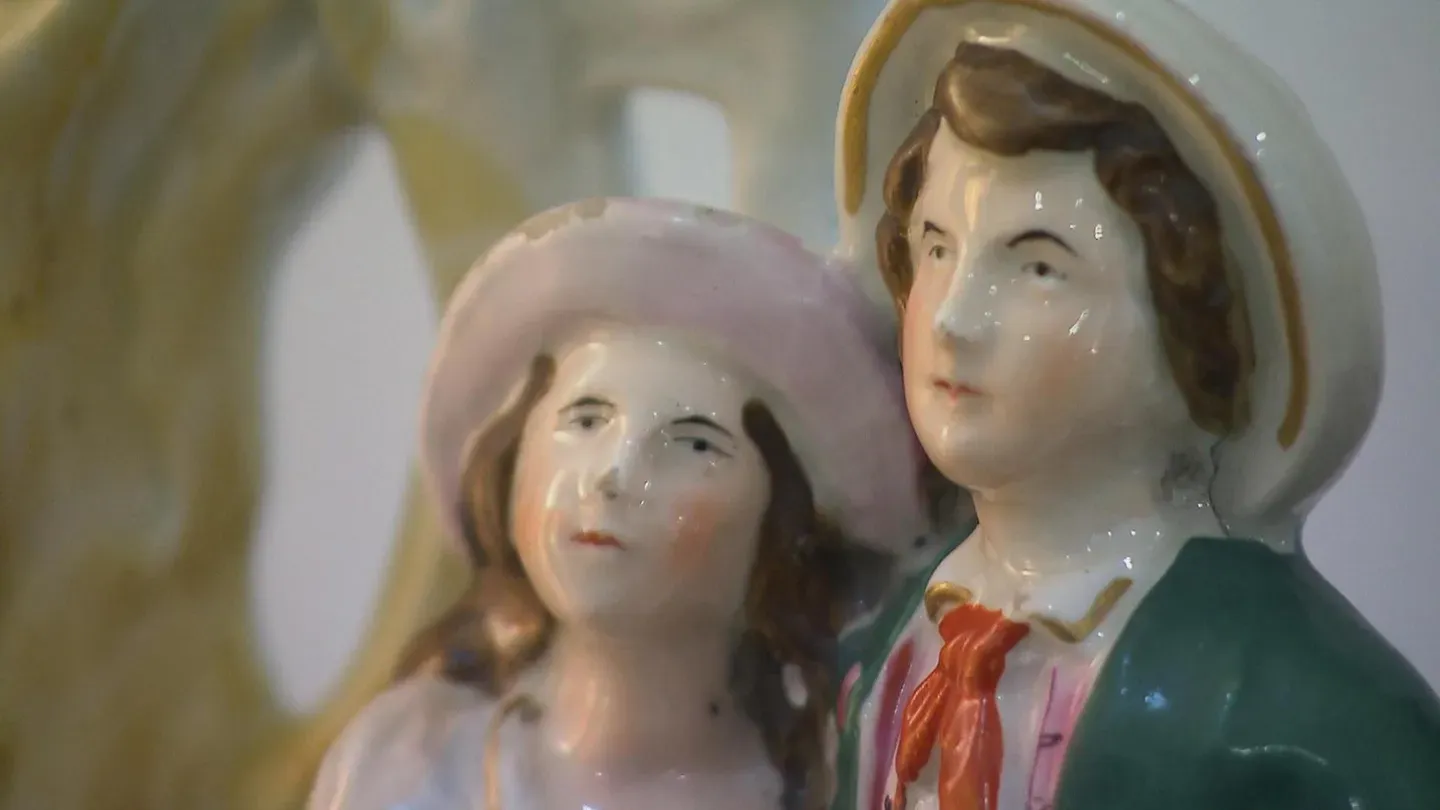
In Victorian times, Staffordshire figures, or flatbacks as they're called, would grace the mantelpiece of every Victorian kitchen.
VO: Flatback figures are so called because they're generally flat on the back and are undecorated there.
They were often placed against a wall or chimney breast in a Victorian house, to add some interest.
Now, Staffordshire figures would often command high prices in the saleroom but they have gone out of fashion.
VO: That one's possible.
What's Anita got her eye on now?
She loves a trout.
So, the girls want their boyfriends out of the T-shirts, out of the sloppy joes and into a nice, crisp, white shirt with a lovely pair of stylish cufflinks, so cufflinks are doing well, and I quite fancy these.
VO: Time to talk money.
The combined ticket price for the two items is £52.99.
I found two things really that I like.
What I would like to pay for the two is probably... ..in the region of 25, 30.
32.
ANITA: £32 for the two?
DEALER: Two.
Let's go for that, Dougie, thank you ANITA: very, very, very much.
DEALER: Thank you very much.
VO: Yeah, nice work, Anita.
£27 for the Staffordshire flatback and £5 for the dapper cufflinks.
That completes this leg's shopping trip, and Anita has a total of five items.
As well as the last two she's just picked up, there's the 1950s standard lamp and cabinet, the milking stool and the little doll's house three-piece suite.
Anita was canny with her cash.
She spent £101.
VO: Phil had a tidy budget to play with and also bought five items - his Masonic lot, the wooden trunk, the 19th-century seal press, the set of ladders and the little and large curling stones.
Phil spent a total of £175.
Now for the juicy bit.
Ha!
What do they think of each other's items?
I love the company seal.
I think it's fabulous.
It's a giant.
Got to make a profit on that.
The two bits that I really love are the Uncle Tom Cobley Widecombe Fair stool and that really little three piece suite.
I think that's really cute.
The shopkeeper's ladder is a smashing item.
It won't fly but it's a good solid profit for him once again.
Game on, eh?
VO: Yeah.
Anita and Phil are crossing the border once more to auction in the city of Carlisle in Cumbria.
I think a wee bit of sartorial might be the thing for you.
I'd like to see a nice white shirt, pair of cufflinks, your hair combed.
ANITA: Your face shaved.
PHIL: Hair combed?
This hasn't been... and I'm clean shaven.
This is like a baby's bottom.
VO: Yeah.
Give the fellow a chance, Anita.
Let's hope lovely Carlisle will give them lots and lots of profits.
H&H Auctions is their penultimate battleground.
Stand by.
ANITA: Wow!
Don't drive straight in.
Stop.
VO: What a carry on, eh?
Dear me.
I feel like I've been welded into that thing.
Well... Penultimate auction.
Yeah.
I've got a lot to make up, Phil.
PHIL: You gonna do it?
ANITA: Fingers crossed.
VO: The best of luck to you both.
Our auctioneer today is Stephen Farthing.
What does he think of Anita and Phil's lots?
If you've seen the joke with the Two Ronnies, the four candles joke, it's identical to the sort of ladder that you will see the old DIY shop and I'm sure a lot of people will recognize that.
It will probably go for the £50-£60 mark.
Continental silver cufflinks, yeah, they're very plain, very simple and very stylish so again I'm hoping that they might do well.
VO: Make yourself comfortable.
The auction is about to begin.
VO: First up are Anita's stylish cufflinks.
Five, eight, 10 on the books.
10 bid, at £10 I'm bid.
At 10 for the pair.
12 at the back.
Yes!
Right at the back, a £12 bid.
At £12 then, at £12 bid.
Right at the back at £12.
VO: Tidy little profit there, Anita.
Great start.
ANITA: That's not bad.
PHIL: Short and sharp, isn't he?
Yeah.
VO: Next are Phil's curling stones.
STEPHEN: Straight in at £10 on the books.
10 bid.
At £10 I'm bid.
At 10 on the books, 12.
12 bid.
At 12, then.
At 15 bid, at 15, 18, at 18, 20 bid, at 20, at 22, 25, 28, 30.
It's climbing.
It's climbing.
At 30, at 32, 35, 38, 40.
It's getting there, Philip.
40 bid, at £40, at £40 then.
All done at £40.
VO: Despite that series of bids, it's a loss, Phil.
Not too bad, though.
I'm not going to count my chickens or my sheep or my coos... Or your dugs.
VO: Next, Anita's three-piece suite for a doll's house.
STEPHEN: A nice little lot there.
There we are, we are straight in at five, eight, 10 on the books.
Again.
10 bid.
Commission bid at 10.
12 at the back.
12 bid, at £12, right at the back at 12, 14 new bidder, at £14, 16, 18.
Come on!
Commission bid at 18.
At £18 on my right, at £18 then.
VO: It's a miniature-sized profit.
But it all adds up.
I'd sort of, kind of, settle for that really.
ANITA: (CHUCKLES) Yeah.
VO: Back to Phil and his big wooden trunk next.
STEPHEN: Bit of interest in this one.
Lot 62, so we start the bidding, four bids, we start the bidding at 20, 25, 30 on the books, 30 bid, at 35, 40, 45.
I'm out, at 45, lady's bid, 50.
ANITA: 50!
STEPHEN: 55, 60.
Thank you, Lord.
Thank you.
65, front row, lady's bid, at 65 then, all done.
At 65.
VO: That's more like it.
Good on you, Phil.
Big, hulking furniture scores well with this audience.
Never any doubt.
Well done, darling.
Never any doubt in my mind at all.
I knew that would do well.
VO: Phil's currently in the lead, Anita.
Can your Staffordshire flatback show him who's boss?
Commission bids at 20, 25, 30, 35.
Yes!
Well done you.
STEPHEN: 38, 40.
ANITA: Yes!
42, 44.
Yes!
At 44 then.
All done at 44, commission bid.
VO: Well done, Anita.
PHIL: Well done you.
I'm happy with that.
I have to say, it sort of deserved that really, didn't it?
Yes, it did.
It did.
VO: Can Phil take the lead once more with his lot of Masonic items?
A bit of interest again.
Five, eight, 10, 12, 15 on the book, 18, 20, 22, 24, 26 I'm out.
Oh, I think that's for nothing.
At £26 then, all done at 26 then.
PHIL: Ouch!
STEPHEN: Last chance at 26 then.
VO: Cor, someone's got a good buy there.
ANITA: It didn't double its money then.
PHIL: I really thought it would.
ANITA: Ah, well... That was a nasty thing to say.
VO: Next, Anita's milking stool.
We're going to start the bidding at two, five, eight bid.
At £8 bid, 10, I'm out at 10, at £10, it's in the room at £10 then, in the room at £10.
Aw, come on.
12 at the back, £12, 14, 16, 18, all done at £18 then.
VO: Another tiny profit, but you're still in the lead, Anita.
ANITA: That's alright.
Well it is, but it isn't really, cuz I thought that was worth a lot more than that.
I know.
I know.
VO: Can Phil's shop-style ladders help him bulk up his profits?
A bit of interest again.
We'll start the bidding at 20, 30, 40, 50, 60.
Yes!
60 bid, 70, at 70, 70 bid.
I must admit that's a huge... ANITA: Yes!
PHIL: Ooh!
90, 100.
110, 120, 130, 130 bid, lady's bid at 130.
I'm quite pleased with that.
Lady's bid at £130 then.
VO: Amazing result, Phil.
VO: That huge profit has catapulted you into the lead.
That's probably the stairway to success, isn't it really?
ANITA: (LAUGHS) It's taken you a step up, hasn't it?
VO: Ooh!
Enough of these terrible puns.
VO: Now, Anita's 1950s standard lamp-cabinet combo.
We're straight in at 20, 30, 40, 50 on the books.
50 bid, at £50, 55.
I'm out at 55, at 60.
And five, 70.
Lovely young blonde girl here.
And five.
Right in the corner at 75 then, at £75 in the corner, at 75 then.
All done.
VO: The 1950s look is definitely in vogue with the Carlisle bidders.
For something that does resemble a three-humped camel... ANITA: (LAUGHS) ..I think you've done very well.
No it is.
It's a cool thing.
It's all a matter of taste, isn't it?
VO: Certainly is, Anita.
Now, the last item of the day, Phil's company seal press.
We are straight in at 20, 25, 30 on the books, at £30.
I think we'll kind of settle for that.
I'll take two if it helps.
32, 35, 38, I'm out at £38.
It's in the room at £38 then.
All done at 38?
VO: That's a good result, Phil.
Ha!
Looks like the bidders like your style.
Well done.
I'm quite pleased with the day.
Let's get the sums done over a cup of tea.
VO: Indeed we will, Anita.
Who will be the jubilant winner of this crucial leg?
Anita started out with £258.30.
After auction costs she made a profit of £35.94, giving her a total of £294.24 for the final leg of the trip.
Phil started off with £399.40 and takes the crown today.
After auction costs, he made a profit of £70.18, giving him a handsome sum of £469.58 to carry forward.
PHIL: Well, I tell you what, I think you're still driving.
PHIL: For sure.
Chauffeuse.
ANITA: (CHUCKLES) Yeah.
PHIL: And I think... Phil, I think you've pulled ahead even more in this auction.
PHIL: Be my driver.
VO: Thought you didn't like Anita's driving, Phil.
Bye bye, you two.
VO: Next time, a thrilling final leg of the road trip.
Have you got any stockings on?
None of your business.
VO: Anita weighs in with some big antiques.
Well this certainly isn't a wee brooch.
VO: And Philip's found his soulmate.
My hero, look.
Hello Spocky.
subtitling@stv.tv














Support for PBS provided by: