Prairie Sportsman
Aquatic Defense Force
Clip: Season 17 Episode 7 | 12m 24sVideo has Closed Captions
Researchers at the Minnesota Aquatic Invasive Species Research Center work to restore native plants.
Researchers at the Minnesota Aquatic Invasive Species Research Center work to restore native plant life in lakes affected by invasive species. These underwater plant communities play a critical role in maintaining lake health, and researchers are continuing to improve methods to support their recovery.
Problems playing video? | Closed Captioning Feedback
Problems playing video? | Closed Captioning Feedback
Prairie Sportsman is a local public television program presented by Pioneer PBS
Production sponsorship is provided by funding from the Environment and Natural Resources Trust Fund and Shalom Hill Farm. Additional funding provided by Big Stone County, Yellow Medicine County, Lac qui...
Support provided by:


Prairie Sportsman
Aquatic Defense Force
Clip: Season 17 Episode 7 | 12m 24sVideo has Closed Captions
Researchers at the Minnesota Aquatic Invasive Species Research Center work to restore native plant life in lakes affected by invasive species. These underwater plant communities play a critical role in maintaining lake health, and researchers are continuing to improve methods to support their recovery.
Problems playing video? | Closed Captioning Feedback
How to Watch Prairie Sportsman
Prairie Sportsman is available to stream on pbs.org and the free PBS App, available on iPhone, Apple TV, Android TV, Android smartphones, Amazon Fire TV, Amazon Fire Tablet, Roku, Samsung Smart TV, and Vizio.
Providing Support for PBS.org
Learn Moreabout PBS online sponsorship(bright music) For much of its history as a state, Minnesota struggled with invasive species in its waters.
From common carp to starry stonewort, these unwelcome guests have created havoc in our underwater ecosystems.
- There's a long list, unfortunately, of aquatic invasive species we're concerned about and many more on the doorstep.
Back in 2012, the state of Minnesota said, enough's enough.
We need to innovate, we to develop new solutions to these growing problems.
Folks were using the best available tools at the time and it just frankly, wasn't working.
So the state invested in creating the Aquatic Invasive Species Research Center, really, a first of its kind in the country, here at the University of Minnesota.
We have, I'd argue probably the most multifaceted and aggressive invasive species program of any state.
- [Bret] Part of the strategy in Minnesota's battle against aquatic invasive species, or AIS, is the training of concerned citizens through a program at the Minnesota Aquatic Invasive Species Research Center and the University of Minnesota extension, known as AIS Detectors.
(gentle music) - The public's essential.
It's cliche probably, to say it's an all hands on deck situation, but it truly is.
So one of the ways that we've been engaging in the public is through our citizen science program called AIS Detectors.
There's almost 600 of them around the state who have volunteered to take a class.
They signed up for a test, to learn more about invasive species and be these resources in the community.
They actively participate in volunteer opportunities and have themselves made a difference in their local areas.
- [Bret] One person who joined the ranks of Minnesota's AIS Detectors is retired veterinarian Ingrid Bey.
- Got a stick in your mouth?
When I retired, I wanted to give back and I didn't know at the time, what form of giving back that would be.
And then I realized that our lakes were being threatened by all these aquatic invasive species.
And so my give back came in the form of trying to preserve our lakes, rivers, streams, watersheds.
And I love being outside, I love the natural world, and I have a biology background.
Good boy.
So it was sort of like a perfect fit for me.
So this is beautiful Kabekona Lake.
It's about a 2,400 acre lake in Hubbard County.
It's known as a really good walleye lake and it is pristine.
And as far as we know, it is AIS free.
- [Bret] A graduate of the AIS Detectors program, Ingrid serves on the Kabekona Lake Association, the Hubbard County Coalition of Lake Associations and the MAISRC Advisory Board.
In addition to all her administrative service, she also takes a hands-on approach when combating AIS.
(bright music) - So a common way that we and professionals look for aquatic invasive species, more specifically vegetation, is by a method called rake toss.
It's a double-sided rake that's on a long length of cord.
So you throw the rake out into the lake and let it drop to the bottom, and then you pull it back in, and you look through all the vegetation.
And this is where it's very helpful to know the native vegetation 'cause you're looking for invasive species, but you'll get a large pile of beautiful native aquatic plants.
So for example, our native milfoil, Northern watermilfoil, which is a beautiful plant, looks very similar to Eurasian watermilfoil.
If you find something that you're concerned about, you can submit it to the AIS specialists, either through the county or through the DNR, and then there's a thing called EDDMapS online.
And if you take a good picture and you submit it to EDDMapS, that's the best way for the specialists to try to sort out if it really is an invasive species or not.
- [Bret] While the work they do is serious, the volunteers on Kabekona Lake have a lighthearted moniker.
- We call ourself the Kabekona Aquatic Vegetation Surveillance Team, otherwise known as the rake tossers.
And we just ask the people who are participating and volunteering that they go out once in July and once in August and do their rake tosses and keep checking the lake.
- [Bret] So far, the rake tossers have been met with good news.
(water splashing) - Well, Kabekona Lake, we do not have AIS at this time.
The challenge is to not get AIS - [Bret] In this age of aquatic invasives, lake associations can play a pivotal role.
- I think lake associations are really important because they bring a sense of community to a lake and that we're all in this together.
Lake associations have become more important than ever because of the financial aspects of treating AIS.
And typically, once AIS is discovered, people look toward the lake association for help.
If people are willing and able to know that they may need to build up their financial situation for their lake association, they're gonna be ahead of the curve.
- [Bret] While Kabekona Lake is still free of invasives, the threat appears to be closing in.
- We have neighboring lakes that, just this summer, were found to have starry stonewort.
And that kind of ups the ante for us because AIS is primarily spread through boater movement and boater traffic.
And so now I think we're going to be even more vigilant.
In the event that would get AIS in Kabekona, I think we're ready to hit the ground running, and probably sadly we've learned from other lakes who've gotten AIS.
But I think we're ready to move if we need to.
- [Bret] The foresight of the Kabekona Lake Association could be critical if invasives are ever found in the lakes waters.
- The impetus for starting AIS Detectors was to increase this capacity for surveillance of aquatic invasive species.
With any invasive species, the best outcomes are possible if you have early detection.
If you find these populations when they're relatively small, the management toolbox is so much better and the outcomes are so much better.
- There's several lakes that found starry stonewort very early, so a very small amount of starry stonewort in the lake.
And they were able to go out and use divers to hand pull these small patches of starry stonewort, plus or minus a copper algaecide.
And they followed the biomass, and each month they got less, and less and less.
And then each year they got less, and less and less.
So, although we can't use the word eradicate, it has definitely been controlled as opposed to a lake that has, well, Benedict Lake for example, they have seven acres of starry stonewort, compared to Garfield Lake that has 0.18 acres of starry stonewort.
So you might say that they found it early in Garfield and were more hopeful then that they can at least control it so that the lake can continue to be enjoyed by anglers and boaters and recreational people, and people who just like to get out in nature and enjoy the lake.
- [Bret] While Ingrid is monitoring lakes in the northern region of the state, another partner in the fight against AIS is working to make a difference in the Twin Cities Metro region.
Former University of Minnesota, Tony Brough serves as the Aquatic Invasive Species Program Coordinator for Hennepin County and oversees a wide range of efforts.
- We work with partners, local partners, we leverage what they're already doing and making it better.
And that's what's so fantastic about this funding is it's all going to projects on the ground.
Specifically, we've done a lot of work with access redesign.
First thing is creating the space away from the access.
Here's where you can go, you can take your time, do what you're supposed to do, and you go here.
So we put stop bars in the asphalt and we don't paint 'cause paint kind of goes away after a year.
We use thermoplastic pavement marking, which I get to use a blowtorch, so it's quite fun.
And you melt it right into the asphalt and it stays bright for 10 to 15 years.
And so most people would come and we're getting 90% of more stopping at these stop bars, at these lines.
And right at that line we put signs, very short like, did you clean?
Did you drain?
And then, thank you.
And then the last thing is to be high level is we can put tools right there to make it easier for them to drain their water, to remove the weeds.
And that's the three tools, kind of in our toolbox.
And so this is a long-term play.
We're not just trying to prevent zebra mussels that's in Minnesota already to come into this new lake.
How can we also prevent this next thing from even getting to Minnesota?
- [Bret] Although the battle against invasives may never end the efforts of MAISRC researchers and concerned citizens are yielding positive results.
- Statewide, you think about, you know, there's just another new report of a zebra mussel in a lake in Minnesota.
But I can tell you over the last decade, we bent that curve, the rate of infestation, the spread of infestation has slowed in Minnesota.
And that is attributable, I'd argue, to the state's investment, that local capacity and the research informed tools that they're using on the landscape.
We have made a difference.
- My hope for the future of Minnesota's lakes is that we can preserve the lakes that are pristine.
We know some lakes are fairly permanently damaged, but if we can preserve what we have, that's our gift to future generations, and that's on all of us.
- It's so simple.
Don't spread water, don't spread plants.
Once you got that, how do you make sure you don't do it and it'll just become normal.
Because we care about our legacy and our lakes, and what we have in Minnesota here is something a lot of states don't have.
It's worth protecting.
(bright music) - [Narrator 2] We can stop aquatic hitchhikers from infesting more lakes and streams by cleaning up everything we pull out of the water.
It's a simple drill.
Clean in, clean out.
Before leaving a water access, clean your boat and water equipment, remove and dispose of all plants and aquatic species in the trash.
Drain water from your boat, ballast tanks, motor, live well and bait container.
Remove drain plugs and keep drain plugs out while transporting equipment.
Dispose of unwanted bait in the trash.
To keep live bait, drain the water and refill the bait container with bottled or tap water.
And if you have been in infested waters, also spray your boat with high pressure water, rinse with very hot water, dry for at least five days.
Stop the spread of AIS.
Adopt a Drain and Aquatic Invasive Species Detectors
Video has Closed Captions
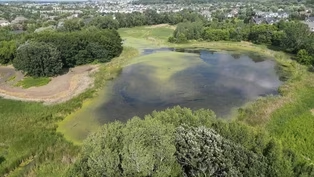
Preview: S17 Ep7 | 30s | Host Bret Amundson explores community-driven efforts to protect water quality. (30s)
 New
NewVideo has Closed Captions
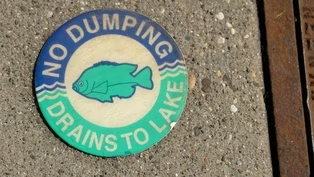
Clip: S17 Ep7 | 12m 23s | A sticker near a storm drain prompts Amundson to view projects aimed at reducing stormwater runoff. (12m 23s)
Providing Support for PBS.org
Learn Moreabout PBS online sponsorship
- Science and Nature

Explore scientific discoveries on television's most acclaimed science documentary series.

- Science and Nature

"Our New World" reveals Nature's astonishing adaptation abilities and how humans can help it thrive.












Support for PBS provided by:
Prairie Sportsman is a local public television program presented by Pioneer PBS
Production sponsorship is provided by funding from the Environment and Natural Resources Trust Fund and Shalom Hill Farm. Additional funding provided by Big Stone County, Yellow Medicine County, Lac qui...