Oregon Art Beat
Art East of the Cascades
Season 25 Episode 8 | 28m 12sVideo has Closed Captions
Meet photographer Nancy Floyd, bird painter Hiroko Cannon, and tour Blue Mountain Fine Art.
Guggenheim award-winning photographer Nancy Floyd’s newest project finds her connecting with and photographing Oregon forest stakeholders. Since 2005, Baker City’s Blue Mountain Fine Art has been the go-to foundry for some of America's best-known bronze artists. Using a precise and delicate touch, Pendleton artist Hiroko Cannon reflects the beauty of the birds in her own backyard.
Problems playing video? | Closed Captioning Feedback
Problems playing video? | Closed Captioning Feedback
Oregon Art Beat is a local public television program presented by OPB
Oregon Art Beat
Art East of the Cascades
Season 25 Episode 8 | 28m 12sVideo has Closed Captions
Guggenheim award-winning photographer Nancy Floyd’s newest project finds her connecting with and photographing Oregon forest stakeholders. Since 2005, Baker City’s Blue Mountain Fine Art has been the go-to foundry for some of America's best-known bronze artists. Using a precise and delicate touch, Pendleton artist Hiroko Cannon reflects the beauty of the birds in her own backyard.
Problems playing video? | Closed Captioning Feedback
How to Watch Oregon Art Beat
Oregon Art Beat is available to stream on pbs.org and the free PBS App, available on iPhone, Apple TV, Android TV, Android smartphones, Amazon Fire TV, Amazon Fire Tablet, Roku, Samsung Smart TV, and Vizio.
Providing Support for PBS.org
Learn Moreabout PBS online sponsorshipSupport for Oregon Art Beat is provided by Jordan Schnitzer and the Harold and Arlene Schnitzer Care Foundation Endowed Fund for Excellence... and OPB members and viewers like you.
Funding for arts and culture coverage is provided by... [ ♪♪♪ ] I'm Nancy Floyd.
I live in Bend, Oregon, and I'm a photographer who's working on a project about trees.
[ ♪♪♪ ] [ both chattering indistinctly ] [ shutter clicking ] [ ♪♪♪ ] In 1982, I mentioned to a friend it would be interesting to see myself age over 20 years, so I started this project called "Weathering Time."
It started with me just with a camera in the corner of the room on a tripod, and every morning at 9:00... [ shutter clicking ] ...I would make a picture.
But because they were environmental portraits which included the rooms where I lived, where I hung out, sometimes with my friends, sometimes with my family, it showed sort of the social cultural life that I'd lived, sort of my generation.
And then at 20 years, I had an exhibition, and that's when I realized that I couldn't stop this project, that it really was a life-long project.
That would be its significance, to see how things change.
[ ♪♪♪ ] A few years ago, I turned 63, and there was this photograph of myself with my mother at 63, and I decided to do a reenactment photograph where I stand in the same position that she was standing in and took a picture so that there's a diptych of me standing there and then my mom.
And then two years later, I was 65, and I had a photograph of my dad, and that's what really surprised me, because I had no idea that I looked like my dad, and I look so much like my dad.
[ birds chirping ] Until 2009, I was primarily a portrait photographer, a documentary or environmental portrait photographer, and I've won quite a few awards, and in 2022 I won a Guggenheim.
[ ♪♪♪ ] And in 2009, I went to Death Valley for the first time.
And while I was there, I learned that my mother was dying.
And within the next month, she had passed away.
And so I started going out there just with the idea of getting away and sort of mourning my mother and just being in this beautiful desert landscape for the first time.
And by the third year I was there, I realized that I could do a project.
And not necessarily showing you what's around me...
I was more interested in sort of the personal space, because the desert is big and vast, and how can you tell the story of the desert?
[ ♪♪♪ ] I can tell the story of me in the desert.
And that led to the exhibition "Walking Through the Desert with My Eyes Closed."
And how big did the madrones get?
As tall as the oaks, more or less.
Really?
In 2021, I stared a project called "For the Love of Trees."
And I'm following stakeholders, those people who are doing work that will advance sort of tree growth or sustainable logging for the future.
[ shutter clicking ] This is a little natural fir that seeded in.
We planted no fir here because the fir was dying.
But some has come in, so I'll let it grow.
And my focus of that is to follow these people and learn what they do and sort of just be a fly on the wall where I just spend a day with them or a week or sometimes years, and that then leads into the second part of the project where I go out and photograph the trees on my own, trying to make work that's both personal to me and also can have some meaning to other people.
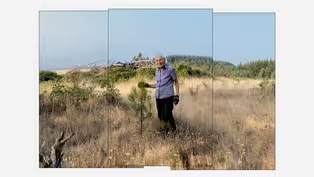
The green trees that you can see... Sarah and her family are sustainable loggers, and they are trying to bring back areas of the forest that have been clear-cut by planting trees to see what will grow, and her goal is to create a forest that's diverse and that can survive climate change.
So these are sequoias that were planted several years ago.
There's one behind you, too, you can see.
These are one of our good hopes for a conifer species that will thrive into the future.
One of her big initiatives is to bring back oak trees, because that area was an oak forest at one point.
Now, there's a very successful planted oak.
This is a pride and joy, I guess you'd say.
Taller than I am.
[ chuckles ] [ shutter clicks ] When I photograph, I photograph across the scene and I'm putting together multiple images to stitch together to create a panoramic.
They won't completely overlap.
You'll be able to see that they're, you know-- Even without the black line, you'd be able to see that they're pasted on top of each other.
But I'm also looking for, in the case of a person, I want them to look good in the photograph.
In the case of the landscape, I'm looking at the sky to see if it looks at a level that I think is going to enhance the foreground.
What makes me do this is when I think that there's a sense of time passing.
So as a viewer, you're not feeling, like, this seamless image, you're noticing the construction of it, and it's kind of like looking through little windows.
This is the final frame.
[ ♪♪♪ ] Her son started a mill, and that mill is used for oak trees.
And they've also started a business where they put in refined floors or build in cabinets and things.
It's a really beautiful work.
So this is the dehumidifier room, which is the last place that the wood comes before it's shipped off.
I'm really interested in the tags that are on here and just the different sizes of the wood.
And I'm also interested in when there's knots in the wood, because I kind of really like that sort of texture, that contrast against the beautiful oak that's here.
An iconic tree is a tree I fall in love with, and it could be a big, monumental tree, an old tree, but it could be a very small tree.
And I think what inspires me about trees is that I have to stay around them for a while to get to know them.
And that sounds kind of like, you know, whatever, but it's not.
When you're sitting there, you hear it as the wind brushes by it, you watch the lizards or the other animals that are running around the forest, and so you get to know sort of that environment.
And that's really important for me in terms of knowing the place.
[ shutter clicks ] The most iconic tree to me is the ponderosa pine because I have a 140-foot one in my front yard.
And when I saw the house in the beginning and saw that giant tree next to it, that was it.
We had a lightning strike, and it started at the top of the tree and came down the tree, went into the ground, split a rock in half, took out the water system to our neighbor's house, and the tree exploded, and for blocks away, there were tree parts.
[ shutter clicking ] [ ♪♪♪ ] What I've really learned through this process is how patient people can be and how thoughtful and sensitive they are to the environment and the needs of not only themselves but others.
They won't know what their work will be, you know, a hundred years from now, but it'll make a difference to people.
I admire them so much, and I think what it does for me is it helps me feel like I'm contributing something myself, even though I'm just taking the pictures, making the pictures.
As an artist, it makes me feel good to show others just how amazing these people are.
[ ♪♪♪ ] MAN: These are some images that we got from the digital printing people to show us how it's going to get cut up.
GILFILLAN: This mosaic of colored parts will eventually be assembled into seven different bronze seating structures.
This is the largest one of them.
It's called "Groves and Stones," and it's the work of Oregon artist Julian Watts and Baker City's Blue Mountain Fine Art.
My name's Tyler Fouts, and I'm the owner of Blue Mountain Fine Art.
It's an art foundry.
It's in Baker City, Oregon.
Over the last 20 years, Blue Mountain Fine Art has become known for producing bronze art that can best be described as contemporary.
They work with national artists like Deborah Butterfield and Jim Dine and local artists like Brenna Kimbro, Bill Will, and Dana Louis.
But the process by which that art is made goes back some 5,000 years.
In the ancient world, bronze's strength and ability to hold fine detail made it highly desirable for everything from coins to weapons to fine art and shows up in cultures as varied as China and Egypt, India and Greece.
It hasn't changed very much.
What has changed is things like the digital printing, but still, most pieces, we have to mold.
The technique is known as lost wax casting.
And it starts here in the mold room.
The artists send us an original sculpture, and we take it through the process of making it into a bronze.
The process by which a sculpture is made into one of the most durable materials in the world starts with one of the most flexible.
We use a urethane rubber and just paint it on with a brush.
And after the rubber's up to thickness, then we make what we call a mother mold, which is the plaster mold.
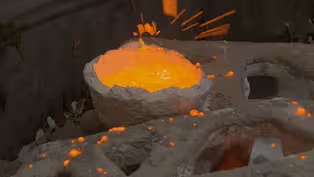
After the mother mold is done, a collection of gates, or feeders, are attached that will allow liquid bronze to be poured into it.
That's what's happening over here.
The red gates on there, or sprues, will eventually be the feeding system for the bronze to flow through.
After the mold's made, we'll pour wax into this and you'll end up with wax parts.
[ ♪♪♪ ] Then we just let it cool down, and then just pop it apart and peel the wax out of there.
This piece here is the part we want in bronze.
It's the artwork.
And the rest of this here is just a feeder system.
Once the wax form and gating, or feeder system, is ready, it's time for the slurry room.
So all the parts are brought in here, and then we will put a ceramic shell coating on them.
We dip it into the slurry, we call it.
It's a silica binder.
And then we apply sand to it.
It takes one fine coat, one medium coat, and anywhere from six to eight coarse coats.
We have to air-dry them in between coats.
After they've gone through the process of dipping and they're up to thickness, then we take them out and we burn the wax out of them in the kiln.
In this burnout oven, the wax is lost or melts out of the heat-resistant shells.
You can see how it's sloped to the bottom and there's a hole in the middle.
Then underneath, there's a container to capture the wax.
After we've burned them out, they'll be ready to go into the oven to be preheated and poured.
The bronze pouring process, even in the 21st century, is done pretty much as it has been for millennia.
[ ♪♪♪ ] [ man speaks indistinctly ] Bronze is heated into a molten state... and poured directly into the molds.
The technique is ancient, but no less compelling.
Anything left is poured into an ingot to be used again in the next pour.
[ steam hissing ] Once cooled, the mold is broken off.
And then all this stuff will get cut off right at the panel, and then that's the art, is the top piece.
This is the piece we want right here, and go in and get sandblasted, and at that point, it'll be ready to get worked on by the metal shop.
[ tools whirring ] Depending on the size of the piece, some pieces can be a hundred parts, some pieces can be just one part.
So the bigger pieces have to be welded together and then tooled.
We use sanders, grinders, air hammers, all kinds of things to make different textures so that we can match the texture on the piece.
Afterwards, it's time to put the patina on.
Various chemicals make different colors.
After we get the color the way we like it, then we warm the piece up and we wax it, and that seals it.
At that point, the piece is pretty much finished.
[ ♪♪♪ ] In the spring of 2023, "Groves and Stones" was installed in downtown Bellevue, Washington.
The setting is urban and contemporary.
But the art was handmade in Baker City, Oregon.
We're a service to the artist, so it's kind of like being involved in that process.
And in the end, there's a lot of satisfaction in knowing that a piece that I install in Seattle, you know, my grandkids can go see it someday.
Hiroko Cannon was a successful illustrator and designer in Tokyo, but in 1987, she and her family moved 5,000 miles away, here, to Pendleton, Oregon.
These days, she's making her mark as a master watercolor artist.
[ ♪♪♪ ] Hiroko Cannon has been painting birds in Pendleton for nearly 20 years.
HIROKO: In the beginning, I just did it for fun, and then I didn't want to give up.
Every time I got a really, really scary feeling.
"Could I do it?
Are you okay to finish this one?"
But after that, I finish it, and then people buy those things.
And I thought, "Oh, I did a good job!"
[ birds chirping ] I go out to my backyard to watch birds.
Need to be really careful and gently go out and patiently wait until birds come.
[ chirping ] That's a pretty one.
Pretty.
It's nice today.
ERIC SLADE: Hiroko never takes photos.
She studies and she remembers.
Just my brain and my eyes are best camera... highest quality in the world, so... [ laughs ] I see a bird that has personality.
It's a shy one.
Cannot get into the bird feeder.
Try it.
Yeah, push them in!
There you go.
[ chuckles ] [ ♪♪♪ ] When you paint the personality-- human or bird or dog-- the most important part is the eyes.
With eyes, eyebrows show the emotion.
I make tiny, tiny feathers up in one part a little stronger, and then it's a totally different face.
I was born in Osaka, Japan.
I liked drawing since I was very young.
When I was 26, I moved to Tokyo.
I started to work as a graphic designer and then went to school in the night after work.
I studied human sketching.
It was really good study.
I loved Tokyo because I could have everything-- movies and food and everything.
Very exciting city.
[ ♪♪♪ ] And then I moved to Pendleton.
That was 1987.
At that time, I had a husband who is American who decided to move back to the United States.
I was almost crying because I was born in Osaka, the second largest city in Japan and then worked in Tokyo.
So that's just a culture shock.
I'd never seen a place like that.
[ cows mooing ] Pendleton is my home now more than Japan now.
I don't want to go back to Japan, because I'd miss people and I'd miss this dry weather.
At the Pendleton Art Center, Hiroko's work is in nearly every room, on every wall.
Is this an original?
Yeah, sure.
Cool.
She's had two solo shows in the past several years.
And in the center of town, a mural elevates her work to a new scale.
The city of Pendleton embraces and celebrates Hiroko Cannon.
[ ♪♪♪ ] I am painting right now a bald eagle.
I use translucent watercolor, and I use tiny brushes and then use them as a colored-pencil kind of way.
Hiroko's work is painstaking and precise... slowly building up layers of color.
A single painting can take two or three months to complete.
How do I feel when I finish my painting?
[ ♪♪♪ ] Just like finishing a spring cleaning, kind of.
[ laughs ] "Oh, I did it!"
Thanks so much for joining us.
You can watch these stories and dozens of others on our website.
Just go to opb.org/artbeat and be sure to follow us on Facebook and Instagram so you can see what we're working on right now.
We'll see you next time.
[ ♪♪♪ ] Support for Oregon Art Beat is provided by Jordan Schnitzer and the Harold and Arlene Schnitzer Care Foundation Endowed Fund for Excellence... and OPB members and viewers like you.
Funding for arts and culture coverage is provided by...
Video has Closed Captions
Clip: S25 Ep8 | 8m 4s | An ancient art flourishes in rural eastern Oregon. (8m 4s)
Video has Closed Captions
Clip: S25 Ep8 | 10m 57s | Guggenheim award-winning photographer Nancy Floyd photographs Oregon forest stakeholders. (10m 57s)
Providing Support for PBS.org
Learn Moreabout PBS online sponsorship















Support for PBS provided by:
Oregon Art Beat is a local public television program presented by OPB