
Art inspired by Black history with Jammie Niemeyer
Clip: Season 14 Episode 1 | 11m 32sVideo has Closed Captions
Jammie Niemeyer talks about how her ancestral roots to inform her most recent art.
Jammie Niemeyer talks about how she looked to her ancestral roots to inform her most recent art. Niemeyer did deep-dive studies of 44 people important to Black history and the Black experience in America. Niemeyer created portraits of these subjects as she learned about them and how they impacted who she is today. “It made me realize that I came from a very powerful place,” Niemeyer explains.
Problems playing video? | Closed Captioning Feedback
Problems playing video? | Closed Captioning Feedback
Postcards is a local public television program presented by Pioneer PBS
Production sponsorship is provided by contributions from the voters of Minnesota through a legislative appropriation from the Arts and Cultural Heritage Fund, Explore Alexandria Tourism, Shalom Hill Farm, West Central...
Support provided by:


Art inspired by Black history with Jammie Niemeyer
Clip: Season 14 Episode 1 | 11m 32sVideo has Closed Captions
Jammie Niemeyer talks about how she looked to her ancestral roots to inform her most recent art. Niemeyer did deep-dive studies of 44 people important to Black history and the Black experience in America. Niemeyer created portraits of these subjects as she learned about them and how they impacted who she is today. “It made me realize that I came from a very powerful place,” Niemeyer explains.
Problems playing video? | Closed Captioning Feedback
Where to Watch Postcards
Postcards is available to stream on pbs.org and the PBS app.
Buy Now
Providing Support for PBS.org
Learn Moreabout PBS online sponsorship- I had to find new purpose.
I needed to find who I was and where I was going.
(bright music) In doing so, that's when I decided that I needed to start finding out about my ancestry.
I needed to find out who I am, where do I belong, what's going on?
I couldn't handle that anymore.
I felt very lost and not accepted.
So I needed to find something.
(bright music) What I decided with it was I wanted to choose 44 people, and at the time, I was 44 years old.
I'm 45 now, and it's been a year process, but I was 44 years old.
When you're in a small-town area in Minnesota, basic teachings about anyone that would be African American would be you know that there's Martin Luther King Jr., you know that there's Harriet Tubman, and you know that there's Rosa Parks.
I did not know anything about them.
I literally, I knew that he had a dream, literally the only line I knew.
(audience applauding) - [MLK] I have a dream that one day on the red hills of Georgia, the sons of former slaves and the sons of former slave owners will be able to sit down together at the table of brotherhood, I have a dream."
- So I took this on, and I decided I need to learn these things.
As I started learning about them, I learned to accept myself.
(calm music) ♪ Ah, ah, ah - Which in past years I would've told you that no, I'm more white than I'm Black.
(calm music) ♪ Ah, ah, ah ♪ Ooh, ooh, ooh - [Jammie] With this project, I was able to pull it out and feel how these people felt, and to know that all of these people did so much for me to be where I am today.
(calm music) ♪ Ooh, ooh, ooh - The very first one you come into when you come into the gallery is Flo-Jo, Florence Griffith Joyner.
She's my idol.
She's my all-time idol.
I was a track athlete in the 100, 200, and 4x1 relay, and that was my thing.
I was planning to go to college and become an Olympic athlete because of her, because I saw she could do it.
Not only that, but she had style.
It gave me something to strive for.
(mellow piano music) The other part of the exhibit has, you know, you get, you run the gamut of people.
I go from Flo-Jo to, I've got Aretha Franklin.
It made me realize that I came from a very powerful place because those people overcame that.
They took what they knew, and they knew that things needed to change, and they went and changed them.
(calm music) My art style and art range from everywhere.
I've been doing art of some kind since I was three or so, as soon as I could pick up a pencil.
And so I was always either drawing on my papers or just, you know, fixing things, putting things together, making them look different, and just going with that.
I got in trouble in high school a lot, and elementary, too, (laughs) for, you know, drawing on my notebooks all the time.
You know, "Stop drawing," you know, "You're not paying attention," but the doodling helps me.
And that's where the doodling didn't come out as actual art for me until I got older.
It was just something that I did to keep my mind occupied as I'm like nervous and having trouble in school.
I have a learning disability.
I am dyslexic, and I have reading comprehension problems, so I had to find ways to learn things.
And a lot of the times it's with cues, whether it's a note or musical cue or color or a picture.
So for me to remember things, I would draw little pictures to be able to do those things.
(whimsical music) - [Smurf] 2.6 bat toenails, 3.9 dandelion spores, 7/10 of a warthog's wart.
(bright music) - My brain works a lot in black and white, or two colors more so at a time.
I do paint, but it's more so I like the two colors and because they like to share.
They're working together.
They're like, "Yeah, we're both here."
(calm music) Never knew my biological father.
His name was not put on my birth certificate.
I have a picture of him, and I have now done some, the MyHeritage to try to find my family on my, you know, on my biological father's side.
I grew up in an all-white family and an all-white neighborhood with no one else understanding me.
You know, it was just the, and the looks and the, just all of those things that come with it that were there because, you know, I was the misfit, and, you know, and all I wanted was just to know who my dad was.
So in recent years now, in doing the ancestry, I was able to find a link, and I found a cousin, and it was like a totally different thing for me.
I cried when I talked to him.
(peaceful music) (bird tweeting) And then when we, my partner and I, went down to go see him in Arizona, I got to meet someone that looked like me for the first time, and that experience was huge.
It was very overwhelming and touched my heart a lot.
(inspiring music) The people that would know me from when I was younger probably could not believe all the things that I'm doing now.
I want someone else one day to look at me and go, "She can do it.
She's done this.
I can do it."
(inspiring music) Not being accepted makes you not accept yourself.
And so when you live that life for so long, you second guess everything you do, and you're never good enough.
You're, you know, and it's taken me till now to even say, you know, "I'm a Black artist, and I'm proud of myself."
(energetic music) (wondrous music) (singer vocalizing) (inspiring music) - [Announcer] "Postcards" is made possible by the Minnesota Arts and Cultural Heritage Fund and the citizens of Minnesota.
Additional support provided by Margaret A. Cargill Philanthropies, Mark and Margaret Yackel-Juleen on behalf of Shalom Hill Farms, a retreat and conference center in a prairie setting near Windom, Minnesota.
On the web at shalomhillfarm.org.
Alexandria, Minnesota, a year-round destination with hundreds of lakes, trails, and attractions for memorable vacations and events.
More information at explorealex.com.
The Lake Region Arts Council's Arts Calendar, an arts and cultural heritage-funded digital calendar showcasing upcoming art events and opportunities for artists in West Central Minnesota.
On the web at lrac4calendar.org.
Playing today's new music plus your favorite hits, 96.7 KRAM.
Online at 967kram.com.
(calm music)
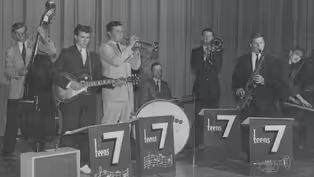
Verlyn Kling and Jammie Niemeyer
Preview: S14 Ep1 | 40s | Listen to the stories about Verlyn Kling’s 1959 Gibson Les Paul and Jammie Niemeyer’s art. (40s)
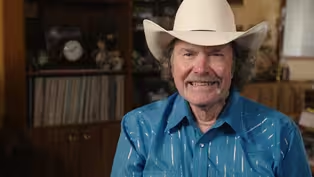
Verlyn Kling and the Missing Les Paul
Video has Closed Captions
Clip: S14 Ep1 | 16m 43s | A small-town musician with a story of a big-time guitar. (16m 43s)
Providing Support for PBS.org
Learn Moreabout PBS online sponsorship
- Arts and Music

Innovative musicians from every genre perform live in the longest-running music series.
 Recently Added
- Arts and Music

Intimate portraits of six of the most influential and celebrated classical music artists.
 New Episode






 New Episode
 New Episode
Support for PBS provided by:
Postcards is a local public television program presented by Pioneer PBS
Production sponsorship is provided by contributions from the voters of Minnesota through a legislative appropriation from the Arts and Cultural Heritage Fund, Explore Alexandria Tourism, Shalom Hill Farm, West Central...