
Verlyn Kling and the Missing Les Paul
Clip: Season 14 Episode 1 | 16m 43sVideo has Closed Captions
A small-town musician with a story of a big-time guitar.
When he bought his guitar as a teenager, Verlyn Kling had no idea that someday his 1959 Les Paul "burst" would become an example of one of the most collectible and valuable guitars in the world.
Problems playing video? | Closed Captioning Feedback
Problems playing video? | Closed Captioning Feedback
Postcards is a local public television program presented by Pioneer PBS
Production sponsorship is provided by contributions from the voters of Minnesota through a legislative appropriation from the Arts and Cultural Heritage Fund, Explore Alexandria Tourism, Shalom Hill Farm, West Central...
Support provided by:


Verlyn Kling and the Missing Les Paul
Clip: Season 14 Episode 1 | 16m 43sVideo has Closed Captions
When he bought his guitar as a teenager, Verlyn Kling had no idea that someday his 1959 Les Paul "burst" would become an example of one of the most collectible and valuable guitars in the world.
Problems playing video? | Closed Captioning Feedback
Where to Watch Postcards
Postcards is available to stream on pbs.org and the PBS app.
Buy Now
Providing Support for PBS.org
Learn Moreabout PBS online sponsorship(suspenseful music) - I couldn't find the guy where he lived anymore.
Finally, my wife found where he lived on the phone someway.
So it was on a Sunday afternoon and We drove up to his house where we thought he lived.
Must have woke him up.
He'd come out of the house rubbing his eyes.
And I hadn't seen him for about 15 years.
I didn't even recognize him.
And he looked at me and he, first thing he said to me was the serial number of my guitar.
(suspenseful music) He didn't even know why I was there.
(whimsical alternative music) (upbeat music) - So about five years ago, my brother-in-law was showing us the 50th anniversary video that he made for his parents.
In this anniversary video.
It's kind of giving the background of his mom and his dad.
And when it got to his dad, it mentioned how he was in an early rock and roll band in Montevideo, Minnesota called The Seventeens.
And it showed a picture of The Seventeens.
And I said, stop the video.
Stop.
That's a 59 Les Paul.
(upbeat guitar music) And I was like, who?
Who is this guy?
And do you know if he still has the guitar?
Is he still alive?
Like who?
Who is this guy?
And he said, oh yeah, that's Verlyn Kling.
I was like Verlyn who?
- Check, check, check.
One two.
(upbeat guitar music) - Kansas City Kansas City here I come Kansas City here I come - My name is Verlyn Kling.
I've been playing in bands 64 plus years and I usually do over a hundred shows a year.
I call myself now the four wheel drive, one man band now.
I'm 79 years old now and still at it.
Give me a call if you want music.
(bright upbeat music) Well, I was 15 years old when I bought the Les Paul with a hard shell case and an amplifier.
I bought it at the music store in Montevideo on Main Street for $440 which was quite a bit of money back then.
(upbeat jazz music) Well, The Seventeens band I was the only guitar player of the group and singer.
We were a pretty good band.
We went to a lot of different places.
We were too young to play in the bars so we did mostly ballrooms and high school proms.
Yeah, we played the show at FTA Ballroom.
I think it was two weeks after my buddy Holly was there.
Here's the poster, Seventeens admission $1.
(upbeat music) This is me the day before I went in the Navy, they had a party for me.
- Really thoughtful of 'em to make you play on your own.
Going away party.
- Yeah, I wasn't very happy.
(laughing) - Don't look very happy here.
(upbeat guitar music) - So that anniversary video led me to Berlin and obviously I wanted to know if he still had his guitar because we're talking about one of the rarest guitars and most desirable guitars ever made.
- What would you do if you found a 59 (inaudible)?
- Oh man, we, we always talk about this here.
We, yeah, we always talk about like in the, like you know you go visit your 92 year old grandfather and then they look in the closet and it's - like, oh, I got 40 years ago at the pawnshop - I'd play it, I'd play it, I'd play it.
I would definitely play it.
I would definitely play it.
I'm not one to just sneak it underneath the bed and let it sit there and rot.
For sure.
I would be one of those guys that you'd see out there playing it, which you call me crazy, I guess.
But I think the 59 is so, is so iconic.
It's because of who played it.
- The 1959 Les Paul is valuable because of its rarity but more so because of the musicians who played it.
All of the most influential guitarists out there have owned and played a '59 Les Paul Standard.
Early on, Keith Richards was on "The Ed Sullivan Show" playing a '59 Les Paul Standard and then we see Michael Bloomfield from the Paul Butterfield Band playing it.
And then Joe Walsh picked it up, and then Eric Clapton picked it up, and Jimmy Page and the list goes on and on.
So I just had an opportunity to speak with Jimmy Page about his Les Paul Standards and why he gravitated towards them, 'cause he was playing a different-brand guitar before them.
And he said the primary reason that he chose the 1959 Les Paul was because on stage at loud volumes, it didn't feed back, or when it did feed back, he could control it.
Other manufacturers of guitars weren't really considering their usage in very-high-volume environments, and that's really why I think they were as popular as they were during the hard rock revolution.
(upbeat rock music) There are very few 1959 Les Paul Standards that are still unaccounted for.
I should say that there's also quite a few fakes and knockoffs that are made that try to pass as the real thing.
We're pretty good at sorting those out.
So Verlyn's is interesting because there's a beautiful book called "The Beauty of the 'Burst" that was done in the 1990s, mid 1990s, and it has by-serial-number photos of all of these guitars, and his is in the perfect gap between two serial numbers in the book, and it would be in there, you know, if it was accounted for.
- My number of the Les Paul is 9-0594.
Here's 93.
Mine should be sitting in here.
It goes from 93 to 97.
(calm music) When I got out of the Navy, then I formed other bands.
Then I'd go into supper clubs and play myself, and I was called Verlyn and His Les Paul.
And then I started a band called Four Wheel Drive.
And then the wife and I have three sets of identical twin boys.
They were with me in the band, not all at one time, though.
(calm music) And then I didn't use the Les Paul anymore, because we switched to a little country, and I wanted to have a brighter sound, you know?
A friend of mine got his stolen, and he wanted to use mine one night after his got stolen.
And I wouldn't let him use it, 'cause everybody seemed to be drawn to it.
They probably knew what it was worth, which I didn't at the time, you know?
We didn't have no internet or nothing, you know?
Till one day this guy called me and wanted to know if he could come and see the Les Paul.
So he came over and looked at it.
We went down in the music room, and he asked if he could play it, and I said, "Sure."
"What would you take if you sold it?"
he said.
I thought for a while.
I said, "Well, how about 3,600?"
"Well, being you made up your mind so fast, I'll give you 3,650."
And I thought, "What'd I do here?"
you know?
(mellow music) - In the late '80s, he sold it and then bought a different guitar instead, which he he liked, and he didn't, he wasn't too regretful about it.
But he is still curious about the current whereabouts of his guitar, as am I. I think it'll show up someday, but it's not in any of the major collections globally.
What makes this guitar special, it has the most spectacular original flame top.
So what that means is the figuring in the maple of the top with side-to-side like tiger-stripe flame.
And the difference between a guitar with figure in the top like that and a guitar with that plain maple top can be half a million dollars.
It's extremely desirable to have a guitar like that.
I think Verlyn's guitar could be worth as much as $700,000 if it shows up with the provenance and if the top is as figured as it looks in those photos.
- It's funny, 'cause a lotta guys, I mean, back in the '50 and '60s didn't think twice about it.
They weren't even, they didn't, you know, think that their guitar was gonna be worth three, four, $500,000.
At that point in time, they were like us, where you go pick up a guitar off the shelf now, it's between 200 to $2,000, and yet you go play the you-know-what out of it.
Yeah, play guitar and then write songs, and the next thing you know, it could be like this mysterious mystique item that everybody wants to get their hands on.
Because that's exactly what happened with Les Pauls is that it started creating this persona behind it.
(wondrous music) - The part of my job that I enjoy most is researching vintage instruments and analyzing them, scanning them, really understanding how they were constructed inside and out, and then we recreate them here at the Custom Shop.
(machinery whirring) So we use 3D scans of original examples to find the accurate neck profiles, the top contours, recreate the parts exactly how they were, and then as you can see in this one, even recreate the way that they aged.
So originally in 1959, a Les Paul would've been cherry sunburst, and they all faded because the dye that they used in the cherry sunburst fades into green and then out to yellow.
So this is called a kind of a green lemon sunburst now.
So it looks like what a guitar would fade into over time.
This guitar also has a beautiful figured top that looks a lot like Verlyn's guitar.
And every detail of this guitar has been kind of authentically recreated from known examples, so including the aging on the back and the checking and all the little dings that the guitar would acquire over time, even the look of the back of the peghead being roughed up.
(energetic rock music) (intense rock music) Originally Gibson electric guitars were made in Kalamazoo, Michigan, and sometime in the mid 1970s, Gibson began to move to Nashville.
What's cool is we still have a lot of the original machinery and tooling and fixturing from the 1950s that we still use in our guitars today, including the Les Paul Standards.
(machinery whirring) This is a slack belt sander machine, and what's cool is this machine was used to make Les Pauls in the 1950s.
(upbeat music) And then we have an amazing staff of people here at Gibson Custom Shop.
So they are very passionate about recreating history and providing the vintage ownership experience.
(calm music) My favorite part of the Verlyn story is when he was trying to track it down, he went over to the gentleman's house who had purchased the guitar, and when the guy opened the door and saw Verlyn, he immediately recited the serial number, 9-0594.
And Verlyn, you know, thought, "Oh, well, maybe he still has the guitar."
But then the guy couldn't remember any details of what happened to the guitar, which I find very suspicious.
Since we know the gentleman's name who purchased it, I tried to do some research about if that person has bought and sold vintage guitars in the past, or was he known in the vintage guitar circles, and I just can't find anything about him.
But obviously to buy a guitar like that for the price that he paid at the time, he knew what he was doing, and he knew, you know, how spectacular Verlyn's example was.
(calm music) - At that time, I told this guy, I says, "I'm not mad that I sold it to you or anything.
You know, I made a good profit on it.
We just wanna find where it is."
"Oh," he says, "I can't tell you that to protect the buyer."
So they're still looking for it.
(laughs) (peaceful music) - My message for the person out there that has Verlyn's guitar is you're welcome, because we have so much provenance for that guitar that will add to the value.
By telling Verlyn's story, by giving Verlyn's photos, by sharing this whole story that we're talking about now, it really increases the value of the instrument to have that provenance, so you're welcome.
(laughs) (peaceful music) You know, that's really the important thing is keeping his story with the guitar.
(peaceful music) - [Interviewer] Do you ever wish you had your Les Paul back?
- Not really.
Money would be good, I suppose.
What would I do with it if I didn't play it?
Sit and look at it?
(laughs) (interviewer laughing) (triumphant music) (calm music) (wondrous music) (singer vocalizing) (inspiring music) - [Announcer] "Postcards" is made possible by the Minnesota Arts and Cultural Heritage Fund and the citizens of Minnesota.
Additional support provided by Margaret A. Cargill Philanthropies, Mark and Margaret Yackel-Juleen on behalf of Shalom Hill Farms, a retreat and conference center in a prairie setting near Windom, Minnesota.
On the web at shalomhillfarm.org.
Alexandria, Minnesota, a year-round destination with hundreds of lakes, trails, and attractions for memorable vacations and events.
More information at explorealex.com.
The Lake Region Arts Council's Arts Calendar, an arts and cultural heritage-funded digital calendar showcasing upcoming art events and opportunities for artists in West Central Minnesota.
On the web at lrac4calendar.org.
Playing today's new music plus your favorite hits, 96.7 KRAM.
Online at 967kram.com.
(calm music)
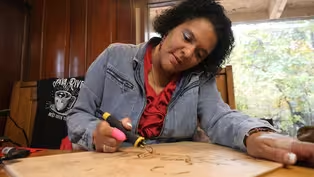
Art inspired by Black history with Jammie Niemeyer
Video has Closed Captions
Clip: S14 Ep1 | 11m 32s | Jammie Niemeyer talks about how her ancestral roots to inform her most recent art. (11m 32s)
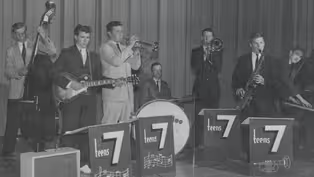
Verlyn Kling and Jammie Niemeyer
Preview: S14 Ep1 | 40s | Listen to the stories about Verlyn Kling’s 1959 Gibson Les Paul and Jammie Niemeyer’s art. (40s)
Providing Support for PBS.org
Learn Moreabout PBS online sponsorship
- Arts and Music

Innovative musicians from every genre perform live in the longest-running music series.
 New Episode
- Arts and Music

Intimate portraits of six of the most influential and celebrated classical music artists.
 New Episode








 New Episode
 New Episode
Support for PBS provided by:
Postcards is a local public television program presented by Pioneer PBS
Production sponsorship is provided by contributions from the voters of Minnesota through a legislative appropriation from the Arts and Cultural Heritage Fund, Explore Alexandria Tourism, Shalom Hill Farm, West Central...