
Ashley M. Jones
Season 14 Episode 6 | 26m 46sVideo has Closed Captions
Alison sits down with Alabama's first Black Woman Poet Laureate, Ashley M. Jones
As though being named the youngest poet laureate in Alabama's history were not enough, Ashley M. Jones is also the first Black Woman to hold the post. Alison talks to the poet about how her verses are opening eyes across the state, and nation, to subjects of justice.
Problems playing video? | Closed Captioning Feedback
Problems playing video? | Closed Captioning Feedback
The A List With Alison Lebovitz is a local public television program presented by WTCI PBS
Funding for The A List with Alison Lebovitz is provided by Chattanooga Funeral Home, Crematory & Florist
Ashley M. Jones
Season 14 Episode 6 | 26m 46sVideo has Closed Captions
As though being named the youngest poet laureate in Alabama's history were not enough, Ashley M. Jones is also the first Black Woman to hold the post. Alison talks to the poet about how her verses are opening eyes across the state, and nation, to subjects of justice.
Problems playing video? | Closed Captioning Feedback
How to Watch The A List With Alison Lebovitz
The A List With Alison Lebovitz is available to stream on pbs.org and the free PBS App, available on iPhone, Apple TV, Android TV, Android smartphones, Amazon Fire TV, Amazon Fire Tablet, Roku, Samsung Smart TV, and Vizio.
Providing Support for PBS.org
Learn Moreabout PBS online sponsorship- [Announcer] Funding for this program was provided by; - [Announcer] Chattanooga Funeral Home Crematory and Florist.
Dedicated to helping you celebrate your life or the life of a loved one for over 85 years.
Chattanooga Funeral Home believes that each funeral should be as unique and memorable as the life being honored.
- [Announcer] This program is also made possible by support from viewers like you, thank you.
- [Alison] This week on "The A List," we'll learn about the power of words with a woman who found her voice on the page.
- When I stand up in front of a crowd, which is still a little scary for me, and I know that I'm saying something that's true to me, that it's my most authentic truth, I feel like the words are there with me.
So in many ways, I'm just reading with the poem.
There are people there, sure, but it's just me and the work.
And that's kind of how I treat all of these public facing situations that I find myself in.
It's just me and the work, or me and the spirit that helped me create the work.
It's not a huge crowd of people, it's not all these strangers who may or may not agree with what I'm saying, it's just me and the truth.
- Join me as I talk with Ashley M. Jones.
Coming up next on "The A List."
(upbeat music) In August of 2021, Ashley M. Jones made history when it was announced she'd been named Poet Laureate of the state of Alabama.
At 31 years old, she was the youngest person to ever hold the position, and the first person of color.
If her historic appointment wasn't impressive enough, she is also the author of three books of poetry, the founding director of the Magic City Poetry Festival, and a member of the Creative Writing faculty at Alabama School of Fine Arts.
Whether she's writing, teaching, or working in her community, Ashley's career has been defined by a deep commitment to truth and authenticity in life, and on the page.
I had a chance to talk with Ashley in our shared hometown, where we met up at the Birmingham Museum of Art.
Ashley, welcome to "The A List."
- Thank you, thanks for having me.
- Well, and we're thrilled to be in your hometown and my hometown, I grew up here too.
But in this beautiful museum of art in Birmingham, I think this is, we're surrounded by beauty, and you have spent your life sort of surrounded by art and beauty.
Tell me about your childhood growing up here.
- Oh man, I love talking about my childhood.
So I grew up here in Birmingham, and I'm a part of a family that's very artsy.
We're a little unusual, I think.
All of my siblings are artsy kind of people.
My two sisters write, they also both do visual art.
My younger brother sings, and my parents weren't practicing artists, but they were just artistically inclined.
So my dad worked as a fire chief and a paramedic, but he had this talent for doing portraiture with pencil that he discovered when he was like eight years old.
He just said, "One day I wanted to draw something, and so I did, and it was amazing."
So he did portraits of all of us that are hanging in my mom's house right now.
And my mom, I think, and another life was a writer.
She has a writer's mind and a writer's eye.
So anything that I write since I was very, very young, I run it by her first and she'll tell me, this is good, this is bad, maybe change it this way.
And so, yeah, I grew up in that environment where we could be whoever we wanted to be.
We loved reading and watching public TV, that was our thing, we didn't have cable, so we were watching "Mr. Rogers" and "Reading Rainbow" and the "Lawrence Welk Show" every night.
As little kids, we were looking forward to this like archaic show.
But it was just a wonderful time to explore and just to be myself.
And from a very young age, I learned that I wanted to be a writer.
And I've been writing poems since I was seven years old.
So in many ways I'm still kind of living in that magical childhood world.
- What stands out more vividly for you; writing your first poem, or reading your first poem out loud?
- Reading my first poem out loud is definitely way more vibrant of a memory.
People always ask me, what's the first poem that I wrote?
I literally don't remember.
I mean, I know it was probably something very bad.
First of all, I was seven after all, so it was a kid poem, and very like anxious.
I've always been like poetically in despair.
You know how we are as poets tortured.
And so, although I wasn't, but you know.
But I do remember reading my first poem aloud when I was seven.
I was in the Self-Contained Gifted program at Epic Elementary in Birmingham, which is a really amazing school.
It kind of started me off on my kind of road to loving diversity, because the school was very diverse, and they valued celebrating differences and helping us understand that differences weren't something to be afraid of.
So in the second grade, my teacher asked us to memorize something that we had been reading, come to class, recite that something in costume.
So it was gifted class, so we did a lot of interesting things.
So I had been reading this book called "Honey, I Love" by Eloise Greenfield.
And I don't remember why that book ended up in my library stack, honestly.
Our librarian, Mrs. Beardon, was amazing, she always had so many great books available.
And the book really kind of changed my whole life, honestly.
I mentioned earlier that I always been a tortured poet, and part of that was that I was kind of struggling with my identity.
My parents were very adamant that we knew our history as Black people in America.
And I am so grateful for that.
But as a child, sometimes it's hard.
It was hard for me to understand how do I live in this society which has done so much harm to my people?
How do I celebrate myself in the face of all this hatred?
And so that book really was a turning point for me because in the book, there are images of Black children.
It's illustrated as well, it's poems and illustrations.
And the children are thinking through all sorts of things.
They're talking about their curiosities, their angers, their joys, their family, and also their history.
And seeing all those sides represented in a Black child kind of showed me that I can be more than one thing at a time.
I can be someone who knows my history, I can be someone who's afraid of people who have hatred in their hearts, and I can be someone who's also joyful, who also loves being Black, who doesn't feel like it's our fault that people treat us this way.
And the poem that I chose to memorize was called "Harriet Tubman."
So I remember getting up in front of my class as a little seven year old person with enlarged adenoids and tonsils.
So I sounded just terrible.
And I was super afraid of crowds and speaking in front of crowds.
But I got up there in my little Harriet Tubman outfit and I began to recite.
"Harriet Tubman didn't take no stuff, wasn't scared of nothing neither, didn't come in this world to be no slave, and wasn't gonna stay one either."
And there's more to the poem that I don't remember, but... - I was just gonna ask if you still remember it.
That is impressive.
- No, no, just that little piece.
But I do remember as I said those words, I felt this incredible power.
Like I felt connected not only to Tubman, but to myself.
I felt proud of being Black, I felt proud of my history.
I felt at home in the language itself.
And I knew that I had to keep doing whatever it was that made me feel all those feelings.
I didn't feel scared, I didn't feel shy.
I just felt like me, for like maybe the first time in life I felt unafraid to just be myself.
So from that day on, I transferred my spy journal, I transformed it into a poetry journal.
I also loved "Harriet The Spy."
So I would spy my family like the little weirdo that I am.
But I wrote all these poems in that book and they were all just weird little anxious poems, or history poems, or poems about God.
All the things that I write about now, I've been writing about since I was seven years old.
- It's clear that poetry called to Ashley the day she read "Harriet Tubman" aloud.
And her answer to that call has been unwavering.
After college, she pursued her Master of Fine Arts in Poetry, while simultaneously beginning her career in teaching.
Her work as an educator, allowed her to share with her students the command of words that empowered her as a young person.
In 2017, she released her first book of Poetry, "Magic City Gospel," which won the silver medal in poetry in the Independent Publisher Book Awards.
Her growing success planted her firmly in the public eye, but being comfortable in the spotlight didn't come easily.
How do you go from the shy, young seven year old who doesn't wanna stand in front of an audience to the opposite side of a spectrum?
To using your words to not only represent your family, your person, your people, but to influence others, and sometimes in a really, really profound and provocative way?
- I mean, it was a long process.
I won't say it just, you know, oh no, I'm not eight.
No, I was still very, I'm an introvert, which nobody knows except me.
It seems people assume that I'm not, 'cause I speak a lot, I'm a public facing person.
But it took a long time to really get comfortable putting myself out there.
And for a while, actually, I told you that I wrote about all those things as a young person.
But once I began my formal writing education, I abandoned all those things that I knew, because I wasn't like the other kids in my class.
So for a lot of us who go to specialized schools or art school or any kind of school that's like different, I guess, those of us who are people of color, often we're not around our people.
And in my case, and it certainly was true when I was coming up, there weren't a lot of us there.
And so when I would write from my authentic experience, I wouldn't always get the reaction that I was hoping for or that I would be met with confusion or there's memories that I have of just feeling like, oh, they don't get this, this is not right, nobody else is writing this.
We're not even reading Black poets as much as I would like us to, so maybe I should just be like everybody else.
So that was part of that process is coming back to those things which are authentic to me.
And part of the authenticity is what allows me to feel more confident.
You know, when I stand up in front of a crowd, which is still a little scary for me, and I know that I'm saying something that's true to me, that it's my most authentic truth, I feel like the words are there with me.
So in many ways, I'm just reading with the poem.
There are people there, sure, but it's just me and the work.
And that's kind of how I treat all of these public facing situations that I find myself in.
It's just me and the work, or me and the spirit that helped me create the work.
It's not a huge crowd of people, it's not all these strangers who may or may not agree with what I'm saying, it's just me and the truth.
- Do you remember the first time you read a poem by Lucille Clifton?
- I do.
So- Well, I do and I don't.
So I had mentioned to someone, or in an interview I said, I discovered Clifton when I was in college.
And somebody reminded me that they shared a poem of hers with me like a few years before.
So it was around like my late teens that I first read her work.
And I just felt this connection that I hadn't really felt before with another poet since that first experience.
And for her, she was coming to me at a time when I was trying to come back to myself and trying to make sure that I felt okay being me on the page, and reading her work just really showed me I can be exactly who I am in exactly the way I want to be who I am on the page, and there is a space for me in American poetry.
Even though I might not see it in my classes, or even see it in my classmates, I do belong somewhere.
If this woman was able to write all these poems and be celebrated as she is, certainly I can be too.
- And Ashley certainly found her space in the landscape of American poetry.
Already allotted writer after the release of her second book, "Dark Thing," it became clear that Ashley was on the right path when in 2019, she received the Lucille Clifton Legacy Award, honoring her contributions to the craft, name for the woman who had given her so much in her formative years.
But even before all of the recognition and awards, Ashley's identity has always been deeply rooted in her art.
So at what point do you think you went from a woman who writes poetry to a poet?
- Oh, I think I was a poet since I was seven years old.
I think once you write a poem, that's what you are, you are a poet, I tell students this all the time.
And even my adult students who are like, well, I'm trying to be a poet.
If you're writing poetry, that's what you are, claim it already.
Because if you spend your whole life thinking, well I just want to be this, I hope I can be this, maybe I'll be this, you're not going to be that thing.
I think we put too many restrictions on people and we tell them you have to reach all these benchmarks to become the thing you want to be.
But for me, if you want to be an artist of any kind, just make the art.
So I've always felt, even in those years where I wasn't quite writing what I wanted to write, I still said, oh, I'm a poet, this is what I do.
Because it is what I do, it's what I feel most comfortable doing, in fact.
So yeah, I don't think there's ever been a transition.
The transition, however, might be from being a poet to a public poet.
- Right.
- That has been an interesting change.
- When did that happen?
- I think in late college and definitely in grad school, I began to do a lot more readings and do more work in the community.
So I had to kind of be Ashley M. Jones instead of just regular old Ashley, which is interesting.
They are two different sides of me.
- So if transitioning from a poet to a public poet was a huge deal, what was the transition to Alabama Poet Laureate like?
- Oh goodness!
It was a lot.
I mean, I already was touring and doing a lot of things outside of Alabama and in Alabama, so I was used to being public in a certain sense.
But once the news broke that I had been named poet laureate and because of the historic nature of my appointment, everything just exploded.
People were so excited because it had been, I think when I was commissioned 91 years of the position existing and never having had any person of color ever, or anybody, I guess under the age of 40 or 50 or something like that, which is a lot to think about.
I never thought that I would be the first anything.
As a kid I thought, okay, that'll be done by the time I was an adult.
Here we are, you know.
So it really wasn't kind of overnight just change.
I was used to doing interviews and doing just the author thing.
But after that news broke, the interviews I was getting asked to do were just like ridiculous.
Getting an email from Good Morning America, I thought it was a scam, if I'm honest with you.
And I read it I was like, no way.
Y'all don't wanna talk to me, I'm just me, I'm nobody.
But I had to realize I'm carrying history in a different way now, I already was, all of us are.
But to know that people are looking at me and looking to me to be whatever it is they think I'm going to be, or to be the thing that allows them to reach for their goals as well.
I've met so many children and even adults who just say thank you for doing what you're doing, thank you for showing up for us.
Thank you for always being Black and not being afraid to say, I'm a Black person and I'm proud of it.
Thank you for talking about our history.
It's been different in that way.
Like, I don't have to imagine who might be reading my poems.
Like now I'm meeting them and they're telling me things, it's more of a conversation in real life instead of just on the page, if that makes sense.
- [Alison] Throughout her four year tenure as poet laureate, Ashley will tour the state, give lectures, read poetry, and hold workshops on a local and national level.
She'll also continue to give back to her own community where she founded the Magic City Poetry Festival, a month long artistic celebration with readings, workshops, panels, and more.
As we took a stroll around the city that has helped shape her, I wondered what could be left on the bucket list for a woman who has achieved so much at such a young age.
- There's a lot of different stuff that we do.
- So what's the goal, like in the future?
Is it that you want to be the US Poet Laureate?
Is it that you, (laughing) is it to to be featured at inaugurations and national, international events?
You know, what, how do you define success?
You've already reached it, obviously.
- Oh, well thank you.
- But how do you sort of scope out what future success looks like for you?
- Well, I have a list of goals that I've had for a while and I've been kind of checking them off as the years go by.
So I do wanna be the US poet laureate one day, hopefully before I'm 40, hopefully.
And I would love to be an inaugural poet, depending on the administration, I would love to be the inaugural poet.
But I really just wanna keep writing books and impacting people.
I have a goal to be the dean of a college at some point in life.
I used to wanna be university president, but like that's a lot.
I really want to be as stress free as I can be when I'm retirement age.
So I might just stop at dean.
But yeah, just to keep writing and just keep living honestly for as long as I can.
- Well, speaking of writing, you mentioned how much you love to read your own poetry.
Would you do us the honor of picking a poem out of your book?
- Of course.
Yeah, this one is one that I read everywhere.
I even went to Good Morning America and read this to the nation.
- Well, if it's good enough for Good Morning America, it's good enough for PBS, right?
- Well, I would reverse those actually, PBS matters a little bit more to me.
- We love that.
- But this poem is a sonnet for anybody who's keeping score out there.
And it's about how racism doesn't just exist in the south.
You know, as somebody who's from the south that people love to say y'all, but it's really all of us.
Even if you go all the way back to the beginning of slavery, the whole country is involved in all of this.
"All Y'all Really From Alabama."
And it begins with a quote from Dr. King, which reads, "The straight jackets of race, prejudice, and discrimination do not wear only southern labels.
The subtle psychological technique of the North has approached in its ugliness and victimization of the Negro, the outright terror and open brutality of the south."
That's from Dr. King's book, "Why We Can't Wait."
"All Y'all Really From Alabama."
This here, the cradle of this here nation, everywhere you look, roots run right back south.
Every vein filled with red dirt, blood, cotton, we the dirty words you spit out your mouth.
Mason Dixon is an imagined line.
You can theorize it, or wish it real, but it's the same old ghost.
See through benign, all y'all from Alabama, we the wheel turning cotton to make the nation move.
We the scapegoat in a land built from death.
No longitude or latitude disproves the truth of founding father's sacred oath.
We hold these truths like dark snuff in our jaw.
Black oppressions, not happenstance, it's law.
- "All Y'all Really From Alabama" is one of the many beautifully crafted and deeply personal poems from Ashley's newest book, "Reparations Now," which was released in 2021.
The book explores history, identity, race, family, God, womanhood, and a need for repair.
Yes, in our politics, but in more personal ways as well.
In offering a more holistic idea of reparations, Ashley is seeking to make sense of pain, and it was the act of writing the book that got her through the most painful experience of her life.
So I wanna end at the beginning.
- Okay.
(laughing) - But the beginning of your book, and your dedication to your dad.
What did that mean to you?
- That's another poem which really took me by surprise.
Of course, I didn't expect my dad to pass away.
It was quite an unexpected death.
I still remember the day very vividly.
It's hard not to see it in my mind actually, every single moment of every day.
But I knew when he passed away and I was preparing the funeral arranged with my family, I knew that I would have to write something, because often when somebody passes away in my family, they ask me to write a poem.
And I didn't know how I was going to do it, because with everyone else, of course I love everybody who's passed away in my family, but my dad is my dad.
Like he was the center of our entire world, our entire family, and I didn't know where to even begin.
The blank page was just screaming at me, honestly.
And I thought back to a conversation I had with a poet named Faisal Mohyuddin who's in Chicago.
And he was telling me about the acrostic form, which is usually used for children, it's where on the left margin, it's spelled something often somebody's name.
And he told me that he uses it to memorialize people.
And I said, okay, I have to try this because I'm trying to put the entirety of my dad.
And he was quite a dynamic person.
I shared with you, he was a fire chief, a paramedic, best dad ever.
- And a portrait artist.
- And there you go, a portrait artist as well, how do I fit this huge piece of my heart into a tiny little page?
And so I wrote his name along the left side and the words began to come, and I couldn't believe that it was happening.
I was like, oh my gosh, how am I writing this right now?
It's only been like two, three days since he's passed away.
I just saw his dead body in the hospital, how am I able?
And the poems really throughout my life, the poems are the things that kind of help me process hard moments.
And in many ways, my whole life of writing about these difficult historical issues prepared me to write about this most difficult issue that I've ever faced in my life.
I was able to pull on the work to kind of get me through it, and I read it at his funeral.
And that memory is just emblazed on my mind.
I can see it now, me standing there and him there in his casket.
And now when I read that poem, I don't feel sadness exactly, which I thought that I would.
Instead, I feel just that feeling of my dad is here, it's as if I'm able to bring him into the space by reading that poem.
And I put it at the beginning of my book, again it was like the very last thing I did because he passed away so unexpectedly.
I knew that I had to have him there to bless the entire project.
So I'm really glad that I was able to include it in this book.
And I've heard actually other people read this poem.
There was a young woman who read it at an event in Lafayette, Louisiana, she memorized it.
I didn't know she had memorized that poem 'cause they had several they were gonna do for the authors who were visiting.
I walked into a coffee shop where they were doing a popup of these recitations, and I heard her start the poem, and I had never heard it before.
I'd only heard myself read this poem.
I can't even describe to you.
I mean, I started to cry, and I don't cry in public either, just like my dad.
But I couldn't even contain like the way that I felt.
It was as if my dad was there.
Somebody else was saying, Hey, there he is, and it felt like, oh, he's close.
He's not really gone.
So yeah, that poem, it does all of that for me.
It's a very short poem, simple poem, but it contains that whole world.
Yeah.
- Well, I know we talked about how words can be powerful, but I want you to know you are powerful.
- Oh, thank you.
- And your words bring us all inspiration and the power to change, so thank you.
- Thank you so much.
(upbeat music) - [Narrator] Watch even more of the shows you love anytime, with WTCI Passport on the free PBS app, download it today.
- [Announcer] Funding for this program was provided by.
- [Announcer] Chattanooga Funeral Home Crematory and Florist, dedicated to helping you celebrate your life or the life of a loved one for over 85 years.
Chattanooga Funeral Home believes that each funeral should be as unique and memorable as the life being honored.
- [Announcer] This program is also made possible by support from viewers like you, thank you.
Preview: Ashley puts her historic appointment in perspective
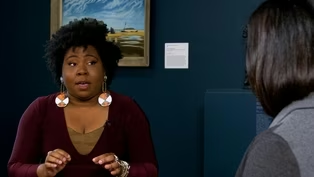
Preview: S14 Ep6 | 2m 30s | Ashley describes the transition to becoming Alabama's poet laureate. (2m 30s)
Providing Support for PBS.org
Learn Moreabout PBS online sponsorship

- News and Public Affairs

Top journalists deliver compelling original analysis of the hour's headlines.












Support for PBS provided by:
The A List With Alison Lebovitz is a local public television program presented by WTCI PBS
Funding for The A List with Alison Lebovitz is provided by Chattanooga Funeral Home, Crematory & Florist