OnQ
August Wilson African American Center Clip
Clip: Season 10 | 9m 41sVideo has Closed Captions
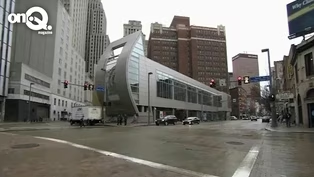
This clip of OnQ features the newly opened August Wilson Center for African-American Culture.
This clip of 'OnQ features a segment about the August Wilson Center for African-American Culture. After opening its doors the previous fall, the center welcomed OnQ correspondent Kemo Crawford for a tour of its new facilities. The segment explores the center’s art gallery, theater, and performance hall, highlighting its mission to celebrate African-American culture.
Problems playing video? | Closed Captioning Feedback
Problems playing video? | Closed Captioning Feedback
OnQ is a local public television program presented by WQED
OnQ
August Wilson African American Center Clip
Clip: Season 10 | 9m 41sVideo has Closed Captions
This clip of 'OnQ features a segment about the August Wilson Center for African-American Culture. After opening its doors the previous fall, the center welcomed OnQ correspondent Kemo Crawford for a tour of its new facilities. The segment explores the center’s art gallery, theater, and performance hall, highlighting its mission to celebrate African-American culture.
Problems playing video? | Closed Captioning Feedback
Where to Watch OnQ
OnQ is available to stream on pbs.org and the PBS app.
Providing Support for PBS.org
Learn Moreabout PBS online sponsorship[Music Plays] Welcome to OnQ.
I'm Michael Bartley.
Tonight, we're headed downtown to see the latest addition to Pittsburgh's cultural district.
The August Wilson Center for African American Culture opened its doors last fall after more than a decade of planning and construction.
It's located on Liberty Avenue near the Federal Building, and inside you'll find a performance hall, a museum and art gallery.
It's an impressive building, and it's being called a world class center OnQs Chris Moore has the story.
[Music Plays] It was 12 years in the making.
I think Pittsburgh is deserving of a cultural center of this magnitude.
It's a great addition to the architectural landscape of Pittsburgh.
I think we've needed something like this.
The August Wilson Center for African American Culture had its dazzling debut in September 2009, making it one of the newest arts and performance venues in downtown Pittsburgh.
It's the crown jewel of the cultural district.
Brand new, shiny building.
There's nothing like this in the world.
Named for Pulitzer Prize winning playwright August Wilson, The center is just a few miles from his modest childhood home in the city's Hill district.
At 65,000 square feet, It's located close to hotels, restaurants and the Pittsburgh Conventio Center for hundred and 86 seats, and you say, not a bad seat in the house?
Every seat provides a great view to the stage.
Kemo Crawford is the project manager who helped oversee construction of the final phases of the center.
We had over 23 contractors working on the project, so it's not your typical project in any way.
It's a very modern looking building.
The spaces are different than what you normally see in a building of this type in the city.
I think the architect, Alison Williams in San Francisco wanted somethin that wasn't stifled by time, but but could grow as a facility and the needs of the grew.
So it's really a great space, a space that's bright, open and inviting, a far contrast to the rundown turn of the century buildings that once occupied this stretch of Liberty Avenue.
You'll notice that the building appears to have more floors than it does.
The floor heights are very, very high.
They're about 22 feet floor to floor.
We have floor to ceiling glass to bring in a lot of ambient light into the space, to really cut down on energy costs during the day.
And then the marquee sale on the end of the building kind of gives it an identity, creating an icon, really, for the August Wilson Center.
[Music Plays] History, culture and innovation blend it together to create many other interesting features here.
The zebra would again going back to the theme being an African American Culture Center and the combination of the stone.
And we have doors that are 20 feet tall that move on a single pivot.
You really don't see that anywhere else, but you see it here.
[Vocal Sounds] Something else, visitors will see, an interactive room and plenty of artwork and photographs by local African Americans like Thad Moseley and Teenie Harris.
Tell me about this beautiful theater in the stage on which we sit.
We have a fully functioning state of the art theater, and it's very, very intimate.
So whatever you're watching, whether it's dance performance or musical performance, it's a great place to really get engaged with the performance on the stage.
And when it comes to performances, the August Wilson Center is reaching out to cultural and arts groups in Pittsburgh and beyond.
Shay Wafer is vice president of programs.
What do you think the center brings to the cultural district and downtown Pittsburgh?
In one word, diversity and diversity.
On many levels, I think we've done a good job at attracting individuals who are diverse, economically diverse in terms of race and ethnicity, as well as diverse in terms of male, female children and adults.
I have taken it upon mysel to have one on one conversations with almost every cultura organization and artist in town, and talking about ways that Wilson Center can support what they're currently doing, be it they do an event here that we present and help them produce or some or their facility or in collaboratio with them at their own facility.
What do you envision over the years coming to the August Wilson Center?
Blockbuster Visual Arts exhibits, engaging in depth explorations of issues and concerns that are happening in the African-American community through our public programs, conversations with great thinkers and scholars, both locally and nationally, as well as the amazing artists that we present and produce on our stage.
We're looking out the at the hotel.
We got the convention center here.
Andre Kimo Stone gues is also excited about the future and the potential of the August Wilson Center, a former vice president and producer for Jazz at Lincoln Center in New York City.
He's now the head of the August Wilson Center.
We're on our way to becoming the preeminent institution for African-American culture in the world.
The fact that the founders had the foresight to see that they didn't want to define themselves in some notion of what an arts and cultural institution should be.
So they didn't say, well, we're either going to be a performing arts center or we're going to be a museum space or a gallery space.
So you have music, you have visual art, you have theater, you have dance, you have all these things speaking to one another and the development of a continuum of art.
And that's what this place will do thats new.
There will be no segregation of them.
So you want this building to live and breathe art, and in particular, African-American art?
Absolutely!
The city has a deep and abiding passion for art, the legacy of great Pittsburgh artists and the African American sphere specifically.
I mean that countless numbers of greats Strayhorn, Bearden, August Wilson Of course, when I say that we are on our way to becoming the preeminent institution for African Americans, that's because there's nothing like this in the world, because there's a place that's in the middle of a cultural district.
It also has a funding community to wrap this arms aroun and truly want to work together.
Those are the recipes for success success that August Wilso would understand and appreciate, having overcome many obstacles himself.
This is the donor's lounge and a beautiful portrait of August Wilson.
Yes, he's always in our midst.
You know, you come in here and he's kind of looking over it.
There was a lot of blood, sweat and tears that went into this place, and it's fitting that it's named after him for what he represents, not only for Pittsburgh, but for theater and arts in general in the world.
It's also befitting that it's named after him for another reason, because he was able to make an international name for himself.
And so we looked to do the same thing is bring the richness of Pittsburgh and hope to take that out to the entire world, and then drawing people from all over the world to come here.
[Music Plays] The staff of the August Wilson Center really hopes to engage the community and bring local talent to the center, but they also want to bring in people fro across the nation and the world.
So expect to see all kinds of engaging performances and artists there over the next few years.
And it's a shame Michael, August Wilson never got to live to see the building completed.
He died in 2005 at the age of 60.
I think he would have been pleased!
Don't you?
He would have been pleased and proud.
What a destination!
You know, I was at a fair there not long ago.
Sitting at those floor to ceiling windows you showed and looking down Liberty Avenue.
The space is just extraordinary.
But some people did want it to be in Homewood.
Well, yeah, that's true.
And I asked Andre Guess about that now.
He said it just made sense to build the facility downtown.
He also said the center was ther for everyone, and being downtown made it accessible to people not just in the city, but those in the surrounding areas as well.
He also stressed that although African American art and culture is showcased at the center, the August Wilson Center is not just for African Americans, but for everyone.
And indeed, I passed by their last night and there was a crowd of people there, and they seemed to be having a good time.
And it's diversity as well.
The auditorium is beautiful, but we have to be pleased with the with the interactive element.
We saw that stuff going on.
Oh, that is really nice!
And I saw a lot of footage from WQED down there.
Chronicles, it chronicles a lot of the history of WQED and indeed Pittsburgh too.
All right, so much to see down there Chris, thanks so much!
All right.
And there's more information.
Don't forget, on our website about all of this WQED.org/OnQ As always, visit the site.
Still to come.
A special preview of this week's episode of Filmmakers Quarter and the River town, once home to a bustling foundry, is preserving that important piece of local industrial history.
OnQ, contributor Dave Crawley has that story next!
[Music Plays]
 Now Playing
August Wilson African American Center Clip
Video has Closed Captions
This clip of OnQ features the newly opened August Wilson Center for African-American Culture. (9m 41s)
Providing Support for PBS.org
Learn Moreabout PBS online sponsorship New Episode
- News and Public Affairs

Top journalists deliver compelling original analysis of the hour's headlines.
 New Episode
- News and Public Affairs

Today's top journalists discuss Washington's current political events and public affairs.
 New Episode
 New Episode
 New Episode
 New Episode
 New Episode
 New Episode
 New Episode
 New Episode
Support for PBS provided by:
OnQ is a local public television program presented by WQED