
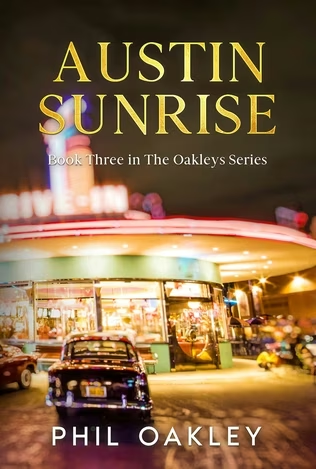
“Austin Sunrise” by Phil Oakley
Season 2026 Episode 10 | 28m 28sVideo has Closed Captions
Phil Oakley joins to discuss his book, "Austin Sunrise".
Phil Oakley, author of Austin Sunrise which is book three in the Oakleys series, discusses the final novel in his family saga trilogy, which follows two brothers whose paths take them across frozen military landscapes, bustling Austin cafes, cutthroat oil fields, and the booming postwar restaurant scene.
Problems playing video? | Closed Captioning Feedback
Problems playing video? | Closed Captioning Feedback
The Bookmark is a local public television program presented by KAMU
“Austin Sunrise” by Phil Oakley
Season 2026 Episode 10 | 28m 28sVideo has Closed Captions
Phil Oakley, author of Austin Sunrise which is book three in the Oakleys series, discusses the final novel in his family saga trilogy, which follows two brothers whose paths take them across frozen military landscapes, bustling Austin cafes, cutthroat oil fields, and the booming postwar restaurant scene.
Problems playing video? | Closed Captioning Feedback
Where to Watch The Bookmark
The Bookmark is available to stream on pbs.org and the PBS app.
Related to This Episode
Providing Support for PBS.org
Learn Moreabout PBS online sponsorshipHello and welcome to The Bookmark.
I'm Christine Brown, your host.
Today my guest is Phil Oakley, and we'll be talking about his latest novel, Austin Sunrise.
Phil, welcome back.
Thank you for being here.
Yes, it is great to be here.
And I appreciate these annual visits.
They're becoming a habit and I love them!
I look forward to it every summer because I'm going to have a new, interesting novel to read.
So this is the last in the trilogy, but I got a little spoiler alert that there may be more coming for next year, so we won't miss our appointment.
Well, I hope not.
I mean, I got a contract on the book.
If you want to put it in writing, I'll go with it today.
Lovely.
Well, we'll look forward to it.
So this is the.
This is the last in this trilogy of the Oakley's just to catch everybody up with our don't remember from last summer or even the summer before.
Can you kind of set the story, you know, What what is this overall story?
Let's catch us up a little bit.
We've now moved to the last days of World War Two, and this story is going to focus on the two youngest brothers, Brooks and Wright.
Other family members are in it too, but their parents have become pretty old at this point.
And we're going to start.
Unfortunately, we've got some funerals to deal with in the family, but there is so much going on between the last days of World War two and the Cuban Missile Crisis and the subsequent assassination of President Kennedy, that it's it's you have to you have to kind of pick your spots.
So we're going to see these two primary characters and other members of the family and other interesting people.
Go through some of the most challenging times that humans have ever seen, and they have some magnificent success.
And in typical family fashion, for my family, they they have a lot of tragedy too.
You're telling the story as in the last book.
This is more of the stories of the children of Walter and Ada.
They had a lot of children had to hate.
Why did you choose these two to focus the story through?
Because when we get to this golden age for Texas and that's what it was.
You know, Texas played a huge part of the war and in development of new weapons systems and all kinds of innovations in aviation and.
These two men led lives that were tragic, temporary, almost and triumphant, and ultimately not so triumph.
Well, so they're they're really interesting people.
One of them was these are characters, you know, the one.
Who is youngest was my father, Ray Oakley.
And the separation time between he and his older brother was about 13 months.
So they were very close together all their lives.
And we saw that in the last book, runners, about how they had come come up in school virtually together, and they go into business together in a very big way.
And they, they also participate in some amazing history, not just World War two.
But Brooks winds up doing more time in Washington than he does in Austin for several years and during very exciting and very perilous times during the Cold War.
I feel like we've talked about this a little bit with the last two books.
These are based on or derived from your your real family history.
But obviously at some point you're diverting or you're embellishing or you're adding to how much of this is fiction and how much of this is is based on a true story, I think.
I think the.
Skeleton of the events is all is all got real events and real.
Situations as, as the basis of reality.
But in the terms of some of the some of the things that happens in their personal lives, it gets very fictitious.
And one of the one of the reasons it's that so is because Loren Steffy, the publisher at Stony Creek, wrote me about maybe 12 words.
He said, this is great, but I wish something really nice could happen for Ray.
So he added about 100 pages to the book and three months of my life.
But he got his wish and it made it a much better book.
I did want to talk about that.
Is this the longest of the three?
I think it was thick.
Yeah, this this simple hatchet are pretty close to the same size.
This is this this one got a little bit longer, but I got a I got a pass from the publisher because it was his idea.
Well, and I think maybe endings are, you know, you don't maybe you don't want to let it go, or maybe you want to really wish that.
He said, you know, he said, we're finishing this.
Let's let's go ahead and do it right.
Sure, sure.
I mean, I don't want to imply that it's too long or that drags or anything.
I, I enjoyed it very much.
But yeah, I think with an ending, you really want to you want to wrap it up, you want to end it proper, you want to give them the sendoff they deserve or they need or they don't deserve.
In some cases maybe.
But yeah, it makes sense.
This one, unlike the other two, doesn't end in a cliff.
Cliffhanger.
That's true.
You do.
We do get some finality for the characters, for sure, and some some of the only way that you can.
This is also, I feel like the other books, they all they covered pretty transitional moments in American history and kind of set the characters in there, but maybe this is one of them.
I mean, it's a lot of a lot of things are happening in not a very, you know, it's really only, what, 20 years, maybe 15 years, but the world between 1944 and 1960, it changes are absolutely entirely.
Yeah.
And it wasn't just the detonation of nuclear weapons.
All the all the science that would end up building these things and all of the other things that eventually won World War two for the allies and particularly for the United States.
This this was a technological era that is very comparable to what we have seen in, in digital technology for the last 25 to 30 years.
And it, it just it just changed everything.
It absolutely changed everything because vast sections of the state of Texas didn't even have electricity in people's homes.
Well, you know, the war comes along and it stops all the construction of that infrastructure that that was scheduled to end with the second Roosevelt administration.
Nobody ever imagined that there would be four terms.
It was, you know, but everything went into the war, and the things that came out of it absolutely changed the entire world.
There's a there's a moment towards the end where character is kind of reflecting on these stories, these tales that they've heard from from Walter's day forward and at.
Walter isn't in this book as much as we we discussed.
But, you know, his life is kind of the impetus for all the books.
And when you when you think about somebody who lived in the time he lived where he went from a cabin and dealing with Native Americans up to what we're talking about, the electrification of the state and nuclear weapons.
I mean, and there were people that your grandfather was a real person who lived this life that saw this.
He came to Texas extreme amount of change with the with the wire getting a mule.
They didn't have automobiles.
When he made his first, first worry into Texas, I had a great grandfather who was born and then traveled the a covered wagon as an infant, and he lived until I in 2003.
I was a teenager.
I mean, when you think about what what a life, what they've seen, it's unfathomable for for someone like me.
Yes.
Well, it's, you know, but again, we're we're talking about things that I've lived through that most people have no recollection of.
And if if you take American history and American high school, you're going to spend a lot more time on the Revolutionary War than you're going to spend on what happened during the 1950s and the 1950s changed everything, and no place other than California was that more true than Texas.
And we do cover that.
How much of a boom, you know, of course, there was the old boom, which we all maybe do know a little bit more about, but what that did to our state, well, look at all the technology that's come out of the oil industry, primary building material in the world today is derived from petroleum products, and whole world is made out of some form of what we used to call plastic there.
There are all kinds of developments, but some of the massive warplanes are mostly these composites.
They're they're invisible to radar.
We talked before about how you had done some research on, like for the first book, the railroad system and stuff like that.
So much American history as we we've been discussing happens in this book.
Did you?
Was it all maybe just from memory or from the history of you've taken or did you do something?
It took a lot of research.
I mean, sure, I knew the I knew the basic framework of it, but many hundreds of Texas towns disappeared because the railroad went somewhere else.
And there are two towns in Texas, two big, huge cities, Dallas and Fort Worth.
That became that way because of railroads.
You know, there's there's not much oil in the city of Dallas.
There's a little bit there's a little bit more in Fort Worth.
But that's that's not the engine that that droves, Dallas and Fort Worth.
Originally it was transportation.
And it's still true.
It's except they call it DFW airport and Love Field and and Alliance Airport in this you know, these are massive changes.
Another big part of the book is the changing landscape or makeup or look or whatever you want to call it, of Austin and Houston, both these, these towns, totally normal change.
I know it's not going to be 1 to 1, but were you trying to kind of get Austin, you talk about the change of like South Congress and and Lamar and these streets that maybe old Austin thinks of differently than people and move there now.
Yeah.
And, you know, I mean, Austin's change in the last five years has been so strikingly dramatic.
And and you you can't imagine how sleepy Austin was even at the end of World War two.
We were talking earlier today, all of these people who used the GI Bill when they got out of the armed services at the end of World War two, came to Austin, they came to College Station, they went to Lubbock, to Texas Tech, University of Houston.
All of these institutions became what they are.
Well, because of World War Two.
And I recall as a child in Austin looking at hundreds and hundreds of not dormitory rooms, but recycled army barracks that were taken from these little flying fields and, and other training facilities, put on big trucks and hall to Austin.
And I'm sure they did it in College Station.
Yeah, we've got some we've got a spot on campus.
That's exactly what it started as.
It's so, you know, the space program, it was another offshoot of the kinds of technology that we've had to deal with over and over again.
Texas Instruments and that little calculator they built that was that was the beginning of a whole new era.
All the avionics that were developed in the state of Texas.
All of that satellites, very rich thing to mind from Bitcoin.
The next book maybe I know I also like there's there's some new characters we get to meet in this book, some you know, kind of especially when we're thinking about the growth of cities, the the apocryphal farmer who doesn't want to sell his land as the city grows around him.
That's a very true story.
That part of the story, it's it's a it's a a truck farmer in Houston, right across the street from him was Memorial Park.
The other direction, less than a mile, was River Oaks, the most exclusive part of the city of Houston.
And he had like 8 or 10 acres that he grew tomatoes.
And that's what he did.
He was a very wealthy man.
He owned all kinds of real estate.
It was real.
He was a real person.
I didn't use his real name, but he was a real person.
And it was just an astounding thing that it was kind of like the end of The Godfather, where where he's out there in his tomato plants when he has a heart attack.
This man lived to raise tomatoes, and he was very proud of what he did.
He was he had come from Italy and and he took a liking to my father.
And eventually for a while, he made my father a wealthy man.
Well, that makes me like the character even more, to know that he was based on a real person, because he was he was a lot of fun.
But he's also, you know, kind of what you think of when you think of that architect.
Yeah, yeah.
And he, you know, he had he had no interest in the modern world at all.
There's a whole bunch of stuff in the book about him not wishing to deal with bankers.
Again, that was based on reality to an extent.
I don't think he was quite as immune to to go into the bank as we portrayed him of the book, but he didn't want to have anything to do with this.
He didn't care anything about going to downtown Houston or anywhere else.
When his wife died, he just stayed at the farm for the the rest of his life.
And you saw one right beside another, you know, I mean, there's a scene where Ray Oakley is in the suite in the Rice Hotel in downtown Houston, and looking out his window a few miles to the west, he can see the pine trees of of Memorial Park and ride.
At the end was this little truck farm.
There was development all around it even then, but he had nothing.
No use for it.
The the restaurant business plays, plays a large part.
And, you know, part of that boom did was that was that based was the word that restaurant family.
Absolutely true.
Some burger, which was my family's hamburger business.
And Whataburger started about the same time.
I think we were about a year ahead of them.
We had far more restaurants than they had, and we grew much faster.
But where they became a Texas institution and we were confined to history, happened because my uncle would not franchise the business to anybody else, and everybody in the world begged him to do what Water Burger eventually did.
The hamburgers were virtually the same.
And but then again, so was Carl's Jr and and in and out.
These these were all post-World War Two versions of an old American Depression era standard.
So the restaurant business paid for my livelihood.
And until I went to work on my own and, and my father had a real steak house in Houston, it was called Petty's.
And it was the place to go to eat steak.
And that's, you know, today where there hundreds of state places all over serving very expensive meat in a restaurant setting that didn't fit with the Great Depression.
That's not what people had grown up doing.
The only reason that had happened was this old Italian farm that believed in the business, you know, and mostly believed in my father, and that he had the foresight to see we're coming into postwar.
It's going to be different.
Yeah.
It's gonna I think both of these main characters really understood that quite well.
I never quite figured out why my uncle wanted to be in the restaurant business, other than the fact that he liked talking to his customers because he deliberately never learned how to cook.
Because he told me, he told me, he said, you know, if I ever cook in this place one time, every time somebody gets sick, I'm going to wind up cooking instead of running my business.
So he deliberately would not even go in the kitchen.
He he just loved this place called the Longhorn, which was an Austin institution for more than 30 years on on Congress Avenue, right?
Basically across the street from the Capitol grounds.
But he he didn't love it because he liked being in the food business.
He loved it because he got to visit with everybody.
He came in there.
They were his friends.
He was their friend.
Everybody in town knew it.
And and they were the only 24 hour a day restaurant in Austin.
For a while, the Nighthawk picked up and did the same thing.
But, you know, we just take 24 hours a day for everything, being open as old, established practice that it is now.
But it wasn't then.
People didn't didn't have radios to listen to in the late 1930s still because they didn't have electricity in the house.
If if they if they read or studied, they did it with a kerosene lamp or Coleman lantern, something like that.
Because if there's no electricity, why is this completely different?
I did enjoy the when the steakhouse together.
There's some characters who maybe come in from out of state or yeah, some out-of-state characters who come in to help cook and maitre d and all that.
And there's a little friction, a little bit of poking fun at how Texans like to take their state run, which is a very learned up.
I think we've learned a little bit, maybe to appreciate a medium or a medium well, but there is there's a general a generation of protection that didn't want to see any pink in that steak.
And, you know, it was really funny.
And there's there's a fair amount of it in the book.
My father literally learned how to cook steaks from listening to his customers in his saloon.
At one end of Congress Avenue was the Longhorn Cafe, which his brother Brooks ran at the river end of Congress Avenue.
Half a block off the street was my dad's saloon called the Shamrock, and he would listen to some of the conversations that took place at that bar, and that gave him the idea of how to how to cook steaks with a with an oak fire in a, in a big brick pit.
And I was old enough to watch him go through all of that part of it, that though I never exist in any of these books, but he he custom built this, this pit in our backyard.
And he cooked steaks for about six months until he got what he wanted to be the final product.
Everybody in the world told him, well, why don't you add this?
Why don't you do this?
And they would inevitably do it right after they had just admitted that it was the best steak they'd ever tasted.
We we all have our own idea of how something should be.
And, you know, lots of businesses, particularly in our era, these specialty chicken places that have made mega millions of dollars for every new arrival who's come along, everybody knows how to cook chicken, but you, you can't cook it that way.
Exactly.
So this wraps up this trilogy.
Now that it's it's or this part of it is over, how do you feel about about the books or the process?
Are you happy with how it all came out?
I really am an especially happy about this book, because I came to terms with my father writing this book.
You know the publisher was right.
I wish something good would happen to Ray, and even though I didn't see that much of it in real life, it was it was great to write some real, serious and important happiness for him.
This book is an easy standalone because it concentrates on two characters that don't have much play in the other books, or at least not as adults.
The others have bigger cast of family members.
This one primarily focuses on two people, so it's easy to read this book and then go back and read the other two.
The middle book is the one I think this hardest sure to get if you haven't read the first, sure, but the first and the third book easily stand up.
So I'm I'm just delighted with the way it came out.
I got to tell a lot of stories about innovations in human behavior that came up, came into being in my lifetime in Texas.
You know, we weren't like most of the other states that had been part of the Confederacy.
Integration of the races came much easier in Texas than it did in our neighboring states to the east, and even in Georgia, which is a very progressive place for for the South.
In modern times, City of Atlanta was kind of an island.
They they never experienced the kind of racial.
Intolerance and disputes that most of the rest of the Deep South did, but that was confined to Atlanta.
Georgia was a very tumultuous place during that era.
And I'm not saying that everything was fine in Texas, but we talk about the integration of public accommodations in Houston, and it almost happened the way I wrote it in the book.
The leadership of the city said, for the biggest city in the state of Texas, we're a world class city now, and we're going to be a huge city.
And they were right.
It is a huge city, and we've got to behave that way.
And at that point, things that would take another ten years to enact into law.
But by the Congress from a Texas president, Lyndon Johnson, who plays a big role in this book, by the way, Houston did not have the kinds of problems that the other southern cities had, including doubts.
Dallas Dallas did not have a pleasant experience.
Sure.
Moving past racial segregation?
Sure.
Well, unfortunately, we run out of time.
So we're going to I know we're going to have to leave it there.
But for all this kind of these themes of of how how we as humans are, we as Texans dealt with these social issues, read the book.
It's a fun way to to get into that history.
Phil, thank you so much for being here.
Thank you.
I enjoyed this so much.
I know when I reach you, I've reached an audience I'm aiming for.
Thank you.
Really appreciate the effort.
That's very kind.
You say we're happy to have you.
We look forward to that next one next summer.
Me too.
That's all the time we've got for today.
Again.
The book is Austin Sunrise.
Thank you so much.
And we'll see you again soon.
 New Season
 New Episode
- News and Public Affairs

Top journalists deliver compelling original analysis of the hour's headlines.


 New Episode




 New Episode

Support for PBS provided by:
The Bookmark is a local public television program presented by KAMU