
Bach: The Cello Suites
Special | 57m 59sVideo has Closed Captions
Edward Klorman and Matthew Zalkind discuss the history of J. S. Bach's six Cello Suites.
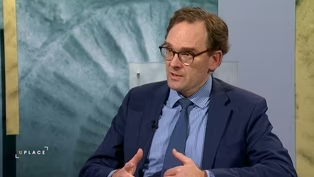
Edward Klorman and Matthew Zalkind, professors at the University of Wisconsin-Madison Mead Witter School of Music, join Wisconsin Public Radio's Norman Gilliland to explore the history and mystery of J.S. Bach's innovative and beloved Cello Suites. Professor Zalkind also performs all six suites.
Problems playing video? | Closed Captioning Feedback
Problems playing video? | Closed Captioning Feedback
University Place is a local public television program presented by PBS Wisconsin
University Place is made possible by the Corporation for Public Broadcasting.
Bach: The Cello Suites
Special | 57m 59sVideo has Closed Captions
Edward Klorman and Matthew Zalkind, professors at the University of Wisconsin-Madison Mead Witter School of Music, join Wisconsin Public Radio's Norman Gilliland to explore the history and mystery of J.S. Bach's innovative and beloved Cello Suites. Professor Zalkind also performs all six suites.
Problems playing video? | Closed Captioning Feedback
Where to Watch University Place
University Place is available to stream on pbs.org and the PBS app.
More from This Collection
PBS Wisconsin's own educational series featuring interviews, performances and lectures. This wide range of presentations features studio interviews hosted by Wisconsin Public Radio's Norman Gilliland, live performances, and lectures on topics ranging from history to science to arts and culture.
Video has Closed Captions
Lea Jacobs explores director John Ford's style and cutting-edge production techniques. (55m 41s)
Inside the Wisconsin State Crime Laboratories
Video has Closed Captions
Robert Block explains forensic field services and shares stories from his career. (41m 40s)
Video has Closed Captions
Mark Louden gives an overview of Amish history, culture, values and faith. (54m 28s)
Video has Closed Captions
Christopher Kolakowski explores how WWII's end triggered a worldwide wave of independence. (55m 53s)
Wrecked: The Edmund Fitzgerald
Video has Closed Captions
Thomas Nelson examines the factors behind the tragic 1975 Lake Superior shipwreck. (56m 13s)
James Madison and the U.S. Constitution
Video has Closed Captions
Howard Schweber explains James Madison's political theory of the U.S. Constitution. (57m 1s)
Profiles in Cold War Espionage
Video has Closed Captions
Alfred McCoy describes covert operatives who orchestrated key events during the Cold War. (59m 1s)
The Conservation Effort to Save the Jaguar
Video has Closed Captions
James Campbell shares the natural wonders and modern challenges of the endangered jaguar. (55m 51s)
John DeMain: The Maestro Remembers the Early Years
Video has Closed Captions
John DeMain shares his musical journey from childhood through his early conducting career. (57m 23s)
American Revolutionary War Tactics
Video has Closed Captions
John Hall examines weapons and tactical development during Revolutionary War battles. (59m 27s)
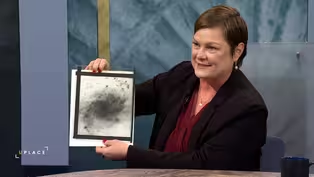
Yerkes Observatory: Past and Future
Video has Closed Captions
Amanda Bauer discusses the observatory's 125 years of astronomical research and education. (56m 55s)
The Effects of Video on Early Childhood Development
Video has Closed Captions
Heather Kirkorian describes positive and negative effects of video on young children. (56m 23s)
Providing Support for PBS.org
Learn Moreabout PBS online sponsorship[gentle music] - Norman Gilliland: Welcome to University Place Presents.
I'm Norman Gilliland.
The half dozen suites for unaccompanied cello by Johann Sebastian Bach are a mystery.
We don't have Bach's original manuscripts of them.
We don't know why he wrote them, and we can only guess at how he wanted them played.
They were practically unknown for 150 years until one prominent cellist made them famous, since which time many cellists have performed and recorded them.
We'll take some of the mystery out surrounding the suites with my two guests from the UW-Madison School of Music.
They're Edward Klorman, professor of music theory and author of Bach: The Cello Suites, and Matthew Zalkind, professor of cello.
Welcome to University Place Presents.
- Edward Klorman: Thanks for having us.
- Matthew Zalkind: Thanks for having us.
- Well, everybody loves a mystery, and Bach is providing us plenty of mysteries here with these six suites for unaccompanied cello.
And so, let's maybe have some guesses and get some facts along the way.
And why do you think that Bach wrote these six suites?
- That's one of the toughest questions to answer.
You know, Bach began his career mostly known as an organist and keyboard player, and he was mostly composing music for those sorts of instruments.
At a certain point, he became interested in developing his skills as a violinist, and that included using the violin as an instrument that could sort of reach beyond its capacity to write contrapuntal music.
That means music with lots of chords, where one instrument has melody and bass line and other voices, and then, at a certain point, he aspired to try to do the same thing with cello.
We don't know if he played the cello during his lifetime.
In German-speaking lands, the cello was mostly used as an accompanying instrument for playing bass lines.
So, what is it exactly that inspired Bach to try to develop the cello sort of beyond what it naturally might seem like it's able to do?
So, in these pieces, often you might have the impression that you're hearing more than one instrument.
He draws a lot of resonance, a lot of technique out of what you're able to do with this instrument.
And then, over the course of these six suites, you hear the instrument in all different kinds of ways, in different styles, in major and minor, playing melodies, playing chords.
One of the pieces even has a fugue.
So, that's a piece where it really sounds like there's two or three different instruments all coming out of one player and one cello.
- Is there some kind of overarching idea that connects all six of these suites?
Each suite has six movements.
- Edward: Yeah, very typically a suite would have five or six movements.
So, all of them have exactly six movements.
They're all different stylized versions of different dance types, and very common in Bach's lifetime to compose pieces in groups of six.
So, the idea is, over the course of these six pieces, you show off sort of encyclopedically what you're able to do in a suite with this particular instrument.
But one thing that's unusual, you know, there are these six pieces for unaccompanied violin that he wrote around the same time.
They're all about the same level of complexity.
But the cello, as you go across the six suites, they get more complex in terms of the technique it takes to play them.
Also more complex, maybe emotionally or in terms of the expression.
I don't know if this was Bach's idea, but there are some people who've responded to it as being almost like a human life, beginning with innocence and something sort of natural and aspiring toward things that are more fraught.
There are even folks who have interpreted as having a kind of a Christian overlay, where maybe Suite No.
5, which is the darkest suite, having something to do with the crucifixion.
And then, Suite No.
6, which is the brilliant climax of the suites as having something to do with the resurrection.
- Well, I've heard that said of his Well-Tempered Clavier for keyboard, where you're getting-- You start out in the C major key where you're comfortable.
- Yeah.
- All white notes on the contemporary piano, and you get farther and farther away into these relatively exotic minor keys, implying that, if we're talking about a religious arc, you are farther and farther away from God by the time you get there.
And then, you have this resolution at the end.
- Yeah, certainly Suite No.
1, we'll hear a little later, the prelude to that first suite, which is the most famous movement from the cello suites, you hear it emphasizes all the open strings.
This is the cello if you play a string with no fingers down.
So, these are the easiest notes to play.
They're the notes that ring the most.
So, it's almost like introducing this instrument in its most natural idiom.
- What is the purpose of a prelude?
I've heard it said that it's, in a way, to serve kind of like an overture, setting you up for what's to come.
Is that true of Bach's preludes in these six suites?
- Yeah, a prelude often would be improvised.
So, if a composer wrote one, it's almost like they've composed something free enough in the manner as if it might sound like you were improvising.
It introduces the key that the movements that follow will be in.
Often, they introduce certain chords or certain musical ideas that you're going to hear come back over the course of the movements.
There were musicians in Bach's lifetime who said that the different movements of a suite should be like a family.
So, not just that they're in the same key, but they have other little hallmarks that make them fit together.
So, the prelude would be responsible for introducing some of those.
- And, so, Matt, what do you hear in the prelude?
- Matthew: Yeah, it's really interesting.
I do realize now, thinking as you're talking, that every prelude is so different, so unbelievably different from each other.
When you think about all the courantes, for example, there's a courante in every suite.
There's an allemande in every suite.
We're talking about dance movements.
You can sort of feel, for the most part, I guess, with some exceptions, you feel the connection with all the courantes, for example.
But that each prelude is so unique and so different, and it really does set the stage for the rest of the suite in a really amazing way.
And you mentioned the open strings, and I could demonstrate now just what the open strings sound like on the cello.
[bows strings] I could tune while we were at it.
In the first suite prelude, which I'll play in a second, you'll hear a lot of those sounds ringing throughout, and Bach really knew how to sort of exploit the resonance of the instrument, which you hear from-- - And which suite does this come from, this prelude?
- The first suite.
And you have some-- I love what you say about the first suite prelude.
- Oh, I've learned that, for instance, on the website Reddit, people write about "that cello song," [all chuckle] and that's what they mean.
- You hear it a lot.
- This is a prelude that is-- it's really ubiquitous.
It's been used in many films.
So, for instance, the film Master and Commander, where it represents the ocean.
It's been used in commercials ranging from pizza to diamonds to La-Z-Boy furniture.
- And yet, Bach didn't get a nickel of royalties.
[all laugh] - That's right.
Even in recent series like on Netflix, the series Wednesday, that's the new Addams Family reboot, in the very first episode, there's a long montage where Wednesday is playing the cello, and what she's playing is a pop song arranged for solo cello.
But when you zoom in and Thing is turning the page for her, that's the music from the prelude to the first cello suite.
- Well, imagine what you will, as we hear this prelude from the Suite No.
1 by Bach.
[bright cello music] [bright cello music] [bright cello music] - A lovely sound, and a lovely beginning.
But you know what I'm reminded of, talking about beginnings, this is probably the most, let's say, popular, most heard movement of all of the, what is it, 36 movements in these suites.
Same thing could be said of the Prelude No.
1 in C from The Well-Tempered Clavier.
Why?
Why are these so wildly popular?
- Well, they're both the very first thing in both of those sets.
So, if The Well-Tempered Clavier is a journey through all the different keys for keyboard, this is something like this for cello.
They're similar.
They're both what we call a pattern prelude.
So, often, if a composer was composing something like this, they'd begin with a chord progression and then they decide, well, what's the figuration going to be?
And, in this case, it's arpeggios.
And so, with the cello, you hear on three different strings, ♪ dee da dum ♪ So, it's a way of getting the cello drawing a lot of sound out of it.
You imagine someone who might be used to the organ and all of its capacities for how much sound, wanting to invite the cello to be just as ringing as that.
- Is it your favorite, Matt?
- That is a tough question.
That's a tough question.
It's... impossible to have a favorite.
I think the favorite is what you're playing in that moment because you realize, when you play these works, that there's so much to discover and a different way to treat a harmony or a phrase.
And every time you come back to it, you can't help but be just astonished by all of it.
So, I can't say that I have a favorite.
- Is relatively simple compared to the other ones, from what you've been saying?
- This prelude?
- Mm-hmm.
- Yeah, you know, that's an interesting question.
Simple, you know, because, in a way, when you look at the harmony of the D major, the final prelude, which is, as Ed mentioned, maybe in a way the most musically complex, you start looking at the harmonic rhythm and the harmony, and it's actually quite simple.
- Mm-hmm.
- Yeah, so it's hard to say.
I think they're all so touching in various ways, you know, so.
- Would you say that one of the reasons Bach is so popular still today is that he knew how to write a tune?
- Hmm, that's an interesting question.
I mean, often, The New York Times, a few years ago, they had this event where, over the course of a few months, their readers were supposed to debate who's the greatest composer of all time.
- Oh, boy.
- And it's inevitable that the answer they come up with, J.S.
Bach, is because so much of the music so many of us are familiar with who deal with Western classical music has some relationship to Bach's music.
It's interesting to imagine that there was a time that this music was scarcely known, that, when this was composed, it probably wasn't played very much for at least 100, maybe even 150 years.
And when it first entered the concert hall, folks weren't entirely sure what to make of it.
And now, it is so ubiquitous, there's over 300 recordings of these pieces.
At least two albums have won the Grammy Award.
It's a rare piece that children can learn to play, but you also might go hear a musician at the level of Yo-Yo Ma go play.
So, it has a lot to find in it for musicians and listeners from different kinds of backgrounds.
- Felix Mendelssohn sometimes gets the credit for creating the whole concept of classical music, because before that it was all contemporary music.
- Edward: Right.
- But to actually go back, an exception might be Handel's Messiah, but when Mendelssohn, at the ripe old age of 20 in 1829, decides to pull out some Bach and put it in a concert, and it's like, everybody is, as you say, "What's this?"
You know, this old-fashioned music.
But then, suddenly Bach just seems to have taken off to a great extent.
Before we go any further, though, Matt, what's the pedigree of your instrument?
- Oh, so this is by a British maker named Thomas Kennedy.
So, it's an 1801 cello.
It's something I've been fortunate to play for a little while, and it's one that I love a lot.
I love the rich, low sound of this cello, which is what drew me to it initially, so... - We've talked about dance movements, and other than the preludes, they're all, for all six suites, dance movements of some kind.
Did people actually dance to these genres in Bach's time, or were they already kind of fossilized?
Except for the minuet, of course.
- Matthew: Such a great question.
- The short answer is mostly no, but I need to give a little background around that.
So, you could think, when I talk about a dance being like a stylized dance movement, that would be like if you listen to a symphony and there's a minuet movement.
That's different from a minuet that would be danced to in a ballroom or as part of a ballet.
So, there were these genres.
You'll hear titles like allemande, courante, sarabande, and gigue.
Those are the four main dances that every suite will have, plus a prelude.
So, that gets us to five out of the six.
But then, in the second-to-last position, so between the sarabande and the gigue, Bach used these more modern dance types that were still popular in his lifetime, such as the minuet, the bourrée, or the gavotte.
So, for a musician in Bach's lifetime, they would know each of these styles.
They would have seen them danced in ballet.
Bach, when he was a teenager, he went to a choir school that was next door to a school that was sort of for aristocratic gentlemen, young aristocrats, and those aristocrats, they aspired toward French culture.
They often spoke the French language, even though their native language was German.
They would have learned comportment from a French dance master who probably had spent time at Versailles.
So, there was a real pedigree to these French dances, and it was maybe something like what, for a generation later, for composers like Haydn or later Mozart, they write a sonata that has, you know, four, three or four movements, and that's a kind of a cycle.
The Baroque suite was the equivalent of that with these different dance types.
- Well, let's hear a couple of dance movements then.
- Matthew: Sure.
- The courante, and we'll get into this maybe after the fact, but the sarabande had a kind of a scandalous history behind it, sort of the equivalent of a tango back in, oh, as early as the 16th century, and these-- This is a courante and sarabande from the Suite No.
3... - Right.
- ...by Bach.
- And the courante literally means what, as a dance?
- Yeah, from the French verb "courir," which means "to run" or "to flow."
- Right, so, in this case, this movement, the courante is a very fast dance, which I'll try not to play too fast, but you'll hear the wonderful energy that comes in all the courantes.
And we'll talk about the sarabande after, I guess, right.
[lively cello music] [lively cello music] [gentle cello music] [gentle cello music] [gentle cello music] - Norman: After hearing that sarabande, it's easy to see why people would think this is Bach thinking about his relationship with the cosmos, if you wanna look at it that way.
I mean, there's this kind of wondering quality to it.
- Mm-hmm.
- Yeah.
These movements, the sarabandes, I think, at times, can have the most introspection, wouldn't you say, within the suites, you know?
- Yeah, they're often played a little bit slower.
Well, you hear these two back to back, and you really hear the contrast, the kind of scampering and the kind of virtuoso quality of the courante that you played, followed by the repose and the timelessness and maybe introspection.
- Yeah, absolutely, yeah.
- We'll get into timelessness again, I'm sure.
But how do we know what kind of instrument exactly?
We say the cello today, we just say the cello.
And back in the day, of course, even now, you still see violoncello.
But if you go back and look at pictures, and I know, Ed, you have a wonderful book about these suites with illustrations of people holding the instrument various ways and the instrument various sizes and even numbers of strings.
- Edward: That's right.
You know, nowadays when we talk about a full-size cello, this is pretty much what we're thinking about.
We, it has four strings.
You play it with an endpin connecting it to the floor, usually.
In Bach's lifetime, there were many different kinds of instruments, all called cello, some larger, some smaller.
Rarely played with anything like an endpin, but sometimes people would put them on a stool to hold them up.
But then, there were even instruments called "violoncello da spalla."
That means something like "shoulder cello," which were played like this with a neck strap and fingered something like a violin.
So, there are folks who speculate.
Could it be that Bach played the violin, and then he considered the violoncello da spalla to be its larger cousin?
The jury's out about that because there aren't surviving instruments of that type that would give us a sense of how large were they?
Would this music be playable on that instrument?
But when I read writings by people in Bach's circle-- So, Bach had a cousin who wrote a dictionary of music, and he writes about "What is a cello?"
He writes more about that da spalla instrument than about this instrument, so it makes you wonder.
Musicians we know historically who played the cello, could that be an instrument they sometimes might have meant?
- And what about five versus four strings?
You'd have completely different fingering, wouldn't you?
- Absolutely.
So, we know fairly certainly that the sixth suite, which we'll, I think, come back to a little bit later, that that was intended to be played on a five-string cello.
And most of the time today, you'll hear that suite on a four-string cello.
It's not super practical to lug around a five-string instrument when you're playing a concert or something.
And it's also difficult to learn if you've never played a five-string cello before.
So, we have to just compensate for that loss of an extra string on a four-string cello.
And it's very hard.
[laughs] - Not exactly, as we say, idiomatic on a four-string cello?
- No.
Would you say that the five-string instrument was...?
- I think it's most likely.
And there are folks who would disagree with me, but the consensus is probably these pieces were written for a cello that looks something like this.
Do we know exactly?
Was it this size, or could it have been smaller?
We don't know.
Bach grew up in a family that was responsible for a lot of different kinds of instruments.
His father had a title called "The Town Piper" in the city of Eisenach.
One imagines maybe the young Johann Sebastian was put to work stringing and repairing instruments as part of the family work.
The violin he seems to have mostly taught himself, so it's not impossible he could have played some version of the cello, but we don't have any evidence that we did.
But it's almost like over the course of the six suites, he wants to explore everything possible on the cello.
So, Suite No.
5 is written for a different tuning that makes some different chords and different colors possible.
And then, Suite No.
6 for the five-string instrument means you can play much higher, more brilliantly.
And then, if you have only a four-string instrument, it's possible, but it requires a lot of compensation to get that high register on an instrument that's missing that high top string.
- How about Bach's use of major versus minor?
What effects does he accomplish when he goes into a minor key?
We've been hearing from major suites so far.
- Yeah, it's really interesting.
I mean, we call-- I don't wanna speak out of turn here with a theorist present, but the relative major or the relative minor key is, if you're in a suite like the C Major Suite, for example, the key of A minor would be the relative minor because the key signature is the same, the same number of sharps and flats.
Is that correct so far?
- Mm-hmm, yeah.
- White keys, white keys, I can tell you that much.
- And, so, very often in, I'd say maybe most of the time in the dance movements of the Bach suites and the preludes, you'll see Bach go into the relative of the original key.
So, in the D Minor Suite, for example, you see F major pretty early on, which is its parallel key.
And it's very interesting 'cause in the context of a minor suite, when you hear a major key, I'm not sure-- You know, we think sometimes hearing a major key is happier.
Sometimes I think the major keys in the minor suite sometimes feel sadder and even more reflective.
And I think his use of that, of going into the major and minor is really quite something.
How do you feel about the... - Over the course of a collection, so if you have these six suites, usually they'll be about half and half major and minor.
In this case, it's interesting.
The first three suites are major, minor, major, and the next three, four, five and six, are also major, minor, major.
That could have been part of how he designed the collection.
And you're absolutely right.
A piece in minor kind of tends to aspire toward its relative major.
So, if we start in C minor, maybe E-flat major, which is the major key with the same key signature, is a place we want to go or the music trends toward.
But also, we mentioned before, those up-to-date dances that are in the second-to-last position, often he does those in pairs.
So, you'll have minuet one, minuet two, and then back to minuet one.
Those are often also major and minor, so you get those juxtaposed as well.
- A device very much with us today still.
Well, let's hear a prelude from a minor key.
- Oh, sure, right, yeah, sounds good.
This is the D minor prelude.
And you'll hear some-- Listen for the F major throughout that as well.
Okay.
[melodic cello music] [melodic cello music] [melodic cello music] [melodic cello music] - Norman: Also quite soulful.
- It is, it is.
- Well, I set up three mysteries at the beginning of our conversation, and we've done our best to answer one of those, which is why Bach wrote these six suites for unaccompanied cello.
But we don't have his original manuscript.
What do we have?
- So, these four manuscript copies, one written by his second wife, Anna Magdalena Bach, one written by an organist who was sort of in his circle, maybe his student, Peter Kellner.
And then, there are these two copies that were made about 50 years later by professional copyists working from a manuscript that had been in the collection of his son, Carl Philipp Emanuel Bach.
And they're all a little different.
So, the notes are mostly the same, but there are some differences.
There are a lot more ornaments in the later two copies.
So, some folks have said, well, they're much later, so surely we should rely on the sources that were made closer to Bach.
But the new thinking around that is, well, they're later, but they were made from a copy that belonged to Bach's son, the treasured copy that he kept his entire lifetime.
So, a cellist-- And then the other thing that's quite different is the slurs.
So, that's a marking saying, basically, how many notes do I play on one bow?
Is it ♪ dee da dum bop bop bop bum?
♪ Or is it ♪ dee-ah da da dum bop?
♪ Or is it ♪ dim bop bop bop bum?
♪ And so, if you're playing these pieces, you really would like to know, if you're a violinist, you have Bach's handwriting for his solo violin pieces.
But a cellist, we have to grapple with these differences and ultimately make our own creative choices about how to approach it.
- Does it help at all to have those violin indications?
Does it translate over to the cello at all, in terms of the phrasing?
- I think yes, because you can get some sense for the kinds of slurs that Bach composes.
But also, this is a kind of Rosetta Stone kind of a story.
Some of the copyists who copied the violin pieces-- the cello pieces also copied the violin pieces.
So, there are scholars who have looked closely and sort of graded them.
What percentage of their slurs matched J.S.
Bach's slurs for the violin pieces, and what does that tell us about how we can rely on their copies of the cello suites?
- So, what do you go with?
[chuckles] - It's hard to say.
I think, comparing the editions and being really thoughtful about certain things, you know, there's even-- There are a couple of moments, let's see, in the D minor suite, for example, with an A flat versus an A natural.
And sometimes I ask the students, like, "How do you feel about this?"
Because it could sound, I mean, they both work so beautifully, and it's so hard to know the answer.
And it's always interesting to see the students say, "Well, I gravitate toward the A flat 'cause it sounds a little more interesting," or, "The, you know, the A natural sounds right to me."
And in that case, I say, "Okay, "well, you know, published, you know, literature here would agree with you on either account."
So, sometimes you have to make those, those determinations, you know?
- Oh, well, I suppose in Bach's time, a piece was never played exactly the same way twice.
Even if you could, probably, it would be more inviting to improvise a little bit on the fly.
- Right.
- All right.
Well, Pablo Casals, the great cellist, the one I teased at the beginning as having made these suites famous, before we get to him, what happened between about, what, 1720 and 1900 or so to these suites?
- Yeah.
It's funny, when I set out to write this book, I thought there wasn't much to say between around 1720 and around 1903.
I discovered there's actually a lot you can trace.
So, one is, when Bach died, one of his students and one of his sons together wrote an obituary describing his greatest accomplishments, and they list all of his compositions that they were aware of because they only knew some of them.
And, you know, it's mostly keyboard music.
It's mostly church music, vocal music.
But then they highlight a handful of pieces that are instrumental pieces that they single out for special mention, and they mention the solo violin and the solo cello pieces.
So, C.P.E.
Bach certainly knew this music.
He had a copy of this.
We know that Bach introduced this music to his students, but it wasn't published until around 1820 in Paris.
And even then, when it was published, it was published in an edition that described it more as études than as concert music.
- Norman: Yeah.
- And we don't even think people played it very much.
There's actually only one copy of that edition that still exists in the world today.
So, the story really picks up around 1860, when there's now many more editions and people are beginning to incorporate this music into their concert repertoire.
And we can trace in the reviews that musicians-- audiences were a little mixed about this.
Sometimes, they'd say, you know, it was extraordinary to discover this music by J.S.
Bach.
It's his highest accomplishment.
The music are true poetry.
And other reviews saying, well, it's really nothing but a bunch of scales and arpeggios.
It really should never leave the classroom.
It's to learn to play the cello, it's not for concerts.
There were musicians, including Robert Schumann, but also others who composed piano accompaniments, and their idea was to modernize this music to suit the tastes of their listeners, to make it something more people might appreciate.
There was another cellist, Friedrich Grützmacher.
He was probably the first to play a complete suite regularly in recital, and he wrote this version that's sort of souped up.
He added more showy fingerings, more chords, more up-bow staccato.
That's where you play many notes in a row, all in one bow.
And his feeling was, he's taking the "bare original," that's his words, and turning it into what Bach would have done if he had fully appreciated what was possible in his writing.
- Well, that's the same thing Mahler said about souping up Beethoven.
- Right.
- You know, so, yeah, it belongs to us now, and we can stylize it for our time.
- Precisely.
- And, of course, they had to sell tickets, too, if he was playing it in concert.
- Yeah.
- Yeah, the Schumann doesn't seem to have taken off very much.
It got kind of, I think, bad reviews from the get-go, didn't it?
- He wasn't able to find a publisher for his cello suites edition.
He did for the violin pieces.
And so, even as late as the 1920s, there were people performing the violin and the cello pieces with piano accompaniments.
Not so much Schumann's, since he didn't publish it, but there were many other accompaniments that were published.
You can hear them on YouTube, and it's interesting to imagine, around the turn of the 20th century, people who heard the cello suites, this was how many of them heard it.
And then, when we compare that to Pablo Casals, whom you mentioned, he really set a kind of standard that has influenced generations of musicians in terms of the idea that a serious cellist should know all six of these suites.
If you perform it, you should perform an entire suite in order with all the repeats and definitely no piano.
So, that idea sort of died with Pablo Casals.
He made the first complete recording in the late 1930s.
- There's one piece in particular from these suites that seems to be popular among Suzuki players.
Which one is that?
- Matthew: Yeah.
So, the first Bach movement that I learned as a kid and that we see quite often is the bourrées from the third suite.
And I don't know for sure if it's still in the Suzuki books.
It's sort of a discussion among many of us to say, how early should we introduce Bach to kids when they maybe don't know the theory when Bach is, you know, our grandfather of modern theory and all these things.
And now, we say, no, it's so great for kids to be exposed to this music and to get it in their ears, right?
And as I did, I think I was maybe nine or ten years old when I learned what I'm about to play for you.
And this is a great example of the major to minor, which you'll hear in the second bourrée, which is entirely in minor.
So, okay.
[lively cello music] [gentle cello music] [lively cello music] - So, how many different ways are there to play that?
[all laugh] - There are so many ways.
There are so many ways.
You know, you have something so simple that can be treated so differently.
It can be strong.
[lively cello music] It could be light.
[softer cello music] It can be playful.
It can be so many different things, you know?
- How did Casals play it?
- It's interesting.
Casals, when you hear the recordings now, we look at those recordings and we say just how unbelievable it was that he recorded these pieces with no standard.
He was the standard.
It's really amazing because now, when we are performing these suites, we can listen to hundreds of recordings for inspiration and ideas and thoughts and what we love, what we don't love.
And to imagine Pablo Casals recording these with, you know, just his own commitment, it's really unbelievable.
A lot of Casals, maybe by today's standards, you'd say that the interpretations are very robust, very earthy, and with a really full, rich sound, which now, as we're starting to learn about period performance, where we're trying to kind of go back to what maybe was more likely the case when Bach wrote these pieces, we maybe wouldn't treat articulations the same way, and we wouldn't treat vibrato and certain things like that in the same way that Casals did now that we've learned so much.
But still amazing to hear how he treated all those pieces.
- Well, if they do get progressively difficult, these six suites for unaccompanied cello, let's tap into that last one.
Put you on the spot, Matt, [Matt laughs] and see how tough we can make it on you with a couple of the dance movements from that, and an up tempo on that.
- Yeah, did you want the demonstrations of why it's so challenging?
- Yeah, why is it so challenging?
- Well, as Professor Klorman, as Ed was saying, we have four strings instead of five for the suite.
There would have been an E string above this A string.
And what that would have meant is playing the gavottes, for example, from the sixth suite, which, on a four-string cello, we have to... [bright notes] ...contort our hand in these crazy ways just to be able to play these chords.
If we had our open strings, it would sound more like... [gentle notes] It'd be so easy.
[Norman laughs] It'd be so great.
And yet, there's something about hearing these pieces in their original key in D major that requires us to try and navigate this.
So, that's what you'll hear.
Shall I play both movements, the gavottes and the gigue now?
- Oh, for sure.
- Yeah.
So, you'll hear the gavottes from the sixth suite and you'll then hear the gigue which follows, which I think are two of the most challenging movements in all six suites, so... - We'll be watching.
- Here it goes, yeah, no promises.
Okay.
[lively cello music] [lively cello music] [lively cello music] [lively cello music] [lively cello music] - Well, given the number of miles traveled by your fingers, [all laugh] I'd say that alone rates... - Matthew: Yeah.
- ...the most difficult part of this exercise.
- This is a lot.
Yeah, it's very hard.
- But it also struck me that those two movements, it was a gavotte and gigue.
- Yes.
- Gigue being just a jig originating in English form, so far as we know.
Struck me as being the most like folk music that we might hear today.
- Yeah.
- Actually, this is the gavottes.
We heard those two gavottes, one after the other.
The second one had a nickname that was given to it sometime around 1870.
It was called "La Musette."
And that's a word that refers to, like, a bagpipe kind of an instrument with a drone.
- Yeah.
- And there's a segment in it.
♪ Ya da da da da da da da da da ♪ Maybe we could hear a little bit.
And you'll hear a droned low D that's meant to sound a little bit like a bagpipe sort of an instrument.
- Hurdy-gurdy?
- Yeah.
[lively cello music] So, when you hear those two gavottes back to back, one of them is in a more sophisticated register, you could say.
And the other is in a more folk register.
So, that's a kind of contrast Bach composed into them.
- Getting back to Casals for a minute, he said something interesting.
He played these six suites for seventy years or more.
- Edward: He began every day... - All the way into his 80s.
- Playing The Well-Tempered Clavier at the piano, followed by the cello suites.
And when people asked him when he was in his 80s and no longer playing concerts, "Why do you still practice every day?"
And he would joke, "Well, I believe I'm making progress."
- I know, isn't that a great line, though?
- It's a great line.
- I mean, because even Casals was saying, who may have been, well, probably was more acquainted with these suites as a performer than anyone else over those, course of those 75 years or so.
Interpreting them slightly differently each time he played them.
- Yeah.
- Well, how's it working for you?
[Matthew laughs] - It is very interesting.
I mean, I've only been playing these suites for maybe 15, 20 years, [laughs] but when I come back and hear an old recording or something, I realize, you know, as we grow and as we change, our feelings about these pieces change.
And I think the most amazing example of this is hearing Glenn Gould's Goldberg Variation recordings.
- Uh-huh, he did 'em twice.
- He did them twice.
- Many years apart.
- There's the 1955, and then there's the-- - 1980, I think.
- Yeah, and to hear just how different that is, it's sort of the lived experience and the thoughtfulness.
And not to say that the '55 recording isn't spectacular, because it is, but... - And of course, not on the harpsichord, but both on the piano, contemporary piano, and, as you say, very different interpretations over the course of time.
- Matthew: Absolutely.
- And that gets us back to this question of time.
What is it that you think makes Bach, and particularly, I'm going to call it this really stripped-down Bach, just one instrument, so... So contemporary and, at the same time, so traditional?
What is it that makes it endure?
- This is music that musicians live with over the course of a lifetime, so it grows with them, and there's so many different ways to do it that it's endlessly enriching.
So, I think that's one piece of it.
I think some of the mysteries surrounding it, how, you know, why this music?
When Bach wrote for solo violin, he had precursors.
He had heard other musicians who had written for solo violin.
He had contemporaries.
But solo cello was, he was sort of doing his own thing, at least in German-speaking lands.
So, this is music that people have always wondered around.
Then, this story around Casals, you know, there's the narrative that Casals discovered the cello suites.
And I push back at that because there's a history before Casals.
But there's a kind of romance about the idea that this was music that was believed to have been completely forgotten and single-handedly resurrected by one person in an unlikely story.
The story is that he, as a teenager, found a used copy on a shelf and never heard of this music.
And then, the other thing that I think Casals has to do with this legacy is, you know, Casals, you know, he was Catalonian.
And when Franco came to power, he fled Spain.
He refused to perform in any country that recognized Franco.
So, his leftist values were very tied to his idea of freedom in music making.
That inspired many other musicians who followed him.
I'm thinking of the Russian cellist Mstislav Rostropovich, who played the Bach cello suites as the Berlin Wall was falling.
- Norman: Checkpoint Charlie.
- Exactly, there's a statue commemorating this.
There's a children's book about Yo-Yo Ma playing the cello suites at the U.S.-Mexico border.
So, many people have found in this music a kind of humanitarian or pro-peace, and something that maybe transcends barriers of language, barriers of culture.
- Is that more so, do you think, than other works by Bach?
Is it singular to these suites?
- I think Bach has a way of reaching our souls in such a special, unique way, I think.
You know, hearing St Matthew's Passion or something has a way of being a truly moving spiritual experience.
I think there is something so unique about being a single-- a single instrumentalist and playing so many voices and playing polyphony, which is what you've been hearing, all the chords, you know, multiple things happening at the same time, but all coming from one person.
I think there is something very special about that too, so.
- One person aspiring to do more than their equipment is really able to do.
So, a lot of it is this fantasy that you're hearing more, or you're aspiring towards something greater than your instrument is equipped.
- Yeah.
- Well, that is the story that you tell of Bach, who always wanted to get more out of the instrument.
And then... And he was always interested in the latest instruments too.
Keyboards or apparently cellos as well.
You know, "What can this one do that I haven't been able to do before?"
- That's right.
He wrote this music while he was working in the city of Kürten, but not too many years later, he moved to Leipzig, where he spent much of his career, and it was there he was interested in different versions of the cello.
So, he wrote some music for what seems to be a five-string cello.
He worked with an instrument maker to develop something called the viola pomposa, which is another variety of a cello-type instrument.
Since some of those had five strings, that's led some people to speculate maybe the cello suites had something to do with those instruments and were written at that time in Leipzig.
But most folks agree that they were probably written at that previous position in Kürten.
That was where he specialized in secular music.
So, a lot of his instrumental music pieces, like The Well-Tempered Clavier were finished there, the Brandenburg Concertos, many of the keyboard suites, and then the unaccompanied violin and cello pieces, most likely.
- And there he is, what, in his mid 30s writing this music.
- Very impressive and mostly self-taught musician who really dreamed a lot about what's possible with limited, limited means.
- Well, Ed Klorman and Matt Zalkind, a great pleasure having you share your music and your insights into the music with us.
- It's been our pleasure.
Thanks for having us.
- Thanks for having us, thank you.
- I'm Norman Gilliland, and I hope you'll join me next time around for University Place Presents.
[gentle music]










Support for PBS provided by:
University Place is a local public television program presented by PBS Wisconsin
University Place is made possible by the Corporation for Public Broadcasting.