
Who Are the Amish?
Special | 54m 28sVideo has Closed Captions
Mark Louden gives an overview of Amish history, culture, values and faith.
Mark Louden, professor in the Department of German, Nordic and Slavic+ at the University of Wisconsin-Madison, joins Wisconsin Public Radio's Norman Gilliland to discuss the history, culture, values and faith of the various branches of the Amish, as well as to dispel widely held myths about the Amish and related groups such as the Mennonites.
Problems playing video? | Closed Captioning Feedback
Problems playing video? | Closed Captioning Feedback
University Place is a local public television program presented by PBS Wisconsin
University Place is made possible by the Corporation for Public Broadcasting.
Who Are the Amish?
Special | 54m 28sVideo has Closed Captions
Mark Louden, professor in the Department of German, Nordic and Slavic+ at the University of Wisconsin-Madison, joins Wisconsin Public Radio's Norman Gilliland to discuss the history, culture, values and faith of the various branches of the Amish, as well as to dispel widely held myths about the Amish and related groups such as the Mennonites.
Problems playing video? | Closed Captioning Feedback
Where to Watch University Place
University Place is available to stream on pbs.org and the PBS app.
More from This Collection
PBS Wisconsin's own educational series featuring interviews, performances and lectures. This wide range of presentations features studio interviews hosted by Wisconsin Public Radio's Norman Gilliland, live performances, and lectures on topics ranging from history to science to arts and culture.

Video has Closed Captions
Lea Jacobs explores director John Ford's style and cutting-edge production techniques. (55m 41s)
Inside the Wisconsin State Crime Laboratories
Video has Closed Captions
Robert Block explains forensic field services and shares stories from his career. (41m 40s)
Video has Closed Captions
Edward Klorman and Matthew Zalkind discuss the history of J. S. Bach's six Cello Suites. (57m 59s)
Video has Closed Captions
Christopher Kolakowski explores how WWII's end triggered a worldwide wave of independence. (55m 53s)
Wrecked: The Edmund Fitzgerald
Video has Closed Captions
Thomas Nelson examines the factors behind the tragic 1975 Lake Superior shipwreck. (56m 13s)
James Madison and the U.S. Constitution
Video has Closed Captions
Howard Schweber explains James Madison's political theory of the U.S. Constitution. (57m 1s)
Profiles in Cold War Espionage
Video has Closed Captions
Alfred McCoy describes covert operatives who orchestrated key events during the Cold War. (59m 1s)
The Conservation Effort to Save the Jaguar
Video has Closed Captions
James Campbell shares the natural wonders and modern challenges of the endangered jaguar. (55m 51s)

John DeMain: The Maestro Remembers the Early Years
Video has Closed Captions
John DeMain shares his musical journey from childhood through his early conducting career. (57m 23s)
American Revolutionary War Tactics
Video has Closed Captions
John Hall examines weapons and tactical development during Revolutionary War battles. (59m 27s)
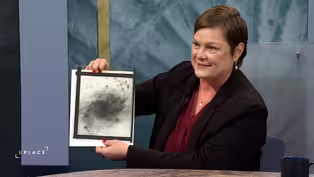
Yerkes Observatory: Past and Future
Video has Closed Captions
Amanda Bauer discusses the observatory's 125 years of astronomical research and education. (56m 55s)

The Effects of Video on Early Childhood Development
Video has Closed Captions
Heather Kirkorian describes positive and negative effects of video on young children. (56m 23s)
Providing Support for PBS.org
Learn Moreabout PBS online sponsorship[gentle music] - Norman Gilliland: Welcome to University Place Presents .
I'm Norman Gilliland.
If you've traveled much through Wisconsin, chances are you've seen them.
Their horse-drawn buggies traveling on the side of the road.
The men in their black felt hats and the women in their kapps and bonnets.
What sort of life do they live without contemporary conveniences and necessities?
And what beliefs are behind that lifestyle?
With me is Mark Louden, professor in the Department of German, Nordic, and Slavic at the UW-Madison, director of the Max Kade Institute, and author of the book Pennsylvania Dutch: The Story of an American Language.
And welcome to University Place Presents.
- Mark Louden: Thank you very much, Norman.
It's nice to be here.
- Well, I think most of us have seen them, and most of us really don't know much about them.
There might be some nostalgia attached for some of us to that lifestyle that we see, and we think of Amish as being great craftsmen and also living close to the earth and taking care of each other.
- Yes.
- But as it turns out, there are, of course, all kinds of Amish in all kinds of places.
Where do the American Amish come from?
- So, the Amish are a religious group, first of all.
A lot of people think in terms of culture and lifestyle and, you know, limited acceptance of technology, that sort of thing.
But they're a religious, Christian denomination whose roots go back actually about 500 years, just almost exactly 500 years, to what was known as the Radical Reformation in Switzerland.
And Zurich, Switzerland, in particular, is where the movement that gave birth to the Amish and related groups began.
- What kind of religious movement are we talking about?
- So, the term is-- The umbrella term to describe the Amish, Mennonites, who are older and from whom the Amish split.
And then two other groups, the Hutterites, which is a communal group living in the prairie provinces of Canada and the central United States, and then Churches of the Brethren.
All four of these branches of Christianity are under the umbrella of what's known as Anabaptism.
Anabaptism is a translation of a German word, Wiedertäufer, meaning literally rebaptizer, which was not a compliment 500 years ago, but it described the fact that the earliest reformers felt that infant baptism was inappropriate for Christians.
that to enter into a covenant with God and to make a formal profession of faith... To live a Christian lifestyle and to adopt the core doctrines of the Christian faith, that that should be a conscious decision made on the part of the person.
So, an infant is not in the position to be able to do that.
And so, Anabaptists, like other Christian churches, not the majority necessarily, but other Christian churches feel that so-called believer's baptism, which is essentially not adult, not child baptism, is the more appropriate choice.
- Was that dangerous back in those days?
- It was not only dangerous, it was considered heretical.
It was considered seditious also, because church and state were kind of intimately intertwined with one another.
Yeah, so infant baptism was one way that the state could sort of keep tabs on who people were, how many kids they have for taxation purposes.
- Still helps quite a bit, doesn't it, for historians.
- It certainly does, absolutely, yeah.
It's a sort of a handy tool to have.
- Well, so what happened to the Mennonites then in central Europe at this time?
I mean, obviously, other than persecution and execution.
- Well, there's a lot of that.
[both chuckle] This starts back basically in 1525, which is at the same time that we're thinking of sort of the broader Protestant Reformation occurring, so that's associated with people like Martin Luther.
And the-- I would say that, you know, from the get-go, there was a lot of not only misunderstanding and lack of respect of the Anabaptists, but sort of more established churches, like, for example, the Roman Catholic Church and various emerging Protestant denominations pretty much could agree that they did not like the Anabaptists.
And so, persecution was the order of the day.
It drove a lot of Anabaptists into, to migrate out of Switzerland and other parts of Europe.
And then, they've been kind of a people on the move for a long time.
But it was in the early 1700s, so in the American colonial era that they were at the invitation of William Penn, that they began to migrate to colonial Pennsylvania.
- Norman: What was William Penn's thinking at that time?
Now, he was a Quaker.
- Mark: He was a Quaker.
And on the surface, there are actually a number of similarities between Quakers and Anabaptists.
I would say the greatest similarity is that our churches are all known as peace-- historic peace churches.
So, our churches reject violence in all forms.
As well as-- So, it's not just simply pacifism, but it's actually what we refer to as nonresistance, which means that you do not engage in violence under any circumstances, including in defensive circumstances, which is setting the bar rather high.
- I would say so offhand, and maybe we'll get more into this later.
But if we associate the Amish in this country with being in rural areas, in some cases, even the frontier, hard to imagine living a completely nonviolent life, nondefensive life.
- Yes, it's a very, as I say, it's a hard-- It's a high bar to raise for oneself.
And in times of war, really starting even before America was established in the so-called Seven Years' War, the French and Indian War, there were pressures on Amish, Mennonites, and Quakers and related groups to serve in a military capacity.
- Did that carry all the way through... - The war on terror.
- ...World War II and beyond?
- Yes, Vietnam, war on terror.
The questions about sort of loyalty and patriotism have been a red thread following Amish and Mennonites, not only in the United States, but everywhere where they've lived.
- This predominant Amish look, and we'll look at some contemporary Amish images.
What time period are we talking about when we look at the American Amish?
I mean, it looks 19th century, early 19th century.
Where did they get, in effect, stuck in time?
- Well, the key to understanding them is that they're actually not stuck in time.
Pretty much every aspect of the Amish, call it culture or lifestyle, has changed since their particular branch of the Anabaptist movement emerged in 1693, in terms of things like the aspects of technology that they adopt or choose not to adopt, the material that they use to make their clothing, right?
It's all acrylic, it's synthetic.
It's not cotton anymore.
They're not sitting at the spinning wheel and making things.
They don't make their own shoes, that sort of thing, the foods that they eat.
These are things that are not carried over from, you know, the late 17th century in Europe.
The one thing that's utterly consistent, though, in terms of Amish life and cultural practices is the-- are the core aspects of their faith and the structure of their religious worship services.
So, basically the kind of, the order of worship that they have and their worship in private homes is pretty much unchanged since 1693 and actually really going before that.
The sermons are original, right?
And it's not like that's not frozen in time, but the actual structure of the worship services, their worship services and the hymns that they sing, these are, you know, going on 500 years old.
- They singing them in Latin or in Pennsylvania Dutch?
-Mark: Sing-- Neither one.
In an archaic form of standard German, which is the, we'll call it the liturgical language or the devotional language that they use.
- Well, let's look at some images then and give us some commentary.
For example, if we see these Amish women, what would you say is the prevailing nature of what they wear?
- Mark: So, all females, and these are unmarried women, that would be referred to as girls, right?
So, that's just simply the way that the Amish distinguish between boys and girls being unmarried and men and women being married.
So, these young women, these girls are actually from Lancaster County, Pennsylvania.
There are some general consistencies of dress across various Amish subgroups, but there are lots and lots of different subgroups.
These young women are from Lancaster County, Pennsylvania.
This image was probably taken in Lancaster itself, but there are a number of people, including here in Wisconsin, who are part of what's known as the Lancaster, Pennsylvania Affiliation of the Amish.
And so, their counterparts would dress identically.
All females wear prayer veils, coverings.
With girls, little girls, it's a little bit variable sometimes, but typically some kind of head covering is considered appropriate for females.
- And the beards for the men?
- So, the beards without the mustache for the men.
- Right.
- So, the choice of letting your beard grow long was something that was basically considered sort of an old biblical practice.
But the shaving of the mustache was an explicit expression of distancing oneself from militarism.
So, if we think about sort of like your stereotypical, you know, kind of like Prussian general or, you know, military hero, especially from, like, the 19th century in Germanic central Europe, you imagine a fair amount of hair on the upper lip.
- Norman: Right.
- And that's something that goes back actually hundreds of years.
And so, that by shaving the upper lip is, among the men, was considered an expression of nonresistance, not militarism.
- And the trademark horse and buggy?
- Mark: So, before about 1910, 1920, it was not unusual to, for most Americans, to get around locally using horse-drawn transportation.
The buggy is actually considered-- was considered in the late 19th century among the Amish to be somewhat fancy, because before that, they were actually riding in open wagons.
And to this day, some highly traditional Amish still use open wagons and do not have the covered buggies.
So, what we're looking at here is a little bit on sort of the progressive side going back to the 19th century.
But the reason why that they've maintained horse-drawn transportation for local distances rather than the automobile is a very conscious decision.
When automobiles came out, which were, you know, basically 1920s, 1930s, like, think of Ford Model A, Model T. That sort of thing.
- Norman: Sure.
And the feeling was, and is, that private ownership of automobiles is something that kind of detracts from community life.
So, it gives-- - Well, it does, doesn't it?
- It does, absolutely, right?
It's a symbol of sort of individual autonomy, yeah.
- Some of the images, or you want to call it characterizations of Amish lifestyles... [chuckles] ...a little bit hysterical in some cases.
[both chuckle] - Mark: Yes, that's true, that's true.
- Norman: And coming from various parts of the media.
- Mark: Yes, yeah, the popular media have done a lot to advance the visibility, I would say, of the Amish, but also a lot of misunderstandings, stereotypes, and distortions.
- And actually, it gets quite extreme.
I'm going to look at some others here that-- The Amish Mafia.
Why does that seem like an extreme oxymoron?
- Mark: You're absolutely correct, there is, I mean, particularly for a nonresistant, nonviolent group to have a so-called reality TV show premised on the idea that there's a sort of Amish, you know, posse, right, that's, whose charge is to sort of defend their community, perhaps using a sawed-off shotgun, which as you see at one side.
That's a complete distortion.
But as we hopefully know, is that reality TV is, there's not a whole lot of reality.
It's TV, but it's not a lot of reality.
[Norman laughs] And it's a little bit like, you know, wrestlers wrestling.
And then there's, you know, wrestling for entertainment.
- Yeah, there is.
[Mark laughs] Yes, so true.
And I guess some romance novels have been spun off too.
- Mark: Yeah, so it's interesting.
You've probably heard the term bodice ripper, right, to describe those Harlequin romances.
- Norman: Yeah, for sure.
- Mark: Amish-themed romance novels are referred to as bonnet rippers.
[both laugh] So, basically they are-- - Norman: That's about as wild as they get.
- Mark: Yeah, it's-- They're a form of Christian fiction, and they're wildly popular.
- Among the Amish, too?
- Less so among the Amish themselves, typically more by outsiders.
If you were to, you know, form opinions on a group of people based on reality TV shows that sort of deal with them, romance novels are gonna make things a little bit more racy and exotic and that sort of thing than everyday life is.
- This might not be the best place to ask this question.
But speaking of kind of outside influences, we'll say, of Amish life, is there this phenomenon of wilding for young Amish men?
- So, that's one of the most misunderstood aspects of Amish life.
The term that's used is rumspringa, which is a Pennsylvania Dutch word meaning literally to run around.
And if you were to look, I think even, like, Wikipedia has it wrong.
But if you look at sort of popular media definitions of what rumspringa supposedly is, it's this idea that somehow young people are either encouraged or allowed to leave the community, go out into the world, sow their wild oats, and then discern whether they want to settle down and join the community formally.
That's not true.
[both chuckle] All it means is that simply when you turn age 16 or 17, depending on your community, you are given-- You've entered into a new stage of life, which means that adults allow you to socialize with other young, unmarried people without adult supervision.
And students in my Amish course, I teach a course here at the UW in religious studies on the Amish, and they liken it to, like, getting their driver's license, right?
So, it's, you're not exactly fully autonomous, but it is a game changer.
- Yes, yes, it would be.
So, is this a point at which some people leave the Amish lifestyle?
- It is a time of discernment.
About 85% to 90% of kids born to Amish parents do make the decision to formally join the church through the act of baptism, which happens, I'd say around 18, 19, 20 years old.
So, after a couple of years of discernment, that happens, yes.
- I can't resist another image here, which is counter to the usual stereotype.
- Mark: Yes.
- Norman: Amish participating in various kinds of sports.
Does that happen?
- Mark: Absolutely.
So, the image that we're looking at here was consciously chosen by the author, Donald Kraybill, who was considered the sort of dean of Amish studies, a sociologist who taught for many years at Elizabethtown College in Pennsylvania.
And the title of his book is, this classic book, he's written several books, but the one that we were looking at here is The Riddle of Amish Culture.
And basically, he's going from the sort of popular outsider's view of the Amish as a paradox, right?
So, they just, it's hard to understand, like, who the Amish are and the choices that they make, particularly when it comes to technology.
So, it's like, "Well, I thought they weren't supposed to-- "You know, they have horse and buggy transportation.
"Yet, I saw a whole van load of Amish people, you know, "at the, you know, big box discount store, "you know, you know, coming out or whatever.
"So, they can ride in a vehicle like a van, "but they can't operate it themselves.
It doesn't make sense."
This image was chosen.
This is not a reality TV image that's on this book cover here.
This was an image that basically shows the fact that the Amish, first of all, are not frozen in time, right?
So, in Lancaster County, Pennsylvania, it's actually considered quite practical with decent weather to get around using roller blades.
There are no dirt roads really anymore in Lancaster County.
So, it's a lot of short distances that you can travel on blacktop, and roller blades and scooters make a pretty good choice.
- So, they adapt in many ways to this lifestyle.
- Absolutely.
- Public transportation, though, you're saying, is certainly acceptable.
- Yes.
- When it's necessary.
- For long distances, train is very popular.
So, anybody that rides Amtrak, especially if they're going through the Midwest or the Mid-Atlantic states, pretty much guaranteed, you'll see Amish people on the train.
- Well, let's get further into the lifestyle.
And if we do that, let's start with talking about differences, if any, among the Amish in the various parts of the country.
And what parts of the country are we talking about?
- So, the Amish are now represented in 32 U.S.
states.
So, most U.S.
states have an Amish presence.
There are three Canadian provinces also that have the Amish.
That's pretty much it, as far as-- There are no Amish left in Europe.
There's one tiny, tiny settlement in Bolivia.
Amish have tried migrating to other countries even before they came to North America.
But by and large, it's just the United States and Canada nowadays.
And the sort of big three states in terms of population are among the oldest population, so it would be Pennsylvania, Ohio, and Indiana.
But Wisconsin is in fourth place.
So, there's between 25,000 and 30,000 Amish that live here in Wisconsin.
- Any particular place in Wisconsin?
Part of Wisconsin?
- By and large, central and western Wisconsin.
So, there are just a couple of settlements in eastern Wisconsin, none in the far sort of southeast part of the state, in the sort of corridor between Milwaukee and Chicago, in part because, you know, inexpensive land or tracts of land in rural areas is not as available there.
But by and large, we're talking about sort of central and western Wisconsin.
- And do they tend to be farmers?
- Not anymore.
So, in the same way that most sort of historically American farms, like small, small-scale farmers have experienced some real challenges by corporate agriculture.
It's just, even for the Amish, whose overhead is overall fairly low, they find it difficult to support their large families exclusively in agriculture.
Now, that could be one part of the sort of economic picture for a family, but by and large, they depend economically in Wisconsin and other states, mostly on small businesses rather than farming.
- Well, we certainly are aware of Amish furnitures having a reputation for a very solid, high-quality product.
What other kind of businesses would typically be Amish?
- So, other things having to do with wood and lumber, so things like cabinet making, pallet shops.
Part of the draw originally to Wisconsin, and the Amish have been a continuous presence here for over 100 years.
Medford, Wisconsin in Taylor County is the oldest Amish settlement still going.
Part of the draw was the access to lumber.
And so, furniture is definitely kind of a popular-- furniture making, cabinet shops, very, very popular.
But other businesses include things like bulk food stores, bakeries, nurseries, garden centers.
All Amish will have pretty serious garden patches.
And so, they may do a little bit of produce farming as a side enterprise.
Those that do farm are kind of drawn to dairy farming, not surprisingly in Wisconsin.
And some have gotten into sort of niche farming.
So, like, for example, goat dairy farms.
- Oh, sure.
- And organic farming is quite popular.
- Are there Amish communities in the sense of villages or towns, or do they tend to be spread out?
- They've never been politically autonomous.
They've always been integrated politically, administratively in the larger communities of which they're a part.
They tend to cluster together.
So, when we talk about Amish communities or Amish settlements, we're talking about sort of geographic proximity.
But they are not-- They don't form colonies, for example, never have.
Population, you mentioned large families, increasing of Amish?
- They are-- Their populations are-- The population is doubling roughly every 20, 21 years.
- Whoa!
[laughs] - There is no other human population on the entire planet that's growing faster than the old order Amish in the United States and Canada.
Now, there are a few other conservative religious groups like Hutterites that I mentioned before, horse and buggy-driving Mennonites, as well as the Hasidim, who speak Yiddish, right, ultra-Orthodox Jews, who also have very high average family size, about six to seven kids per family, and retention rates that are somewhere around 90%.
And most of the babies are born healthy.
Their moms are the, you know, do well in childbirth.
And, you know, they have a very high retention rate.
And so, they are-- Their population is booming.
- Give us a day in the life of an Amish family.
- So, Monday through Saturday would be profoundly different from Sunday.
So, Sunday is the Sabbath.
So, basically from midnight Sunday morning to midnight Monday morning, there's no manual labor that is to be done other than sort of, like, basic chores.
That's a day of worship, it's a day of rest, it's a day of socializing.
Worship services are held every other Sunday in one's church district because the size of a church district, which is similar to a parish, is limited by the number of people that you can comfortably fit into your home for the service.
And so, that's somewhere, you know, kind of following the Amish floor plan, which is kind of open concept, somewhere around 125 to 150.
And so, then-- - In your home.
- In your home.
- Okay.
- In your home.
- Well, they do have-- They start with a large family, so I guess they're gonna have a big house anyway.
- Exactly.
And you know, if the weather's nice, you can worship in a barn or a shop, that kind of thing too.
So, when a-- when a community or a congregation-- they call it church district-- gets above that sort of, you know, level of about 150, then they just sort of naturally divide, right, split into another district.
And so, you'll have, like, for example, in Lancaster County, Pennsylvania, like 115, 120 church districts.
And if you were always kind of tied down to go to your immediate church district every Sunday, you would never see a lot of your friends and relatives and neighbors and so on.
The so-called "in-between" Sunday, it's an opportunity for people to visit other church congregations.
- What are the relations between the genders?
- So, I'd say it's equitable.
In other words, everybody works hard.
There are certain kind of gender roles that are, I wouldn't say prescribed, necessarily, but are sort of traditional.
So, things that are generally relating to outside of the immediate home tend to be the domain of the male in the family, whereas sort of domestic spheres and things having to do with child rearing and child care and that sort of thing, the wife may, or the mother would have sort of maybe a little bit greater say-so.
But there's a lot more balance between the genders in terms of decision-making, especially big decisions like, "Should we move?
Should we invest in this particular business?"
Or the health care decisions they're making, for example, about their kids.
Those are decisions that are, by and large, shared.
I mean, you always find differences, as you do in sort of the general population, where certain aspects of family life, maybe the husband/father has a sort of, you know, greater voice or something versus the wife and the mother.
But it's overall, comes out as fairly equitable, I'd say.
- Is there a separation in these church services of genders, as you might find in some... - Yes, in terms of the seating patterns, they're separated by gender and then by marital status and then by age.
So, the oldest married females and the oldest married males sit up close to the front.
And then, children up to the age of about 11 need to be seated with a parent.
But again, talking about sort of like getting your driver's license, moving to the next stage, before you're able to socialize with young people, it's a big deal when you're able to "sit with the boys" or "sit with the girls," where you don't have to sit with your parents.
And that happens, as I say, around the age of 11.
- How does courtship work out in an Amish community?
- It's a fairly traditional process.
So, courtship is, you know, people selecting partners.
They're not assigned partners.
There's no arranged marriage or anything like that.
It's just simply the mutual decision of the partners.
- What would they do on a date?
- So, a date, dates typically happen on Sunday evenings.
So, the family that has hosted church that day invites all the young people to come back for supper.
And then, if the weather's nice, play volleyball, games, and that sort of thing.
And a young male can invite a female on a date, and then that would take place at the female's home.
And typically, if a girl is dating or if there are multiple daughters in a family that are dating, they would have, say, a parlor, a small room kind of set aside as their sort of territory where they can host their beaus.
- Mm, back to, well, 19th-century America... - Yes, absolutely, exactly.
- ...when just about everybody middle class or higher than that.
- Yes, it's very-- the sort of dating, courtship practices are not, you know, 18th-century European.
They're basically early American.
- Do they have more than one kind of costume that they wear for various circumstances, or the men always, as we see, you know, in-- tend to be in the black and the women with their skirts and aprons and kapps and capes?
- So, the basic sort of designs of dress are consistent.
But there are certain variants, and certainly the material it's made that are more appropriate for work clothes versus formal clothes.
So, like, going-to-church clothes or going visiting or something.
So, for example, for men, they would typically wear denim pants during the week.
You would rarely wear denim to church.
- When an Amish wants to, let's say, raise a barn.
Is that a community effort?
- That is definitely a community effort.
[both chuckle] Raising a barn, building a shop, work parties in general are very, very common events.
And, you know, sort of work is play, play is work.
Amish are very, very social.
There's no such thing as an Amish hermit.
There's no such thing as, like, a rugged Amish individualist.
Everybody thinks in terms of we/us rather than I/me.
And the barn raising is a classic example of that.
- Have the Amish... We're talking still rural here, been... ...having conflicts with environmentalists, given their traditional way of doing things?
- To a certain extent, yes.
I mean, basically by being Amish, your carbon footprint is just inherently from the get-go limited, right?
So, things like sort of using-- avoiding a lot of fossil fuels, I mean, like putting gasoline in your car, that sort of thing, not eating a lot of processed foods, you know, kind of sort of farm-to-table diet.
You know, not investing in fast fashion, right?
These are all things that, you know, they kind of avoid just simply by being Amish.
Now, when it comes to things like use of pesticides and herbicides, they tend to be fairly low-tech anyway.
So, they don't kind of run afoul of that.
There have been some situations-- And situations including here in Wisconsin that I've helped sort of serve as an intermediary for, where the question of some groups, they use outhouses.
And so, you know, it's like, what is happening with what's referred to as the blackwater?
Is there proper control of the-- in terms of sanitation, so that the water table is not polluted?
- And as far as just disposing of various things.
I know 150 years ago, a lot of times, you just dump it in a ravine somewhere on the property and not worry about it.
- Yeah, they are more aware of the fact that that can pose some serious environmental hazards because that ravine, you know, the creek that they're putting something into is probably connected to the water source that they're drinking from their well, because they're not on municipal water systems.
So, just even if they were to be completely selfish about it, which they aren't, but they're also altruistic, they're thinking about their communities.
It's like, you know, it behooves them as well as everybody else-- and the golf courses that may be close by too-- to be mindful of what's put on the ground.
- Are there co-ops?
- There are not Amish co-ops, per se.
They do participate in typically outside agriculture cooperatives, like milk cooperatives.
They're also very strong supporters of Organic Valley here in Wisconsin.
But there are, you know, especially for dairy farmers, they do participate in some cooperative enterprises.
But there are not sort of, like, Amish internal cooperative enterprises.
- Do they pay cash?
- They pay cash, but they also do-- they use banks.
Many use credit cards.
I'd say check writing is more common among the Amish than in the general population.
They don't have smartphones, so they don't have like, you know, pay with your phone, that kind of thing.
But checks, and some-- many do actually use credit cards or debit cards quite commonly.
- They take out loans?
- They do take out loans.
That's true, yep, yep.
To finance, like, you know, to get a mortgage, that sort of thing.
It's, you know, not-- It's possible for every, say, you know, parents, set of parents to, you know, give their children, you know, enough funds to make a go of buying their own property and starting a business, that sort of thing.
Particularly when you're talking about six or seven kids.
- Well, yeah, and population doubling every 20 years.
Then there's got to be a lot of buying going on of one kind or another.
- Absolutely.
- Do Amish have, occasionally, day jobs such as university professorships, and then go back to the fold at the end of the day?
How does that work?
- Yes.
Not so much in Wisconsin, but especially in northern Indiana.
So, like in the Elkhart, LaGrange County area in northern Indiana, that's considered sort of America's RV capital, right?
- [chuckles] Yeah.
- And a lot of these factories that are making manufactured housing and RVs and, you know, ambulances and that sort of thing, much of the workforce is Amish there.
And so, they're actually employed by non-Amish enterprises.
And they're using all kinds of power tools and eating their lunch in the electrified, you know, break room and that sort of thing, and then going back to their farm in the afternoon.
- We have a couple of charts here coming up that may require a long look to get the most out of, but one of them has to do with the relationship among the various-- we'll call them subgroups of Mennonites and Amish.
And can you just give us a quick gloss of this?
- Mark: Yeah, so at the top of that chart, you see the term Anabaptist, right?
And then, the year 1525.
Last year was a big year.
It was the 500th anniversary of the Anabaptist movement.
And there were lots of commemorative events, local and international.
I was very excited to go to Zurich, Switzerland, in late May.
- Norman: Kind of the birthplace.
- Mark: The birthplace where it all began.
And there were Anabaptists-- There were several thousand Anabaptists from around the world that all gathered together in-- on that day.
But the four major branches of Anabaptism are Mennonites, Amish, Hutterites, and Brethren.
Hutterites, I think, would be considered the oldest.
But Mennonites are also quite old.
Hutterites were already getting established around 1525.
Mennonites, about that time, although they were not using the name Mennonite at that point.
And then, as I say, the Amish kind of split off of Swiss Mennonites in 1693.
And then the Brethren group, that fourth group were also traditionally known as Dunkards because they practiced full-immersion baptism.
[Norman chuckles] Dunking.
- When the person being baptized was 16 years old or so.
- Correct, correct, and here's a little fun fact.
So, the English verb "to dunk," right, sounds like an old sort of Germanic verb.
It is the only word in sort of standard American English that has been borrowed from Pennsylvania Dutch.
[laughs] Dunke.
- Fascinating fact.
- Yeah.
- As long as we're talking about language and we've heard about Pennsylvania Dutch... - Yeah.
- Give us the gloss on the language of the Amish.
- So, the language that's associated with the Amish pretty much exclusively today is a language called Pennsylvania Dutch.
It's a language whose roots go back almost 300 years into colonial Pennsylvania.
From about 1710 to about 1765, 1770, there were about 81,000 speakers of German dialects from southern, southwestern Germany that migrated to colonial Pennsylvania.
So, 81,000.
Of that group, there were maybe 1,500 who were Mennonites, and then maybe 300 to 500 who were Amish.
So, the vast majority of the people that became known as the Pennsylvania Dutch had really nothing to do with the Amish or Mennonites other than living in the same communities, the same general areas.
They were, by and large, Protestant, so members of Lutheran and German Reformed churches.
The majority of the Pennsylvania Dutch-speaking population-- Pennsylvania Dutch is essentially a kind of what we call a coalesced dialect of German that has become an autonomous Germanic language, 'cause it's not spoken in Europe anymore.
It's not mutually intelligible with German.
It's not mutually intelligible with the dialects in southwestern Germany from whence it sprang.
- Changed that fast?
- Yeah, it did.
One important factor was that, from the get-go, the speakers of Pennsylvania Dutch were bilingual, and so, to speak Pennsylvania Dutch, you have to also speak English, right?
- Truly?
- Yeah.
- An interesting fact that, the only president of the United States who grew up with English as a second language-- Martin Van Buren.
- Martin Van Buren, yeah, a Dutch speaker.
His wife was also a native speaker of Dutch, and they used Dutch as a secret language in the White House.
- Oh, no kidding?
- Yeah.
There would be some advantages to that, wouldn't there?
- Yeah, yeah, that's true.
- Well, okay, as long as we've gotten to that, let's, I know we have this bit of prose here in Pennsylvania Dutch.
- Yeah.
- And can you give us a sense of what it sounds like and what the text is?
- Sure, so this is-- So Pennsylvania Dutch is, by and large, an oral vernacular language.
So, it's largely just spoken rather than written down, although there's a fairly long literary tradition going back to the early 1800s of writing Pennsylvania Dutch poetry and prose.
But for most Amish today, their literacy needs are met by English, right?
Their schools are all conducted in English.
And by standard German, which they learn to read and recite and sing from for devotional purposes.
There are, you know, some do, as a kind of sideline, sort of write in Pennsylvania Dutch.
And what I'm gonna be reading from you now is a-- for you-- is an excerpt from a book of children's Bible stories written in Pennsylvania Dutch that was put together by a committee of native speakers of Pennsylvania Dutch who worked with a team from the Wycliffe Society to translate the entire Christian Bible from the original languages into Pennsylvania Dutch.
It's a project that took some 30 years and was completed in 2013.
And so, as a sort of sideline, they say, "Well, we're doing all this work "to translate scripture into Pennsylvania Dutch.
Why don't we have some sort of auxiliary texts?"
And so, the title of this book is Vella Laysa, right, which means "Let's Read."
And the subtitle is Bivvel Shtoahris Fa Kinnah.
"Bible Stories for Children."
Now, for folks that know German, you just look at this and you think, "That ain't German."
Right?
[Norman chuckles] - Norman: Not even as close as Yiddish, I guess.
- Mark: Yeah, it's basically-- the orthography that's used here-- There is no standard orthography for Pennsylvania Dutch, but the orthography that's typically preferred by native speakers is English, because their main literacy needs are met by English.
And so, if we look at that slide there and, say, the cover where it says Vella Laysa: Bivvel Shtoahris Fa Kinnah, I'll give you an example of-- I won't translate it because the plot is fairly familiar.
It's the beginning of the creation story from Genesis 1:1.
And this is how you would basically read the creation story to children, I'd say at bedtime, in Pennsylvania Dutch.
So, it's not the Bible per se, but it's basically colloquial Pennsylvania Dutch.
"Da Shteaht Funn Di Eaht.
"Vay lang zrikk hott's kenn eaht katt, "kenn leit, kenn helling.
"Es voah alles yusht dunkel gvest.
"Fa shteahra mitt hott Gott da himmel un di eaht gmacht.
"No hott Eah ksawt, 'Loss es licht sei.'
"Yusht vi sell voah's licht gvest.
"Gott hott's licht dawk kaysa, un's dunkel nacht.
"Dess voah no da eahsht dawk es selayva voah.
"Da neksht dawk hott eah di volka gmacht.
"Eah hott aw di luft gmacht so es ma shnaufa kann.
"Uf da dritt dawk hott eah's vassah un's land fadayld.
"Eah hott da say un di hivvla gmacht sellah dawk.
"Eah hott no ksawt, 'Loss dibaym un's graws shteahra vaxa.'
Un si henn no kshteaht vaxa."
- Norman: Would almost work for code talking, wouldn't it?
- [laughs] Yes, actually, you're right.
Except they wouldn't have been serving in the military, so... - There is that, there is that.
But, yes, you say, well, it sounds like German, but I don't recognize a single German word in there.
Himmel maybe at one point.
- Yeah, himmel, Gott, you know, and some things, yeah.
- And so, when they're home, the Amish are always speaking Pennsylvania Dutch.
- That's correct.
So, when there are not outsiders present that don't speak Pennsylvania Dutch, then they are speaking Pennsylvania Dutch.
In school, however, it's basically English only is the rule.
And because they say that, you know, in order to be able to thrive in North American society, they've got to be bilingual, and so their kids are, you know, schooled by immersion in English.
Some teachers may sometimes require that Pennsylvania Dutch be avoided also on the playground so they kind of get used to using English colloquially with one another.
On the other hand, you know, some may just play in Pennsylvania Dutch as well.
But basically, you walk into that schoolhouse, it's English, and then you leave and then you speak Pennsylvania Dutch again.
- Are there any points of-- I'll say conflict between the Amish lifestyle and the government requirements?
- Yes.
I would say, you know, we've been talking about sort of the militaristic question and times of war.
You know, being a conscientious objector, that was not even an official option until after Vietnam.
And so, there were conflicts between, you know, communities and sometimes families and draft boards and that sort of thing.
I would say that's one sort of point of conflict.
Social Security was also an issue.
- Norman: Really?
- In the first half of the 20th century.
So, during the New Deal, when Social Security was started, it was something that every single American taxpayer was expected to become a part of.
And that's the way that, you know, that's how the system is ideally supposed to work.
Now, the Amish are "paying unto Caesar what is lawfully Caesar's" kind of thing.
But they say Social Security is different, right?
Because you pay into a system that then sort of pays you back in your later years, and they practice a kind of community self-reliance such that retirement accounts, pensions, and Social Security are not necessary.
And so, after years of kind of negotiating with the Social Security Administration, in the 1950s, they and other similar religious groups that declined to accept government assistance on sort of spiritual grounds were allowed to opt out of paying into Social Security if they promise never to collect it and if they're also self-employed.
So, those Amish people that work in, say, factories, for example, they have to have Social Security withheld because they're not self-employed.
So, it's essentially kind of a gift to the government that those taxpayers are making.
- Anything else other than-- I mean, Social Security is surprising when you say it, but then you see the logic.
- Yeah.
Another thing that's sort of quasi governmental is that, again, that they don't accept government assistance, but they also don't buy private health insurance.
So, when it comes to the health care system, they are self-pay patients.
And that's a real challenge in our U.S.
health care system.
- More so all the time.
- More so all the time.
You're absolutely correct.
- Well, how do they handle something that would be, you know, major operation, a lot of money involved?
- So, what they do is they tend to negotiate discounts.
So, they say, "We want to pay our fair share, just not much more than our fair share, please."
And so, basically what they do is they try and get the so-called chargemaster rates down to something close to what insurers would pay, which is about 70% discount, or the medical assistance rate, which is like Medicaid and Medicare, which is somewhere between 80% and 85% off the so-called sticker price for health care.
- So, all of these contemporary conveniences and necessities that I mentioned at the beginning of the conversation, they pretty much can live without, if we're talking about, for example-- Well, actually we have a chart for that too, come to think of it.
- Yeah, yeah.
- As to what various kinds of Amish are willing to live with.
And it's really quite interesting.
Go through that for us.
- Mark: Yes, so there are about 40, at least 40 different Amish subgroups, and so on this chart here, we've got about a dozen-- that's the column on the far left there-- from the most traditional or most conservative to the most progressive, right?
Those are from top to bottom.
And then going from left to right-- and this is taken from Wikipedia-- from left to right you see aspects of technology that have been sort of, where there have been differences of opinion across different groups.
So, by and large, on the far left column there, we see "Tractor for fieldwork."
So, rather than using draft horses for field cultivation, tractors are okay, but only in a very small number of groups.
So, that's the green "yes" box at the bottom there.
Everybody else has that sort of orange "no."
- Norman: They still use a team.
- Mark: Still use a team, right?
But then, if you go all the way to the right of that chart, you see "Motorized washing machines."
Now, this is where Amish females have kind of put their foot down and said, "You know, six to seven kids per family, "even if we're not doing laundry every day, that's a lot of clothes to wash."
And there's a big difference between a washboard, taking your washboard down to a creek versus using a motorized washing machine.
So, motorized washing machines are essentially all but universal.
Now, they're not electric, electricity driven.
- I was gonna say, yeah, how does that work?
- So, they're basically the old wringer washers, like, that Maytag made until the 1980s.
- No kidding?
- So, it's a little bit like the, you know, the '50s cars in Cuba or something like that.
The Amish keep the wringer washers going and repaired, but they're run by little Honda motors.
So, little gasoline motors or diesel motors.
- Not by mules.
- Not by mules, no.
[both laugh] - But it does give you a good sense, this graph again, the varieties of Amish out there and how various groups range from very ultra conservative to what would be called more conventional.
Your experience as Amish?
- Experience in terms of, like, how I've... - Yeah.
- ...gotten into this?
- Yeah.
- So, I was not raised in a churchgoing home as a kid.
I was not baptized as a child.
But I felt a draw to the Christian faith fairly early in life.
And when I was in college, I was visiting a lot of different churches, friends' churches and that sort of thing.
On a large college campus, there's a lot of diversity.
But my first year of graduate school, I felt particularly drawn to Anabaptism for the peace message, and as well as other aspects in terms of, like, valuing humility and discipleship and nonviolence, nonresistance in all capacities.
That all kind of spoke to me.
And I felt that the sort of logic of believer's baptism sort of spoke to me.
I was in upstate New York in the Finger Lakes region going to college, and there was no Mennonite church close by, but there was an Amish community.
And 41 years ago this year, I just went up, and there was a family that had a bakery along the side of the road.
And I just drove in and sort of, you know, chatted with-- There was a mom and a daughter working in the bakery.
And we were chatting and she said, "You ought to talk to my husband.
I think he'd like to meet you."
And so, then we were chatting with him and talking.
I knew German at that point, but I didn't know Pennsylvania Dutch.
And so, he said, "So, you know German?"
He said, "Well, we use German in church," that kind of thing.
And I said, "Do you ever allow visitors in church?"
And he goes, "You're the first guy that's ever asked us here."
It was a very small community.
Said, "Sure."
He said, "You're welcome to come to worship services."
He said, "They're gonna be actually in our home in 10 days."
And so, I did in that February of 1985 and never stopped.
[chuckles] - Well, knowing German, how much did that help with Pennsylvania Dutch?
- Not a lot, except I was studying Germanic linguistics with an emphasis on dialectology, and I had lived in Munich, Germany, for a year, so southern Germany, and my ears were kind of primed to listen for certain linguistic features in Pennsylvania Dutch.
So, I was doing a little bit of kind of meta linguistic analysis as I was being immersed.
There were stretches of speech that I understood just fine.
And then there were other things where just, like, I had no idea what people were talking about.
And a lot of that had to do with cultural content that I was not familiar with.
- Sure.
- But your average worship service is-- Well, in a church service, aside from singing and praying, it's one person talking.
And this is two and a half hours.
These are long services.
And you've typically got two sermons: a short sermon for a half hour and a long sermon that's, like, 45 minutes to an hour.
And those are delivered in Pennsylvania Dutch.
And so, if you know what the basic topic is, like the Scriptures... - Well, I suppose, yeah, right.
- ...then it's not hard to sort of follow along.
So, it's basically kind of like Duolingo, right?
[both laugh] - Uh-huh, uh-huh.
- In a sort of 16th-century package, you know, but in the 20th or 21st century.
- Does this happen very often that you have somebody who is not raised as Amish joins the church and sticks with it?
- No, it's very rare.
You know, probably a hundred years ago was more common when the differences in lifestyle between Amish and non-Amish were not as great.
A lot of it is less the sort of language, although the language is a part of it.
The language is a barrier, definitely.
But it's really just sort of, as the Amish people would say, "It's a lot easier for us to go in your direction, to gain material things, than to give it up."
- Than to shrink back down.
- Exactly.
But the language is really important too.
But there are probably, there's an estimate of, like, maybe 200 people in the Amish today who are not born to Amish parents.
And I know some that have done quite well, including linguistically.
And it's sort of like migrants.
You move to another country and you're immersed, and there's motivation there.
You don't have to be, you know, a linguistic, you know... - That's true, it's all about the immersion, isn't it?
- Exactly.
- Immersion through these, like, an hour and a half or so of sermon.
- Right.
- And then, presumably, conversation after that where you could actually be kind of guided into the meaning of it.
But now, on the other hand, having immersed yourself for all these, what, 41 years or so in Pennsylvania Dutch, then is it ever necessary for you to actually translate for Pennsylvania Dutch speakers into English or vice versa in situations?
- I do serve as a medical interpreter and a court interpreter in Wisconsin and in many other states.
I'm the only official medical interpreter for Pennsylvania Dutch west of Ohio.
And so, here in Madison, I volunteer for interpreter services through UW Health.
So, I spend, when-- I'm essentially on call for families that would like my services at the University Hospital and American Family Children's Hospital.
It's not that they don't know English, right?
So, every Amish person that, you know, like, starts school, right, so at the age of six is exposed to English.
But the language of health care, the language of the legal system in a very emotionally charged, stressful setting, like a courtroom or a hospital room, these are situations where your "heart language," your first language is preferred.
So, yes, I serve as an interpreter.
I'm doing sort of linguistic mediation, but I really do a lot of things, like my work overlaps with what social workers do and actually pastoral care, 'cause we're talking about a lot of spiritual things.
I'm a Mennonite myself.
I was, you know, sort of continuing the story, I was baptized in a Mennonite church.
And so, you know, our basic doctrines are all the same.
I'm a member here of Madison Mennonite Church.
And so, you know, a lot of questions about sort of health and spirituality and just sort of, like, life and spirituality that you have at a patient's bedside, those are conversations that they find difficult to have with, say, the providers.
- Norman: Too personal.
- It's very personal, it's very emotional.
- You do all this while in-- I'll call it, what, contemporary American clothing?
Or you actually put on the Mennonite panoply?
- I dress modestly, typically, so I would typically wear sort of darker clothes, you know, long-sleeve button-down shirts, maybe short-sleeve button-down shirts, whatever, but not polo shirts.
I do have an Amish suit, actually.
I was married in that Amish suit.
And so, when I attend weddings or funerals or special-- or church services, actually.
And I have three different hats.
[both laugh] - Summer and winter and other?
- Actually, they're for different affiliations.
So, the broader the brim, the more conservative the affiliation.
So, I have a fairly broad-brimmed hat that was given to me by a close friend from Lancaster, Pennsylvania.
He said, "Mark, you need this hat."
[laughs] And then, I have a shorter-- a couple of shorter-brimmed hats also.
- You travel around much from Amish community to Amish community?
- Mark: Quite a bit.
- Interstate?
- Yep, quite a bit.
Usually, you know, I'm sort of-- my day job is as a professor, and so I don't have-- During the academic year, there's sort of less free time, but especially in the summertime I do a fair amount of travel.
But I'm on the road actually quite a bit as my schedule permits, you know... - Not with horse-drawn conveyance.
- No, no, I mean, I learned how to drive it myself.
- How to drive a team?
- Driving is okay.
It's actually sort of getting the tack onto the horse and making sure that all the straps and buckles are there.
- Norman: Lots of details.
- It's a lot of details.
And you wanna make sure that you get that right, or else the buggy is-- The horse may get away from the buggy.
- Well, it must have been a fascinating odyssey for you to go into that culture and then go back and forth between the two.
- But, you know, it just, it's, it seems very natural to me.
It's like, I feel like I'm the same Mark Louden you know, whether I'm, you know, seated in Amish-- singing in an Amish worship service or standing in a classroom or in my backyard.
Still the same Mark Louden.
[laughs] - Well, Mark Louden, I certainly appreciate you giving us this look into the Amish life.
Just a glimpse, really, but it's fascinating one at that.
- Thank you very much for the invitation, Norman.
- I'm Norman Gilliland.
I hope you can join me next time around for University Place Presents.
[gentle music]











Support for PBS provided by:
University Place is a local public television program presented by PBS Wisconsin
University Place is made possible by the Corporation for Public Broadcasting.