
Basketball comedy “King James” at Detroit Public Theatre, AAPI Heritage Month, Caregiving Conversations
Season 10 Episode 46 | 8m 18sVideo has Closed Captions
A look at a new play, a story about a man finding his Filipino birth mother and more on caregiving.
We’ll talk with the director and lead actors in Detroit Public Theatre’s basketball comedy titled “King James.” Plus, in recognition of Asian American and Pacific Islander Heritage Month, we’ll feature a story about a local man’s search for his Filipino birth mother. And as part of our caregiving initiative, we’ll share stories of local residents caring for family members.
Problems playing video? | Closed Captioning Feedback
Problems playing video? | Closed Captioning Feedback
One Detroit is a local public television program presented by Detroit PBS
Basketball comedy “King James” at Detroit Public Theatre, AAPI Heritage Month, Caregiving Conversations
Season 10 Episode 46 | 8m 18sVideo has Closed Captions
We’ll talk with the director and lead actors in Detroit Public Theatre’s basketball comedy titled “King James.” Plus, in recognition of Asian American and Pacific Islander Heritage Month, we’ll feature a story about a local man’s search for his Filipino birth mother. And as part of our caregiving initiative, we’ll share stories of local residents caring for family members.
Problems playing video? | Closed Captioning Feedback
Where to Watch One Detroit
One Detroit is available to stream on pbs.org and the PBS app.
Providing Support for PBS.org
Learn Moreabout PBS online sponsorship- So like, what about LeBron?
You think he could be as good as MJ?
- He already is.
He's better.
- What?
What does that mean?
- It means LeBron has already eclipsed Jordan.
- He's a rookie.
What are you talking about?
- Better than Jordan.
- [Chris] A bar in Cleveland, 2004, two young men forge a friendship over their love of the Cavaliers in the opening scene of "King James" at Detroit Public Theater.
- [Courtney] Well, "King James" is a great comedy about friendship and basketball.
And the play takes place over the span of LeBron James's time in the city of Cleveland.
- You get snippets of their life prior to meeting, but then also you get to see their different points of their life.
So like between the first two scenes, there are six and a half years.
- So I think ultimately the play is not just about basketball.
I think basketball is sort of the parentheses around this whole thing.
And the meat of it is just about friendship and the ups and downs and just like people that become family to you, chosen family.
- [Courtney] I would also say that the play really is about growing up because we meet these young men when they're at such a early part of their lives, and a part of their careers as they're building their lives, we get to see, you know, what that's like, what it's like to grow up in America, and we have the kind of framework of the game and the framework of the team.
- I'm happy for you man.
- Thanks.
- Decisions abound.
LeBron, and now you.
- That's not exactly the same thing.
- No, I know.
It is, though, kind of similar.
I don't know.
I guess when you live in Cleveland, the grass really is always greener.
- That's not the takeaway here.
- I know, but it kind of is.
- Telling the story of characters' lives over, you know, a decade plus of time, there's like a lot of ways that you could look at that story, a lot of like lenses into that.
Why basketball fandom?
- I think it's because of LeBron James specifically.
You know, people like that only come around every so often.
There's like Michael Jordan and there's LeBron James.
So I think that with this sort of like idolization or pathologization of people like that.
It's easier to create story around that.
LeBron James is like an American story.
- And potentially the greatest player of all time.
- Yeah.
- Some say.
And it's a point of great debate throughout the course of the play is LeBron or Michael Jordan.
The conversation is a through line and it's a through line, I think, through our culture.
- Hear ye, hear ye!
Michael Jordan has officially become the second greatest basketball player of all time.
Long live the king!
- Aah, that's not true!
- LeBron's the goat!
- LeBron is not the goat!
- [Chris] The run of the play is starting as Detroit and Cleveland are facing off in the playoffs.
That happening right now as a whole other layer of significance to the play that might not have necessarily had, if the season had been going differently.
- It feels like a lot of synchronicity.
It feels like the conversation is really relevant and really alive and it feels really exciting to be doing this play in this moment.
- You can also just feel it in the air, like being in Detroit.
Like I'm just on the way here, just seeing like throngs of people.
It's such good timing.
- Yeah.
- Yeah.
Because like they talk about in the play, you know, it's been 52 years since Cleveland had won a championship.
And so even being here at this time, it's been 18 years since the Pistons even made it past the playoffs.
And so the fact that we did, we're currently in the semis playing against the Cavs, it's really a great moment to be witnessing this while doing the play.
- We're already seeing also like, people being rowdier and more like attentive in some ways, even in the previews of like when we're talking basketball in the show, people are like, saying stuff out loud.
They can't even help themselves.
- [Courtney] There's an active conversation.
- Yeah.
- Which we welcome.
- In a good way, yeah.
- Yeah, Dominique Morso is our executive artistic producer and she has what are called the playwrights rules of engagement, which are literally written on the wall here at the theater.
And one of the lines is, this can be church for some of us and testifying is allowed, and we have absolutely seen basketball fans testifying.
- And that is something that's really unique and really cool about this theater that, you know, a lot of theaters don't welcome.
I'm just curious, like for you guys as performers, especially doing something like a comedy that kind of thrives on like audience reaction, what's it like performing this play when the audience is like, giving back and having that conversation?
- That's actually one of my favorite things about theater is the fact that we're all in the same space.
There's energy that's being shifted, transferred back and forth.
And so being up on stage, being able to hear the laughs, being able to hear the reactions fuels me in order to know, not only that I'm doing my job, but that it's like you're engaged, you're connecting with what's being said.
And that makes me want to do even more in order to like, okay, how can we almost like remove the veil of like, just you're just an audience member, watching someone up on stage?
Like, you know, you can go to the movies if you wanna do that, if you just wanna watch somebody perform.
But no, it's alive when people are reacting, you know?
- I also like just to talk smack a little bit 'cause this is basketball related, you know?
Detroit just does it different.
So like, seeing theater in Boston or New York or LA, like people are just like, you know?
People here are like, "Let's go."
They're very much more invested.
It's just so much more fun, I think, performing in Detroit.
- [Mateo] I had a professor tell me once, you know, "It's called a play, so you should play."
- Absolutely.
- And so yeah, thank you to Courtney for giving us the space in order to play, figure things out.
- So what is it like for you guys to be just like, the two of you carrying this whole play?
What's that like as actors?
It's gotta be incredibly different from an ensemble piece.
- Yeah, there's a lot more, I wouldn't necessarily call it pressure, but there is a lot more, at least personally, a degree that I'm like, okay, I want to push even harder because there's nothing else besides us and the words.
- [Alexander] I didn't fully know what I was getting into.
It's hard.
It's really hard.
I think acting requires an immense amount of concentration and focus, and I think that the magic of it is making it look really simple and natural and so that it seems like it doesn't require that.
But with a two-hander, you can never put the ball down for a second.
Like, you have to keep up the pace.
You have to be listening to the other person.
You have to be remembering your lines.
You have to be remembering you're blocking.
But it's also super fun.
That pressure is great.
That weight to carry is great.
And also just telling the story over a course of an hour and a half with no breaks and like, not having downtime, I mean, that's like some warrior stuff as an actor, you know?
And I'm not saying that as like, for myself.
I'm saying that in general, like it feels both difficult and incredibly empowering.
- Yeah, Rajiv Joseph, the playwright, structured this play in four quarters.
So it really is structured like a basketball game, right?
So we have quarter one and quarter two in one location, then we have a halftime, and then we have quarter three and quarter four.
And the game is, you know, neck and neck, and we're watching people score points throughout.
We're watching these two people going up and going down throughout the play.
So the kind of the framework that he created and the text that he created and the relationship that he created between these two gentlemen, my job is to just really make that real and feel come alive.
And if I cast the play well, a lot of my work is done.
And in this case, I feel like we did.
But we had a really good time in the room, you know, picking this apart and running those plays.
I come from a basketball family, so a lot of people are like, "You're doing this play?"
And I'm like, "No, I'm doing this play."
I've spent a lot of my time, my life kind of rejecting that.
But in my adulthood I'm like, "Oh, you know what?
I know a lot about the game of basketball."
And so having that knowledge coming into this process has been really beneficial, and then sharing this kind of play with the people I love who love this game, and it's a real good game that these two guys play.
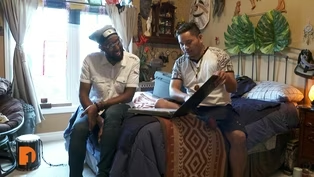
AAPI Stories | Dan and Joe | Dan searches for his birth mother
Video has Closed Captions
Clip: S10 Ep46 | 9m 53s | Dan and his partner Joe talk about his search. (9m 53s)
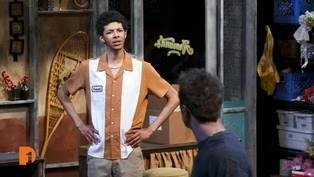
"King James:" A tale of friendship, basketball and fandom at Detroit Public Theatre
Video has Closed Captions
Clip: S10 Ep46 | 8m 18s | It's a story about the ups and downs of sports fandom and how friendships change through adulthood. (8m 18s)
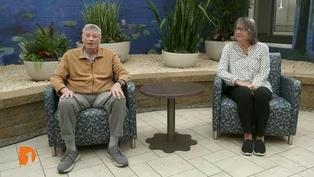
Local caregivers share their experiences caring for family members
Video has Closed Captions
Clip: S10 Ep46 | 4m 20s | We hear from three Oakland County residents in our Caregiving Conversations series. (4m 20s)
Providing Support for PBS.org
Learn Moreabout PBS online sponsorship New Episode
- News and Public Affairs

Top journalists deliver compelling original analysis of the hour's headlines.
 New Episode
- News and Public Affairs

Today's top journalists discuss Washington's current political events and public affairs.

 New Episode
 New Episode
 New Episode
 New Episode
 New Episode

 New Episode
 New Episode
 New Episode
Support for PBS provided by:
One Detroit is a local public television program presented by Detroit PBS