
The Desert Speaks
Bats Among Us
Season 15 Episode 1508 | 26m 20sVideo has Closed Captions
Explore how bat population density affects humans.
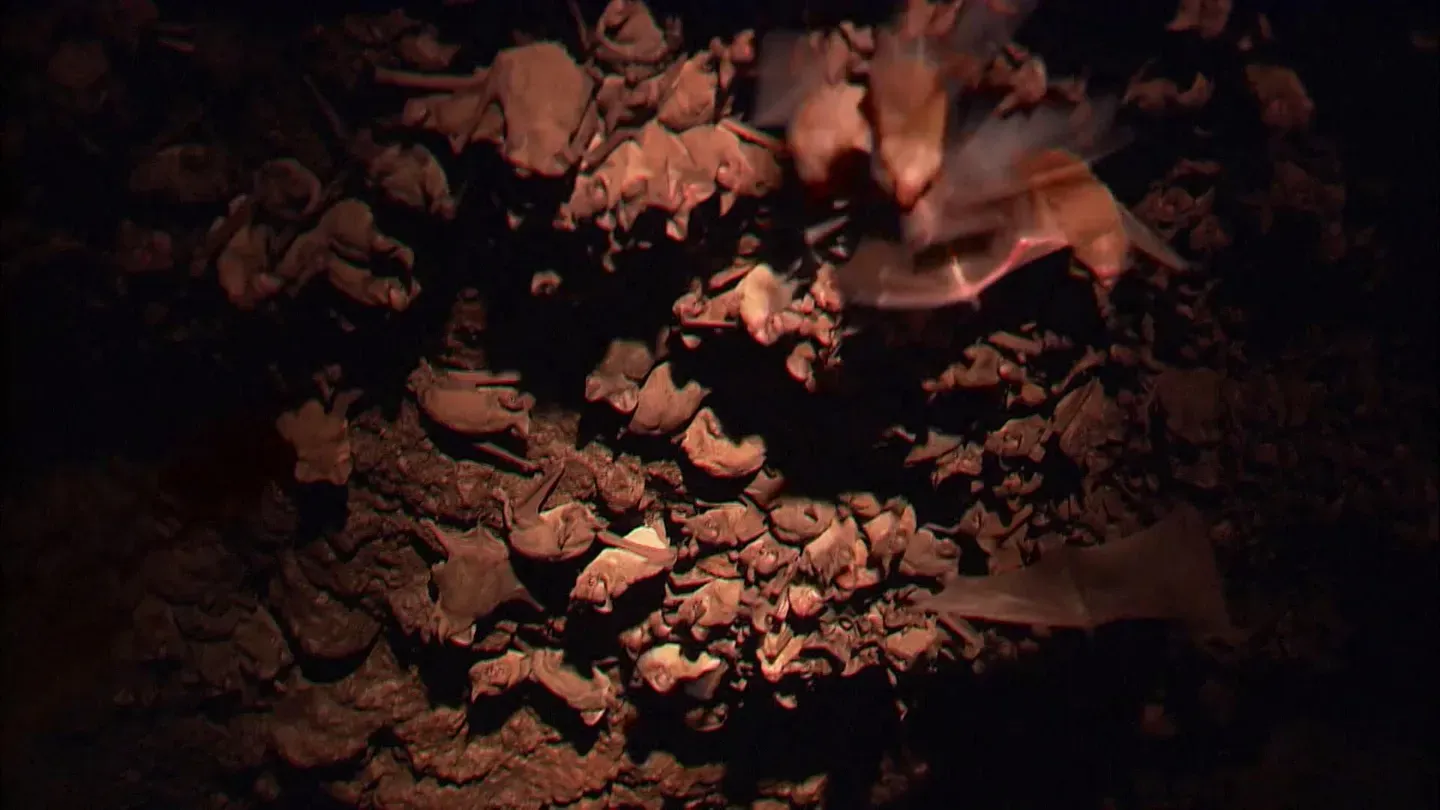
Visit Montezuma Castle, a five-story 20-room cliff dwelling, served as a “high-rise apartment building” for prehistoric Sinagua Indians. Now it serves the same purpose to a colony of bats. At Tonto National Monument the scale of the ruins makes capturing bats a test of will and ingenuity. Chiricahua National Monument shows how aa natural gem is perfect for collecting data on tree-roosting bats.
Problems playing video? | Closed Captioning Feedback
Problems playing video? | Closed Captioning Feedback
The Desert Speaks is presented by your local public television station.
This AZPM Original Production streams here because of viewer donations. Make a gift now and support its creation and let us know what you love about it! Even more episodes are available to stream with AZPM Passport.
The Desert Speaks
Bats Among Us
Season 15 Episode 1508 | 26m 20sVideo has Closed Captions
Visit Montezuma Castle, a five-story 20-room cliff dwelling, served as a “high-rise apartment building” for prehistoric Sinagua Indians. Now it serves the same purpose to a colony of bats. At Tonto National Monument the scale of the ruins makes capturing bats a test of will and ingenuity. Chiricahua National Monument shows how aa natural gem is perfect for collecting data on tree-roosting bats.
Problems playing video? | Closed Captioning Feedback
Where to Watch The Desert Speaks
The Desert Speaks is available to stream on pbs.org and the PBS app.
Providing Support for PBS.org
Learn Moreabout PBS online sponsorshipBats have been around for tens of millions of years, much longer than humans.
We have left our marks on the landscape much more than bats.
Because of the hours they keep, bats are mostly out of sight and out of mind.
But in hand, a bat is full of surprises and questions.
Funding for the Desert Speaks was provided by Desert Program Partners.
Representing concerned viewers making a financial commitment to the education about and preservation of deserts.
And by The Stonewall Foundation.
We humans are creatures of the day and we tend to be suspicious of creatures of the night, like bats.
Still, over the eons we've worked out an accommodation with bats over sharing spaces, sometimes a lot closer than we realize.
Bat researchers like Yar Petryszyn are a special kind of specialist.
Yar's been studying bats for over 35 years.
Bats are much more difficult to study than virtually any other animal because of their habits and because of their delicate makeup.
The bats that utilize this particular bridge are Mexican free tail bats, at least the majority of them are.
And they're called Mexican free tail because part of the tail protrudes beyond the tail membrane.
And this is a maternity colony.
And about 10,000 to 15,000 female Mexican free tail bats get here around March and have the young here and they'll stay here until about October.
This is a juvenile.
It kind of landed at our feet and it probably ran into another bat and kind of stunned him cause it's perfectly fine but he's young of the year and isn't out foraging with mom yet.
She comes back after feeding on insects and then nurses the little bat.
Insect feeding bat like these can eat about half their weight in insects a night.
And I estimate this particular colony eats over 200 pounds a night and during the time that they're here, they consume about 40,000 pounds of insects in one year.
That's pretty impressive for a little animal like this.
After foraging at night, they come back and hang up during the day and process the insects that they feed on and it comes out as poop called bat guano.
And you have rows and rows of it here.
And it's very dry.
Just little pellets.
And if you crushed up the guano, you could see actually microscopically little insect parts from the exoskeleton.
Very rich in nitrate.
Some of the best fertilizer in the world is bat guano.
Bats love roosting under bridges because that massive amount of cement kind of modifies the temperature.
It's like a heat sink so it's cooler through the day and warmer at night.
Also these bridges have big expansion joints that run the length of the bridge and that's perfect roosting area for the bats.
They're protected, they're in close like that, they're off the ground.
Most people don't even realize that the bats are there.
They're driving their cars back and forth across this bridge day and night and aren't even aware of it.
They don't come in contact with the bats.
So there's not much conflict with the bats and people and yet these bats provide a tremendous service and the tremendous amount of insects that they feed on every night.
People in charge of some very old structures worry about possible damage caused by the bats' occupation.
The only way to tell for sure is to bring in the researchers.
Geez, Yar, those Salado people knew a good place when they saw it.
Yeah, but it's a lot of work getting up here.
I mean it's quite a hike.
But it's also a great place for bats to roost and also to forage along this cliff face here.
So we're going to set up a big net and see if we can catch some.
Over here in this dwelling we set up a net that stands about 25 feet under the cave ceiling and it's 40 feet long and about 20 feet in width, the net itself.
And we just hope that they aren't paying attention and kind of slam into the net.
Go ahead and untie those and we'll put these segments on the wall.
We're doing a couple different things.
We're finding out what kinds of bats are using these archaeological structures as well as what affect they may have on the structures themselves because these are important historic sites in the southwest.
So the Park is interested if bats are having an adverse affect by depositing their guano.
And their urine, if it's staining any parts of the structures.
.back into this big overhang to roost.
They're going to roost up high or chasing insects cause there's moths and stuff that hang out during the day and they're out leaving.
Well, cliff dwellings are typically in a cavity in a cliff, a semi-cave.
And those are ideal roosts for bats.
They can climb up in there.
The temperature's stable.
It's relatively neither too hot or too cold.
Same reason that the Indians utilized the same kind of structure.
Warmer during the winter and cooler during summer.
.lower that side.
Settle down, settle down.
Yeah, he's not a happy camper.
He says, "I was minding my own business and all of a sudden I run into this cobweb, huge cobweb.
There.
All right.
Settle down.
This is a Mexican free tail bat.
We will take them out of the net, remove them.
We'll identify them to species, sex them, check for breeding condition and then weigh them and release them.
17 and a half.
Great.
Let's get the net back up, cause they're flying.
Many of the bats that utilize this area migrate in and will stay through spring, summer and then leave in the fall.
But others may spend the whole season, or the whole year.
She's not lactating at the moment but at least we know that she gave birth and had young this year.
Especially a place like Tonto National Monument cause it's lower elevation, relatively mild winters.
But they can stay in their roost in one of these cracks for days on end without having to come out to drink or forage.
Usually a bat, the first thing when it leaves its day roost goes out to get a drink.
It's just like us getting up in the morning, you want a glass of orange juice or just a drink of water.
And here you have Roosevelt Lake.
Prior to that you have the Salt River and also down below is a nice little riparian area with a trickle of water, a small stream.
22.
And then this whole area's just a rich foraging area.
They have these razor sharp teeth.
Insects have that hard outer shell.
They can chew up that.
And they'll utilize these different habitats in the area, the riparian down below the slope, and they seem to really like the cliff face here as well.
It's a pallid bat.
It's blonde and it has big ears and no free tail.
These guys are cool.
They land on the ground and get scorpions and centipedes and things like that.
Okay, sweetheart, off you go.
Bats benefit from human structures in buildings, bridges and abandoned mines.
In their journeys bats seem to know from year to year when people are gone and it's safe to move in.
Well, this is an abandoned mine tunnel and bats love using these as day roosts.
Some of them are even used as maternity colonies as well.
Well, most bats are nocturnal so they make their living at night either going after insects.
If they're fruit eaters, looking for fruit or nectar or whatever their food source.
That means since they are night creatures they have to spend somewhere during the day and typically they have their day roosts where they hang up and usually rest, digest and it could be numerous places.
And that's what we're here is to check this particular colony to see how it's doing.
And it's been using this abandoned mine for probably over 30, 40 years.
For the bats that accumulate in fairly large colonies, by the thousands, tens of thousands, hundreds of thousands, here in the southwest abandoned mines have become a very important resource as roosting sites.
Some are maternity sites where they have their young.
Others are transient sites that they'll use for several months and then move on and may well have doubled the population of some species of bats in particular areas.
Today, most of them are Mexican free tail bats and many of them were young of the year, they're capable of flying and soon they'll be leaving this site, foraging with mom for insects, fatten up and then they'll head south for the winter into Mexico.
And then they'll come back then next spring and do it all over again.
They do a lot of sleeping but they'll groom themselves while they're there.
Once it gets kind of time to get ready, they're no different than we are.
They'll get active.
You can see them stretching their wings.
And nectar feeding bats, they'll exercise their tongue because that tongue expands.
It's erectile tissue and so it engorges with blood when the bat wants it to and it can increase in size three or four times longer than it usually is.
And that allows them to really get down into flowers to get the nectar.
So you'll see them exercising and stretching and flying about just like we would if we're ready to go out and do a run or a jog or something like that.
Unfortunately for bats, humans have a long history of persecuting them.
For their own safety, bats tend to congregate in inaccessible places.
The people who built Montezuma Castle also wanted to live well protected from their enemies.
Today the bats benefit from their security concerns.
Get this set up and we'll the last.
That's why we're up here is to record their activity up here.
The Park Service is curious about what bats use and how often they use it.
And also how much guano, bat droppings, accumulates over the years.
And that could potentially at least do some damage.
Yeah, that's what they're worried about.
So far we haven't found any problems cause bat guano is little dry pellets that's just parts of insects essentially.
Do you suppose the Sinaguas ever came bursting through the doorways?
I don't think so.
There's not enough room to do that.
Yeah, we're on the top floor now, top level.
And I need to check this room for bats.
Oops, even I don't like that place.
There you go.
It's hanging up.
Okay, let's just work it down to my end.
So lift your end up.
There.
Now, once you've weighed this, then that'll tell you how many.
Yeah, it'll give us a rate of deposition cause we know the surface area of these plastic sheets, collecting sheets, and then we can extrapolate it for the whole room.
That's quite a bit.
Just times that by.
So that's about a kilo there, probably two pounds or so?
Yeah, about two pounds, I'm guessing.
For three months.
Yeah, not too bad.
The most we've seen.
Yeah.
Yeah, when we first emptied this to start this project, what was it, a hundred pounds of guano we hauled out of here.
Out of the whole castle.
Out of the whole castle but a bulk of it come from this room.
As far as the sites themselves go, there wasn't, we didn't find any issue at all with them roosting in any of the sites.
We didn't recommend any kind of eradication or anything.
We think they can co-exist well with the site.
And it's good for the bats, it's roost sites for the bats.
Water for the people of Montezuma Castle came from not very far away.
I used to come here as a kid to go swimming but it's, I don't remember it being as dark down in here.
Is that why there are bats?
Now that actually has nothing to do with why there are bats.
This is a great spot to catch them, all the trees and the insects from the water.
They fly through here and forage.
Oh, so it's a good habitat for all sorts of insects, then.
Right.
Why don't you guys wait here and let me check out and see how deep this is.
One huge step for bat-kind.
I can see why bats would get confused by this cause it really does look like a black wig.
Yeah.
This is a glorified hair net.
You need at least two or three people to stretch one of these nests, especially across the water.
How's it looking?
How many species of bats are you going to guarantee we'll find here?
I really don't want to make any guarantees in September.
So you rely upon their habit of coming here, being able to swoop down and surprise element.
It's kind of like you getting up to go to the bathroom in the middle of the night.
You know where your furniture is in the dark so you just walk to your bathroom.
But if I were to move your couch, it would be kind of funny for me, maybe not for you.
So it's not.bats don't take it as a big joke.
This is an ultrasound detector, which is sound well outside of our hearing range, higher frequency sound, which.
that's what bats put out when they echolocate.
Some bats will be in our range but not many.
And it'll detect it, set it off, transform that sound into audible sound, which is then recorded onto an audio tape and then this tape is played back into a computer program and it gives us a visual picture of frequency versus sound.
And we can tell different species of bats by the picture we get with the visual.
Okay, let's go ahead and open it.
All right, let's open it.
I believe we are in readiness.
I think so.
.to capture murcielagos.
Well, we've got to periodically check the net.
Oh, hear that?
Hear that bat?
Oh, yeah.
We've got a bat in the net.
All right.
There's the one.
This is a great catch.
This is a beautiful bat.
It's one of the tree bats.
You sort of feel your way across here.
Yeah, you've got to feel with your feet.
Wait 'til you see this one up close, though.
Well, this group actually roosts in trees.
But they're adapted for colder climate as well, so you can find them at higher elevation.
Wow, look at that rich pelt.
Yeah.
I mean that.
you can see why.
Cause most bats on the tail membrane, it's usually bare.
But here it's got fur on it to keep heat loss down.
He's completely different.
Oh, yeah, he's.real biters.
So we went from red to big brown.
And this is a big, big brown bat.
They're really widespread, all the way from southern Canada to Mexico and from coast to coast in the United States.
Belligerent too.
Belligerent and full of insects.
Hear her?
Yeah.
Isn't that cool?
I have a reference library of bats that I've caught in mist nets and so I know what those are because I've had them in hand.
So as I released them, I recorded their sound and then put it back into the computer and made a file of that bat, that specific individual.
I'm looking at a picture of the bat call in frequency versus time and so different bats will put out different pictures.
Their sound will look different visually.
Bats fly around at night so they're nocturnal, they're small and they move long distances rather quickly.
So this allows me to be anywhere and record any bats that might be present nearby.
I'm not constrained to being near a water source and a mist net to catch bats.
So it gets you away from being limited by how much you can study them.
It's just another technique to help us figure out what they're doing out there.
I think I'm most surprised by how many bats are actually out just over the open desert.
They're flying around and feeding a lot more than I would have anticipated they would.
Many of those bats flying over the desert have gotten there by migrating, just as birds do.
One of their favorite destinations is also home to resident bats in a very special mountain range in southern Arizona.
These sky islands, like the Chiricahuas, must be just terrific for bats.
Ah, they're the best.
Probably more species of bats in the Chiricahuas and other sky islands in the area than anywhere else in the United States.
Why exactly is that?
Well, you have such a diversity of habitats.
Right.
Down below you've got the desert.
Up on top, spruce fir.
And then everything in between.
And look at all these rocks, cracks and crevices and.
Yeah, there's plenty of them.
Yeah.
Little cavelets, plenty of places for bats to roost.
With all this diversity too that means they'll have the different species plenty of food.
Yeah.
They can partition up the habitat, forage different areas.
There's 16 to 18 species commonly found.
What we're trying to find out is any patterns or trends.
What I do is I net before the rains and then after so I net in May and I net again in August.
Get in there, little guy.
Bats come and get a drink of water, they use streams and pools sometimes as corridors or roads like we would and so it's a good place to set up a net and catch bats.
This is the big-eared bat and you can see that the name is appropriate, these huge ears.
Back here on the wing you can see, this is the wrist and it has all the little bones that you have in your wrist and this claw here is the thumb.
Right here.
So most of the wing of a bat is its hand.
We usually have more bats before the rains come because the bats seem to be concentrated at the few water sites there are.
Once the rain comes, then they disperse.
I don't think we've gotten any Abtesicas have we?
Oh, big brown bat?
Yeah.
This is a bat with an attitude.
One of the most common bats in the United States.
There you go.
Little foot and big foot.
Yeah, these little pips are so small that they only have a wingspread of about five inches, which is about the size of a big moth.
Look at this big old guy.
Oh, I know.
Look at that.
Look at the difference, just between these two.
More.
Interesting to see the species, the condition of the bats, if they're pregnant, what happens when it's dry and what happens when it's wet.
In August it's hard to catch these bats because there's a lot more water so they're not concentrated at these few sites.
Oh, it's a female.
Let's see if she's pregnant.
That might be one reason for her attitude.
Yeah, she's.
this is a pregnant female.
9.
Hey.
Last year we had 10 so we've got.
9 species already.
This is the biggest bat that we've gotten tonight.
Comparing it with the Pipestrels.
That's right.
He's ten times as big.
We've got 28 species in Arizona.
26 of those are insect eating bats, two are nectar pollinating bats.
The nectar pollinating bats are very important pollinators of some of the columnar cactus that we have in this area.
This species is an excellent insect catcher.
With their eco-location, their hearing ability, they can track something as small as a mosquito.
They tons and tons of insects and we should encourage that and protect the bats and also the bat habitat.
There big guy, there you go.
Let's see if he'll let go of my finger long enough to get a weight on him.
Every bat has a distinctive face.
Some have these little lumpy things on their nose, maybe to enhance projection of the sound.
Oh, my gosh.
Oh, this is a good bat.
This is a very good bat.
So every bat is different.
The more we find out about bats, the more we appreciate the vital role they play in a variety of eco-systems.
And the more we understand how we can co-exist with them.
Next time on the Desert Speaks The Grand Canyon region is known as one of the greatest natural wonders of the world.
But a journey along the Colorado River reveals the human side that has existed there for thousands of years.
So do people bring tanks and stuff to work in this kind of environment.
Yes.
Oxygen tanks.
...
Oxygen tanks.
Gas masks.
Another name for Mexican free tail bat is the guano bat.
So the floor is covered with guano and it decomposes with added moisture and it releases ammonia.
So the ammonia is very, very strong in these sites this time of year to the extent that you can only stay in there for just a few minutes.
Funding for the Desert Speaks was provided by Desert Program Partners.
Representing concerned viewers making a financial commitment to the education about and preservation of deserts.

- Science and Nature

Explore scientific discoveries on television's most acclaimed science documentary series.

- Science and Nature

Capturing the splendor of the natural world, from the African plains to the Antarctic ice.

 New Season
 New Episode
 Recently Added


Support for PBS provided by:
The Desert Speaks is presented by your local public television station.
This AZPM Original Production streams here because of viewer donations. Make a gift now and support its creation and let us know what you love about it! Even more episodes are available to stream with AZPM Passport.